

Last updated: November 19, 2026
Quick answer: 5 checks can prevent many freelance claim errors. For How to Avoid Common Mistakes When Filing a Freelance Claim, treat the claim as a document trail, not a phone call: file within your policy period, keep one clear version of events, attach complete proof, and answer the adjuster the same way every time. This is information, not financial advice; for your own situation, a qualified insurance professional or attorney can help if coverage, liability, or a deductible dispute is in play.
Key takeaways
- Late notice, thin records, and changing details can cause claim problems before the insurer even reviews the loss.
- The claim form should match your emails, notes, invoices, and any photos from day one.
- A reservation of rights means the carrier is still investigating and may later limit or deny parts of the claim.
- If the adjuster asks for more documents, send them in one clean batch and keep copies of everything.
- When the facts are messy, the right move is to slow down and document more, not to guess.
Who does this advice apply to?

This applies to freelancers who need to file an insurance claim and already know the basics of their policy, their deductible, and the claim form they received. It assumes you can describe the incident, list the dates, and gather records such as invoices, messages, and repair estimates.
It is not the right path if you do not know what coverage applies, if the loss may fall outside the policy period, or if you are already dealing with a formal coverage dispute. In those situations, the smarter next step is to get qualified help before you send a statement that may later be compared line by line with the insurer’s file. For general claim-handling standards, the National Association of Insurance Commissioners and your state insurance department are the kinds of sources that can help frame the process. See the NAIC claims guidance and, for example, the New York Department of Financial Services claim filing page.
A freelance claim goes wrong most often when the paperwork is rushed. The insurer is not guessing from memory; it is comparing the claim form, your notes, the adjuster’s log, and any reservation of rights letter against each other.
What mistakes cause freelance claim problems?
The most damaging mistakes are late notice, incomplete documentation, changing stories, weak repair estimates, and sloppy carrier communication. Each one gives the insurer a reason to slow the file, ask for more proof, or question parts of the loss.
Late notice can matter even when the underlying event is real. If your policy asks for prompt notice and you wait, the carrier may argue that delay made it harder to verify the damage or cost. In a claim file, that can mean more back-and-forth before payment is even discussed.
Incomplete documentation is the second big problem. A claim with a half-filled form, missing photos, or no supporting invoice often forces the adjuster to pause the review. If the insurer sends a request for more information and you answer only part of it, the file can stay open for weeks longer than it should.
Changing details can create doubt. If you describe the incident one way in email and another way on the phone, the adjuster will notice. Even small changes in timing, sequence, or who was present can make the file look unreliable.
A weak repair estimate can also hurt you. If the estimate does not match the actual damage or leaves out important line items, the insurer may issue a lower amount first and ask for more proof later. That may not mean denial, but it can mean delay.
Poor carrier communication is the quiet mistake that adds up. Missing a call, ignoring a request, or using vague language like “I think maybe” makes the file harder to verify. The better habit is plain, dated answers tied to one record set.
How do you file a freelance claim without simple errors?

You avoid simple errors by following the same order every time and checking each document against the last one. The point is not speed; it is consistency across the claim form, the adjuster’s notes, and the policy period.
- Write the incident summary first: Put the date, time, place, and what happened into one short timeline before you call anyone. Verify that every date fits inside the policy period; if a date is uncertain, mark it as uncertain instead of guessing, because a guessed date can cause a coverage problem.
- Gather the core proof in one folder: Collect photos, invoices, messages, contracts, and any repair estimate before you submit the form. Verify that each file clearly shows what it claims to show; a blurry image or missing page signals a weak record.
- Fill out the claim form using one version of the facts: Copy the same dates, names, and sequence into every field. Verify that the form matches your timeline exactly; if one answer conflicts with another, the insurer may send the file back for correction.
- State the deductible correctly: Check the deductible shown on the policy or declarations page and use that figure only if the policy says it applies to this loss. Verify that you are not subtracting it twice or assuming the insurer already did; a mismatch can make the payment amount look wrong.
- Send documents in a labeled batch: Use clear file names and group similar items together, such as photos, invoices, and estimates. Verify that the adjuster can open every file; a broken attachment or unreadable scan is a common reason for follow-up delays.
- Keep a contact log: Record every call, email, and request with the date, the person’s name, and the next step. Verify that your log matches the carrier’s messages; if it does not, you may lose track of what was asked for.
- Answer questions in the same order they were asked: Reply directly and avoid adding new theories or side stories unless they matter to the claim. Verify that your answer does not contradict earlier statements; a new detail can look like a change in story if it arrives too late.
- Save every version you send: Keep the submitted form, attachments, and any revised estimate in a dated file. Verify that you can show exactly what the insurer received; without that record, it is harder to dispute a missing page or changed figure.
What should you check before you send the form?
You should check whether the form, the estimate, and the insurer’s request all say the same thing. A one-page mismatch can create a long delay, especially when the file is already being reviewed under a reservation of rights. That is why this step matters before you press send.
| Item to compare | What to look for | What can go wrong |
|---|---|---|
| Claim form vs. timeline | Same date, same sequence, same location | The adjuster may question the whole story |
| Form vs. emails | Same names and contact details | The file may be sent back for correction |
| Estimate vs. damage photos | Same items and same scope | Payment may be reduced or split into parts |
| Policy vs. deductible | Same deductible amount and same coverage section | You may expect the wrong payment amount |
| Carrier request vs. your reply | Every question answered once | The file can stall for another review cycle |
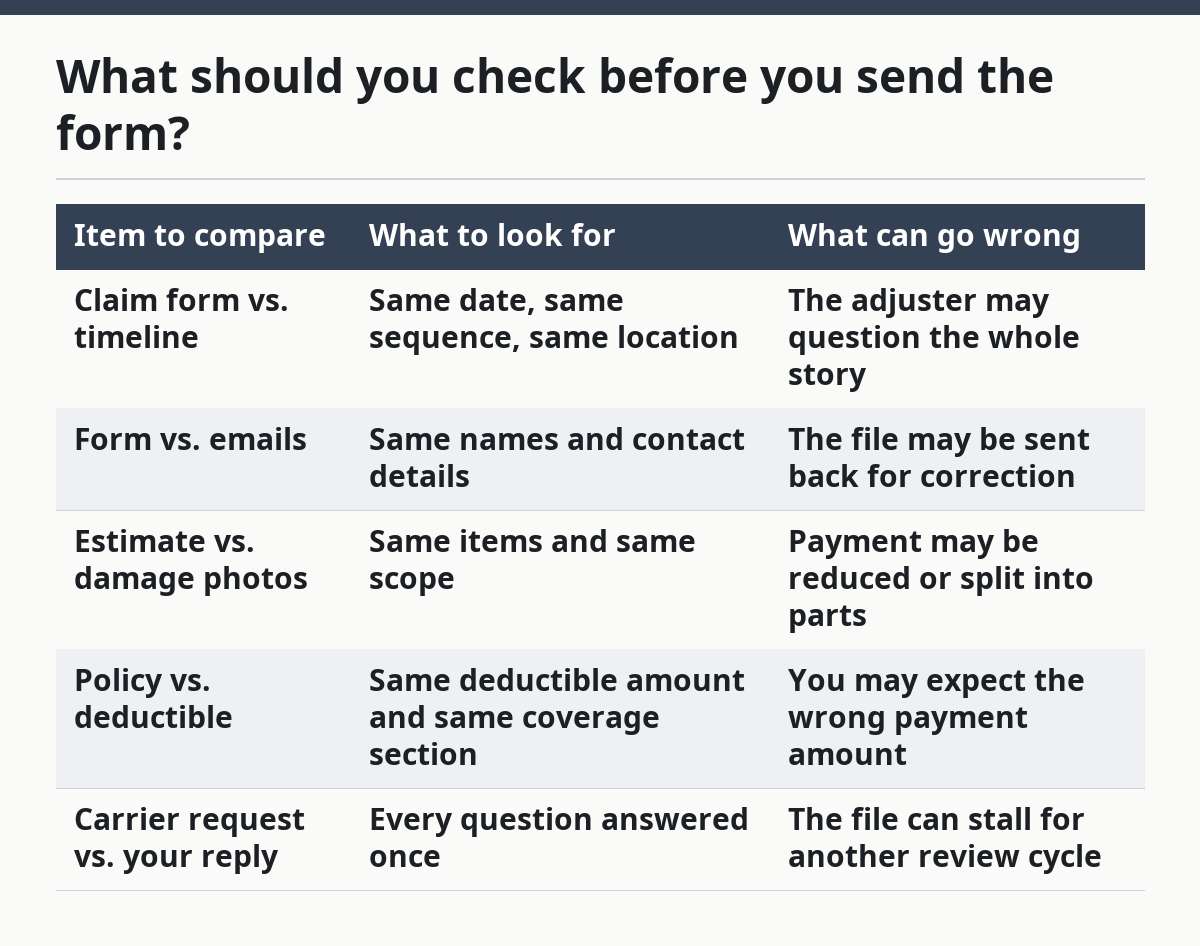
This check takes a few minutes, but it often prevents days of back-and-forth. The most common surprise is that the insurer is not disputing the claim itself; it is asking for a cleaner record because one attachment, one estimate line, or one date does not line up. If the claim is large or disputed, a qualified insurance professional or attorney can help you compare the documents before you respond.
When should you stop and get help?
You should stop and get help when the claim stops being a paperwork task and starts becoming a coverage dispute. That usually means the file has moved beyond simple correction and into interpretation of the policy language.
You receive a reservation of rights letter: The carrier is investigating while reserving the right to limit or deny coverage later — get qualified help before you send more detail, because your next statement may affect the final coverage decision.
The loss may fall outside the policy period: The date may not match the coverage window — pause and confirm the policy dates before filing, because an out-of-period loss can change the whole claim.
The adjuster asks for a recorded statement you cannot give consistently: Your facts are still uncertain — slow down and organize the record first, because a shaky statement can hurt more than a short delay.
The deductible is close to the claimed amount: The claim may not result in meaningful payment — ask for guidance before you spend time assembling a large file, because the practical value of the claim may be limited.
The insurer disputes the repair estimate line by line: The file is turning into a technical review — get a second review of the estimate, because missing line items or wrong scope can distort the amount under review.
How do carrier calls and adjuster questions go wrong?
Carrier communication goes wrong when the answers drift away from the file. The adjuster is not just listening for a story; the adjuster is checking whether your explanation matches the claim form, the photos, the estimate, and any prior emails.
Because of that, the cleanest rule is to answer only what is asked and keep the language plain. If the question is about when the damage was first seen, answer that. Do not add speculation about cause, fault, or cost unless you have a record that supports it.
A second problem is overexplaining. A 10-minute answer can create more issues than a 30-second answer if it introduces a new detail that was never in the claim form. If you remember something important later, send it in writing and label it as a correction or addition.
The third problem is failing to track what the carrier asked for. If the adjuster wants a repair estimate, a contract, and 3 photos, send exactly that and note the date. If one item is missing, say so clearly instead of pretending the packet is complete.
What changes when the claim is messy?
The standard process needs modification when the facts are incomplete, the loss happened over time, or more than one job is involved. In those cases, the goal is not a polished story; it is a record that separates known facts from estimates and guesses.
If the loss happened over several days, build a dated sequence instead of one summary paragraph. If there are multiple projects, keep each one in a separate section so the insurer does not mix the evidence. If a repair estimate changes, keep the older version and label the newer one, because the insurer may want to see why the amount moved.
That is why people make the most damaging mistake here: they smooth the edges. A rough file with honest gaps is usually better than a polished file with made-up certainty. The first is imperfect; the second can look false.
What mistakes delay freelancer insurance claims?
Late notice, missing documents, and a claim form that does not match the rest of the file are the usual delay points. The adjuster may then ask for more proof, and each extra request adds another round of review. If the policy period or deductible is unclear, the file can slow down even more.
How do I avoid claim denial mistakes?
Keep the facts consistent, answer every request, and do not guess about dates, costs, or cause. A reservation of rights letter means the insurer is still deciding coverage, so the better move is to submit clean records, not new theories. If the estimate or policy language is confusing, get qualified help before you respond.
What should not be done when filing a claim?
Do not change your story, submit partial records as if they are complete, or ignore the adjuster’s requests. Do not assume the deductible or payment amount is obvious without checking the policy first. A claim file is built from what you can prove, not what feels fair in the moment.
Drafted with AI; not yet reviewed by a person.
