

Last updated: November 19, 2026
Quick answer: To document insurance compliance for a client audit, keep a dated packet with the certificate of insurance, policy declarations, endorsements, and renewal proof; in practice, that is usually 4 core document types in one folder. This article shows how How to Document Insurance Compliance for a Client Audit works in a clean paper trail, what to save, how to label it, and how to hand it over without scrambling. The steps below settle what counts, what does not, and where audits usually go sideways.
This is information, not financial advice; a qualified adviser should be consulted for your own situation.
Key takeaways
- Keep one audit file per client, not one loose folder for all jobs.
- Save the certificate of insurance, the policy declarations page, and any endorsement that changes client-specific terms.
- Pair each document with the date you got it and the client request that triggered it.
- Track renewals and replacements as a chain, so a client can see continuous coverage, not a one-off snapshot.
- If the client is asking for unusual wording, a required limit, or proof tied to a vendor audit, slow down and confirm the policy details first.
What counts as insurance compliance proof?

Insurance compliance proof is the set of records that shows your coverage matched the client’s contract at the time they asked. For How to Document Insurance Compliance for a Client Audit, that usually means a current certificate of insurance, the policy declarations page from the insurer, and any endorsement that names the client or changes coverage terms.
Because the audit trail needs those records together, picture this: you open a vendor portal and the client wants proof within 24 hours. You need a file that shows the policy number, insurer, named insured, effective dates, and any special wording the client required. If those pieces are missing, the audit turns into a back-and-forth.
Not ideal.
A certificate alone is often not enough because it is a summary, not the policy itself. The declarations page shows the coverage types and limits at a point in time, while an endorsement is the page that changes the contract language after the policy was issued. Keep all three together, plus the client’s audit request or email so the reason for the documents is clear.
For the broader contract side, this page sits alongside the hub on freelancer insurance for client contracts and vendor requirements, which covers how client demands get written into agreements.
How do you document insurance compliance for a client audit?
You document insurance compliance for a client audit by building a dated record set that shows the request, the coverage, the change history, and the renewal trail. Start with the request, then collect the policy documents, then save proof that the coverage stayed active through the audit window.
Because the file has to tell a complete story, picture this: you’re opening a shared folder after a client flags a file for review. The folder should answer four questions fast — what they asked for, what policy was in force, whether any endorsement changed it, and whether coverage was renewed on time. If a stranger can’t trace that story in under 5 minutes, the file is too thin.
- Save the client’s audit request in PDF or email form the same day it arrives. Record the date, the named client, the project, and any required wording or deadline. Verify the request mentions the policy type, such as general liability or professional liability; if it does not, the file is incomplete.
- Download the certificate of insurance from the insurer or broker portal as soon as it is issued. Check that the insured name, insurer name, policy number, and effective dates match the client contract; if the names differ, the certificate may not satisfy the audit.
- Attach the policy declarations page for each active line of coverage. Look for the coverage type, limits, deductible or retention, and policy term; if the declarations page is missing or expired, the audit trail breaks.
- Save every endorsement that affects the client relationship. That includes additional insured wording, waiver of subrogation language, or any change to limits. Verify the endorsement number and effective date; if the endorsement date falls after the client’s required start date, mark the gap.
- Add renewal proof each time the policy renews. Keep the new certificate, the updated declarations page, and any replacement endorsements together, and note the old policy term beside the new one; if you only save the new certificate, continuity is hard to prove.
- Label each file with a simple naming system: client name, policy type, document type, and date in YYYY-MM-DD format. For example, a file named “ClientA_GL_COI_2026-03-01” sorts cleanly; if you cannot tell the latest version at a glance, the naming system is failing.
- Store the set in one folder per client and one subfolder per policy year. This keeps a vendor audit from mixing old and new coverage; if you have to search across random folders, the structure is too loose.
- Keep a short log that lists what was sent, when it was sent, and who received it. That log should show the exact date of transmission and the response, if any; if there is no log, you may not be able to prove what the client saw.
Once that system is in place, a client audit becomes a file check, not a scavenger hunt. The catch is that the system only works if you update it every time coverage changes.
What should be in the audit file, and what should not?
An audit file should contain the proof chain for one client and one policy term, not a pile of unrelated insurance paperwork. For How to Document Insurance Compliance for a Client Audit, the clean set is usually the client request, certificate of insurance, policy declarations, endorsements, renewal proof, and the transmittal record that shows when you sent each item.
Because the reviewer needs a straight line from request to proof, picture this: a client asks for evidence during a vendor audit and you pull up a folder with 18 attachments. If the insurer letter sits next to old quotes, unrelated invoices, and a canceled policy from 2 years ago, the reviewer has to guess what matters. That is how delays start.
Use this simple filter:
- Keep documents that prove coverage status, effective dates, changes, or client-specific wording.
- Keep the exact version that was active at the time of the request.
- Keep the email or portal notice that triggered the update.
- Keep the reply from the client if they accepted the file or asked for a correction.
Leave out:
- Marketing sheets from the insurer
- Old quotes that never became bound coverage
- Duplicate scans with no date or label
- Policies for unrelated clients unless the audit asks for a wider review
A good audit file should let someone answer: “Was the right coverage in force, and can you show it?” If the answer takes more than one folder to assemble, the file needs work.
What if the client wants something beyond the certificate?
You should treat that as a document request, not just a certificate request, and if the wording is unclear, consult a qualified adviser or insurer/broker and verify the source documents first. Many clients accept a certificate of insurance, but some vendor audits also ask for the policy declarations page, endorsements, or a letter from the broker or insurer that confirms specific terms.
Because the certificate may not be the full answer, picture this: the client says the certificate is not enough because their contract calls for additional insured status or a waiver of subrogation. A certificate alone can list those terms, but the endorsement is the stronger proof because it is the policy change itself. If the endorsement is missing, the file is not complete.
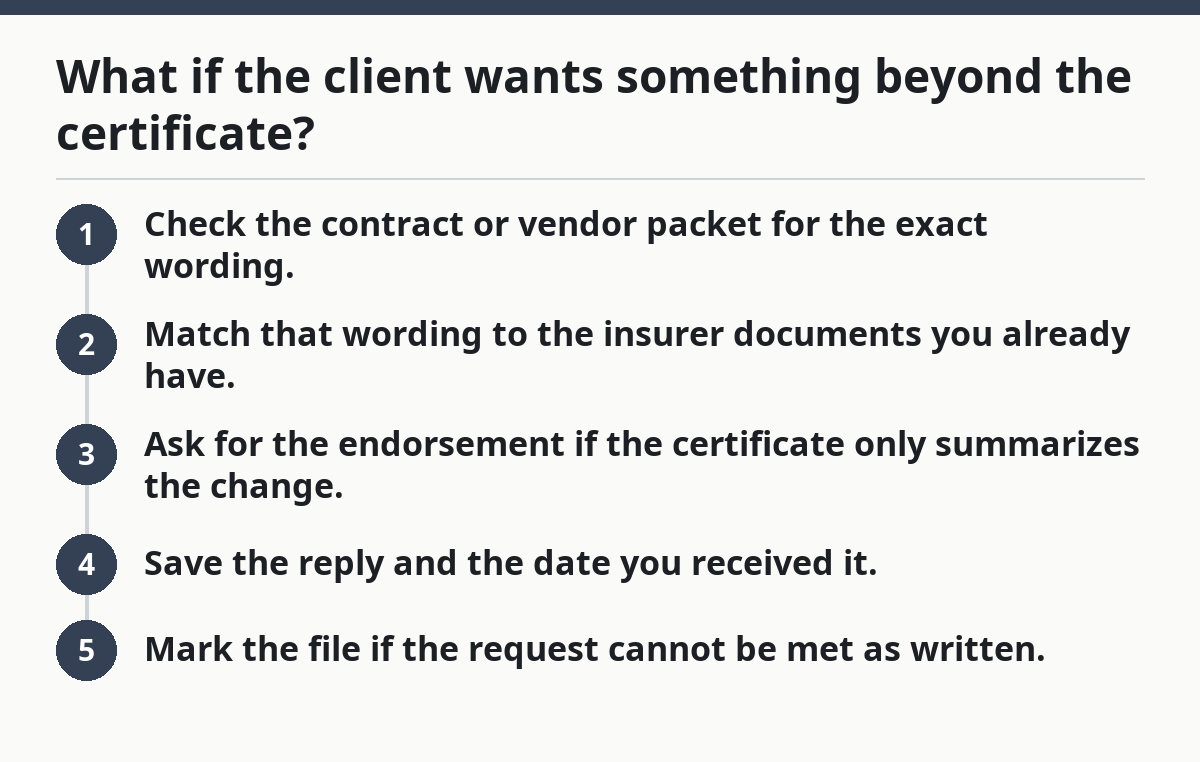
For that reason, use this order:
- Check the contract or vendor packet for the exact wording.
- Match that wording to the insurer documents you already have.
- Ask for the endorsement if the certificate only summarizes the change.
- Save the reply and the date you received it.
- Mark the file if the request cannot be met as written.
A common mistake is to send whatever document is closest and hope the client accepts it. That can work for a simple compliance check. It fails when the client is doing a formal vendor audit and wants the policy record, not a summary sheet.
When should you stop handling this yourself?
You should stop and get qualified help when the request goes beyond routine document filing and starts changing the insurance terms you may not control. That is especially true when the client wants contract language, unusual limits, or proof that depends on the policy wording itself.
Because this is where document control becomes coverage interpretation, picture this: you have the request in hand, but one line mentions an unusual endorsement, another asks for backdated proof, and a third wants a limit you have never carried. That is not a filing task anymore. It’s a coverage question, and the wrong answer can leave a gap in the audit trail.
Stop and get help in these situations:
- The client asks for an endorsement you do not already have: It means the policy may not satisfy the contract as written — ask the insurer or broker to confirm the document before sending anything else.
- The policy names differ from the contract names: It means the certificate may not match the insured party — confirm the legal entity name first.
- The audit asks for prior-year proof you cannot find: It means the continuity record is broken — reconstruct the file from the insurer, broker, or archived email.
- The client demands wording you have never seen before: It means the request may require contract review — pause until you know exactly what the wording means in the policy context.
- Coverage lapsed or renewed late: It means there may be a gap in the proof chain — document the gap honestly and collect the replacement records.
- The request comes from a regulated vendor or prime contractor: It means the audit may have its own rules — follow the vendor packet and do not guess.
This is one of those records where “close enough” is not close enough. If the file needs interpretation, not just storage, pause.
The mistakes that cause audit delays
The most common mistakes are small, but they create big delays because they weaken the evidence trail. A missing date, a stale certificate, or the wrong file name can make a client reject the packet and start over.
Because delays usually start with a weak chain of proof, picture this: you send proof on Monday and get the same request again on Wednesday. That usually means the client could not trace the coverage from one document to the next. The issue is not always the policy. It is often the file.
Here are the errors I see most often:
- Sending only the certificate: It may show the broad status, but it does not prove the policy language behind it. Send the declarations page and any relevant endorsement with it.
- Using old renewal copies: It makes the coverage look expired or uncertain. Replace older versions with the current term and keep the earlier term in archive.
- Mixing client files together: It turns one audit into a search job. Separate each client by folder and label.
- Leaving out the request itself: It hides why the documents were gathered. Save the email or portal notice as page 1.
- Not logging delivery: It makes it hard to prove what was sent and when. Keep a simple date-and-recipient note.
- Ignoring endorsement dates: It can make a change look active when it was not yet in force. Check the effective date on every endorsement.
The fix is boring and effective: one client, one folder, one dated paper trail. That is what auditors want to see.
How long should you keep the records?
You should keep the records for as long as the contract, client policy, or local record rule requires, and those timelines differ by country and sometimes by industry. If you do not know the rule that applies to you, treat the safer position as keeping the full trail longer rather than shorter, and confirm with a qualified adviser or the relevant insurer/broker guidance.
Because retention is part of the audit trail, picture this: the job ended a year ago, but the client comes back with a claim or a vendor review. If you no longer have the certificate, declarations, and endorsement history, you cannot reconstruct the chain cleanly. That is why retention matters as much as collection.
At minimum, keep:
- The client request
- The certificate of insurance
- The declarations page
- Every endorsement tied to that client
- Renewal proof for each policy term
- The delivery log or email trail
If you work across multiple clients, keep one master index so you can find the record fast. A 5-minute search beats a 5-hour rebuild.
How do I make the file easy to audit later?
You make the file easy to audit later by using a fixed naming pattern, a dated log, and one storage place for every client. The goal is simple: anyone should be able to open the folder and trace coverage from request to renewal without guessing.
Because the folder has to work months later, picture this: six months pass, and a new client manager asks for proof again. A clean file shows the path in the same order every time — request, certificate, declarations, endorsement, renewal. If the latest version is not obvious, the file is not audit-ready.
Use these rules:
- Put the client name first.
- Put the document type second.
- Put the date in YYYY-MM-DD format.
- Put the policy year in the folder name.
- Keep a short change log at the top of the folder.
That structure is simple enough for one freelancer and clear enough for a vendor audit. It also keeps you from sending the wrong version when a client asks for proof mid-project.
What proof do clients usually accept?
Clients usually accept a certificate of insurance, plus the policy declarations page when they want more detail. If the contract requires special wording, they may also want the endorsement that changes the policy terms. A certificate alone is often enough for a quick check, but it may not satisfy a formal vendor audit.
How long should I keep insurance records?
Keep insurance records for as long as your contract, client policy, or local rule requires, and those rules vary by country and sector. If you are unsure, keep the full audit trail longer and confirm the retention period with a qualified adviser. The safest file is one you can still produce when a claim or review shows up later.
What if my client audits my coverage mid-project?
Send the current certificate, declarations page, and any relevant endorsement right away, then note the date and what was delivered. If the client asks for wording you do not already have, pause and confirm the policy details before sending anything else. Mid-project audits are common, and the cleanest response is a dated packet, not a hurried guess.
Drafted with AI; not yet reviewed by a person.
