

Last updated: November 19, 2026
Key Takeaways
- Coverage turns on the trigger date, not the project type.
- Occurrence fits freelancers who may switch insurers, pause work, or stop the same policy form later.
- Claims-made fits freelancers who keep coverage active and follow renewal rules.
- Claims-made works best when the business is steady, the renewal date is controlled, and reporting stays on schedule.
Quick Answer
How Claims-Made and Occurrence Policies Differ for Freelancers comes down to timing: claims-made covers claims first made while the policy is active, while occurrence covers work done during the policy period. In plain terms, one is claim-date coverage, and the other is work-date coverage. That difference matters most when a claim arrives months or years later.
A claims-made policy protects you only if the claim is first made while the policy is active, or during any tail coverage you buy after it ends. An occurrence policy protects you for work done during the policy period, even if the claim shows up years later after policy expiration.
Freelancers need that difference spelled out because client work ends, carriers change, and disputes often arrive late. The policy form decides whether yesterday’s project is still covered when a demand letter lands next year.
I write on professional liability and business insurance for independent workers, and this comparison is where timing matters more than the premium line on the page. The topic here is How Claims-Made and Occurrence Policies Differ for Freelancers, and that timing question should guide every choice.
For a broader framework on timing, see the hub on freelancer insurance claims timing. This page stays focused on the two policy structures and how delayed disputes change the choice.
The one difference that decides everything: when coverage is triggered
The claims-made form wins or loses on the coverage trigger. It responds to the date the claim is first made, not the date you finished the job. The occurrence form responds to the date of the work itself, which is why it still protects a past project after the policy expiration date.
That distinction sounds small until a freelancer changes carriers. Say you had a six-month contract, the project wrapped in March, and a complaint arrives the next February. Under an occurrence policy, the date of the alleged error matters most, so the old policy can still answer if the work happened inside that policy period. Under a claims-made policy, the February notice usually needs a policy that is active then, or a tail coverage arrangement that extends reporting rights after the policy ends.
This is why the question is not “Which policy sounds safer?” It is “How likely is it that a dispute will surface after you move on?” For freelance writers, designers, developers, consultants, and other project-based professionals, that timing can matter more than the size of the account.
The other term that matters here is prior acts. A claims-made form usually hinges on when the work was performed and whether the policy includes those earlier acts, but the real practical issue for a freelancer is simpler: if the claim is filed later, do you still have a live policy relationship that can receive it? If the answer is no, you may need tail coverage to preserve the reporting window.
Occurrence policies are the cleaner fit for freelancers who expect to switch carriers
Occurrence coverage wins for freelancers who plan to change insurers, pause their business, or stop buying the same policy form later. The reason is simple: once the work lands inside the policy period, the protection stays tied to that period even if the policy itself expires years ago.
That makes occurrence policies easier to understand. There is no tail to buy just to keep old work alive, and no need to worry that a later carrier will refuse a late notice because the claim arrived after you changed plans. For a solo graphic designer who wraps jobs, invoices, and then moves on, that simplicity is worth real money and real peace of mind.
The strength is even clearer for anyone whose work can produce delayed disputes. A website launch, a brand strategy memo, a contract review, or a consulting recommendation can all sit quietly for months before a client notices a loss. With an occurrence form, the old policy remains the place to look if the work date is inside that window.
The weakness is not mysterious. Occurrence forms can be harder to find in some lines, and the premium structure often reflects the fact that the insurer is carrying long-tail exposure for the future. A freelancer who only wants short-term coverage for a single contract may find the form overbuilt for the risk.
Occurrence is not always the best answer for every independent worker. If you are just starting out and do not yet know whether you will keep the same policy year after year, the form is attractive because it avoids the “did I remember to extend reporting?” problem. If your business lives on one-off projects and the chance of a late dispute is not trivial, this is the cleaner structure.
Claims-made policies are built for continuous coverage, not one-off stops and starts
Claims-made coverage wins when a freelancer keeps insurance in force without gaps and understands the renewal rules. The advantage is not glamour; it is mechanics. The policy is designed to respond to claims first made during the policy term, which is why insurers can price the risk more tightly and why these forms are common in professional liability.
That structure rewards continuity. If you renew on time and keep the same risk chain alive, the policy can work well for a consultant, copywriter, developer, accountant, or other independent professional who wants ongoing protection while the business keeps operating. It also tends to fit freelancers who expect to maintain the same insurance rhythm each year and do not plan to drop coverage after a single project.
The drawback is the one that catches people after a carrier switch. If a project ends in one policy year and the complaint is first made after the policy expires, the old policy may not answer unless the reporting rights were extended. That is why tail coverage matters so much here. A tail is not new insurance for new work; it is the reporting extension that keeps old work reachable after the policy stops.
There is a second drawback: a claims-made form can punish administrative drift. A missed renewal, a month-long gap, or a change in insurer without clean transition paperwork can matter. That is a poor fit for a freelancer who prefers to buy a policy once and forget about it for the rest of the year.
Still, this form is not a trap. It is a disciplined structure that works if you treat renewal dates as part of your risk management. Consult a licensed insurance broker or advisor if you are unsure how a renewal gap, prior acts, or tail coverage would apply to your policy. For a freelancer with ongoing contracts, repeated engagements with the same kind of client, or any work where the insurer expects a steady reporting timeline, claims-made can be the right buy.
Head-to-head: what changes the choice for a freelancer
| Criteria | Claims-made policy | Occurrence policy | Winner for this condition |
|---|---|---|---|
| Coverage trigger | Claim must be first made during the active policy or a valid tail period | Work date controls; the policy period is what matters | Occurrence, when delayed notice is a real risk |
| Need for tail coverage | Often yes, if the policy ends and old work still needs protection | No tail needed for the same work-date risk | Occurrence |
| Switching carriers | Can create gaps if the handoff is not clean | Past work stays tied to the old policy period | Occurrence |
| Renewal discipline | Requires close attention to continuity | More forgiving after expiration | Occurrence |
| Pricing structure | Often easier for carriers to price on an annual basis | Can reflect longer-lived exposure | Claims-made, for budget control over ongoing coverage |
| Late client complaints | May be uncovered without active coverage or a tail | More likely to remain covered if the work was inside the term | Occurrence |
| Best fit for ongoing practice | Strong fit if you renew every year | Also usable, but less dependent on renewals | Claims-made |
| Best fit for stop-start freelancing | Risky if coverage lapses | Better when business activity is irregular | Occurrence |
| Administrative burden | Higher because reporting dates matter | Lower because the policy period does the heavy lifting | Occurrence |
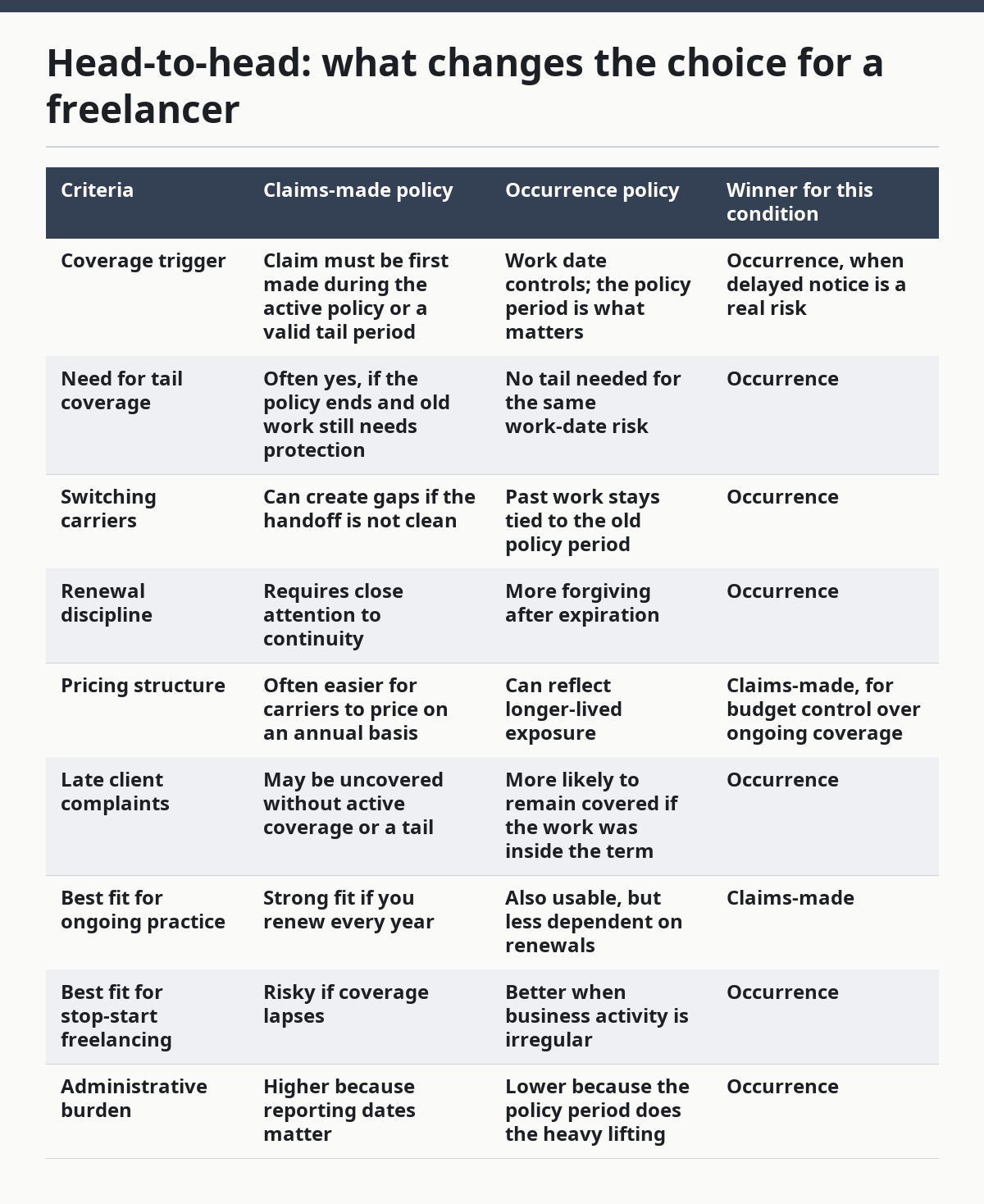
The table points in a clear direction: occurrence is usually the safer structure for freelancers whose work can outlive the policy year, especially if they expect to switch carriers or pause coverage. Claims-made is the better fit when the business is steady, the renewal date is controlled, and the freelancer is willing to manage the reporting timeline carefully.
That does not mean claims-made is inferior. It means its logic depends on continuity, while occurrence depends on the date of the work. For a solo professional who wants the least drama after policy expiration, that difference is decisive.
Tail coverage is the hidden cost people miss with claims-made forms
Tail coverage matters because it is the bridge between a finished policy and a late-arriving dispute. If a claim is first made after the claims-made policy ends, a tail can preserve the right to report that old work. Without it, the policy can feel like it vanished exactly when the issue finally surfaced.
That is the part many freelancers miss when they compare policy forms only on annual premium. A claims-made policy may look manageable until the business changes shape. You might stop freelancing, take a salaried job, switch brokers, or simply let the policy lapse because the project stream slowed down. The next year, a former client raises a problem tied to something you did long ago. If the reporting window is gone, the old policy may not help.
Occurrence avoids that timing problem for work already inside the covered year. There is no separate tail purchase just to preserve notice rights on the old job. That is one reason the occurrence form is easier to live with for freelancers who do not want insurance to become a recurring administrative task.
The trade-off is straightforward. Tail coverage is not a flaw in itself; it is the cost of using a claims-made structure. But if your freelance work is irregular, or if you know you will not keep the policy year after year, the tail can turn a “good enough” policy into a poor fit. If the business may wind down, occurrence is usually the cleaner answer.
Which policy fits which freelancer?
Choose a claims-made policy if you keep insurance continuously, renew on time, and want a structure that fits an ongoing freelance practice. Choose an occurrence policy if you expect to switch carriers, pause coverage, or want protection tied to when the work happened rather than when the complaint arrives. Neither is a good fit if you cannot keep track of the renewal date or you are buying coverage for a project with obvious already-known disputes.
That is the cleanest verdict for this page. A freelancer who wants fewer moving parts after policy expiration should lean toward occurrence. A freelancer with a stable annual insurance routine can choose claims-made, but only if the renewal and reporting rules will actually be followed.
The biggest mistake is to compare them as if they are two versions of the same thing. They are not. Claims-made is a timing system that asks for continuity. Occurrence is a date-of-work system that gives you more freedom to move on later. If delayed claims are part of the real risk, that difference is the whole story.
When the answer flips
A few situations can change the choice.
First, if your insurer only offers one form for your line of work, the available policy may decide the issue before theory does. Some professional liability markets are built primarily around claims-made wording, so availability can matter as much as preference.
Second, if you already know you will keep the same coverage for several years and your work rarely produces late complaints, claims-made can be perfectly acceptable. The policy is doing what it is designed to do, and the reporting system is less burdensome when the business is stable.
Third, if you are about to end freelancing altogether, tail coverage can be worth checking before you cancel a claims-made policy. That is the one moment when the cost of preserving reporting rights may be worth more than the premium savings of walking away cleanly.
Fourth, if the work you do is the kind that tends to generate delayed allegations — advisory work, professional recommendations, code, copy, financial records, design choices, or anything similar — occurrence usually becomes more attractive because the claim may surface well after the job is done. For independent professionals, that delayed timing is the point.
The Verdict
Choose an occurrence policy if you are a freelancer who may switch carriers, pause coverage, or stop freelancing and still wants old work protected after policy expiration. Choose a claims-made policy if you will keep coverage continuous, understand tail coverage, and want a form that fits a steady annual renewal habit. Neither if you are likely to let the policy lapse and then assume a late complaint will still be covered.
Which is better for freelancers: claims-made or occurrence?
Occurrence is better for many freelancers because it handles delayed claims more gracefully after the policy period ends. Claims-made can still be the right choice if the freelancer keeps continuous coverage and is disciplined about renewals and reporting.
Does occurrence coverage need tail insurance?
No, occurrence coverage does not need tail insurance for the same reason claims-made policies do. The work date is what matters, so a later complaint about covered work can still attach to the old policy even after expiration.
Why do professional liability policies use claims-made wording?
Professional liability policies often use claims-made wording because it gives the insurer a clearer timing boundary for when a loss is reported. That structure can make pricing and administration easier, but it shifts more responsibility onto the freelancer to keep coverage continuous or preserve reporting rights with tail coverage.
Where to verify the policy rules
For general consumer guidance, see the U.S. Small Business Administration on business insurance, and review your insurer’s policy wording before you buy. For professional liability timing concepts, the Insurance Information Institute explains why claims-made forms depend on when a claim is reported, not just when the work was done.
Drafted with AI; not yet reviewed by a person.
