

Last updated: November 29, 2026
Quick answer: handle a venue contract insurance requirement in 3 steps — read the clause, match it to your general liability insurance and certificate of insurance, then verify any additional insured request before the event starts. This guide on how freelancers should handle liability insurance requirements in venue and location contracts is about checking the wording first and getting qualified advice if the contract asks for more than you carry or for wording your policy cannot support. This is information, not financial advice; a qualified adviser should review your own situation.
Key takeaways
The key takeaways are simple: treat the venue’s insurance clause as a deadline problem, not just a paperwork problem, and consult a qualified professional if the wording is unclear. A certificate of insurance proves coverage exists; it does not change the policy by itself. “Additional insured” is not the same as “named insured,” and that difference matters. Indemnity language can shift more risk than the insurance line by itself shows. If the venue wants proof before load-in, set the policy and certificate process in motion early.
Who this applies to — and who should pause
This applies to freelancers who work in venues or on location and are asked for proof of insurance, often before setup, access, or payment. It assumes you already have, or are about to obtain, general liability insurance and can read the basic insurance terms in a venue contract. It also assumes the venue is asking for a certificate of insurance, additional insured wording, or both. See also the related guidance on certificate of insurance basics, additional insured wording, and general liability insurance.
This is not the right place to improvise if the contract ties insurance to a live event, a public-facing shoot, or a location with stricter rules than your usual jobs. A venue contract can put your money and legal exposure on the line in the same paragraph, so consult a qualified adviser before you sign. If the document asks for limits, endorsements, or indemnity language you do not understand, stop before signing and get qualified help.
One clean way to think about this is simple: the venue is not asking for a promise that nothing will go wrong. It is asking for proof that a policy exists, and sometimes proof that the venue sits inside that policy’s protections. The difference between those two ideas is where many freelancers get stuck.
What does the venue actually want?
The venue usually wants proof that your policy exists, and sometimes it wants to be protected by that policy too. A certificate of insurance is the proof document; it usually lists the policyholder, insurer, policy dates, and coverage type, but it does not rewrite the policy on its own. That matters because a certificate can look complete while still missing the exact language the venue asked for.
The three terms that cause the most trouble are certificate of insurance, additional insured, and indemnity clause. An additional insured is a person or business added to the policy by endorsement so it can receive some coverage under the policy terms. An indemnity clause is the contract language that says who pays if claims, losses, or defense costs arise from the work or the event. For more detail, the Insurance Information Institute and the U.S. Small Business Administration both explain these terms in plain language.
Read the venue clause as a chain, not as separate words. If the contract says you must carry general liability insurance, provide a certificate of insurance, and name the venue as additional insured by a deadline, all three requests can matter at once. Missing one link can keep you from getting on site, even if the others are fine.
A lot of generic advice gets this wrong by treating “insurance required” as one single ask, so consult a qualified adviser if the wording is unfamiliar. It is usually three asks: carry coverage, show evidence, and extend protection in a particular way. That is why a freelancer should not answer the venue with a vague “I’m insured” message and call it done.
How do you work through the contract?
You work through it by checking the insurance clause against your policy, then matching the venue’s wording to what your insurer can actually issue. The goal is not to negotiate the contract here; the goal is to see whether the paperwork and the policy line up before the start date.
- Pull the insurance clause out first. Copy the exact wording for coverage type, limits, additional insured language, waiver language, and deadline into one note. Verify that the clause names the venue, the event, and the date or start time. If the clause is vague about who needs to be insured, that is a problem because the certificate can be issued to the wrong party.
- Check your general liability insurance form and policy period. Look for the policy type, effective dates, and whether the policy is active on the event date. Verify that the policy period covers the whole job, from load-in to strike if the contract expects that. If the job starts before the policy does, the venue can reject your proof.
- Match the requested additional insured language. Confirm whether the venue wants to be added by endorsement or just listed on the certificate. Verify the exact legal name of the venue and any property manager, promoter, or owner named in the contract. If the policy cannot add them in the form requested, that is a coverage gap, not a formatting issue. See the related note on [venue contract review](/venue-contract-review).
- Request the certificate of insurance early. Send the insurer or broker the venue’s exact wording, plus the legal names and certificate holder details. Verify that the certificate shows the correct insurer, policy number, effective dates, and endorsements. If the certificate uses a trade name instead of the legal entity, the venue may reject it.
- Check the indemnity clause beside the insurance clause. Read whether you are promising to defend, hold harmless, or indemnify the venue. Verify whether that promise covers your own negligence only, or also the acts of others on site. If the clause makes you responsible for broad losses while your policy is narrower, the contract and the coverage do not match.
- Watch the proof deadline. The contract may require proof before load-in, before access badges are issued, or before the event date. Verify the deadline in writing and calendar it as a hard stop. If the venue says “send it later,” do not rely on that unless the contract change is written and accepted.
- Keep a clean copy of everything you send. Save the contract, certificate, email trail, and any endorsement request in one folder. Verify that the certificate sent is the same version the venue acknowledged. If the venue asks again for the same item, missing records can turn a small delay into a lost booking. A short paper trail can save hours later.
- Recheck the scope if the location changes. A studio, hotel ballroom, museum, warehouse, or outdoor site can each have different insurance rules. Verify that the certificate names the correct venue and not just the production company or client. If the job location changes after the certificate is issued, the old document may no longer satisfy the contract.
A good result is usually boring: the venue accepts the certificate, the additional insured wording matches the contract, and there is no last-minute scramble on the day of the event. A bad result is equally easy to spot: the venue says the certificate is missing the endorsement, the names do not match, or the policy dates miss the event by even one day.
For more background on liability coverage terms, the Insurance Information Institute and the U.S. Small Business Administration both have general explainers on business insurance and liability coverage. Those pages do not replace your contract, but they help keep the terms straight.
Which parts of the clause matter most?
The parts that matter most are the named parties, the coverage type, the endorsement language, the limits if stated, and the deadline. A venue contract can look short and still carry more risk than a long insurance form because one sentence can decide who pays if someone is injured or property is damaged.
Use this quick comparison to sort the usual requests:
| Contract language | What it means | What to verify |
|---|---|---|
| Certificate of insurance | Proof that a policy exists | Policyholder name, insurer, dates, and coverage type |
| Additional insured | The venue wants protection under your policy by endorsement | Exact legal name and whether the insurer can issue the endorsement |
| Indemnity clause | You may have to cover losses or defense costs tied to the work | How broad the promise is and whether it matches the policy terms |
| General liability insurance | Core coverage the venue often expects | That the policy is active for the job and covers the right activity |
| Proof deadline | The date the venue needs the document in hand | Whether it is before access, setup, or the event date |
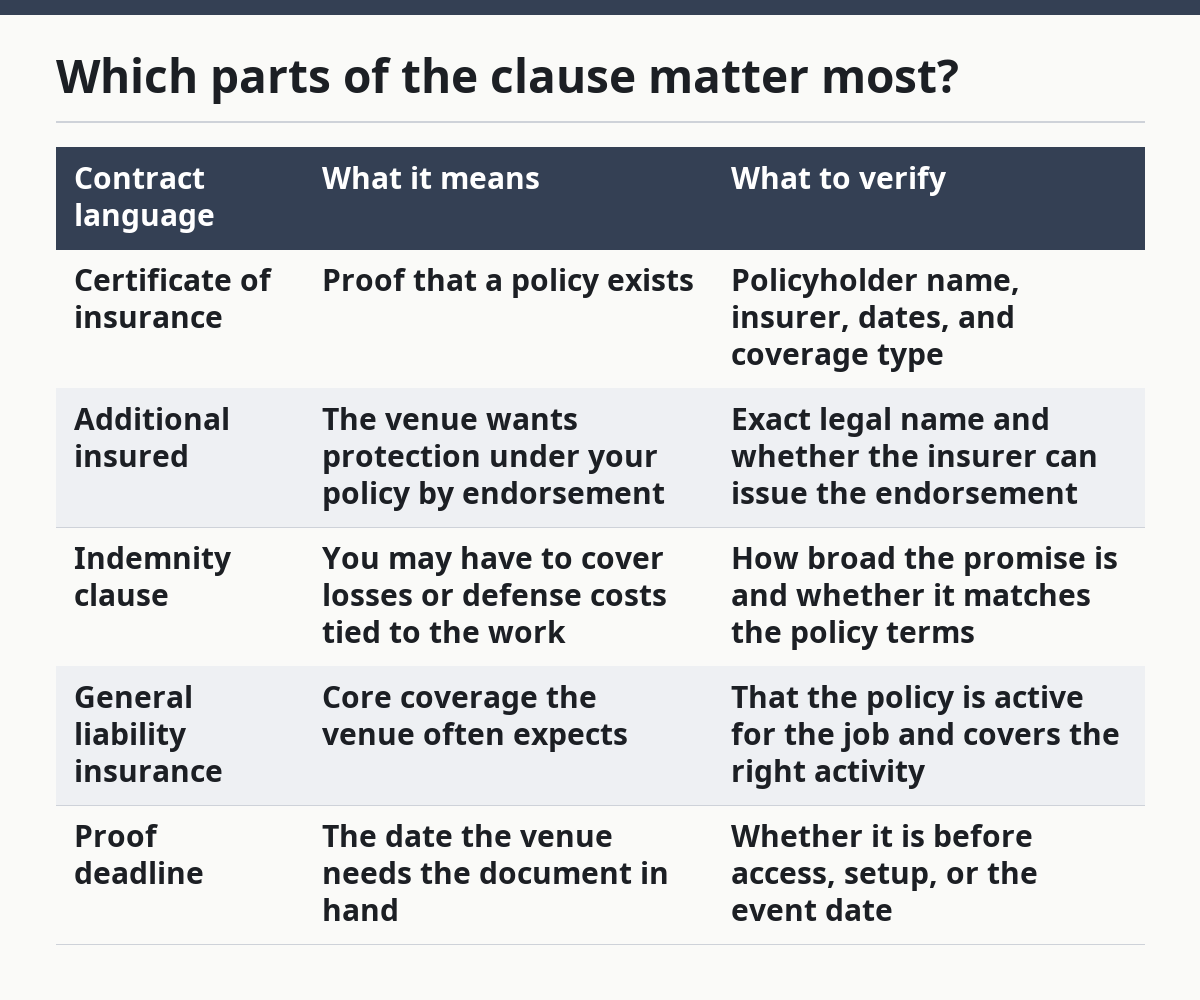
The biggest trap is assuming the certificate alone solves everything. It often does not. A venue may ask for a certificate, then reject it because the additional insured endorsement is missing or because the indemnity language is broader than the policy supports. See also indemnity clauses in service contracts.
When should you stop and get help?
You should stop when the contract asks for coverage or wording that you cannot confirm on the policy, because that is where a small paperwork issue becomes a money problem. There are five clear stop signs.

The venue wants additional insured status, but your insurer will not issue that endorsement: that means the contract and policy do not line up — do not sign until a qualified adviser reviews the gap.
The clause asks for defense or indemnity beyond your own work: that can shift liability for someone else’s conduct — do not guess at the meaning or rely on a certificate to fix it.
The venue needs proof before a deadline you cannot meet: that can block access or cancellation — ask for the deadline in writing and get help if the timing is impossible.
The contract names several parties with different legal names: that can cause a mismatch on the certificate — check the exact entity names before you send anything.
The event or shoot moves to a different location after the paperwork is issued: that can invalidate the old certificate for the new site — update the insurer and reissue the proof.
If the job is large, public, or tied to a venue that is strict about insurance wording, the ordinary approach stops working fast. That is the point where a qualified adviser is worth the time, because the cost of a bad assumption can be much higher than the cost of a careful review. The SBA and the Insurance Information Institute both recommend checking policy details before you rely on proof of coverage.
What mistakes do freelancers make?
The most common mistake is sending a certificate of insurance without checking the actual contract wording. That can lead to a rejected document and a delayed start. The better move is to match the certificate to the clause before you send it.

Another mistake is thinking “additional insured” and “certificate holder” mean the same thing. They do not. The certificate holder gets a copy of the paper; the additional insured gets a policy position, if the endorsement exists.
A third mistake is ignoring the indemnity clause because the insurance line looks fine. That can leave you promising to cover losses that the policy does not clearly cover. Read both clauses together, not one at a time.
A fourth mistake is missing the deadline by assuming the venue will wait. Many locations want proof before access, and some will not let you load in without it. A late certificate can cost you the job even if the policy itself is valid.
A fifth mistake is using the wrong legal name for the venue. Trade names, brand names, and operating names often look right but fail when the contract needs the exact entity. The certificate should match the contract, not the social media profile.
What if the venue asks for more than you carry?
If the venue asks for more than your policy shows, the contract is asking for a different risk level than your current setup supports. That does not mean the venue is wrong; it means the paper stack is mismatched. Do not assume the certificate can stretch coverage that the policy does not contain.
This is where freelancers get tempted to treat insurance like a checkbox, so pause and confirm the wording before you sign. It is not. A venue may ask for a specific coverage type, an endorsement, or a certificate before the event starts, and the policy may or may not support that request as written. The safe move is to pause and get qualified advice before accepting terms you cannot verify.
A location can also be stricter than a client. A hotel, theater, gallery, studio, or private estate may want its own wording, even if the client thinks the contract is routine. That is why the venue contract itself matters as much as the main service agreement.
FAQ
What if the venue asks for more coverage than I have?
That means the venue’s requirement and your policy do not match. The certificate cannot fix a missing coverage amount or an endorsement the policy does not allow, so the next step is to pause and get qualified advice before signing or starting work.
How do I show proof of insurance to a venue?
You usually send a certificate of insurance that lists the policyholder, insurer, policy dates, and coverage type. If the venue also wants additional insured wording, the certificate alone may not be enough, so check whether an endorsement or another proof document is also required.
Can a venue require me to add them as additional insured?
Yes, a venue can ask for that in a contract, but the request only works if your policy can support the endorsement. The practical issue is not the wording of the ask; it is whether your insurer can issue the additional insured status the venue wants.
Drafted with AI; not yet reviewed by a person.
