
Last updated: November 29, 2026
Quick answer: for freelancers, general liability insurance usually covers 3 kinds of third-party claims — bodily injury, property damage, and some personal and advertising injury claims — but it usually does not pay for professional mistakes, bad advice, or contract disputes. In this guide to general liability coverage for freelancers: what it protects and what it does not, the key question is simple: do you face client-site accidents, or do you mainly face service-quality risk?
General liability insurance for freelancers mainly protects you when your work causes bodily injury, property damage, or certain personal and advertising injury claims — but it does not pay for most professional mistakes, bad advice, or contract disputes. If you work in client offices, meet people in person, or keep gear where it can damage someone else’s property, this coverage can matter a lot. For a broader map of coverage choices, see the freelancer liability insurance hub and the professional liability insurance page.
Key takeaways
- General liability insurance is built for third-party injury and damage claims, not for correcting work mistakes.
- It can respond when a client, visitor, or bystander says your work space, equipment, or ad caused harm.
- The policy language matters. An exclusion can remove coverage even when the claim sounds close to covered.
- A claim at a client’s premises is one of the clearest places this coverage can come into play.
- This is information, not financial advice; a qualified adviser should be consulted about your own situation.
Who is general liability insurance for?
General liability insurance is for freelancers who can cause harm to other people or their property during ordinary business activity. That includes people who visit client sites, work in shared offices, store equipment, meet clients face to face, or use ads and websites to promote their services.
It is less useful for a freelancer whose main risk is a bad deliverable, a missed deadline, or a wrong recommendation. Those problems are often handled under a different policy type, so a general liability policy should not be treated as a catch-all. The Insurance Information Institute’s general liability pages and the National Association of Insurance Commissioners’ consumer materials both explain this broad structure. For a plain-language overview, see the NAIC consumer guide and the Insurance Information Institute.
A simple way to think about it: if a claim starts with injury, damage, or reputational harm tied to advertising, general liability may be relevant. If a claim starts with the quality of your work itself, the policy often stops short. That line is the one most freelancers miss.
What does it usually protect?
General liability insurance usually protects against three core claim types: bodily injury, property damage, and personal and advertising injury. Each one has a different trigger, and each one is limited by the policy form and its exclusions.
Bodily injury means physical harm to another person. A client trips over your laptop bag in an office lobby, falls, and claims medical costs. That is the kind of claim general liability is built to address.
Property damage means harm to someone else’s tangible property. If you knock over a client’s monitor, spill coffee on a rented desk, or damage a conference-room screen while setting up, the claim can fall into this bucket.
Because these claims are about other people’s property, the setting matters. A conference room, shared office, or rented venue can turn a small accident into an insurance question. General liability is designed for that kind of third-party loss, not for the freelancer’s own equipment.
Personal and advertising injury is a technical phrase for certain non-physical harms, often tied to ads or publicity. It can include claims like libel, slander, or misuse of another party’s advertising idea, depending on the policy wording. The exact wording matters because an exclusion can narrow this protection quickly. The IRMI glossary is useful here because it defines the terms insurers use.
Client premises claims are a practical example of all of this. If you are working in a client’s office and your presence leads to injury or damage, general liability is the policy that is often looked at first. That does not mean every claim is covered; it means the policy is designed to address this kind of third-party loss.
How do you read the policy before you rely on it?
You read a general liability policy by checking the insuring agreement, the definitions, and the exclusions in that order. The promise is usually broad at the start, then trimmed by exclusions, exceptions, and endorsements. That is why the last pages matter as much as the first.
- Find the coverage grant. Look for the section that names bodily injury, property damage, and personal and advertising injury. Verify that the policy is actually a general liability form, not a different business policy. If those words are missing, the problem is that the policy may not address the claim you expect.
- Check who counts as an insured. Confirm whether you are covered as an individual freelancer, under a business name, or through a partnership or LLC. If the named insured does not match how you invoice or sign contracts, a claim can become messy fast.
- Read the exclusions page by page. Look for exclusion headings such as professional services, contractual liability, workers’ compensation, and damage to property in your care. An exclusion is a policy rule that removes coverage. If your likely risk sits inside an exclusion, the claim may be outside the policy even if it sounds close.
- Check the location of the work. Make sure the policy covers work done at a client’s premises, a rented office, or another temporary site if that is where you operate. If the policy is written for only one location, a claim elsewhere may not fit.
- Review the advertising language. Look for the part that defines personal and advertising injury. Verify whether the policy mentions libel, slander, or infringement-related wording. If your business uses ads, testimonials, or social posts, weak wording here can matter.
- Look for endorsements. Endorsements are policy add-ons that change the standard form. Verify whether any endorsement narrows coverage for subcontractors, products, or specific business activities. If an endorsement changes the base policy, the base policy no longer tells the whole story.
- Match the policy to your contract promises. Compare the policy with any insurance requirements in your client agreement. Verify that the policy can actually satisfy the type of proof the client asks for. If the contract asks for coverage the policy does not provide, the contract and the policy are out of sync.
- Confirm the claims process. Check how soon you must report an incident or suit. If the policy requires prompt notice and you wait, the delay can create a coverage problem. A claim that is not reported in time is often the first sign something is wrong.
If you want a plain-English backup while reading policy language, the International Risk Management Institute glossary and the NAIC consumer pages are useful references. They do not replace the policy form, but they help decode the terms.
What does it not cover?
General liability insurance does not cover most professional mistakes, and that is the gap freelancers need to see clearly. If a client says your work was late, wrong, incomplete, or based on bad advice, general liability usually is not the right policy form.
It also does not act like a business safety net for every loss. Theft of your own tools, damage to your own laptop, injuries to you, and many disputes over payment are commonly outside this coverage. A policy can still have narrow exceptions, but the basic rule is that general liability is for third-party harm, not your own losses.
Here are common situations where the policy often stops short, but a qualified adviser should be consulted because policy wording varies and the claim facts matter. The NAIC and III both warn readers to check the form, exclusions, and endorsements.
| Situation | What it usually means | Why it matters |
|---|---|---|
| Wrong advice, bad design choice, missed deadline | Often treated as a professional error | General liability is not built for service-quality claims |
| Damage to your own camera, laptop, or tools | First-party property loss | The policy is usually aimed at other people’s property |
| Injury to you while working | Personal injury or workers’ compensation issue | General liability is about claims against you by others |
| Dispute over unpaid invoice | Contract/payment dispute | There is usually no injury or property damage trigger |
| Work done without the required policy wording | Contract problem | The client may still ask for proof you cannot provide |
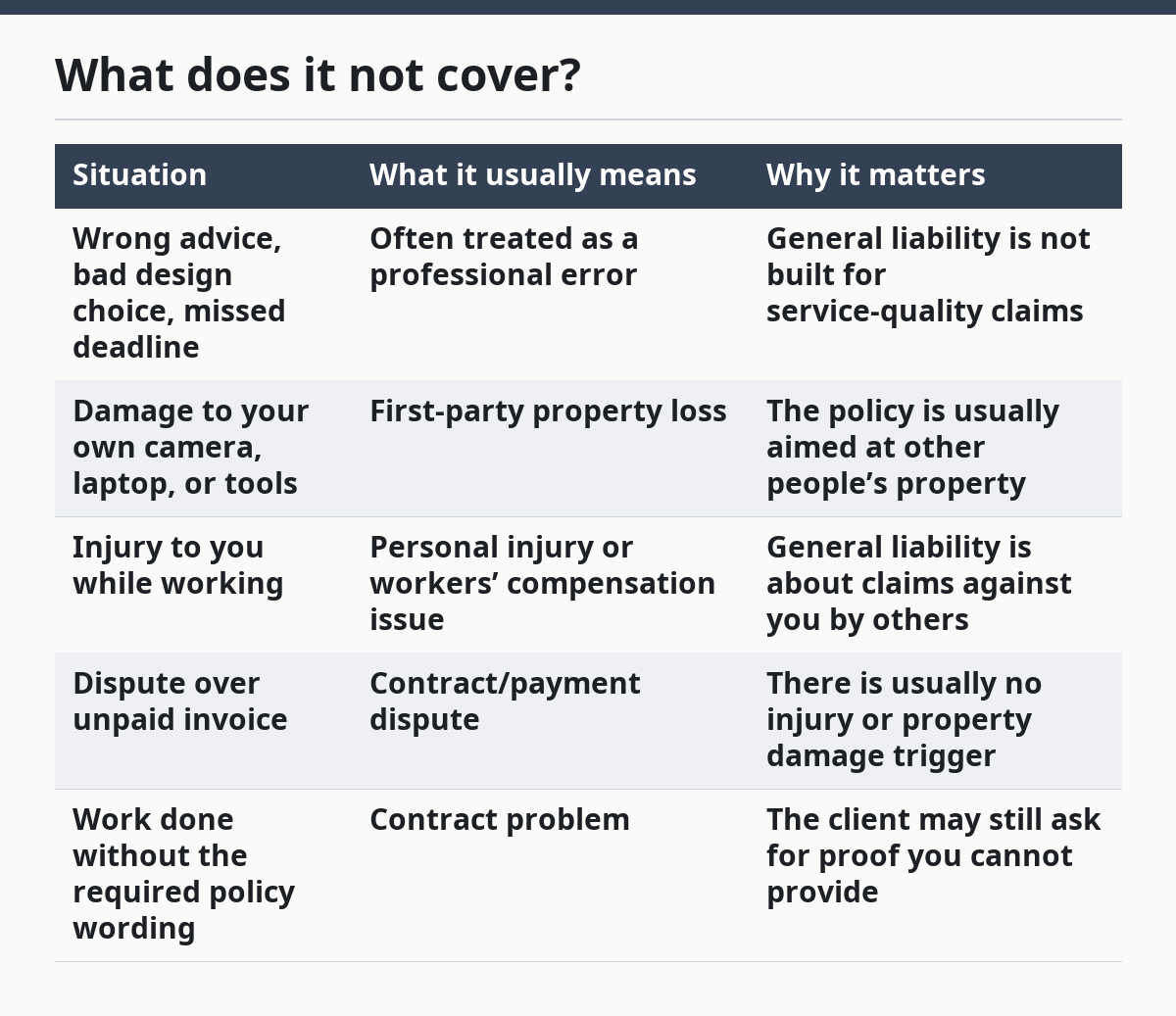
The biggest mistake is assuming “general” means “everything.” It does not. The policy is broad in some places and narrow in others, and the exclusion section is where that narrowness shows up.
When does the standard approach stop working?
The standard general liability approach stops working when the claim is really about your service, your advice, or a business arrangement rather than injury or property damage. That is the point where the policy can become the wrong tool.
A claim says your report was wrong: That is usually a professional services issue, not a bodily injury or property damage issue — the general liability policy may not respond.
The client wants payment back for a bad result: That is often a contract or service-quality dispute — look at the contract and any other policy form, not just general liability.
Your work happens entirely online with no client visits: You may still face advertising injury exposure, but client premises claims are less likely — the risk picture changes.
You keep expensive gear at home: Damage to your own equipment is not the same as third-party property damage — a general liability policy may leave that loss untouched.
The contract asks for “professional liability” wording: The request points to a different risk category — do not assume a general liability certificate satisfies it.
The policy has a strong exclusion for your line of work: The exclusion can erase the protection you expected — read the endorsement and ask a qualified adviser about the gap.
In other words, the policy is not wrong; the use case is. That matters because a freelancer can pay for coverage and still be underprotected if the main risk sits outside the policy form. For a direct comparison, see the business insurance basics page.
What mistakes do freelancers make with this coverage?
Freelancers usually make five mistakes with general liability insurance, and each one creates a different kind of gap.
Therefore, they buy a policy because a client asked for a certificate, then never read the exclusions. The result is a false sense of security. The better move is to compare the certificate request with the policy form and endorsements.
Second, they assume every claim at a client site is covered. That is not true. The policy may respond to a slip-and-fall or a broken monitor, but it can still exclude certain activities or property conditions.
Third, they confuse advertising injury with general business reputation risk. A social post or ad can create a claim in some cases, but not every complaint about marketing language is covered. The exact wording in the policy controls.
Fourth, they treat general liability as the answer to a bad deliverable. That is usually too broad a reading. If the claim is about your work product, the issue is often professional rather than accidental, so a qualified adviser should be consulted.
Fifth, they ignore how the business is named. If you work under your personal name but the policy names an LLC, or the other way around, the coverage picture can get complicated. Matching names sounds basic, but it is one of the easiest places for a mismatch.
The corrective step is simple, even if the policy itself is not: read the grant, then the exclusions, then the endorsements. If the claim type you expect is not clearly inside that chain, do not assume the policy will save it.
How should a freelancer think about client premises claims?
Client premises claims are one of the clearest uses of general liability insurance because they involve other people’s space and other people’s property. If you are working in an office, studio, retail space, or rented venue, the policy may respond when your presence causes injury or damage.
This does not mean the coverage is automatic. The policy still depends on the details: what happened, where it happened, who was injured, and whether an exclusion applies. A claim for a cracked screen is very different from a claim for a faulty service result.
The practical check is simple. If your work requires visiting clients at least once, even for a 30-minute meeting, you should know whether the policy contemplates that setting. If your work never leaves your desk and never touches someone else’s property, the risk shape changes, and the value of the coverage changes with it.
However, the best use of this coverage is not as a substitute for careful work. It is there for accidents that happen around the work, not for the work itself.
What should a beginner do next?
A beginner should start by listing the 3 most likely third-party risks in the business and matching each one to the policy language. If the risk is bodily injury, property damage, or personal and advertising injury, general liability may be part of the answer. If the risk is a wrong deliverable or a contract fight, it probably is not.
Then compare the policy to any client contract that mentions insurance. If the contract asks for coverage that the policy excludes, the gap is real and should be treated as such. A qualified adviser should be consulted for the reader’s own situation, because terms, limits, and policy forms vary by country and change over time.
For a wider overview of the broader insurance map, the freelancer liability insurance hub on this site is the better next stop. This page is only the line between general liability protection and the risks it does not solve.
FAQ
What does general liability cover for freelancers?
General liability insurance usually covers third-party bodily injury, third-party property damage, and some personal and advertising injury claims. That means it is aimed at accidents that harm someone else or damage someone else’s property, not at mistakes in your own work. The exact scope depends on the policy form and its exclusions.
Does general liability cover professional mistakes?
No, general liability usually does not cover professional mistakes, bad advice, missed deadlines, or other service-quality problems. Those claims are commonly handled under a different type of policy. If the dispute is about the content or result of your work, general liability is often the wrong fit.
What is not covered by general liability insurance?
General liability insurance usually does not cover your own tools, your own injuries, unpaid invoices, or most claims about poor professional work. Exclusions can also remove coverage for certain activities or contract promises. The policy is broad in some areas, but it is not a universal business policy.
Drafted with AI; not yet reviewed by a person.
