
Last updated: November 28, 2026
Quick Answer: worldwide liability exposure for freelancers working with overseas clients usually turns on 3 things: the contract’s choice of law, the client’s country, and the policy territory on the insurance. This article explains worldwide liability exposure for freelancers working with overseas clients in practical terms. This is information, not financial advice; rules change by country, so a qualified adviser should be consulted for your own situation.
Key takeaways
- A foreign client does not erase liability. A claim can follow the contract, the work site, or the place where harm is felt.
- The contract matters because choice of law and forum clauses can point disputes to one country’s courts instead of another’s.
- Insurance wording matters because some policies limit cover to a named territory or exclude certain foreign claims.
- Cross-border services raise extra issues when work is delivered online, when travel is involved, or when a client uses the work in a different country.
- The safest reading is usually not “global means covered”; it is to check the policy territory, claim location, and contract language together.
Who this applies to
This applies to freelancers who sell services to an international client and assume the work is “remote,” so the legal risk must stay remote too. That assumption is wrong often enough to matter, especially when the service is used abroad, stored abroad, or triggers loss in a foreign jurisdiction.
However, it also applies if you already carry freelancer liability insurance and want to know whether overseas work changes the risk. The answer depends on the policy territory, any territory restriction in the wording, and whether the claim is for professional error, property damage, or personal injury. If the contract is large, the client is in a high-risk country for disputes, or the wording is unclear, a qualified broker or lawyer should read the contract and policy together.
What makes overseas client work different?
Overseas client work changes liability because the claim can be tied to several places at once. A dispute may start with a service delivered from one country, a client based in another, and damage that shows up in a third. That cross-border pattern is common in digital work, consulting, design, marketing, software, and advisory services.
Therefore, the legal terms that matter are simple once defined. Choice of law is the rule that says which country’s law governs the contract. Forum is the place where a case is heard. Policy territory is the geographic area where the insurance applies. A policy may say “worldwide,” “worldwide excluding certain countries,” or “only for claims brought in specific places,” and those phrases do not always mean the same thing. In practice, wording like this should be checked with a broker or lawyer, and the policy wording should be read as a whole. See, for example, the International Bar Association’s guidance on cross-border disputes.
A generic liability article often skips the fact that a claim is not the same as a lawsuit. A client can allege loss first, and the insurance response may depend on where the claim is made, where the work was done, and where the policy says the cover operates. The International Bar Association and local insurance regulators regularly stress that jurisdiction and wording matter, which is why a one-country reading is too shallow for cross-border services. The UK Financial Conduct Authority also treats clear policy wording as central to consumer understanding.
How does liability exposure spread across borders?
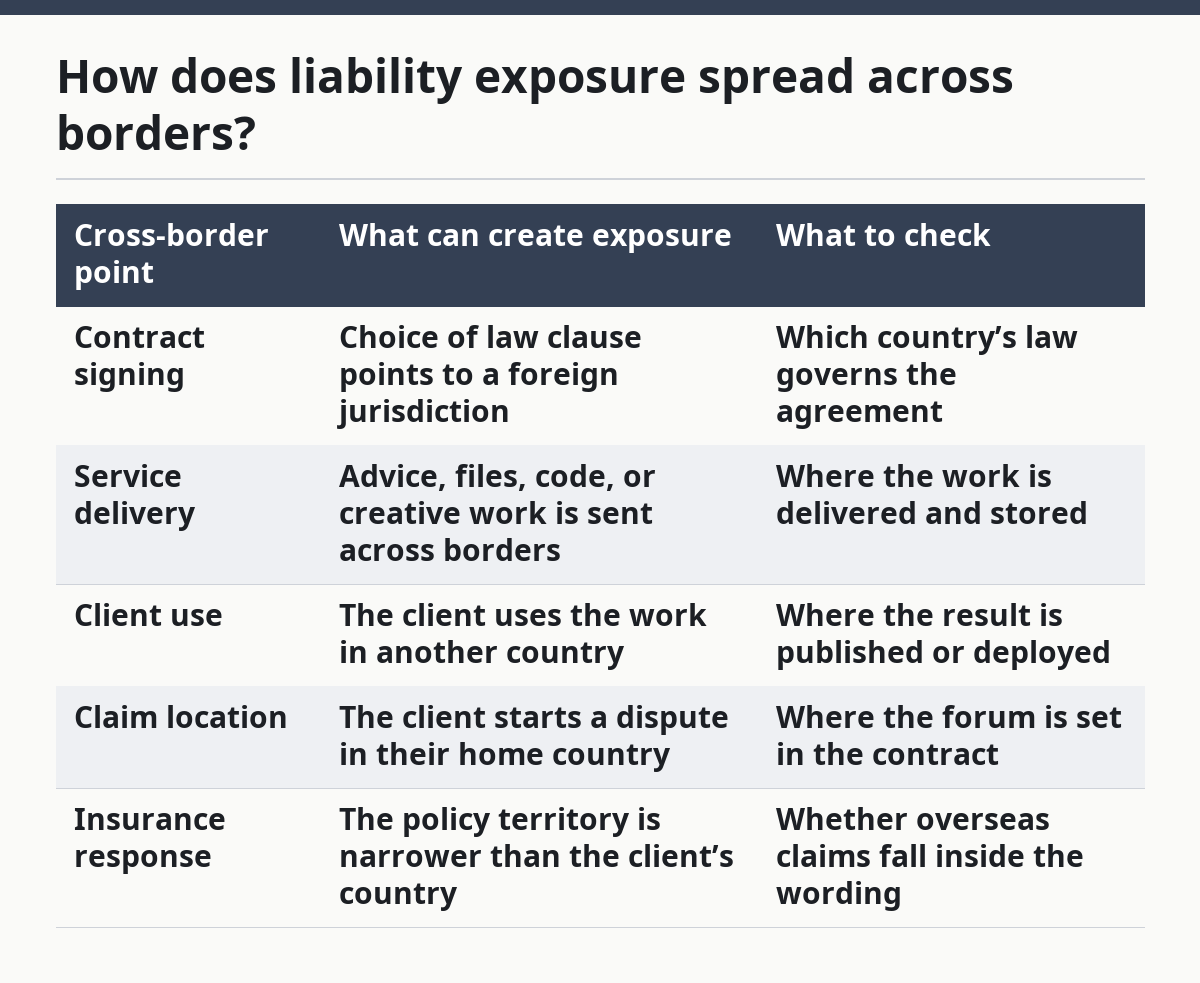
Because liability exposure spreads across borders when the contract, the service delivery, and the harm do not happen in the same place, the cleanest way to see it is to trace the work from first email to final handoff.
| Cross-border point | What can create exposure | What to check |
|---|---|---|
| Contract signing | Choice of law clause points to a foreign jurisdiction | Which country’s law governs the agreement |
| Service delivery | Advice, files, code, or creative work is sent across borders | Where the work is delivered and stored |
| Client use | The client uses the work in another country | Where the result is published or deployed |
| Claim location | The client starts a dispute in their home country | Where the forum is set in the contract |
| Insurance response | The policy territory is narrower than the client’s country | Whether overseas claims fall inside the wording |
For example, a claim can also appear where the damage is felt, not just where the freelancer sits. That matters for defamation, IP disputes, negligent advice, and some business interruption claims tied to a foreign client’s loss. If the work travels through 3 countries before it is used, the exposure can travel too.
Specifically, the practical point is blunt: do not assume a remote invoice creates a remote risk. The work may be delivered in 5 minutes over email, but the dispute can still move into another country’s courts, and that can change defense costs, process, and outcome.
What should you check before taking overseas work?
You should check the contract, the policy wording, and the way the service is actually delivered before you treat cross-border work as routine. Start with the contract because that is usually where the dispute map is drawn. If anything is unclear, consult a qualified broker or lawyer before you sign, because cross-border wording can change the result. See the IBA cross-border dispute resources and your local regulator’s guidance.
-
Read the choice of law clause line by line. Identify the country named in the contract and verify whether it matches the country you expected. If the clause is missing or vague, that is a problem because the dispute may land where you did not plan for it.
-
Look for the forum or jurisdiction clause. Check whether disputes must be heard in the client’s country, your country, or arbitration. If the clause names a foreign court, your legal costs and response time can change fast, so a professional review is sensible before work begins.
-
Find the policy territory in the insurance wording. Look for phrases like “worldwide,” “territorial limits,” or “territory restriction.” If the wording limits cover to a region, the client’s country may sit outside it.
-
Check whether claims-made wording applies. A claims-made policy usually responds when the claim is made during the policy period, not when the work was done. If the claim appears after the policy ends, that can be a problem unless the wording protects against it.
-
Map the service delivery path. Note where files are stored, where meetings happen, where code is deployed, and where the client uses the final output. If the path crosses borders, the risk does too.
-
Separate professional error from bodily injury or property damage. Many freelancers think one liability section covers every problem. It may not. A dropped laptop in a client office is a different issue from a bad strategy memo or defective code.
-
Check travel-related risk if you ever visit the client. A short trip can create local liability for accidents, document loss, or work done on site. If the policy only contemplates desk-based remote work, this needs review.
-
Keep records of who asked for what and where it was sent. Save the signed scope, delivery emails, and version history. If a dispute starts, those records can show what was promised and where the service was performed.
If any one of those checks is unclear, the problem is not paperwork noise; it is a gap that can turn into a coverage fight later. For foreign-jurisdiction work, uncertainty is itself a risk signal.
What happens when the standard approach does not fit?
The standard approach does not fit when the client’s contract, the policy, or the service model creates a mismatch across countries. These are the situations that usually need extra review.
The contract points to another country’s law: that can shift the dispute into a system with different deadlines, forms, and cost rules — get qualified legal help before signing.
The policy territory is narrower than the client base: that may leave a real gap if the claim comes from outside the covered area — ask for a wording review before relying on the policy.
The work is advisory and the client will use it abroad: that can raise exposure in the place where the advice is acted on — get a cross-border view of the contract and scope.
The job includes travel to the client’s country: that adds on-site accident and property risk, not just remote-service risk — check whether the policy contemplates travel-related risk.
The client insists on foreign court or arbitration language: that can change cost, process, and timing even if the service is small — do not treat this as a standard formality; consult a qualified adviser and review the policy wording and contract together.
The service touches regulated sectors: that can bring stricter local rules and more serious claims — stop and get advice before accepting the work.
This is where generic freelancer insurance advice falls short. A one-size answer ignores the difference between a claim that stays local and a claim that crosses a border. For overseas clients, that difference is the whole problem.
What mistakes do freelancers make most often?
Freelancers most often make the mistake of reading “international client” as if it automatically means “covered everywhere.” That error can leave them exposed when a claim lands in a country the policy never meant to cover.
-
Assuming a worldwide business means worldwide cover. The consequence is a false sense of safety. The correct alternative is to read the policy territory and any exclusion list.
-
Ignoring the choice of law clause. The consequence is surprise when the dispute is governed by a foreign legal system. The correct alternative is to review the clause before work starts.
-
Treating remote delivery as territory-free. The consequence is missing where the service is actually performed, stored, or used. The correct alternative is to map the full delivery chain and, if needed, get a qualified adviser to review the contract and policy wording.
-
Not checking whether travel is part of the job. The consequence is overlooking on-site risk in the client’s country. The correct alternative is to separate desk work from travel work in the contract and policy review.
-
Letting standard terms stay vague. The consequence is a wider dispute about what was promised. The correct alternative is to define scope, revisions, handoff, and acceptance in writing.
-
Buying insurance without asking how foreign claims are handled. The consequence is discovering the gap only after a letter arrives. The correct alternative is to ask how the policy treats foreign jurisdiction claims and defense costs, and to confirm the answer with a broker or lawyer if the wording is unclear.
The common thread is simple: people look at where they sit, not where the liability can land. The better habit is to look at the dispute path from contract to court.
When should you pause and get a professional review?
You should pause when the contract or policy contains more than one country’s legal language, because cross-border wording can change the result without warning. That is especially true if the agreement names a foreign forum, the client wants a local-law clause, or the policy has a territory restriction that is hard to read.
Therefore, you should also pause if the work includes regulated advice, travel, or a long delivery chain with subcontractors in another country. Those are not routine admin issues; they are signs that the liability map is wider than a normal home-country freelance job. A qualified adviser can help you read the contract and policy against the countries involved.
If your client is asking for a warranty, indemnity, or broad uncapped promise, pause before signing. Those clauses can move risk far beyond the fee for the job, and they are especially risky in a foreign jurisdiction where enforcement rules differ.
FAQ
Does freelancer liability insurance cover work for overseas clients?
It can, but only if the policy wording and territory fit the work. A foreign client by itself does not decide coverage. The key checks are the policy territory, any exclusion for certain countries, and whether the claim is made in a place the policy recognizes.
What happens if a foreign client sues a freelancer?
The contract and the policy usually decide the first move. Choice of law and forum clauses may point to a specific country, and the insurer may look at where the claim was brought, where the work was done, and whether the policy territory includes that place.
Do policy territories matter for remote international work?
Yes, they matter a lot. Remote work can still create a claim in another country, so the policy territory has to match the real service path, not just the freelancer’s home address. If the wording is narrow, the work may be partly or fully outside cover.
Drafted with AI; not yet reviewed by a person.
