
Last updated: November 24, 2026
Quick answer: in about 10 minutes, you can usually read a freelance insurance quote schedule well enough to spot the premium, the effective date, the limits, the deductible, and any endorsements that change the offer. A freelance insurance quote schedule tells you what coverage is being offered, when it starts, how much it costs, and what limits, deductibles, and endorsements are attached. Read it line by line before you bind anything, because the schedule is the part that shows the trade-offs, not just the headline premium.
Key takeaways
- The quote schedule is the quick map of the offer: coverage parts, dates, limits, deductibles, and premium.
- A low premium can hide a narrower coverage part, a higher deductible, or an endorsement that trims protection.
- The effective date matters as much as the price, because a quote can look fine and still start later than you need.
- Missing details in the schedule usually mean you need the carrier or broker to clarify before you move on.
- This is information, not financial advice; a qualified adviser should help with your own situation.
Who should read the quote schedule?
This applies to a freelancer who has a quote in hand and needs to tell what it actually includes before coverage is bound. It assumes you already know the basic business you do, the kind of risk you want covered, and the quote schedule in front of you, even if some lines still look dense. This is information, not financial advice, and a qualified adviser should be consulted for your own situation.
It also assumes the quote is for freelancer liability insurance or a related package, not a claims form or a full policy packet. The quote schedule is usually a summary page or set of pages that lists the offered coverage parts, premium, effective date, limits, deductibles, and endorsements. For background on preparing better quotes, the site’s hub on freelance insurance application and quote readiness belongs before this page in the reading order.
This method is right for someone who can slow down for 10 to 15 minutes and check line items. It is not the right tool if you need to settle a claim, compare every carrier side by side, or read a declarations page, which is a different document with a different job.
What is a quote schedule in insurance?
A quote schedule is the summary sheet that shows the proposed terms of the insurance offer. It is not the policy itself, and it is not the same as a declarations page, even when the words on the page feel similar.
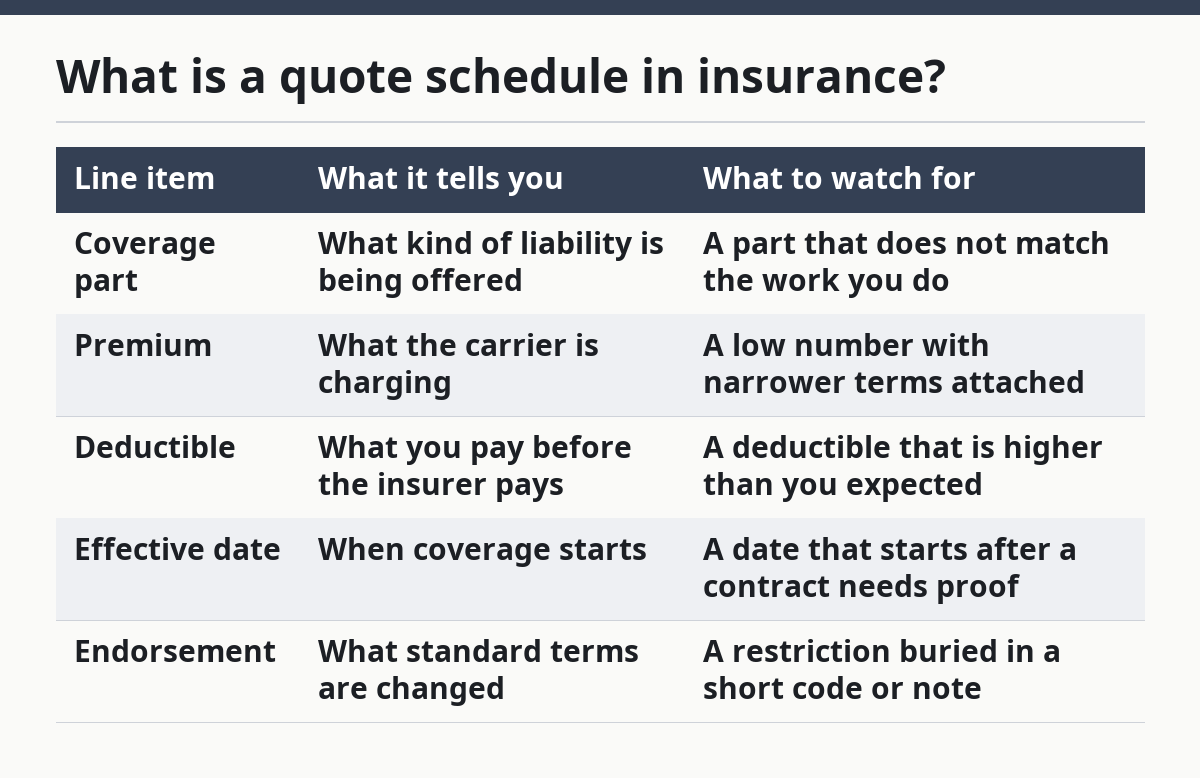
The schedule usually names the coverage part, shows the effective date, lists the premium, and may attach one or more endorsements. An endorsement is a change to standard coverage terms, and it can add, remove, or narrow protection. If the schedule does not clearly show those pieces, the quote is incomplete until someone explains the missing line.
| Line item | What it tells you | What to watch for |
|---|---|---|
| Coverage part | What kind of liability is being offered | A part that does not match the work you do |
| Premium | What the carrier is charging | A low number with narrower terms attached |
| Deductible | What you pay before the insurer pays | A deductible that is higher than you expected |
| Effective date | When coverage starts | A date that starts after a contract needs proof |
| Endorsement | What standard terms are changed | A restriction buried in a short code or note |
Two useful reference points for terminology are the National Association of Insurance Commissioners and the Insurance Information Institute. Their consumer explainers define insurance language in plain terms and are helpful when a quote uses jargon, though your own schedule still controls what is offered. See the NAIC consumer pages at naic.org and the Insurance Information Institute’s glossary at iii.org. For a practical definition of a binder versus a quote, the Insurance Information Institute is also useful.
How do you read the schedule step by step?
You read it by starting at the top and checking each line in order, because the meaning of a premium only makes sense after you see the limits, deductibles, and endorsements that sit beside it. Here is the practical sequence.
- Confirm the named insured and business description. Check that your legal name and freelance business description match the application on the page, down to spelling and entity type, if shown. A mismatch of even one word can mean the quote was built for the wrong risk, and that is a problem before price even comes up.
- Check the effective date first. Read the start date and any expiration date, if shown, before anything else. If the date does not line up with a client contract, a lease, or another deadline, the quote may be useless for your timing even if the premium looks good.
- Read the coverage part names exactly as written. Identify each coverage part and ask what it covers in plain English, such as liability tied to your services rather than some broader business class. If the label is vague or broader than your work, the schedule may be incomplete for your needs.
- Note every limit and sublimit. Write down the limit beside each coverage part and any smaller sublimit, if the schedule shows one. A schedule that lists one large limit but hides a smaller cap for a specific loss type is a problem, because the smaller cap controls that slice of coverage.
- Mark the deductible or self-insured retention. Find the amount you must pay before the insurer’s payment starts. If the deductible is shown as a percentage or as a separate retention, treat that as a different cost structure; if you are unsure, consult a licensed broker or insurance professional and check a source such as the Insurance Information Institute.
- Check the premium and payment basis. Read the quoted premium as the price for the stated term, not as proof that the whole offer is strong. If the schedule also mentions monthly billing, finance charges, or installment terms, treat those as separate payment details; if the setup is unclear, ask a professional to confirm it and compare it with the carrier’s terms before you rely on it.
- Scan endorsements and exclusions attached to the quote. Look for code numbers, short labels, or notes that change the standard terms. If an endorsement removes a service, a client type, or a location, the quote may not fit your actual freelance work.
- Verify any duty or condition notes. Some schedules mention requirements such as proof of prior coverage, a particular filing, or an operating condition. If you cannot meet one of those conditions, the quote may not be ready to bind; consult a broker or qualified professional and confirm the carrier’s rule before you treat it as usable, because a binder is not the same as the final policy (III).
That process usually takes only a few minutes once you know where to look, but the value is in the order. The premium is the last number to judge, not the first.
What should you check before you go further?
You should check whether the schedule matches the actual freelance work you do, the dates you need, and the level of risk you can live with. Those three checks catch most bad fits before anyone pays a premium that later feels wasted.

A useful way to think about the schedule is to sort each line into “fits,” “needs clarification,” or “does not fit.” If the effective date is right but the coverage part is wrong, the quote does not solve the problem. If the coverage part is right but an endorsement narrows it too far, the same problem remains.
If the schedule includes a deductible, ask whether it is per claim, per occurrence, or described some other way. Those terms are not interchangeable, and the difference changes how much you may owe on a loss. If the document uses insurer shorthand, get the plain-language meaning in writing before you move on. For a broader explainer on policy wording, see the NAIC consumer resources.
When should you stop and get help?
You should stop when the quote schedule is missing enough information that you cannot tell what is being offered. That is the point where guessing becomes expensive, especially with liability coverage.
The coverage part is named in broad terms only: the schedule may be too thin to show what risks are actually covered — ask for the full wording or a clear written explanation before you bind.
The endorsement list changes the coverage in a way you do not understand: a short code can hide a major limitation — stop and get the wording explained in plain language.
The effective date does not match a contract deadline: a one-day gap can matter if a client requires proof of insurance by a set date — do not assume the quote solves the timing problem.
The deductible or retention is written in a format you cannot interpret: a percentage, split amount, or separate retention may change your out-of-pocket cost — get the exact calculation clarified, and if needed, consult a licensed insurance professional before you bind.
The schedule mentions a duty, condition, or warrant that you cannot meet: the offer may depend on something you do not have — resolve that before you treat the quote as usable, and confirm the issue with a broker or attorney if needed.
You are unsure whether the policy language fits cross-border, part-time, or project-based work: standard wording often assumes a steadier business model — ask for help rather than guessing at fit.
What mistakes do people make?
People usually make the same five errors, and each one has a cost. The schedule is short enough to read quickly, but that speed is exactly why these mistakes happen.
Mistake one is chasing the lowest premium and stopping there. The consequence is a quote that looks cheaper because it carries narrower terms, a higher deductible, or a stronger endorsement. The correct move is to read the coverage part and the restrictions before you look at price.
Mistake two is treating the effective date as a formality. The consequence is a coverage gap if the date starts after a contract, job, or client requirement. The correct move is to match the date to the real deadline on your calendar, and if the timing is sensitive, ask a licensed professional to confirm it before binding.
Mistake three is ignoring endorsements because the codes look technical. The consequence is missing a change that trims the offer in a way that matters to your work. The correct move is to have the endorsement explained line by line.
Mistake four is assuming every limit is the same kind of limit. The consequence is thinking you have more protection than you do, especially if a sublimit is buried under the main limit. The correct move is to note each limit exactly as written.
Mistake five is reading the schedule as if it were the full policy. The consequence is overlooking terms that live elsewhere, where the policy can still change the result. The correct move is to use the schedule as the map, then verify the rest of the terms before binding.
What if the quote schedule is unusual?
The standard reading method needs adjustment when the schedule uses nonstandard labels, mixed coverage parts, or project-based timing. That happens often with freelancers whose work changes from one client to the next.
If the schedule lists more than one coverage part, read them separately and do not assume one line explains the others. If one part has a $0 deductible and another does not, that is a different risk structure, not a typo. If the quote is for a short term or a project term, the effective date matters even more because the policy may be built around a narrow time window.
Some schedules also bundle liability with other lines that are not the main reason you asked for the quote. In that case, the premium can look efficient while the part you care about is still limited. The fix is not to guess; it is to ask for the exact coverage part you need in writing. For more on fit, see what should you check before you go further?.
How do you know the schedule is complete enough?
A quote schedule is complete enough when you can answer four plain questions from the page alone: what is covered, when it starts, what it costs, and what changes are attached. If one of those answers is missing, the schedule is not ready for a decision.
A good schedule does not need to be long, but it does need to be clear. If you can circle the coverage part, premium, limits, deductibles, effective date, and endorsements without hunting through three pages, you are close to a usable quote. If you cannot, the document is doing too little work and needs clarification.
One practical sign of a good result is that the schedule lets you explain the offer to someone else in one minute without inventing any terms. If you need to guess at the meaning of a code or skip a limit, the quote is not yet transparent enough for a binding decision. For a quick recap, return to the key takeaways.
FAQ
What is a quote schedule in insurance?
A quote schedule is the summary of the insurance offer. It shows the quoted premium, the coverage part, the effective date, limits, deductibles, and any endorsement that changes the terms. It is a working document for review, not the policy itself.
What is the difference between a quote and a policy?
A quote is the proposed offer, while a policy is the contract that takes effect after binding. The quote schedule can change before the policy is issued, especially if details are missing or corrected. Read the schedule first, then confirm the policy matches it later.
What should I check first on an insurance quote?
Check the effective date first, then the coverage part. If the date is wrong, the quote may not fit your deadline, and if the coverage part is wrong, the price does not matter much. After that, check the premium, deductible, and any endorsement that narrows the offer.
Drafted with AI; not yet reviewed by a person.
