

Last updated: November 23, 2026
Quick Answer: for a freelance insurance policy, separate limits usually work better when the policy has more than one material risk, while shared limits fit simpler policies with one narrow exposure. This guide explains How to Choose Between Shared and Separate Limits on a Freelance Insurance Policy; it is information, not financial advice, and a qualified adviser should review your own policy and situation.
Key takeaways
- Shared limits put more than one claim type against the same pot of coverage.
- Separate limits keep each coverage part in its own bucket, which can protect one section from another claim.
- The right choice depends on which risks are most likely to hit at the same time.
- Policy declarations matter because they show whether the limit is shared, stacked, or separate.
- Endorsements can change the limit structure without changing the rest of the policy.
What does a shared limit mean?

A shared limit means one dollar bucket can apply across more than one coverage part, so a claim in one area can reduce what is left for another. In a freelance policy, that usually matters when the declarations page or policy wording shows one combined limit for related coverages rather than a separate cap for each one.
That structure is common when the insurer wants one overall ceiling for a policy section instead of multiple standalone ceilings. The result is simple: if one covered loss uses part of the limit, less remains for the next loss under the same shared bucket.
The important detail is not the label alone but the policy section that controls the loss. The declarations page, insuring agreement, and endorsements tell you whether the limit is shared, separate, or altered by a rider. For a plain-language guide to policy structure, the National Association of Insurance Commissioners explains how policy parts work and why declarations matter: NAIC consumer insurance resources.
Shared limits can be useful when the covered exposures are closely linked and the policy is written that way on purpose. They are less useful when a freelancer wants each coverage part to protect itself from another claim.
What does a separate limit mean?
A separate limit means each coverage part has its own bucket, so a loss under one part does not eat into another part’s limit. For a freelance policy, that can matter when general liability, professional liability, cyber coverage, or property coverage each have their own ceiling.
This setup is easier to think through because each section stands on its own. If the policy has a separate limit for property coverage and a different limit for professional liability, a claim on the office equipment side should not reduce the limit available for client-work claims, unless the wording says otherwise.
That protection is the main reason separate limits win for freelancers who have mixed exposures. It creates clearer boundaries between policy sections and reduces the chance that one event drains more than one bucket at once. The trade-off is that the total structure can be more complex to read, especially when endorsements create sublimits.
The Insurance Information Institute has a plain explanation of liability insurance structure and policy terms here: Insurance Information Institute insurance basics. It is worth reading alongside the declarations page, not instead of it.
How do shared and separate limits compare?

Separate limits win for most freelancers who want to protect different coverage parts from each other. Shared limits are simpler, but they create more overlap risk if more than one covered loss happens in the same policy period.
| Criteria | Shared limits | Separate limits | Winner for this condition |
|---|---|---|---|
| How the money is allocated | One pool covers multiple claims or coverage parts | Each coverage part has its own bucket | Separate limits when the freelancer has more than one material exposure |
| Risk that one claim reduces another | Higher | Lower | Separate limits when claims can happen in more than one area |
| Ease of reading the policy | Usually simpler on the face of it | Usually more detailed | Shared limits for a very simple policy |
| Fit for mixed freelance work | Often weaker | Stronger | Separate limits for freelancers with client work, equipment, and online risk |
| Exposure to policy wording changes | More sensitive to broad wording | More controlled by section | Separate limits when endorsements may change one section only |
| Usefulness of the declarations page | Shows one shared bucket clearly | Shows each bucket clearly | Separate limits when you want a clearer map of coverage |
| Risk of hidden reduction after one loss | Higher | Lower | Separate limits when cash flow depends on one coverage staying intact |
| Chance of sublimits mattering | Often more likely to matter | Still possible, but easier to isolate | Separate limits when the policy has endorsements |
| Best fit for a very small risk profile | Can work if exposures are narrow | May be more than needed | Shared limits for very limited freelance activity |
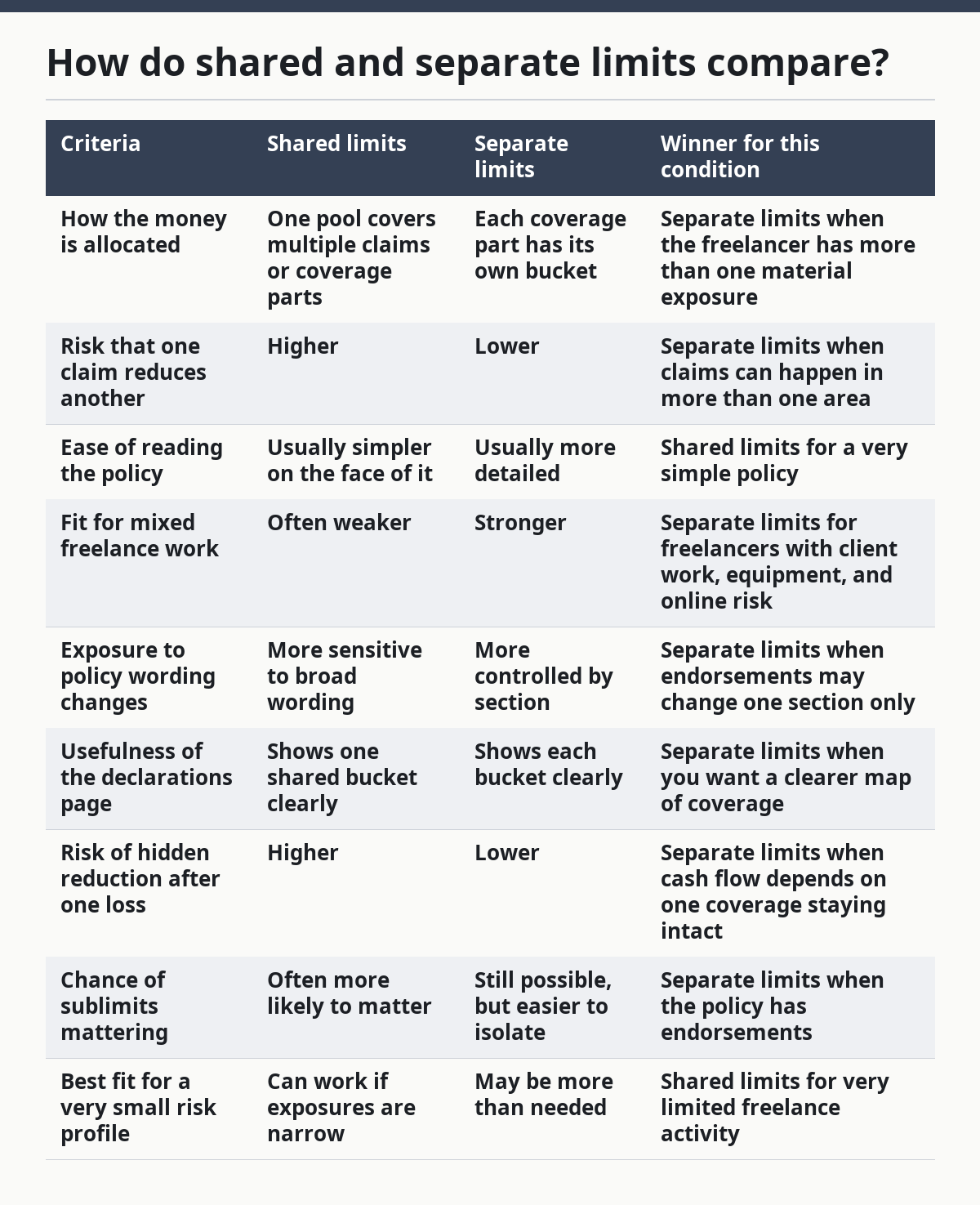
Shared limits are not automatically bad. They can make sense when the policy is narrow, the coverage parts are tightly related, and the freelancer is not trying to protect several different types of property or liability at once. The weakness is that one claim can leave less available for the next one, and that is the kind of problem that shows up only after a loss.
Shared limits: who should consider them?
Shared limits win for freelancers with a narrow risk profile and little need to protect one coverage part from another. If the policy is small, the work is simple, and the exposures do not overlap much, a shared structure can be easier to follow on the declarations page.
This can fit a freelancer whose insurance need is mostly one line of protection rather than several different kinds of coverage. A policy with one combined bucket can be easier to track, and it can keep the paperwork lighter when the policy is otherwise straightforward. That does not make it better in every case; it just makes it easier to understand.
The drawback is concrete: if a claim uses up part of the shared bucket, the next claim has less room to breathe. That matters most when a freelancer has property coverage, professional liability, and cyber coverage in the same policy form, because those risks do not always move together. A single shared bucket can leave one part underprotected after another part takes a hit.
Shared limits are not the right fit when the freelancer has significant client-facing work, expensive equipment, or a higher chance of separate claims in the same period. In those cases, the savings in simplicity can turn into a coverage gap after a loss. For a broader look at policy design, see freelance insurance limits and policy structure.
Separate limits: when do they make more sense?
Separate limits make more sense when the freelancer has more than one meaningful exposure and wants each coverage part to keep its own ceiling. That usually includes policies that mix general liability, professional liability, cyber coverage, and property coverage in one package or in coordinated parts.
The strength here is straightforward. If a claim under one section does not reduce another section’s limit, the policy can handle more than one problem without one event crowding out the next. That matters when work depends on equipment, data, client deliverables, or space that could be damaged or interrupted. A $10,000 equipment loss should not cut into a $100,000 liability bucket unless the wording says it can.
The downside is that separate limits can be harder to compare because each section may also have its own exclusions, deductible, or sublimit. A freelancer may think the policy is broad when one part is capped more tightly than the others. Endorsements can also change one section without making the change obvious unless the declarations page is read carefully.
A separate-limit structure is not a cure-all, so it is worth having a licensed adviser or broker review the wording if the policy is complex. It still needs the right policy wording, and it can still leave gaps if one coverage part has a low sublimit or an exclusion that takes away the expected protection. But when the question is whether one claim should shrink another section’s protection, separate limits are the cleaner structure. For more on reading policy parts, see freelance insurance limits and policy structure.
What should the declarations page tell you?
The declarations page should tell you whether the limit is shared, separate, or altered by an endorsement. That page is often the quickest way to see the policy’s structure before you get lost in the longer wording.
Look for the coverage names first, then the limit shown next to each one, then any note that a limit is combined, aggregate, or subject to a separate sublimit. If the page lists one amount beside multiple coverages, that is a sign the limit may be shared. If each coverage has its own amount, the structure is more likely separate.
Endorsements deserve special attention because they can change a limit without rewriting the whole policy. A rider can add a cap, narrow a section, or shift how one coverage part responds after a loss. That is why the declarations page is not enough by itself; it points to the structure, but the endorsements confirm it. On a policy with one or two endorsements, this check can take only a few minutes.
If the wording is unclear, do not guess at the limit structure. Ask for the exact policy section that controls the limit, because the title on the declarations page is not always the full story. This is especially true with cyber coverage and professional liability, where sublimits can matter as much as the main limit. For a second pass on wording, review freelance insurance limits and policy structure.
Which option should a freelancer choose?
Choose separate limits if the freelance business has more than one material risk and needs one claim not to eat another coverage part. Choose shared limits if the policy is simple, the risks are narrow, and a single combined bucket is easy to monitor. Neither option works well if the declarations page is unclear or the endorsements change the limit structure in a way that is hard to trace.
That is the cleanest call because the main decision is not about which label sounds better. It is about whether the policy can protect one part of the business after another part has already been used.
For most freelancers with mixed work, separate limits are the better structure. They are better at preserving coverage across general liability, professional liability, cyber coverage, and property coverage when those risks do not rise and fall together. Shared limits only win when simplicity matters more than isolation between coverage parts.
The wrong choice is the one made from a quick glance at the declarations page alone. A page that shows one number can hide a shared bucket, a sublimit, or an endorsement that changes the meaning of the limit. Before you buy, compare the policy with freelance insurance limits and policy structure and the NAIC consumer insurance resources.
When should this decision change?
The verdict flips in a few specific cases, and those cases matter more than the label on the policy. If the policy has only one meaningful exposure and the other parts are minor, shared limits can be enough. If the policy includes valuable equipment or regular client data handling, separate limits usually deserve a closer look.
A second flip happens when endorsements add a sublimit to one section. In that case, a separate-limit policy can still behave like a partially shared one inside that section, so the declarations page needs a second read. A third flip happens when the policy is being bundled with other coverages and the document uses combined wording that is not obvious at first glance.
A fourth flip happens if the policy is being renewed after a claim. One prior loss can make a shared structure much less attractive because the next claim has less room left in the same bucket. That is not a theory problem; it is a policy structure problem. A $5,000 claim can matter a lot more on a small shared limit than on a larger separate one.
For a broader map of how limit structure fits into the rest of freelance policy design, the hub on freelance insurance limits and policy structure is the right next stop. This article stays on the shared-versus-separate question only, because that choice changes how the rest of the policy behaves.
Drafted with AI; not yet reviewed by a person.
