

Last updated: November 23, 2026
Quick Answer: verify 3 documents — the certificate, the additional insured endorsement, and the client contract — and make sure the names, dates, and scope match. How to Verify Additional Insured Wording on a Freelance Certificate is a three-document check, not a one-line certificate check. A certificate of insurance can mention additional insured status, but the real proof is the policy endorsement and the exact wording tied to the client contract. According to ACORD’s standard certificate language, the certificate does not amend coverage and does not confer rights; the certificate is only a summary, while the endorsement controls. This guide is information, and a qualified adviser should be consulted for your own situation.
Key takeaways
- The certificate is a summary; the endorsement is the binding policy change.
- The client contract controls the wording you should expect to see.
- “Additional insured” can be blanket or specific, and the wording is not the same.
- If the certificate names the certificate holder but the endorsement is silent, that is a warning sign.
- When the wording is unclear, ask for the endorsement reference, and if needed, review it with a broker or attorney.
Who should use this check?
This check is for freelancers who already have a certificate of insurance, a client contract, and the policy endorsement or a copy of the wording that was issued with the policy. It assumes the reader can compare names, dates, and policy forms line by line, which is the whole job here.
Therefore, it is not for someone who only has a client’s one-line request and no policy documents yet. It is also not enough if the project needs a very specific clause in a contract, because that belongs in a separate review of the client insurance requirement, not in a certificate-only review. For freelance liability insurance, a practical habit is to compare the certificate, the endorsement, and the contract together, then keep the records for the policy term, which is often 12 months.
A certificate check can be done by a freelancer, but it stops being a simple admin task once the wording conflicts with the endorsement or the contract. That is where the paper trail matters more than the form.
How do I verify the wording step by step?
You verify the wording by comparing the certificate of insurance, the additional insured endorsement, and the client contract in a fixed order. The point is to see whether the certificate is describing actual policy language or just repeating a request.
- Open the certificate of insurance: Locate the “certificate holder” box and the additional insured language on the ACORD-style form, then confirm the policy number and policy period match the job. The certificate should show the same named insured and dates as the policy; a mismatch in even one field means the document may be stale.
- Read the client contract: Find the exact clause that asks for additional insured status, then note whether it asks for “ongoing operations,” “completed operations,” or both. If the contract names only the client and not the client’s parent, landlord, or project owner, that difference matters.
- Open the additional insured endorsement: Find the endorsement form number and the scheduled name, if any, then compare it to the contract language. The endorsement should say who is added and under what condition; if the endorsement says nothing about the client named in the contract, the wording does not match.
- Match the named entity: Check that the exact legal name on the endorsement matches the contract party, not a trade name or an unrelated office address. If the certificate says “ABC Studios” but the endorsement names “ABC Productions LLC,” that is a problem unless the contract uses the LLC name too.
- Check the trigger phrase: Look for terms such as “when required by written contract” or “where required by contract.” Those phrases matter because they often limit blanket additional insured wording to certain projects. If the contract is oral or the wrong project is named, the wording may not attach.
- Confirm the scope: See whether the wording covers only ongoing operations or also completed operations. If the client contract asks for both and the endorsement covers only one, the certificate is incomplete for that request.
- Verify the timing: Confirm the endorsement and certificate sit inside the same policy term and that the contract date falls inside that window. A certificate dated after the work started can still be valid if the endorsement was already in force, but a gap between dates is a red flag.
- Flag the wording problem: If the certificate uses broad language but the endorsement is narrower, treat the endorsement as controlling. The certificate does not expand coverage by itself; if the wording on the certificate is nicer than the endorsement, the certificate may be misleading. If the documents conflict, consult a broker, attorney, or insurer and ask for the endorsement page that applies.
A good result is simple: the certificate points to an endorsement, the endorsement names the right client, and the contract language and policy language line up on scope. A bad result is also simple: the certificate looks right, but the endorsement is missing, generic, or attached to the wrong project.
What wording should appear for an additional insured?
The wording should identify the additional insured relationship in plain policy language and match the client contract exactly. In practice, that means the certificate should point to the correct endorsement form, and the endorsement should show whether the client is added by name or by contract requirement.
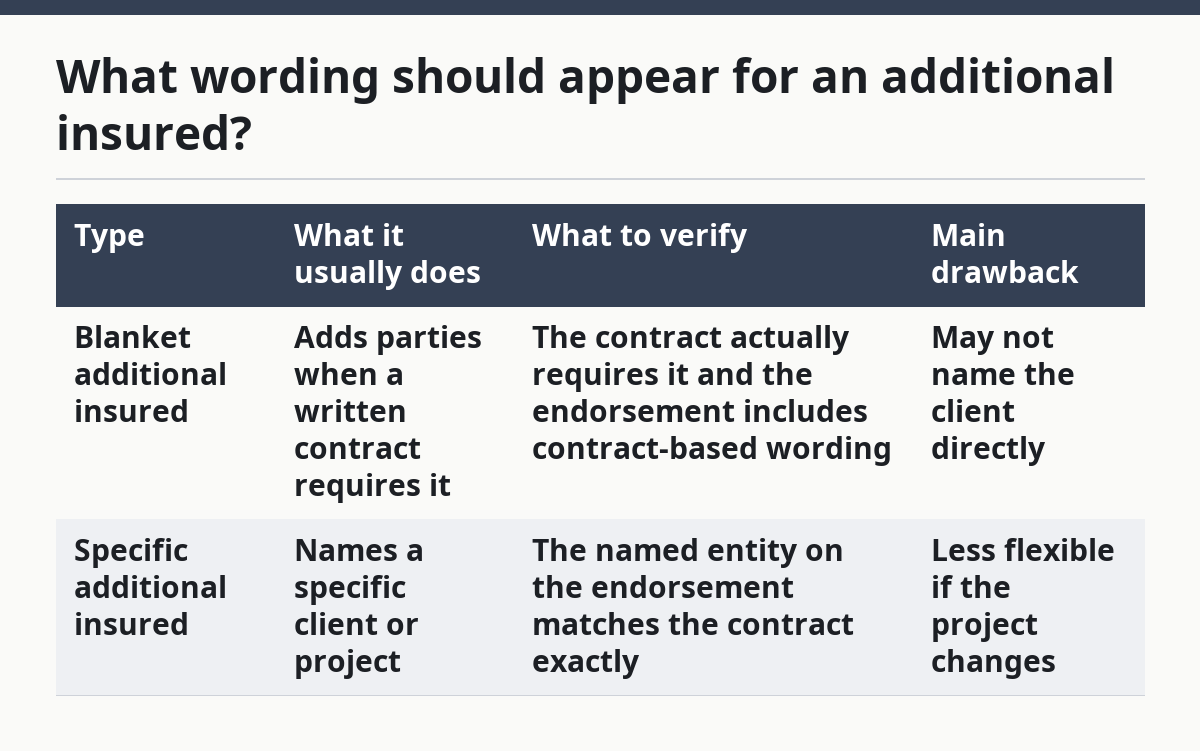
The common split is between blanket additional insured wording and specific additional insured wording. Blanket wording often applies when the policyholder has a written contract that requires it, so the endorsement does not always list a single client by name. Specific wording names the client or the project directly, often because the contract demands that exact party appear.
| Type | What it usually does | What to verify | Main drawback |
|---|---|---|---|
| Blanket additional insured | Adds parties when a written contract requires it | The contract actually requires it and the endorsement includes contract-based wording | May not name the client directly |
| Specific additional insured | Names a specific client or project | The named entity on the endorsement matches the contract exactly | Less flexible if the project changes |
For example, if the contract says the freelancer must add the client as an additional insured for the job, the endorsement should either name that client or clearly rely on that written contract. ACORD certificate wording and many insurer forms make the same basic point: the certificate is not the coverage grant.
The right wording is not the one that sounds broadest. It is the one that matches the contract, the policy form, and the certificate holder information without guessing.
What mistakes should I look for?
The biggest mistakes are simple paperwork mistakes that make the certificate look stronger than it is. Each one creates a different problem, and each one needs a different correction.
Certificate only, no endorsement: The form can mention additional insured status without changing the policy. That means the certificate is not enough on its own; the fix is to check the endorsement page or ask for the endorsement reference.
Wrong entity name: A client’s trade name is not the same as its legal name. If the contract names “North River Design LLC” and the endorsement names “North River Design,” the mismatch can break the chain of wording.
Wrong scope: The client asks for completed operations, but the endorsement only supports ongoing operations. The consequence is a gap in the coverage request, and the fix is to compare the exact contract clause, not the short certificate line.
Blanket wording assumed to be specific: A blanket endorsement may sound broad, but it may not list the exact client. The fix is to see whether the policy says “when required by written contract” and whether that contract exists in writing.
Outdated dates: A certificate can be old while the contract is new. If the policy term on the certificate ended 30 days before the project began, the wording cannot support that job.
Reading the certificate as if it were the policy: The certificate is a snapshot, not the policy contract. The fix is to use the certificate as a pointer, then confirm the endorsement wording and the client contract.
When does the standard check stop working?
The standard check stops working when the certificate, the endorsement, and the client contract do not line up in a way a reader can verify. That usually means the issue is not wording alone but missing policy paperwork.
The endorsement is missing: The certificate may list additional insured status, but there is no endorsement page to prove it. That means there is nothing to compare, so the check is incomplete.
The contract is vague: If the contract says “provide additional insured coverage as needed,” there is no precise wording to verify. That means the request is too broad to measure, and the wording may need clarification before anyone can confirm it.
The client name changed: If the client changed its legal name during the policy term, the old wording may no longer match. That means the certificate may be outdated even though the project is still active.
The policy uses a form you cannot read: If the endorsement form number is visible but the wording itself is not attached, the certificate cannot prove the detail. That means the reader needs the actual endorsement page, not a summary.
The contract asks for terms beyond additional insured status: If the request includes waiver of subrogation, primary and noncontributory wording, or other insurance language, the certificate check alone is not enough. That means another document review is needed because the certificate cannot carry every contract term.
How can I tell if additional insured wording is correct?
The wording is correct when the certificate, the endorsement, and the client contract all say the same thing in different places. The key question is not whether the certificate looks official; it is whether the policy endorsement actually supports the promise the certificate appears to make.
A reliable check has three parts. First, the certificate should point to a real policy in force for the right dates. Second, the endorsement should name the correct additional insured party or clearly tie coverage to a written contract. Third, the contract should ask for the same scope that the endorsement gives.
If one of those three pieces is missing, the wording is not fully verified. That does not always mean the certificate is wrong, but it does mean the reader does not yet know that it is right.
For more on certificate handling in the wider process, see the site’s hub on freelance insurance policy administration and the related certificate of insurance guide.
FAQ
What wording should appear for an additional insured?
The wording should match the policy endorsement and the client contract, not just the certificate line. In many cases it will either name the additional insured directly or state that the party is covered when required by a written contract. The exact phrase changes by policy form and country.
Does a certificate prove additional insured status?
No, a certificate by itself does not prove additional insured status. It is a summary document, not the policy endorsement that actually changes coverage. The endorsement is the document that should be checked if the certificate says the client is an additional insured. For a broader explanation, see the waiver of subrogation guide, which uses the same document-check method.
How can I tell if additional insured wording is correct?
Compare the certificate, the endorsement, and the client contract side by side. The names, dates, and scope should match, and the endorsement should clearly support the contract’s request. If the endorsement is missing or the names do not match, the wording is not fully verified.
Drafted with AI; not yet reviewed by a person.
