
Last updated: November 19, 2026
Quick Answer: in a 3-step proposal insurance checklist, send a short coverage summary first, the certificate of insurance only when asked or required, and keep the policy period aligned with the job dates.
Freelance proposal insurance paperwork works best when the proposal insurance checklist travels with the bid, while the certificate of insurance waits until the client asks for proof.
That keeps the scope, coverage summary, and certificate availability aligned before anyone signs.
This article on How to Match Insurance Documentation to a Freelance Proposal Process explains what to attach, when to send it, and where the process usually breaks.
Key Takeaways
- Match documents to the proposal stage, not just the final contract.
- Send a short coverage summary first; hold the certificate of insurance for the review stage unless the client asks earlier.
- Tie every insurance item to a named scope of work so the client can compare risk with the actual job.
- Use one checklist for every proposal so you don’t forget renewal dates, endorsements, or missing proof.
- If the client’s request is unclear or unusually strict, pause and verify it with the carrier or a qualified adviser.
This is information, not financial advice; because insurance rules, contract terms, and disclosure laws differ by country and change often, a qualified adviser should be consulted about your own situation.
What a proposal insurance checklist does
A proposal insurance checklist keeps your insurance documents attached to the same review path as your freelance proposal. It does not replace the contract; it organizes proof, timing, and scope so the client can see what is covered before the deal moves forward.
Picture this: you’ve sent a freelance proposal, the client wants proof of coverage, and someone on their side starts asking for “insurance paperwork” without saying which file they mean. The checklist gives that request a home and a order. It stops the back-and-forth before it starts.
A usable checklist usually includes these items:
- the proposal itself
- a short coverage summary
- the certificate of insurance, often called a COI
- the named insured on the policy
- policy dates and the expiration date
- any endorsements the client specifically requested
- the scope of work the policy should be matched against
The point is not volume. A 2-page summary often works better than a 12-page packet if the client only needs to confirm that the policy exists, what it covers, and whether it is active for the job dates.
The checklist also helps you avoid a common mistake: sending insurance proof with no context. A COI without the proposal leaves the client guessing which project it protects. A proposal without proof leaves them guessing whether you can actually meet their vendor requirements.
The one thing to keep in view
The insurance document should answer the same question your proposal answers: what work is being done, for whom, and under what risk terms. If those three pieces do not match, the paperwork looks sloppy even if the policy is valid.
How to match insurance documentation to a freelance proposal process
You match insurance documentation by building it into the proposal stages you already use: draft, send, review, revise, and accept. The cleanest version uses one document set for each stage, not one giant packet sent to every client.
Picture this: you finish a proposal for a design or consulting job, and the client opens it on a phone during a 15-minute internal review. If the insurance file is buried or sent too early, it gets ignored; if it shows up too late, the deal stalls. Stage timing matters as much as the policy itself.
Use this sequence:
- Map the scope first. Write the scope of work in plain language, including deliverables, project length, and any on-site or client-system access. Verify that the policy terms cover that kind of work. If the scope mentions work outside the policy class, you have a mismatch.
- Prepare a short coverage summary. List the insurer, policy type, named insured, policy period, and any limits or endorsements the client asked about. Keep it to one page when possible. If you cannot name the active dates, the summary is incomplete.
- Attach the proposal with the summary. Send both together when the client is in the first review stage. That lets the reviewer see the job and the proof in one pass. If the documents live in separate emails with no labels, expect delays.
- Hold the COI until needed. The certificate of insurance is the formal proof document, so send it when the client asks for it or when their process requires it. Verify that the certificate name matches the legal business name on the proposal. A mismatch is a red flag.
- Check certificate availability. Make sure the COI can be issued quickly enough for the review window. If the client wants proof within 24 hours and your carrier issues certificates through an agent only, the process may slow down. That is a process problem, not a wording problem.
- Track special wording requests. Some clients want additional insured status, waiver language, or project naming on the certificate. Verify whether your carrier can issue that wording before you promise it in the proposal. If the carrier cannot support it, the proposal should not imply otherwise.
- Confirm dates against the job start. Compare the proposal timeline to the policy period. If the job starts after the policy expires, or if the renewal is pending, the package is incomplete. A 30-day renewal gap can stop a review cold.
- Log the final packet. Save the proposal, summary, COI, and any client confirmation in one folder with a clear project name. If the client revisits the file 6 months later, you need the same set of documents, not a search through old email.
This process still works when the client has a simple intake form or a formal vendor review. The documents change less than the timing does.
What to verify before you send anything
Check these points every time:
- legal business name
- policy holder name
- policy dates
- project scope
- client’s requested document type
- expiration date
- certificate wording needs
If any one of those is missing, fix the gap before the client review stage. A missing detail forces a second round of questions and makes the proposal look unprepared.
What belongs in the proposal packet, and what stays out?
A proposal packet should include only the documents that help the client make a yes-or-no review decision. It should not become a dump of every policy page you own.
Picture this: you have a clean freelance proposal, then you attach a 20-page insurance form stack because you think more proof means less risk. The opposite usually happens. Too much paper slows review.
A practical packet usually contains:
- the freelance proposal
- a coverage summary in plain language
- the certificate of insurance, if requested
- any endorsement page tied to the client request
- a short note showing where to direct follow-up questions
What usually stays out:
- full policy forms
- unrelated endorsements
- old certificates
- personal insurance documents
- internal notes about pricing or carrier shopping
The reason is simple. The client is checking fit, not auditing your whole insurance file. A focused packet makes the review stage faster and keeps private policy detail out of circulation.
A good packet also keeps the scope of work visible on the same screen or page as the coverage summary. That lets the client compare the job and the proof without hunting through attachments. If they cannot do that in under a minute, the packet is too messy.
One note on terminology: a certificate of insurance is a summary document issued by the insurer or its agent; it is not the policy itself. That matters because a COI can show active coverage, but it does not rewrite the terms of the policy. If the client needs a specific endorsement, the COI alone may not be enough.
A simple document order
- Proposal first
- Coverage summary second
- COI third, if requested
- Endorsement or extra proof last, only if needed
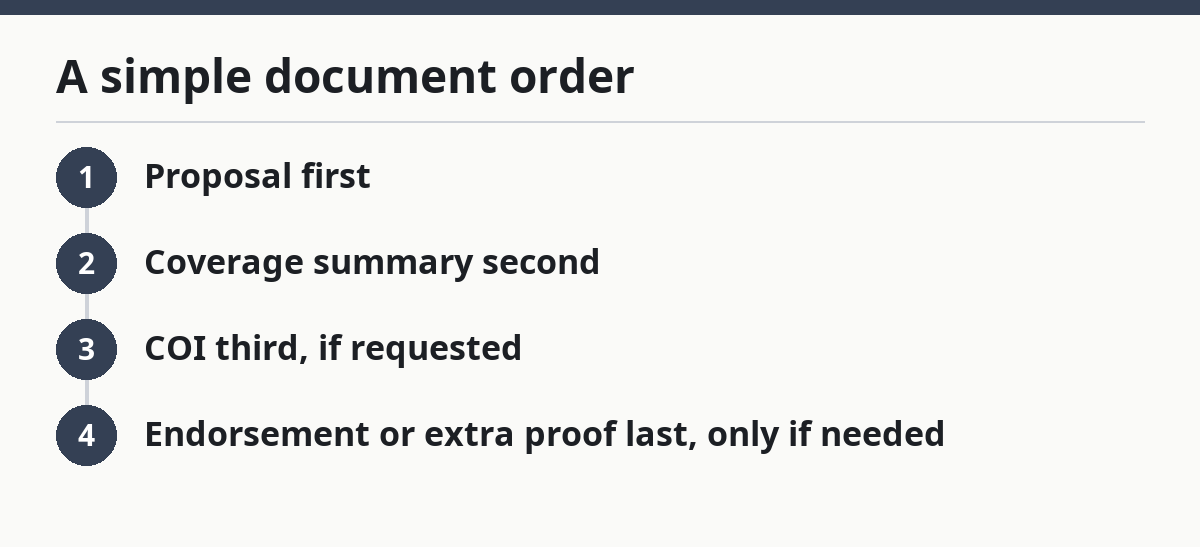
That order keeps the review from getting buried in paperwork.
When should proof of insurance go out in the sales process?
Proof of insurance should go out after the proposal is clear and before the client finalizes approval, unless the client’s process asks for it earlier. Sending it too soon can create questions you do not need yet; sending it too late can stall the deal.
Picture this: a buyer likes your work, but their vendor team needs proof before they can move the proposal to approval. If you wait until after the verbal yes, you may lose a week. Timing is part of the process.
Use this timing guide:
- At proposal send: share the coverage summary if the client has already mentioned insurance.
- At review stage: send the COI if the client asks for it or if their intake form requires it.
- Before signature or kickoff: confirm that the policy dates, scope, and any extra wording still match the project.
- After change in scope: resend the packet if the work expands into a new risk area.
The review stage is often the safest point for proof because it answers the client’s main concern without crowding the first pitch. If the project is simple and the client never asks about insurance, the full packet may never be needed. That can be normal.
The truth is, some clients treat insurance like a vendor box to check, while others use it as a hard gate. Consult a professional about your own situation, because requirements can vary by client and jurisdiction, and vendor policies differ. Your process should assume both. That means you keep the documents ready, but you do not lead with them unless the process calls for it.
Signs the timing is off
- the client asks for proof twice
- the proposal is approved but the job is frozen
- the COI name does not match the proposal
- the policy expires before the start date
- the client wants a document the carrier cannot issue
When those signs show up, the problem is process alignment, not just paperwork.
The mistakes that break the handoff
The biggest mistakes are sending the wrong document, sending it at the wrong time, or failing to match the scope to the policy. Each one creates avoidable review friction.
Picture this: the client has your proposal, but the insurance file does not match the project name, the dates, or the work type. Now someone has to stop and verify everything again. That delay is self-inflicted.
Common errors and what they cost:
- Sending only a COI: The client sees proof of coverage but not the work context. The fix is to attach a coverage summary and the proposal together.
- Using a stale certificate: An expired or soon-to-expire COI can trigger a new request. The fix is to check the policy period before every send.
- Ignoring the scope of work: If the proposal includes travel, site visits, or client-system access and the policy does not, the packet looks incomplete. The fix is to match the scope before outreach.
- Mixing personal and business documents: That confuses the review and can expose private information. The fix is to keep a business-only folder for proposal attachments.
- Assuming the client knows the form: Different clients ask for different proof. The fix is to confirm the exact document type before the review stage.
- Promising wording the carrier will not issue: That can stop the deal after the proposal is already in motion. The fix is to verify certificate availability before you promise the file.
The cost is usually delay, not drama. But delay can still wreck a sales process if the client has a deadline, a budget cycle, or a vendor onboarding queue.
When the standard approach does not apply
The standard packet needs changes when the client, the work, or the policy has unusual requirements. In those cases, a one-size-fits-all checklist is the wrong tool.
Picture this: you are bidding on a job that involves subcontractors, client premises, or a project name that must appear on the certificate. A normal proposal packet may not be enough. The process needs a custom pass.
Stop and recheck the process in these situations:
The client asks for additional insured status: That is a policy or endorsement issue, not just a document issue — verify whether the carrier can issue it before the proposal moves forward.
The work changes after the proposal is sent: The scope of work no longer matches the insurance summary — update the packet before approval.
The policy is near expiration: The proof may go stale before kickoff — confirm renewal timing and resend if needed.
The client requires a named project or venue on the certificate: The COI may need special wording — check issuance rules with the carrier or agent.
The job crosses into a new risk category: The current policy may not fit the work type — pause the proposal process until the coverage question is settled.
The client’s vendor portal rejects your documents: The problem may be file format or naming, not coverage — convert the packet and resubmit with clean labels.
These are the moments when process discipline matters most. A neat packet is good; a correct packet is better.
How to know the process is working
The process is working when the client can review the proposal and insurance proof in one pass, ask only targeted questions, and move toward approval without document churn.
Picture this: the client opens the packet, checks the scope, sees the proof, and sends one follow-up instead of five. That is the signal. Less friction means better alignment.
A good result usually looks like this:
- the proposal and insurance packet use the same project name
- the client can tell who is insured and for what work
- the COI is current when they open it
- the coverage summary fits on one page
- follow-up questions are specific, not confused
A bad result looks very different. The client asks for the same file twice, the dates do not line up, or the proposal moves forward while the insurance review stalls. If that keeps happening, the checklist is not detailed enough, or it is being sent at the wrong stage.
For the broader setup around this process, the hub on Freelancer Business Insurance Fundamentals gives the bigger picture. This page handles the workflow piece; the hub handles the wider readiness system.
Should insurance be mentioned in a proposal or a contract?
Insurance can be mentioned in both, but the role is different in each.
Drafted with AI; not yet reviewed by a person.
