
Last updated: November 19, 2026
Key Takeaways
- A mailing address can differ from a business address, depending on how the policy is set up.
- Ask the carrier to update the policy record, then verify the declarations page and billing file.
- Check whether the move changes only mail delivery or the policy record too.
- Get extra help when the move changes the risk address, named insured details, or policy state.
Quick Answer
How to Change Your Mailing Address on a Freelance Insurance Policy usually takes one request and one follow-up check. In most cases, you ask the carrier to update the policy record, then confirm the declarations page and billing file show the new address. This guide covers how to change your mailing address on a freelance insurance policy, what to verify, and when the update may need more than a simple mail change.
Your freelance insurance policy needs the new mailing address on file as soon as you move or your mail starts going to the wrong place. The right update keeps policy notices, renewal papers, and payment mail pointed at the right inbox. This guide shows what to change, what not to mix up, and what to check on the declarations page.
Who this applies to, and what you need in hand
This applies to a freelancer who already has an active policy and needs the insurer to use a different mailing address for records, notices, or billing. It assumes you can log in to the carrier portal, read your policy declarations page, and tell the difference between your mailing address, business address, and billing address.
This is information, not financial advice; if your move also changes how your business is rated or listed, a qualified adviser or the carrier’s service team can help you sort the record with your own facts. The truth is, a mailing fix is simple only when it stays a mailing fix.
For example, a freelancer who moves in 2026 may still need renewal papers sent to the old mailbox until the policy record is updated. You need the carrier’s file to show the right address, not just your email inbox. The job is to update the policy record, then confirm what kind of address changed.
- Mailing address: where the insurer sends notices.
- Business address: where the work is actually based.
- Billing address: where invoices and payment mail go.
If the policy is tied to a business location, a separate risk address may also matter. That term means the place the insurer uses to judge exposure, such as an office, studio, or home workspace. If that location changes, the update can affect more than a letter in the mail.
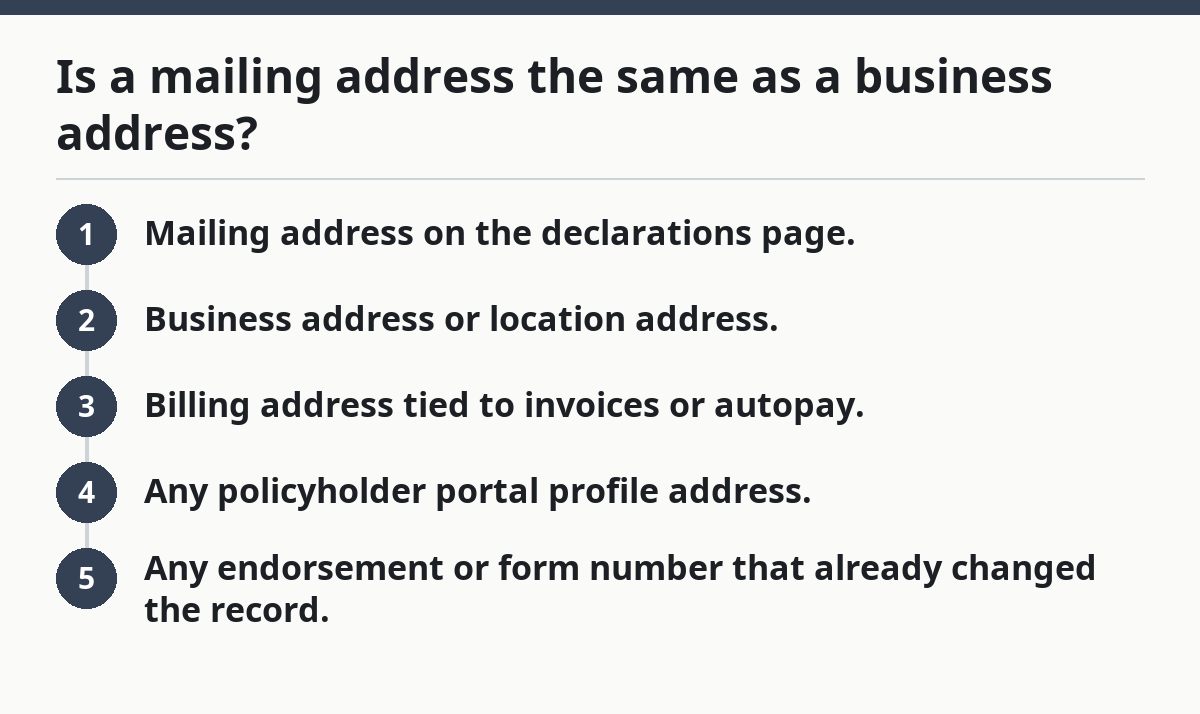
Is a mailing address the same as a business address?
A mailing address is not always the same as a business address. A freelancer may receive policy mail at a P.O. box or home mailbox while the business address stays at the studio, home office, or registered work site.
That split matters because the insurer can store more than one address on the policy record. One address may control notices, another may control underwriting details, and a third may control billing. If you blur them together, the carrier may fix the wrong field and leave the real problem untouched.
For instance, some carriers use a single address field for several purposes, while others separate them on the declarations page. That page is the policy summary that lists named insured, address details, coverages, and key dates.
Check these fields before you request a change:
- Mailing address on the declarations page.
- Business address or location address.
- Billing address tied to invoices or autopay.
- Any policyholder portal profile address.
- Any endorsement or form number that already changed the record.
If the address shown on the declarations page is the one where the business operates, changing only the mailing line may not be enough. In that case, the carrier may need a formal update to the policy record, not just a contact note.
How do I change the mailing address on my freelance insurance policy?
You change it by asking the carrier to update the policy record, then confirming the declarations page and billing file show the new address. Most insurers let you do this by phone, online account, or written request; the exact channel depends on the carrier.
For example, you have the policy number, the new address, and one old notice in front of you. You want the update done once, not bounced between support lines. Use the carrier’s service channel, then verify the endorsement or account update.
- Gather the policy number and current declarations page. Have the full policy number, named insured, and the latest declarations page ready. Verify the policy term dates and the address currently on file. If the number or name does not match, the request can stall or hit the wrong policy.
- Write the new address exactly as it should appear. Use the full street line, suite or unit, city, state or province, and postal code. Verify whether the address is for mailing only or also for billing. If you skip unit details, mail can still miss you.
- Contact the carrier through the service channel they list. Use the insurer portal, phone line, or written form the carrier provides. Verify the agent or system can change the mailing field and not just your login profile. If they can only change the website profile, the policy file may stay wrong.
- State whether the business address also changed. Say clearly if the business still operates at the old address, or if the move changed the office, studio, or home workspace. Verify which field they are updating. A mismatch here can leave the rating address untouched.
- Ask whether proof of address is needed. Some carriers may ask for a lease, utility bill, or government mail that shows the new address. Verify what document format they want and whether a PDF or photo is acceptable. If the proof is rejected, the request may remain pending.
- Confirm whether billing needs a separate update. A billing address can be different from the mailing address, especially if payment mail goes to an office or accountant. Verify autopay, invoices, and refund mail use the right address. If billing stays old, you may still miss a notice.
- Request written confirmation of the change. Ask for an email, case number, or endorsement showing the update. Verify the effective date of the change and the exact address printed. If the confirmation still shows the old line, the record is not finished.
- Check the declarations page after the update posts. Log back in or wait for the revised policy page to appear. Verify the mailing address, and if needed, the business or risk address. If the declarations page still shows the old data after the carrier says it is done, call again with the case number.
That update is usually administrative, not a full policy rewrite. But the paperwork still has to match the carrier’s system, and that is where mistakes happen.
What should I check before I send the request?
You should check whether the move affects only mail or also the policy record itself. That distinction decides whether the carrier just edits contact details or issues an endorsement, which is the written change to the policy.
For example, you are about to submit the form, and you are not sure which address matters for the policy, the invoice, or the work site. A 5-minute check can save a back-and-forth cycle that drags on for days. The right field matters more than the new street name.
Before you send anything, compare these items:
- The address on the declarations page.
- The address in your online profile.
- The address on recent billing notices.
- The address used for tax or business records.
- The address where the insured work actually happens.
If those five do not match, do not assume the insurer knows which one to change. A carrier can update one field and leave the others alone.
A few carriers also separate mailing address, billing address, and policy location in their forms. If you move from one state, province, or country to another, the address change may trigger a different rating review. Rates, filing rules, and notice rules vary by place, so the carrier may ask for more than a simple edit.
- If only mail delivery changed, ask for a mailing update only.
- If the work site changed, ask whether the business address or risk address must move too.
- If the invoice destination changed, update billing at the same time.
- If the policy is in a business name, make sure the name on the record stays exact.
When does an address change need extra help?
An address change needs extra help when the move changes the risk address, the named insured details, or the policy state. That does not mean the request is impossible; it means the change is no longer a simple mailbox edit.
For example, you may be moving a home office to a new county, or your studio may now sit at a different street address. The insurer may need to re-rate or refile part of the policy record. That is a different task than changing where letters go.
The policy lists the old work site: the insurer may treat the move as a location update, not just a mail change — ask for the business or risk address to be reviewed, and consult the carrier or a qualified adviser if you are unsure.
The business moved to a new state or province: filing and rating rules can change by jurisdiction — the carrier may need more documentation before it can update the record.
The mailing address is a P.O. box but the business runs elsewhere: some carriers want a physical location on file — keep both addresses clear and separate.
The policy is bundled with another line, like general liability and professional liability: one line may update faster than the other — verify each policy number separately.
The carrier asks for proof of occupancy or business use: the new address may affect underwriting, not just correspondence — send the exact document they ask for, not a random utility bill.
If the carrier cannot tell you which field needs changing, stop and ask for a service rep who handles policy administration. A guessing game creates gaps in the record.
What mistakes cause the most trouble?
The most common mistakes are small, but they can leave the policy record wrong for weeks. A wrong address can send notices to the old place, delay billing, or leave the declarations page out of sync with the real business location.
For example, you think the change is done, but the renewal packet still goes to the old apartment and the portal still shows the old suite number. That is not a deep insurance problem; it is a file problem. Small filing errors cause the longest headaches.
- Changing only the website profile. The portal may update fast while the policy file stays old. The fix is to ask for a policy change, not just a login edit.
- Using a short address with missing unit or suite data. Mail can land at the building and still miss you. The fix is to spell out the full address exactly as the postal service expects.
- Mixing up mailing and billing addresses. The carrier may update notices but leave invoices unchanged. The fix is to ask for both fields if both need to move.
- Ignoring the declarations page. If the summary page still shows the old line, the update may not have posted. The fix is to verify the page after the carrier says the change is done.
- Not mentioning a business move. A mail-only request can leave the risk address unchanged. The fix is to state plainly whether the work location changed too.
- Forgetting proof of address. Some carriers will pause the request until they get supporting documents. The fix is to send the document format they requested the first time.
The truth is, a clean update is less about speed and more about precision. One clear request beats three vague ones.
How long does the change usually take?
The change can take a few minutes to submit, but the policy record may take longer to show the new address. The exact timing depends on the carrier’s process, whether proof is needed, and whether the move also affects the business or risk address.
For example, you file the request on a Tuesday, then wait for the revised declarations page to appear. You want to know when the job is really done. Done means the policy file and the paperwork match.
A good result usually looks like this:
- The carrier confirms the new mailing address.
- The billing file, if changed, shows the same address.
- The declarations page reflects the update.
- Any mailed notice goes to the new address on the next cycle.
- The policy number and named insured stay unchanged unless a separate issue exists.
If the update is for records only, you may see the change quickly in a portal or confirmation email. If the carrier needs proof or manual review, the process can take longer. That is normal; what matters is that the confirmation matches the request.
You should be cautious if the carrier says the address changed but the declarations page does not. That gap usually means the record is not fully posted yet.
What if my insurer has the wrong address?
If your insurer has the wrong address, fix it right away and keep proof of the request. The wrong address can send policy notices, invoices, or renewal papers to the wrong place, which can create gaps in your records even if the coverage itself is still active.
For example, you discover an old address after a notice bounces back or a bill never arrives. The problem is not just annoyance; it is the paper trail. The record has to match the real world.
Do this next:
- Contact the carrier and give the correct address in full.
- Ask whether the mailing, billing, or business address is wrong.
- Save the case number, email, or portal confirmation.
- Check the declarations page after the update posts.
- If the move also changed the work site, ask whether a separate business address update is needed.
If the wrong address caused missed notices, the carrier may still have to follow its own notice rules, which vary by place and policy type. Because this is a money issue, not just a clerical one, a qualified adviser can help if the address error overlaps with billing, cancellation, or jurisdiction questions.
FAQ
Do I need to update my policy if I move?
Yes, if your mailing address changes, you should update the policy record so notices and billing mail go to the right place. If the move also changes where the freelance work happens, the business or risk address may need an update too. The declarations page should show what changed and when.
Is a mailing address the same as a business address?
No, they can be different. A mailing address is where the insurer sends letters and notices, while a business address is where the work is carried out or where the business is based. Many policies keep those fields separate, so changing one does not always update the other.
Drafted with AI; not yet reviewed by a person.
