
Last updated: November 19, 2026
Key Takeaways
- Match the old policy’s end to the new policy’s start, then get written confirmation.
- Keep the cancellation wording short, exact, and date-specific.
- Stop if timing depends on a live contract, claims-made form, billing dispute, or unbound replacement policy.
- Final billing is the insurer’s last premium calculation after the cancellation date is set.
Canceling a freelance insurance policy without a gap means lining up the replacement policy, cancellation date, and proof of termination before you send the notice. This guide explains how to cancel a freelance insurance policy safely, and the first step is to make sure the new coverage is active before the old one ends.
Who this applies to — and what you need before you start
This applies if you already have a freelance insurance policy and want to end it without leaving a day uncovered. It assumes you know your policy period, have the insurer’s name or policy number, and can get a replacement policy in place before the old one ends.
If your coverage is tied to a claims-made policy, a contract requirement, or a project that is still active, the timing matters more. This is information, not financial advice; because insurance rules vary by country and carrier, a qualified adviser should review your situation if the policy supports a live client contract or a formal legal dispute. According to the NAIC, policyholders should review their policy language and ask the insurer how cancellation will be handled.
Picture this: you’re staring at two policies, a renewal notice, and a calendar that could leave you exposed for even one day. The fix is to cancel only after the new coverage is active, the insurer has confirmed the effective cancellation date, and you have something in writing that proves the old policy ended when you expected.
- Keep these on hand: policy number, carrier name, renewal date, and contact details for the replacement insurer.
- Check whether the current policy is prepaid, monthly billed, or set to renew automatically.
- Save every email, PDF, and portal message in one folder.
How do you cancel a freelance insurance policy without a gap?
You cancel it by matching the end of the old policy to the start of the new one, then getting written confirmation from the insurer. The sequence matters more than the form.
Here’s the catch: a cancellation request alone does not protect you. The insurer may process it on the date they receive it, on the date you asked for, or on another date allowed by the policy form and local rules.
- Get the replacement policy bound first. Ask for the exact start time, not just the date, and verify the policy number or binder is issued. A problem exists if the new coverage is “pending,” “under review,” or waiting on payment.
- Find the current policy’s end point. Check the declarations page and the cancellation section for the policy period and any notice rule. Verify whether the carrier requires written notice. A problem exists if you are guessing at the end date from a renewal email.
- Choose the cancellation date one day after the new policy starts. If the replacement begins at 12:01 a.m. on a given date, the old policy should end at 12:01 a.m. on that same date or at the precise handoff the carrier accepts. Verify there is no hour, day, or timezone gap. A problem exists if the old policy ends before the new one begins.
- Send written cancellation notice to the carrier. Use the method the insurer accepts: portal upload, email, fax, or a signed form. Include policy number, requested end date, and your contact details. Verify you get an acknowledgment. A problem exists if the carrier says the request is unreadable, unsigned, or missing key data.
- Ask for the effective cancellation date in writing. Do not stop at “received.” You want the date the insurer will treat as the policy’s end. Consult the insurer’s written confirmation or a licensed insurance professional if the date is unclear. Verify it matches your replacement policy start. A problem exists if the carrier uses a different date than the one you requested.
- Check final billing and any refund estimate. A refund, if any, depends on the policy form, the carrier’s rules, and local law. Verify whether the policy is prepaid and whether fees or minimum earned premiums apply. A problem exists if the refund is based on a date later than the one you asked for.
- Save proof of termination. Keep the cancellation confirmation, the final invoice, and the refund notice. Verify the documents show the carrier name, policy number, and termination date. A problem exists if you only have a phone note with no written record.
A clean result is when one policy ends exactly when the next one begins, and you can prove it in writing.
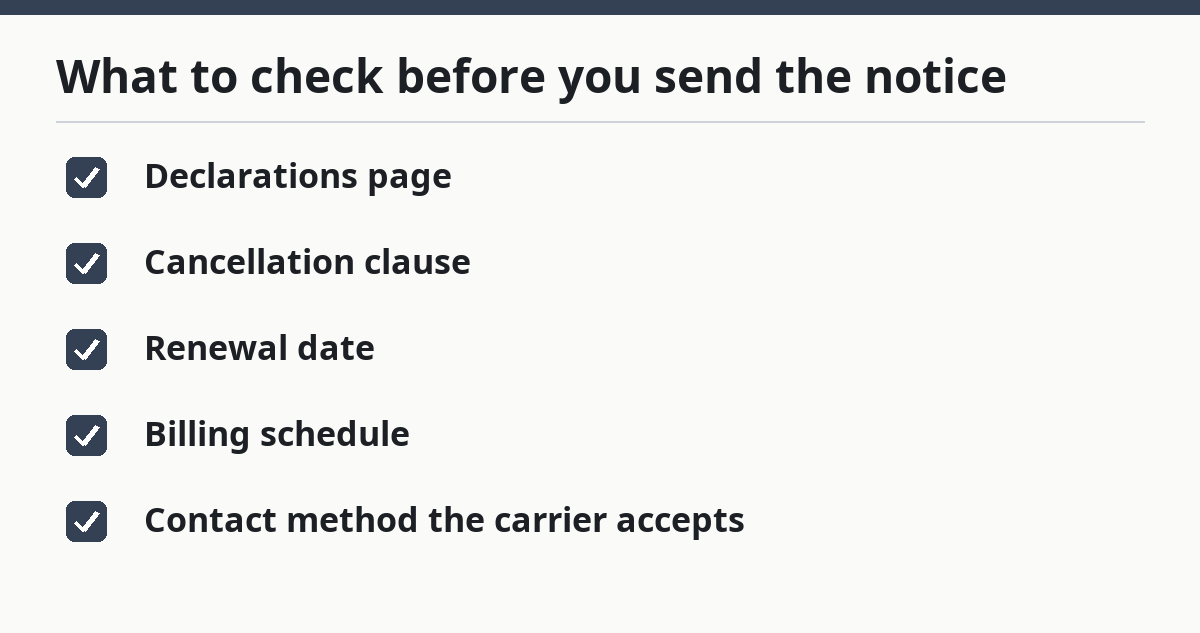
What to check before you send the notice
Start with the declaration page, then read the cancellation clause. That clause tells you whether the carrier needs advance notice, what kind of written notice counts, and whether mid-term cancellation changes your refund.
Check three dates side by side: the current policy end, the new policy start, and the date you plan to send notice. If those three do not line up on the same timeline, stop and fix the order.
- Declarations page
- Cancellation clause
- Renewal date
- Billing schedule
- Contact method the carrier accepts
What should the cancellation notice say?
It should say the policy number, the exact cancellation date, and that you want written confirmation of termination. The wording can be short, but it must be precise.
Picture this: you are sending one message that has to survive a claims review, a billing dispute, and a file audit. A vague note like “please cancel my policy soon” is a bad message.
A solid notice usually includes:
- Your full name or business name as listed on the policy
- Policy number
- Carrier name
- Requested cancellation date
- Request for confirmation of the final premium and any refund
- Preferred email address for written proof
If the carrier offers a form, use it. If it asks for a signed letter, sign it. If it accepts portal messages only, do that and save the submission receipt. Use the channel the insurer accepts and keep one record.
When should you stop and get help instead?
You should stop if the timing depends on a live contract, a claims-made form, a disputed billing history, or another policy that has not been bound yet. Those are not paper cuts; they are points where the wrong date can create a coverage problem.
The truth is, cancellation is simple only when the dates are simple. If the situation is not simple, a qualified insurance adviser or carrier representative can help confirm the sequence in writing.
The new policy is not bound: You do not yet have replacement coverage — delay cancellation until the binder or active policy is issued.
The carrier will not confirm the end date: You lack proof of termination — ask for written confirmation before you rely on the cancellation.
Your policy supports an active client contract: Ending it early may affect contract compliance — review the contract terms before sending notice.
There is an open billing dispute: The insurer may process the account differently — resolve the billing record or get written instructions first.
The policy is claims-made and another page on this site covers tail coverage: This page does not cover that issue — stop here and use the separate tail-coverage guidance.
The mistakes people make when they try to rush this
They usually do not make one big mistake. They make three small ones that stack up into a gap, a billing mess, or both.
One common error is canceling the old policy before the replacement is active. That leaves a blank day, even if the gap is only hours long. The correct move is to bind the new coverage first, then set the old policy to end at the exact handoff.
Another error is trusting a verbal promise from a phone call. A carrier rep may be helpful, but proof lives in email, portal records, or a signed form. Keep the written record.
-
Wrong date: The old policy ends on the wrong day.
Consequence: A coverage gap can appear in the file.
Better alternative: Match the cancellation date to the new policy start time. -
No written proof: You rely on a call.
Consequence: Billing or claims staff may not honor your memory.
Better alternative: Get confirmation by email or portal message. -
Ignoring the notice rule: You send notice too late.
Consequence: The carrier may process cancellation later than you wanted.
Better alternative: Check the notice period in the policy form. -
Not checking final billing: You assume a refund is automatic.
Consequence: The account can show an unpaid balance.
Better alternative: Ask for the final premium calculation in writing. -
Using the renewal date as the cancellation date: You guess instead of checking the policy.
Consequence: The policy may renew before the cancellation lands.
Better alternative: Read the actual policy period and notice terms.
What happens with final billing and refunds?
Final billing is the insurer’s last calculation of what you owe or what it owes you after the cancellation date is set. A refund, if one applies, depends on the policy’s billing method, earned premium rules, and local regulation.
Picture this: you expect money back, but the final invoice shows a balance instead. That can happen if the policy has a minimum earned premium, a short-rate cancellation rule, or service fees that do not disappear when coverage ends.
Do not assume the refund arrives immediately. Carriers often process it after the cancellation becomes effective and the account is closed, which can take time. If you need proof for a landlord, client, or lender, ask for a termination letter and a final invoice, not just a promise of reimbursement.
- Match the final bill to the cancellation date
- Verify any refund against the carrier’s written calculation
- Keep the final statement with the confirmation letter
- Question any charge you do not recognize before closing the file
What proof should you keep after cancellation?
You should keep proof that shows the policy ended, the date it ended, and the fact that the carrier accepted the request. That proof matters if a client asks later, a billing error appears, or you need to show when coverage changed.
The minimum file should include the cancellation request, the insurer’s acknowledgment, the final billing statement, and any refund notice. A PDF folder is better than a memory.
If the replacement policy is already active, keep its declarations page too. That lets you show the old and new coverage overlapped cleanly, with no blank day in between.
How long does the whole process take?
It can take one day or longer, depending on the carrier’s notice rule, the billing cycle, and how fast the replacement policy is issued. The exact timing varies by insurer and country, so check the policy form rather than guessing.
The good result is simple: your cancellation notice is accepted, the end date matches the new policy start, and the final paperwork shows a clean handoff. One clean record. No blank coverage period.
How to avoid the usual edge cases
You need a slightly different approach when the policy does not renew monthly, when the carrier requires advance notice, or when the policy is tied to a project-specific requirement. In those cases, the same basic rule still applies: line up the dates first.
One edge case is a prepaid annual policy. If you cancel mid-term, the refund may be partial or reduced by fees, depending on the carrier’s rules. Another is a policy that auto-renews at the end of the term; in that case, the cancellation notice must arrive early enough to stop the renewal.
- Auto-renewal in 30 days: Send notice before the renewal point, or the policy may continue.
- Prepaid annual billing: Ask how the carrier calculates the final premium.
- Contract-required coverage: Check the contract date before ending the policy.
- Carrier portal only: Use the portal if that is the only accepted cancellation channel.
- Multiple insured activities: Make sure the replacement policy covers every line of work the old one covered.
How does this connect to the bigger insurance setup?
It connects to the rest of your policy records, your client contracts, and the timing of any new coverage. This page covers cancellation only; the hub page on Freelancer Business Insurance Fundamentals handles the broader setup and recordkeeping that sit around it.
Picture this: you are not just ending one policy. You are changing the paper trail that tells clients, carriers, and billing staff what protection exists on a given day. The paper trail has to be consistent across every document.
If you need to keep your file tidy, the checklist is short: active replacement policy, cancellation notice, confirmed end date, final bill, and proof of termination. That is the whole job. Clean records beat guesswork every time.
When should I cancel a business insurance policy?
You should cancel only after the replacement policy is active or when you no longer need the coverage for an existing obligation. If a contract, lender, or client requirement still depends on the policy, ending it too early can create a compliance problem. Check the policy period and written notice terms first.
Do I need a replacement policy before cancelling?
Yes, if you want to avoid a gap in coverage. The new policy should be bound before the old one ends, and the dates should overlap or meet exactly on the handoff day. If the replacement is still pending, wait for written confirmation.
Can I cancel coverage mid-term?
Yes, many policies allow mid-term cancellation, but the refund and notice rules vary by carrier and policy form. Mid-term cancellation can also change the final premium calculation, so read the cancellation clause and get the end date in writing before you act.
Drafted with AI; not yet reviewed by a person.
