
Last updated: November 20, 2026
Quick Answer: most freelancers can get quote-ready in about 30 minutes if they have 3 to 6 core documents and a clear service description ready. Freelance insurance application and quote readiness means having the right business details, documents, and risk information ready before you ask for a quote. This guide, Freelance insurance application and quote readiness — The Complete Guide, explains how to prepare the facts insurers usually ask for.
If the application is complete and consistent, the quote process is usually faster and the price you see is less likely to change later.
This is information, not financial advice. Insurance rules, wording, taxes, and disclosure duties vary by country and change often, so a qualified adviser should check your own situation.
Key takeaways
- A ready application is mostly about clean facts: what you do, who you work for, how much income you expect, and what work you will not do.
- The biggest quote delays come from gaps, contradictions, and vague job descriptions, not from “bad” answers.
- Some freelancers need more than a simple liability policy because contracts, client work, and subcontracting can change the risk picture.
- The safest habit is usually to answer exactly what is asked, keep copies of what you send, and avoid guessing on dates, limits, or past claims.
- If your work crosses borders, handles client property, or includes regulated advice, the standard form may not fit well without expert help.
Who this guide applies to
This guide applies to freelancers, sole traders, and independent contractors who need to prepare for an insurance application or request a quote, and it assumes the reader already knows the broad shape of their business. It also assumes there is a real business activity to describe, such as consulting, design, writing, development, photography, trades, tutoring, or similar work.
The guide is for people who can list their services, clients, tools, and recent income without rebuilding the entire history from scratch. It is not for someone who needs to decide whether to form a company, sort out tax status, or resolve a dispute about past cover, because those questions can change the insurance structure itself.
Some situations need qualified help before any form is submitted. If the work involves regulated advice, client money, bodily injury exposure, international contracts, subcontractors, or prior claims, a broker or other qualified adviser can help match the disclosure to the cover. Insurance questionnaires can look simple, but a wrong answer about scope of work or claims history can distort the quote or the policy wording.
The key idea is simple: quote readiness is not about impressing the insurer. It is about giving a clean, accurate picture in one pass, using the same facts a claims handler would later check.
What insurers want to know
However, insurers want a short, consistent risk picture, not a business biography. In most applications, the core questions are who you are, what you do, how much work you do, where you work, and what could go wrong. The form may ask for annual revenue, years trading, professional qualifications, claims history, and the exact services you provide.
The reason is mechanical. Premiums and policy terms depend on the type of work, the scale of activity, the places where work happens, and the chance of a third-party claim. A designer who hands over digital files, a carpenter who enters a client’s home, and a consultant who gives advice face different risk patterns even if they all work alone.
A strong application uses plain, narrow language. “Marketing services” is weaker than “social media content planning, ad copy, and email campaigns,” because broad labels hide risk details. “Tech support” is weaker than “software troubleshooting for small businesses,” because the insurer cannot tell whether the work includes coding, data handling, or system changes.
Two sources help explain why exact wording matters: the UK Financial Conduct Authority’s consumer insurance disclosure rules and the U.S. Insurance Information Institute’s material on commercial liability insurance. The FCA page on disclosure and representations is here: https://www.fca.org.uk/firms/insurance-disclosure. The Insurance Information Institute’s commercial general liability overview is here: https://www.iii.org/article/commercial-general-liability-insurance.
How do you get quote-ready?
Because quote readiness starts with records, you get quote-ready by turning your business into a single, accurate file before you start the application. The practical goal is to answer the form in one sitting without guessing, chasing records, or changing your story halfway through.
- Write the exact service description. List 1 primary service and any 2 to 5 secondary services in plain language, such as “brand copywriting” or “bathroom tiling.” Verify that every word matches what you actually sell. A problem shows up if the description is so broad that it could describe a different trade entirely.
- Gather business identity details. Collect the legal name, trading name, address, registration details if any, and contact information in one place. Verify that the name matches tax records and invoices. A problem shows up if one document uses a trading name and another uses a different legal name without explanation.
- List revenue and work volume facts. Prepare the figures the form asks for, usually annual turnover or expected revenue, plus any split by service line if requested. Verify that the numbers come from the same accounting period or forecast method. A problem shows up if the totals do not match invoices, bank records, or prior submissions.
- Map your client and location exposure. Note whether you work from home, at client sites, online, or in public spaces, and whether you work for 1 client or many. Verify that the answer reflects the riskiest regular setting, not the easiest one. A problem shows up if the form says “home-based” but the work often takes place on site.
- Record claims and incidents honestly. Prepare any past claims, complaints, or incidents the insurer asks about, even if they did not become full claims. Verify dates, parties, and outcomes from records before you submit. A problem shows up if the history is vague, because missing incidents can later become disclosure issues.
- Check tools, data, and property handling. Write down whether you store client files, use subcontractors, hold keys, handle equipment, or access sensitive data. Verify which parts are routine and which are rare. A problem shows up if you ignore data handling when the work involves personal or commercial records.
- Review contract and indemnity terms. Look for clauses about liability caps, indemnity, professional standards, and required cover levels in any client contract or 12-month retainer. Verify that the insurance application does not contradict those clauses. A problem shows up if the contract demands a scope of cover that the application leaves out.
- Prepare supporting documents. Keep invoices, tax summaries, qualifications, certificates, website copy, and sample contracts ready as PDFs or scans. Verify that dates, names, and business descriptions line up across the files. A problem shows up if a document proves a different line of work than the one stated on the form.
A ready file is not a huge file. It is a tidy one. A strong application is often only a few pages of facts backed by 3 to 6 documents that all say the same thing.
What information should be ready before you apply?
Therefore, the most useful information is the information the insurer is most likely to ask for again if something is unclear. That usually includes turnover, business age, job title, a short description of services, where the work happens, who the clients are, and whether anyone else helps with the work.
A good habit is to prepare answers in the language of the policy rather than in casual business language. If the form asks for “professional services,” answer with the services you actually provide, not with a slogan from a homepage. If it asks for “subcontractors,” say whether they are used at all, even if only once or twice a year.
This is also the place to check for edge terms. “Consulting” can mean strategy, advice, implementation, training, or all four. “Administration” can mean bookkeeping, diary support, billing, or database work. The more precise the wording, the less likely the insurer is to assume a higher-risk activity than you intended.
A simple comparison helps:
| What the form asks | Stronger answer | Weaker answer | Why it matters |
|---|---|---|---|
| Business activity | “Freelance website design for small businesses” | “Creative services” | The insurer can price the actual work |
| Work setting | “Home office and occasional client visits” | “Anywhere” | Location changes liability exposure |
| Client type | “Small firms and sole traders” | “Everyone” | Client profile can affect contract risk |
| Claims history | “No claims in the period asked about” | “Nothing major” | The insurer needs a clear disclosure answer |
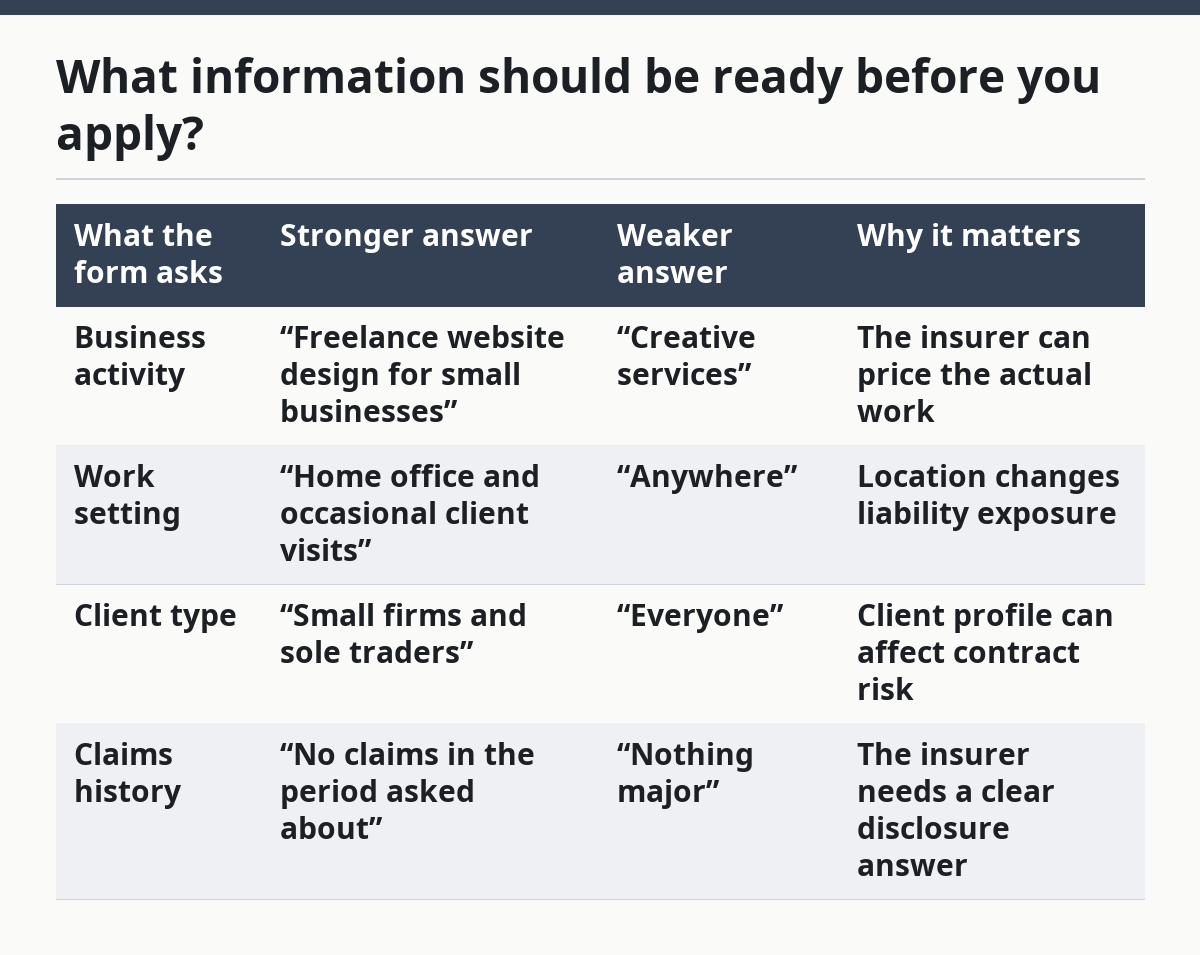
A clean answer does not need long prose. It needs enough detail to remove doubt. If a sentence could apply to 3 different jobs, it is probably too vague for an application.
When should you stop and ask for help?
You should stop and ask for help when the form stops matching the real business. That usually means the standard quote process no longer fits a simple freelancer profile, and the risk of a wrong disclosure rises.
Work across borders: If clients, jobs, or claims could involve more than 1 country, the policy territory and law may change — get qualified help before answering. A mistake here can leave a gap between the place where the work happens and the place the policy actually covers.
Regulated or professional advice: If the work includes advice that a client relies on for money, legal rights, or regulated decisions, the cover may need a different form — ask for guidance before submitting a generic form. A broad “consulting” label can hide a much higher exposure.
Client money or property is involved: If you hold deposits, keys, equipment, or documents for a client, the exposure is not the same as desk-based work — check whether the application asks about care, custody, and control. Missing that detail can lead to the wrong class of risk.
Subcontractors help on jobs: If another person does part of the work, even 1 job in a 12-month period, the insurer may ask different questions — get the structure clear first. A solo application can be misleading if the work is not truly solo.
There was a past claim or complaint: If there has been any claim, warning letter, or dispute that the form asks about, do not guess at the date or outcome — verify it from records. A wrong disclosure can cause problems later even if the issue seemed minor at the time.
The contract demands special terms: If a client contract requires a particular limit, waiver, or indemnity wording, the ordinary quote may not match the deal — pause and compare the paperwork. A policy that sounds fine in isolation may still fail the contract test.
The common thread is simple: if the real work is more complex than “I work alone from home for local clients,” the standard form may need care. That is the point where speed matters less than accuracy.
What are the most common mistakes?
The most common mistakes are not dramatic. They are small mismatches that make the risk picture messy, and mess is what slows quotes down or distorts them.
-
Using a vague job title. A label like “freelancer” or “consultant” hides the actual service. The consequence is a quote that may be rated for the wrong activity. The better alternative is a specific service description with 1 main line of work and any secondary tasks spelled out.
-
Leaving out small claims or incidents. A minor complaint, canceled job dispute, or prior claim may seem unimportant. The consequence is a disclosure problem later if the insurer expected a full history. The better alternative is to list what the form asks for, even if the event did not become a large loss.
-
Guessing on revenue. Some people round up or use the nearest figure without checking records. The consequence is a mismatch between the application and actual business scale. The better alternative is to use accounting records, invoices, or a documented forecast for the same 12-month period.
-
Forgetting where the work happens. Home office work is one thing; client-site work, travel, and public-facing jobs are another. The consequence is a gap between the described exposure and the real one. The better alternative is to list every regular work location and say which one is most common.
-
Assuming the contract and application are separate. A client contract may require cover for activities that were never stated on the form. The consequence is a policy that looks fine until a claim checks the paperwork. The better alternative is to compare the contract wording with the application before it is sent.
-
Not updating after the business changes. A freelancer who adds subcontractors, new services, or new client types can outgrow last year’s form. The consequence is stale information that no longer reflects the business. The better alternative is to treat the application like a living record and review it before each renewal cycle.
These mistakes cost time first and money later. The time loss shows up as rework, questions, or delayed quotes. The money loss can show up in pricing, exclusions, or a policy that is harder to rely on when a claim arrives.
Which edge cases change the answer?
Then edge cases change the answer when the business is still freelance in name but not simple in structure. The standard approach needs modification when the risk profile has moved past a one-person, one-service setup.
One edge case is mixed work. A freelancer may do design, training, and ad management in the same year. In that case, the application should separate the services rather than bundle them into a single line, because different services can carry different exposures. If the form cannot handle that split clearly, it may be time to ask for help.
Another edge case is international clients. A writer in one country may contract with clients in several others, and the policy question is not just where the freelancer sits, but where the legal exposure can arise. The application should name the usual client locations and any work performed outside the home country if the form asks.
A third edge case is client property or sensitive data. If the freelancer handles laptops, keys, files, passwords, or personal records, the application should say so directly. That detail matters because a standard “work from home” answer can hide the part of the job where loss or misuse is most likely to be discussed.
A fourth edge case is a growing team. If a freelancer uses a virtual assistant, subcontractor, or occasional helper, the application should not read like a one-person operation when it is not. Even 1 helper can change questions about supervision, responsibility, and who performs the work.
A fifth edge case is contract-heavy work. Some clients use 20-page agreements with indemnity clauses, liability caps, and required wordings. If the insurance form is completed without reading those clauses, the result can be a policy that does not match the contract. The standard approach here is to compare paperwork, not assumptions.
How long does readiness take?
However, quote readiness can take as little as 30 minutes for a very simple freelancer and longer if records are scattered or the work has changed recently. The time is not the main issue; the completeness of the facts is.
A good result looks like this: the same business name appears on the form, invoice records, and website; the service description is specific; the revenue figure matches the same 12-month period used elsewhere; and the claims history is complete. That kind of consistency usually makes follow-up questions shorter.
A poor result looks like this: one answer says “consulting,” another says “copywriting,” the revenue figure is estimated, and the work location changes from home to client sites halfway through the form. That version invites more questions and can create avoidable delays.
The readiness stage is also the best time to check whether the requested cover still fits the work. A freelancer who started with one service may now have 2 or 3 revenue streams, and the application should reflect the current business, not the version from 2 years ago.
What should you check before you submit?
Because small mismatches cause many delays, you should check for consistency, completeness, and wording that matches the real work. That three-part check catches most avoidable problems before the insurer sees the form.
First, check that the business name, address, and contact details match across every document. Second, check that the service description is narrow enough to be honest but broad enough to include the actual day-to-day work. Third, check that the claims, incidents, and dates are complete and written the same way everywhere.
It also helps to read the application as if a claims handler will compare it to a contract later, because that is often what happens. If a sentence could be read two ways, rewrite it. If a figure is estimated, say it is estimated only if the form allows that wording.
For some readers, the most useful final check is simple: if a client, accountant, or adviser read the form, would they recognize the business immediately? If the answer is no, the form probably still needs work.
FAQ
What does “quote ready” mean for a freelancer?
Quote ready means the freelancer has the facts and documents needed to complete an insurance application without guessing. That usually includes the business description, revenue information, work locations, claims history, and any contract terms that may affect cover. The goal is a clear application that can be checked against real records.
Do I need all my documents before I ask for a quote?
No, not always, but missing documents can slow the process or lead to follow-up questions. The most useful items are invoices, tax records, a short service description, and any past claims details the form asks for. If the business is simple, a few clean records are often enough.
What if my work changed this year?
If the work changed, the application should describe the current business, not the old one. A new service, subcontractor, or client type can change the risk picture, so the form should be updated before submission. If the change is large, a qualified adviser can help decide how to describe it accurately.
Can I use broad wording to keep the form short?
Broad wording saves time, but it can also hide important risk details. A short answer is fine if it is still specific, such as naming the exact service and work setting. If the wording is so broad that it could fit 3 different jobs, it is too loose for a quote form.
Drafted with AI; not yet reviewed by a person.
