
Last updated: November 20, 2026
Quick Answer: In most freelance business formation and legal setup decisions, 5 factors do the most work: jurisdiction, risk, taxes, contracts, and insurance. In the guide Freelance business formation and legal setup — The Complete Guide, the first choice is whether to stay a sole proprietor or form a separate legal entity, and the second is how to handle contracts, taxes, insurance, and records so the business is real on paper, not just in your inbox. This is general information, not legal advice, and a qualified lawyer in your jurisdiction should be consulted. For practical starting points, see the IRS self-employment tax, the SBA choose a business structure, freelance contract basics, and business insurance for freelancers.
Key takeaways
- The “best” freelance setup is not one-size-fits-all. A designer, developer, writer, consultant, and photographer can face very different risk and tax issues.
- The biggest legal questions are usually formation, liability, tax registration, contract terms, and insurance, not branding or bookkeeping software.
- If your work can cause client loss, data exposure, IP disputes, or on-site injury, the legal setup matters more than if you only do low-risk digital work.
- A separate business entity can help with structure, but it does not erase bad contracts, missed filings, or unpaid taxes.
- The cleanest setup is the one that matches your jurisdiction, your clients, and the level of risk you actually carry.
What actually determines the right setup?

The right setup is determined by three things: your jurisdiction, your risk level, and how clients pay you. If you are in a place where freelance income is treated as self-employment by default, consult a professional and check the local tax authority before assuming a sole proprietorship is enough. If your work involves sensitive data, physical visits, or high-value deliverables, the legal structure and insurance choices matter more from day one. For U.S. readers, the IRS self-employment tax page is a useful starting point, but local advice still matters.
A generic article often gets this wrong by treating “freelancer” as one category, so it is safer to consult a lawyer or accountant in your jurisdiction before copying a template. A copywriter billing small businesses, a consultant handling payroll data, and a photographer entering homes all face different exposure. One may mainly need clean invoices and a basic contract; another may need an entity, data handling terms, and professional liability coverage. For a broader comparison, the SBA business structure guide is helpful.
A useful way to think about it is by failure mode. If the main worry is tax filing, the fix is usually registration and recordkeeping. If the worry is client disputes, the fix is usually a better contract. If the worry is someone suing over a mistake or an accident, the fix may include both an entity and insurance. That logic also keeps the setup focused on the actual risk, not on the loudest advice.
The IRS page on self-employment tax explains how self-employment income is generally treated in the United States, and the U.S. Small Business Administration has a plain-language overview of business structure choices. Those pages are useful starting points if you are in the U.S.: IRS self-employment tax and SBA choose a business structure. If your country uses different labels, check the local revenue authority before you file.
If you are outside the United States, the labels change fast. A “sole trader,” “sole proprietor,” “independent contractor,” or “microbusiness” may mean different filing duties and different liability rules, even when the day-to-day work looks identical.
- Write down where you live and where your clients are located.
- List what you do, including whether you give advice, handle data, enter homes, or create work that can be reused by others.
- Separate low-risk service work from higher-risk work such as strategy advice, code, design systems, or work tied to deadlines and revenue.
- Check whether your jurisdiction requires business registration, a tax number, or trade name filing before you invoice.
- Choose the simplest structure that matches the risk, then add contracts and insurance that fit the work.
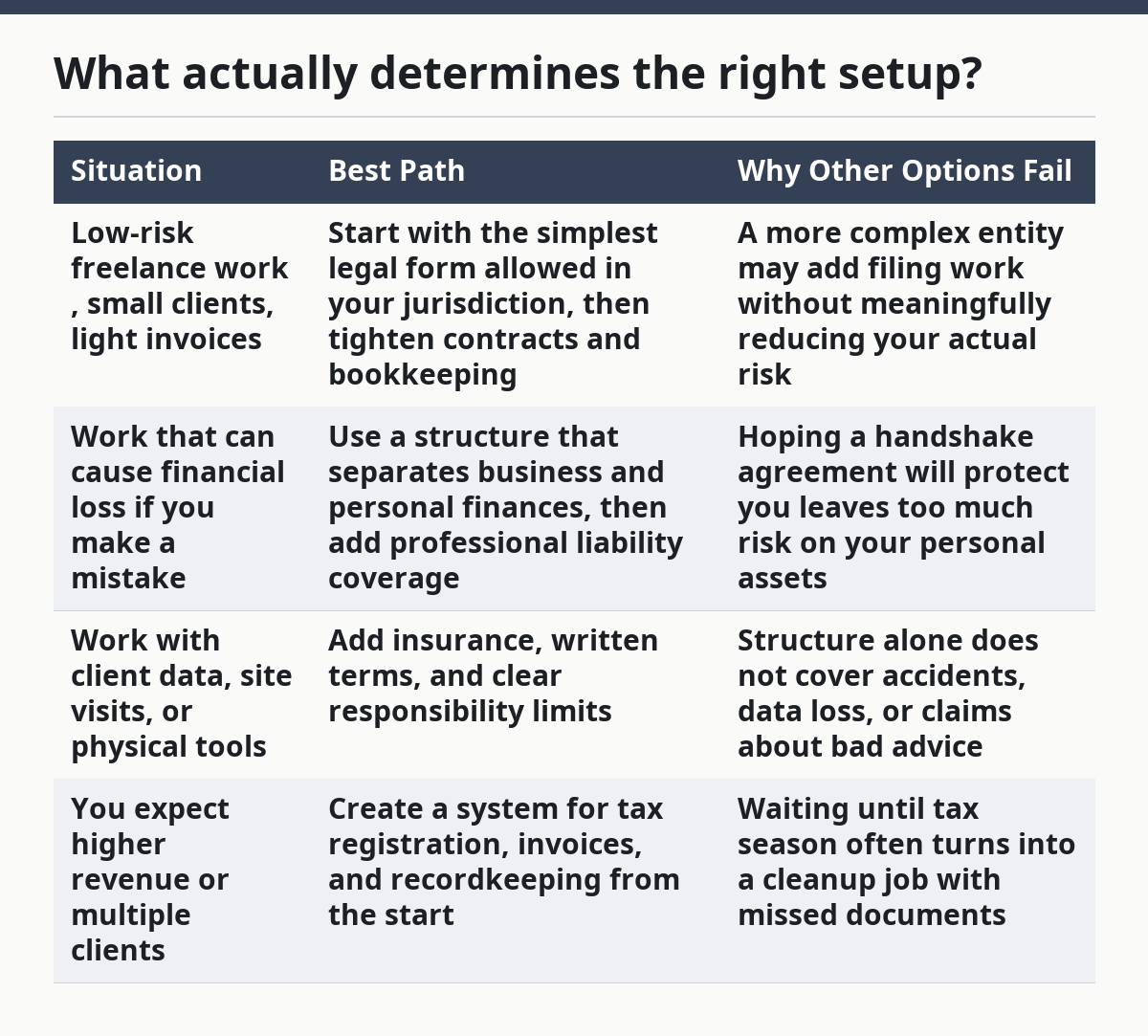
| Situation | Best Path | Why Other Options Fail |
|---|---|---|
| Low-risk freelance work, small clients, light invoices | Start with the simplest legal form allowed in your jurisdiction, then tighten contracts and bookkeeping | A more complex entity may add filing work without meaningfully reducing your actual risk |
| Work that can cause financial loss if you make a mistake | Use a structure that separates business and personal finances, then add professional liability coverage | Hoping a handshake agreement will protect you leaves too much risk on your personal assets |
| Work with client data, site visits, or physical tools | Add insurance, written terms, and clear responsibility limits | Structure alone does not cover accidents, data loss, or claims about bad advice |
| You expect higher revenue or multiple clients | Create a system for tax registration, invoices, and recordkeeping from the start | Waiting until tax season often turns into a cleanup job with missed documents |
Quick check: If you can describe your work in one sentence, you still need to answer one more question: what can go wrong if the client blames you?
Should you stay a sole proprietor or form an entity?
You should stay a sole proprietor if your jurisdiction allows it, your work is low risk, and you want the cheapest, simplest start. You should form an entity if your work carries meaningful liability, if clients demand it, or if you want cleaner separation between business and personal affairs.
This is where many freelancers overcorrect. A company form does not make taxes disappear, and it does not block every claim. But it can help keep the business’s obligations separate from your personal life, which matters if a dispute turns serious. The trade-off is extra paperwork, ongoing filings, and sometimes separate tax returns or annual fees depending on the jurisdiction.
The standard advice is too absolute when it says a small freelancer should always “just incorporate.” That can be expensive and unnecessary. It is also too absolute in the other direction when it says “don’t bother until you are huge.” Some freelancers are exposed on the first client, especially if they handle confidential data, give professional advice, or work on projects where a mistake can trigger a missed deadline or loss of revenue.
- List your contract size, client type, and exposure to claims.
- Ask whether your jurisdiction lets a sole proprietor register a trade name or business name without forming a company.
- Check whether your clients require a specific entity, tax form, or insurance certificate before they will pay you.
- Compare the cost of entity formation and ongoing filings against the amount of risk your work creates.
- Decide whether you need a structure change now or can start simple and revisit after a few months of actual work.
- Keep business money separate from personal money from the first payment onward.
A practical benchmark is this: if you cannot explain why the entity would change your risk, tax, or client access, it may be too early. If you can name a clear reason and a clear cost, the choice becomes much easier. That is also why the choice should be revisited after revenue or risk changes.
Quick check: If your first answer is “I just want to invoice legally,” you may not need a complex entity yet; if your first answer is “I could get sued if something goes wrong,” you probably need more than a basic setup.
What legal documents do freelancers need?

Freelancers need a contract, payment terms, ownership terms, and a dispute clause that fits the job. A simple invoice is not enough once the work involves deadlines, revisions, deliverables, data, or a risk of confusion about who owns what.
A contract does the most useful work when it makes the job visible. If you write, design, code, consult, photograph, or advise, your contract should say what is included, what is extra, when payment is due, who owns the output, and what happens if the client stops responding. A lot of disputes begin because nobody wrote down the revision limit or the approval process.
If you work in a field with intellectual property issues, the ownership section matters a great deal. Some clients assume they own everything the moment they pay. That may be wrong unless the contract says so and the law in your jurisdiction supports it. If you handle confidential data, you also need a confidentiality clause and a practical description of how data is stored, shared, and deleted. For a fuller checklist, see freelance contract basics and confidentiality and IP terms.
A freelancer should not copy a random template and call it done. Templates are useful, but only after they are trimmed to match the work. A 20-page agreement for a simple logo job can create confusion. A 2-page agreement for consulting work with access to sensitive systems may leave too many gaps. The better question is whether the terms match the work and the risk.
The table below shows the most common choices and where each one breaks.
| Situation | Best Path | Why Other Options Fail |
|---|---|---|
| Small, repeatable project with clear scope | Short contract plus invoice terms | A verbal agreement leaves scope and revision disputes wide open |
| Project with milestones and deposits | Contract with payment schedule and acceptance steps | Waiting until final delivery to discuss payment creates cash-flow risk |
| Work involving confidential data | Contract plus confidentiality clause and data handling terms | Generic templates often say nothing about storage, access, or deletion |
| Creative or technical work with ownership questions | Clear IP clause and license language | If ownership is vague, the client may expect rights you never gave |
| Client-facing work with deadlines | Contract with date, revision, and pause clauses | Without pause terms, a stalled client can still blame you for delay |
- Describe the exact service in plain language.
- Set the price, deposit, milestone dates, and final payment trigger.
- State how many revisions are included and what counts as extra work.
- Write the ownership rule for the work product and any source files, notes, or drafts.
- Add a confidentiality clause if you will see private or business-sensitive information.
- Put the dispute process somewhere visible, even if it is just a simple notice period and governing-law clause for your jurisdiction.
Quick check: If your client could read your contract and still misunderstand what gets delivered, the contract is not ready.
How do taxes, registration, and bank accounts fit together?
Taxes, registration, and bank accounts fit together because they turn freelance income into a trackable business instead of a pile of personal deposits. If your jurisdiction requires business registration or a tax number, handle that before or right when you start invoicing. If your rules do not require a separate business bank account, you may still want one to keep records clean. For tax setup, a freelance tax guide can help you organize the order of tasks.
This is the part many freelancers postpone because it feels administrative, and the delay usually creates more work later. The problem is that payment records, invoices, receipts, and tax forms are easier to manage when the money flows through one place. A separate account also makes it easier to prove what is business income and what is personal spending if questions come up later.
The exact tax rules vary by jurisdiction, so the safe move is to check the local revenue authority rather than guess. In the United States, the IRS self-employment guidance is the place to start; in other countries, the tax agency will usually spell out whether you need to register as self-employed, file quarterly estimates, collect VAT or GST, or issue local invoice details. Do not assume that online advice from another country applies to you.
A useful threshold is not a dollar amount but a paperwork trigger. If your work has become regular enough that you are invoicing monthly, paying recurring software subscriptions, and chasing late payments, you need a system. That system should include invoice numbering, receipt storage, a profit-and-loss view, and a habit of setting aside tax money before you spend the rest. Monthly tracking also makes year-end filing easier.
- Find out whether your jurisdiction requires a business registration, tax ID, or trade name filing.
- Open a dedicated business bank account if your bank and local rules allow it.
- Use one invoice format for every client, with dates, services, and payment terms in the same place.
- Keep receipts for software, equipment, insurance, and travel tied to business work.
- Track money by category each month, not once a year.
- Set aside tax money as soon as income lands, instead of waiting for a bill that arrives later.
The wrong move is to mix every payment into a personal account and sort it out at tax time. That makes it harder to prove what the business earned, what you spent, and what should be reserved for taxes. It also makes it harder to spot unpaid invoices and client patterns. A separate account reduces that confusion.
Quick check: If you are already using a personal account for business money, the first repair is better records, not a fancy accounting system.
What insurance and liability protection do freelancers actually need?
Freelancers usually need some mix of professional liability, general liability, cyber coverage, or equipment coverage, depending on the work. The exact names and availability vary by jurisdiction and insurer, but the risk categories stay similar. For a comparison of policy types, see business insurance for freelancers.
The answer is not that every freelancer needs every policy. A writer who works remotely may have different needs from a photographer who carries gear to shoots or a consultant who handles client data. The right question is not “What policy sounds impressive?” It is “What loss would hurt me enough to matter?”
Professional liability is about claims that your work caused a financial loss, mistake, or bad advice. General liability tends to focus on bodily injury or property damage, such as a client tripping over your gear at a site visit. Cyber coverage may matter if you store client files, logins, or personal data. Equipment coverage can matter if your tools are expensive enough that a loss would stop work for a week or more.
A separate entity and an insurance policy do different jobs. One may help separate legal obligations; the other helps pay for specific losses or defense costs. A freelancer who relies on only one of them can still be exposed. A contract with a liability cap can also help, but it is not a substitute for insurance.
- List the worst realistic claim from your work: bad advice, lost file, injury, theft, or data exposure.
- Match that risk to a policy type instead of buying a random bundle.
- Check whether a client contract requires proof of insurance before work starts.
- Confirm whether your policy covers subcontractors, remote work, and work done outside your home.
- Keep policy dates, certificates, and renewal reminders in one place.
- Review coverage after any major change, such as a new service, bigger client, or more equipment.
A plain rule works here: if the job can create a claim larger than the cost of replacing a laptop, insurance deserves a hard look. If the job never puts you near client property, sensitive data, or advice that can cause loss, you may need less than a high-risk freelancer.
Quick check: If your biggest risk is a late invoice, insurance is not the first fix; if your biggest risk is a claim after a mistake or accident, it is.
What do you do if the standard advice breaks down?
The standard advice breaks down when your work crosses borders, includes subcontractors, handles sensitive data, or grows into something that no longer looks like “just freelance.” In those cases, the simple sole-proprietor template can stop fitting the real business.
Here are the common edge cases and what changes in each one:
-
You work for clients in another country.
What changes: tax rules, withholding, invoices, and contract law may shift.
What to do instead: check both your local rules and the client’s country rules before you invoice. A clause about governing law and payment currency may matter more than usual. -
You use subcontractors or assistants.
What changes: you are no longer the only person touching the work.
What to do instead: use written subcontract terms, assignment rules, confidentiality language, and payment timing that matches your own client deadlines. -
You handle personal or sensitive client data.
What changes: privacy and security risk become part of the job.
What to do instead: add data-handling terms, limit access, set retention periods, and check whether your insurance addresses cyber exposure. -
You enter client property or work on-site.
What changes: bodily injury and property damage become real risks.
What to do instead: look harder at general liability, safety rules, and any contract language about access, site conduct, and damage reporting. -
You sell one-off creative work and also recurring advisory work.
What changes: ownership and liability are not the same for both services.
What to do instead: separate the service types in your documents so the intellectual property clause does not conflict with the advice clause. -
Your income grows fast enough that bookkeeping becomes messy.
What changes: cash flow and tax timing start to matter more than setup simplicity.
What to do instead: move to monthly recordkeeping, separate accounts, and a clearer structure before the year-end cleanup becomes a problem.
The trap in edge cases is pretending the old setup still fits because it is familiar. That is how freelancers end up with contracts that say one thing, invoices that say another, and taxes that do not match either. It is also how small issues turn into repeated cleanup work.
Quick check: If any part of your work touches another person’s data, property, or money, you are probably past the “basic template is enough” stage.
How do you build the setup step by step?
You build the setup by choosing the legal form first, then the paperwork, then the contract and insurance layer, then the recordkeeping system. If you try to do it in the opposite order, you often end up rewriting forms after the first client is already waiting.
A clean setup does not have to be complicated, but it does need to be complete. A freelancer who forms an entity but never updates the invoice terms still has a weak setup. A freelancer who has a great contract but no tax registration still has a weak setup. The setup works only when the legal form, money, and paperwork all point in the same direction.
The sequence below works for many freelancers, but local law can change the order. In some places, you need a registration number before you can open a bank account. In others, you can open the account first and register later. That is why checking the local authority matters before signing forms.
- Identify your jurisdiction and the rules that apply to self-employed work, registration, and tax filing.
- Decide whether you are starting as a sole proprietor or forming an entity.
- Register the business name or entity if your jurisdiction requires it.
- Open a separate bank account or at least set up separate accounting from the first payment.
- Put a written contract in place before you start work on any client project.
- Add insurance that matches the actual risks of the work you do.
- Create a monthly routine for invoices, receipts, tax reserves, and renewal dates.
A good benchmark is whether a stranger could inspect your files and see a business instead of a pile of casual payments. If the answer is yes, the setup is doing its job. If the answer is no, the problem is usually not one document; it is the missing link between legal form, money, and paperwork. Freelance bookkeeping basics can help close that gap.
What this article is not for is the freelancer who wants a shortcut around local rules. It also is not for someone seeking a custom legal opinion on a specific dispute, tax situation, or contract fight. Those need local professional guidance.
Quick check: If you cannot say where your registration, bank account, contract, and insurance live in the same sentence, your setup still has a gap.
What should you do first this week?
You should start with your biggest risk, not with the prettiest form or the fanciest business name. If your work is low risk, begin with registration and a contract. If your work is high risk, begin with a structure review and insurance question before you take the next client.
The fastest useful move is to make the invisible parts visible. Write down your services, list the risks, and compare the legal form you have now with the one you actually need. Then check the local business authority, the tax authority, and one trusted insurance source or broker in your jurisdiction. If you are in the United States, the SBA and IRS pages linked above are sensible starting points.
A practical next step is to make one concrete change this week. That could be a better contract, a separate account, a clearer invoice, a proper entity, or the right policy. The point is not to make the business look bigger than it is. The point is to make it less fragile.
One thing to avoid is copying advice from another country and treating it as universal. A setup that works in one jurisdiction may fail in another because tax registration, entity names, and liability rules are local. If a guide says “just form an LLC” or “just register as a sole trader,” that advice is incomplete unless it names the country and the actual legal steps. For a broader checklist, see freelancer legal setup checklist.
Quick check: If you are ready to do one thing today, make it the step that reduces the most risk for the least cost.
Do I need an LLC or can I stay a sole proprietor?
You may be able to stay a sole proprietor if your jurisdiction allows it and your work risk is low. If your work can create meaningful claims, a separate entity may be worth the extra filings, but the answer depends on local law and the type of work you do.
What contract terms matter most for freelancers?
The most important terms are scope, payment timing, revisions, ownership, confidentiality, and what happens if the client pauses the project. Those terms do the most work because they stop scope creep, payment disputes, and ownership confusion before they start.
Is business insurance necessary for every freelancer?
No, not every freelancer needs every policy. The right coverage depends on whether you face advice claims, on-site injury risk, data exposure, or equipment loss, and the answer changes with the kind of client work you do.
Can I use my personal bank account for freelance income?
You often can at the start, but it is a poor long-term setup because it blurs business income, personal spending, and tax records. A separate account makes bookkeeping and proof of income much cleaner, especially once payments become regular.
What is the first thing I should fix if I already started freelancing?
Fix the weakest point first: registration, contracts, banking separation, or insurance. If you already have clients, the biggest risk is usually not the logo or website; it is the missing document or the money trail that is hard to explain later.
Drafted with AI; not yet reviewed by a person.
