

Last updated: November 20, 2026
Underwriting red flags are the most common reason a freelancer insurance application slows down, because the underwriter sees missing facts, mixed-up work descriptions, or a claims history that needs review. If the form does not match the real scope of work, the application often goes back for questions instead of moving to approval. This is information, not financial advice; for your own situation, a qualified adviser should be consulted.
Key takeaways
- Small gaps can trigger a longer review, even when the policy is still possible to issue.
- The biggest delays usually come from a mismatch between the application and the real scope of work.
- Prior claims, policy lapses, and unclear contract terms tend to prompt follow-up questions.
- A clean application is not about being perfect; it is about being consistent across every answer.
- If your work includes higher-risk services, expect the underwriter to ask for more detail, not less.
Who this applies to

This applies to freelancers applying for liability insurance when an underwriter needs to decide whether the risk fits the policy terms. It assumes you already know your business name, your service list, your recent claims history, and whether you have had a policy lapse or a break in coverage. It also assumes you can describe your scope of work in plain language, not just in a contract title.
A freelancer with simple services and one client type may move through review faster than someone with subcontractors, international clients, or high-risk services. A freelancer with a recent claim, a gap in coverage, or a contract that shifts liability in a hard-to-read way should expect extra questions. If the business structure, revenue source, or work location is unclear, the underwriter will usually pause the file rather than guess.
A clean application does not mean “no risk.” It means the facts line up. The underwriter is checking whether the application, claims history, and coverage history tell the same story. A mismatch of even one sentence can trigger a delay because the insurer has to verify whether the policy form fits the work.
What does an underwriter flag first?
An underwriter flags anything that looks incomplete, inconsistent, or outside the normal pattern for the class of business. Missing fields, a vague service description, and a scope of work that does not match the contract are usually the first problems to slow approval. A form with 2 blank answers is often more troublesome than one with a riskier but fully explained business model.
The biggest red flag is usually not the word “freelancer” itself. It is the gap between what the form says and what the client contract says. If the application says “consulting,” but the contract includes implementation, code changes, or published content, the underwriter may need to sort out whether the exposure is professional liability, general liability, or another form of cover.
Claims history is another fast trigger. A past claim is not the same thing as a decline, but it almost always leads to follow-up. The same is true for a policy lapse or a period with no coverage history. Underwriters often want to know whether the gap was a paperwork issue, a business break, or a risk change.
For background on how insurers use information to assess risk, the NAIC explains underwriting as part of the insurance decision process.
Which application details cause delays?

The details that delay approval are the ones that force a human reader to stop and ask, “What exactly does this freelancer do?” Missing information, vague dates, and mismatched answers are the usual culprits. A form that leaves 3 key questions unanswered can sit in review even if the business itself is straightforward.
Start with the business description. If the scope of work is written so broadly that it could fit 10 different jobs, the underwriter may ask for a narrower explanation. “Marketing services” is not the same as “paid social ads, email campaigns, and landing page edits,” because each one creates a different risk profile. The clearer the scope, the less room there is for delay.
Then check the claims history section. If the form asks about prior claims and the answer is “none,” but another document shows a past dispute or payment demand, the file usually gets parked. A lapse in coverage can create the same problem. Even a short gap may need an explanation if the insurer is trying to understand whether there was a break in work or a missed renewal.
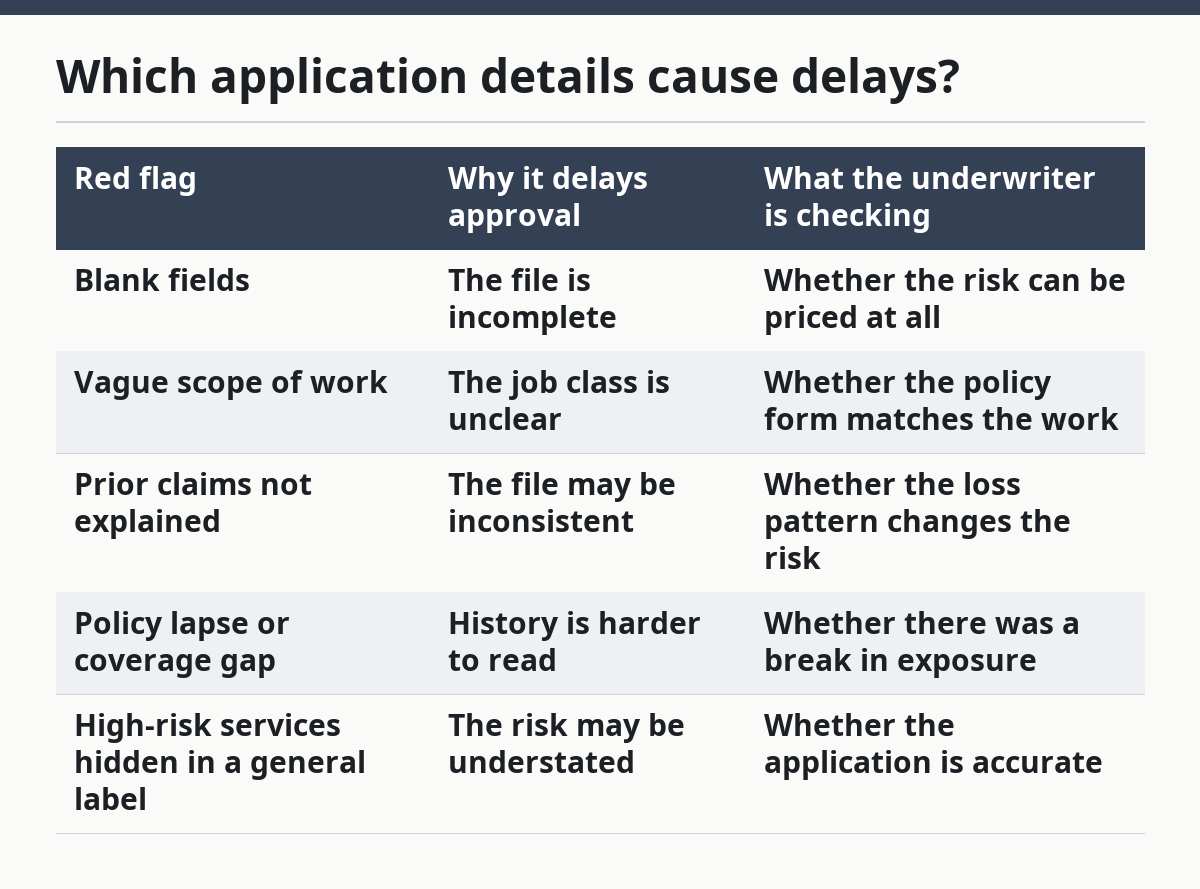
The table below shows the most common red flags and why they slow the file.
| Red flag | Why it delays approval | What the underwriter is checking |
|---|---|---|
| Blank fields | The file is incomplete | Whether the risk can be priced at all |
| Vague scope of work | The job class is unclear | Whether the policy form matches the work |
| Prior claims not explained | The file may be inconsistent | Whether the loss pattern changes the risk |
| Policy lapse or coverage gap | History is harder to read | Whether there was a break in exposure |
| High-risk services hidden in a general label | The risk may be understated | Whether the application is accurate |
How do I fix underwriting red flags before I submit?
You fix underwriting red flags by making every answer match the same facts in the same terms. A careful 10-minute review before submission often prevents a 10-day follow-up cycle. The goal is not to overshare; it is to remove the contradictions that make an underwriter stop.
- Write the scope of work in one sentence. State the actual service, the client type, and the deliverable in 20 to 25 words. Verify that this sentence matches your website, invoice language, and contract. A problem shows up when one document says “consulting” and another says “production work.”
- List every service line that creates exposure. Separate core services from add-ons, subcontracted work, and any high-risk services. Use 3 buckets if needed: primary, occasional, and excluded. A problem appears when the application hides a service that the contract includes.
- Review claims history line by line. Check the date, type, and status of every prior claim, even if it was denied or settled. Verify that the application and any supporting documents use the same terminology. A problem appears when the loss story changes between forms.
- Explain any policy lapse plainly. State whether the lapse was a billing issue, a pause in business, or a change in carrier. If there was no coverage for a period, note the length of the gap in plain words. A problem appears when the gap is left unexplained.
- Match contract language to the application. Look for indemnity clauses, hold harmless wording, warranty promises, and deadline penalties. Mark anything that shifts responsibility beyond your service. A problem appears when the contract creates duties that the application never mentions.
- Check dates, names, and addresses for consistency. Use the same legal name and business name everywhere, and confirm that dates line up across the form and attachments. A problem appears when one document uses a trading name and another uses a legal entity name with no explanation.
- Flag higher-risk work before the underwriter does. If you handle regulated data, publish content for clients, or perform work with physical or financial exposure, say so directly. Verify that you have not mixed ordinary admin work with specialized services. A problem appears when the risk is described too lightly for the work involved.
The process is less about perfection than about consistency. If the underwriter can read the application and the supporting documents without a 2-page follow-up note, approval usually moves faster.
What contract terms slow things down?
Contract terms slow things down when they move responsibility in ways the insurer needs to review. The underwriter is not just looking at what you do; the underwriter is looking at what you have agreed to take on. A 1-page contract can still create a delay if it includes unusual indemnity language or a broad hold harmless promise.
A common problem is scope creep hidden inside the contract. If the agreement starts with one service and ends with extra duties, the application may understate the actual exposure. Another problem is a contract that promises results, deadlines, or compliance outcomes that go beyond the service itself. Those promises can change how the risk is viewed.
High-risk services need especially careful wording. A freelancer who works across several client types may be fine, but the application should show the differences. If the form treats all work as one general bucket, the underwriter may ask for clarification before deciding whether the policy terms fit. The same is true for subcontracting: if another person does part of the work, that can change the risk even when the freelancer remains the main contact.
The issue is not that contracts are bad. The issue is that contracts create the record the insurer uses to verify the application. If the contract and application disagree, the underwriter usually chooses review over speed.
When should you expect a delay?
You should expect a delay when the application raises a question that cannot be answered from the form alone. A delay is not always a rejection; it is often a request for more detail. Still, some situations almost always trigger a slower path through underwriting.
There is a prior claim on the record: That means the underwriter may need dates, outcomes, and loss details before moving ahead — be ready to explain the claim in plain terms, with the same wording across all documents.
The application shows a policy lapse: That suggests a possible gap in coverage history — be prepared to explain whether the break was intentional, administrative, or tied to a pause in work.
The scope of work is broad or vague: That makes the risk hard to classify — narrow the description to the actual deliverable and the client type before resubmitting.
The contract adds unusual obligations: That can change the exposure beyond the basic service — highlight indemnity, hold harmless, warranty, or deadline language for review.
The business includes higher-risk services: That often means more questions, not automatic denial — identify those services clearly so the underwriter can place them correctly.
The application and website do not match: That creates a credibility problem — align the wording before the file is reviewed again.
If any of these issues involve a large contract, a long coverage gap, or a complicated claims history, a qualified adviser can help interpret the documents for your own situation.
What mistakes make delays worse?
The mistakes that make delays worse are the ones that create a second round of review. A small error can become a long delay if the insurer has to re-check the file after already spotting a problem. The usual pattern is simple: one vague answer leads to one follow-up question, and that question exposes 2 more mismatches.
The first mistake is writing the scope of work in marketing language. That sounds polished, but it does not help the underwriter classify the risk. The better choice is concrete language that names the service, the client type, and the deliverable.
The second mistake is omitting a claim because it feels minor. The insurer may still see the record elsewhere, and the mismatch can slow the file more than the claim itself. The better choice is to state the claim plainly and keep the explanation short.
The third mistake is ignoring a policy lapse because it was short. Even a brief gap can matter if the insurer is trying to understand coverage history. The better choice is to say what happened and whether the business kept operating.
The fourth mistake is letting the contract and application tell different stories. If the contract includes duties that the form leaves out, the underwriter has to reconcile them. The better choice is to compare the 2 documents before submission.
The fifth mistake is assuming that “freelancer” means low risk. The role can still include client money, regulated data, subcontractors, or public-facing work. The better choice is to describe the real work, not the simplest version of it.
What if your work is unusual?
Unusual work needs more detail because standard labels may not fit. If your freelancing includes international clients, regulated data, subcontractors, or mixed services, the standard application fields can miss the part that matters most. The fix is not to force the work into a simple box; it is to explain the edge case clearly.
If you do both creative and technical work, separate them. A 2-part description is easier for the underwriter to read than one broad title. If you have a mix of client types, name the main one and the secondary one, then show which service belongs to each. That helps the insurer see where the real exposure sits.
If you had a prior claim but the claim was tied to a different service line, say so directly. A claim from 18 months ago in one line of work may not mean the same thing for another line of work, but the file needs that explanation. The same rule applies to a policy lapse: if the gap happened during a period with no active contracts, that context matters.
For more on how to prepare the file before you submit it, see the hub on freelancer insurance application and quote readiness rather than trying to fix the whole application after the underwriter has already asked for more.
What causes an insurance application to be delayed?
An insurance application is usually delayed when the underwriter has to stop and verify missing or inconsistent information. The most common causes are blank fields, a vague scope of work, prior claims that are not explained, and a policy lapse that needs context. A delay does not always mean rejection; it often means the file needs clearer facts.
Can a freelancer be declined for coverage?
Yes, a freelancer can be declined for coverage if the risk does not fit the insurer’s rules or the information provided is not enough for underwriting. A decline is more likely when the application leaves out key facts, the claims history raises concern, or the work includes services the insurer does not want to cover. A qualified adviser can help interpret the reason.
How can I avoid underwriting delays?
You can avoid underwriting delays by making the application, contract, and coverage history say the same thing. Use plain language for the scope of work, list prior claims honestly, explain any lapse in coverage, and flag higher-risk services before submission. A final 5-minute comparison across documents can prevent a much longer review.
Drafted with AI; not yet reviewed by a person.
