
Last updated: November 20, 2026
Quick Answer: In 1 to 2 sentences, name the side business, say what it does, and note whether it overlaps with your freelance work. That is the core of How to Explain a Side Business on a Freelance Insurance Application, because the underwriter needs a clear picture of your risk, not a polished sales pitch. This is information only, not financial advice; your own situation may need a qualified adviser. For general recordkeeping guidance, see the IRS on self-employed recordkeeping.
Key takeaways
- List the side business as a real activity, not as a vague hobby or a vague “other income” line.
- Match the description to the work you actually do, especially if it touches the same clients, tools, or services as your freelance business.
- Be ready to explain moonlighting, outside employment, and any employer policy that limits side work.
- If the side business changes your revenue split, your work location, or your service mix, say so in plain language.
- When the application asks about business activity, a direct answer is usually the safest choice, but the wording should still match the facts.
What should I say about a side business?

Therefore, you should say exactly what the side business does, how often you do it, and whether it is separate from your freelance business. A clean description gives the underwriter the basic facts in one sentence, such as “I do freelance graphic design and also sell handmade prints through a separate online shop.” The point is clarity, not a long backstory.
Treat the application like a risk form, not a bio, and if the wording is unclear, a qualified adviser can help you check it against the form and your records. If the side business uses different tools, serves different clients, or produces different income, those facts matter because they help the insurer judge the full business picture. If the side business and freelance work overlap, that overlap should be stated, not hidden.
A useful test is this: if a stranger read your answer in 10 seconds, would they understand that there are 2 activities, not 1? If not, the description is too thin. If your side business is tied to your employer or includes outside employment, that link also belongs in the answer.
How do I fill it out step by step?
Because the underwriter reads for risk first, you should answer the application in the same order: activity, ownership, income, overlap, and outside work. That usually means writing a short description first and then checking each line for anything that could change how the insurer sees the business. For related guidance, see the hub on freelancer insurance application and quote readiness.
- Name both activities. Write the freelance business and the side business separately in 1 to 2 sentences. Verify that each name matches what you use on invoices, listings, or tax forms. If the names blur together, the application may look incomplete.
- State the main work for each one. Say what you sell, make, or do, using concrete terms. Verify that the description fits the real service, not the broad category. If the side business looks like a hobby in your wording but produces income, that is a problem.
- Show the relationship between them. Explain whether the side business is completely separate, partly related, or tied to the same clients. Verify whether there is service overlap, because overlap can change the underwriter’s view of exposure. If you leave this out, the application can read as incomplete.
- Note outside employment or moonlighting. If you also work for an employer, say so if the form asks about it. Verify whether your employer moonlighting policy limits side work, client type, or hours. If the policy conflicts with the application, that is a red flag.
- Separate the money streams. State whether revenue is split across the freelance business and the side business, and whether one is occasional. Verify that your answer matches your records for invoices, deposits, or bookkeeping categories. If the split is unclear, the insurer may ask for more detail.
- Describe where the work happens. Say whether the work is done at home, on client sites, online, or somewhere else. Verify the setting because location can affect how the underwriter thinks about property, liability, and contact with the public. If the location changes often, say that plainly.
- Check for shared risks. Look for shared tools, shared branding, or the same client base across both businesses. Verify whether the same mistake in one line of work could affect both lines. If the risk looks joined, do not present it as separate just to keep the form short.
- Answer every question directly. Fill in each field instead of using “see attached” unless the form allows it. Verify that the final version contains no blank spots, no guesswork, and no statements that conflict. A gap in the form is often a gap in the quote process.
If the application has room for a short note, use it for the facts that matter most: 2 business activities, any outside employment, and whether the side business overlaps with the freelance business. The best answer is usually plain and brief, but it should still reflect the full situation.
Why does the underwriter care?

Therefore, the underwriter cares because a side business can change the risk profile of the application. “Underwriter” means the person or system that reviews the application and decides how the insurer views the risk, based on the facts you provide.
A side business can affect more than income. It can change the type of clients you see, the tools you use, the places you work, and the chance that one claim could involve both businesses. That is why a 2-line side business description can matter more than a long personal explanation.
This is also where service overlap matters. If your freelance business is copywriting and your side business is social media management, the underwriter may see close overlap even if you think of them as separate. If your freelance business is bookkeeping and your side business is selling crafts, the risks may look more distinct. The application should help the underwriter sort those differences out.
For a broader checklist on preparing your application, the hub on freelancer insurance application and quote readiness is the right place to start. This page stays with one question: how to explain the side business itself.
What if I also have a job?
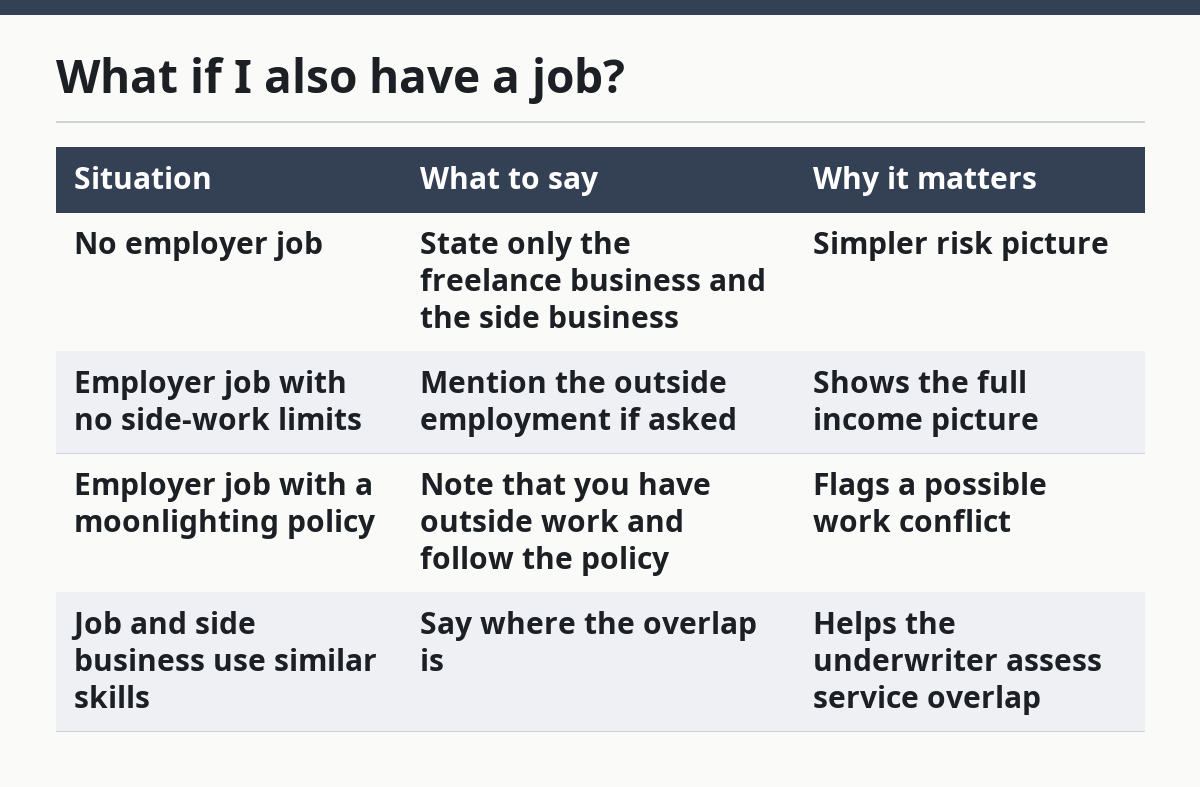
However, you should mention a job if the application asks about outside employment or moonlighting. “Moonlighting” means paid work done outside your main job, usually after hours or on weekends, and employers sometimes set rules about it.
The key issue is not only whether the job exists, but whether the job changes your business story. If your employer restricts outside work, or if the side business uses the same skills, clients, or hours as the job, the underwriter may want that spelled out. A short, honest note is better than making the work sound invisible.
| Situation | What to say | Why it matters |
|---|---|---|
| No employer job | State only the freelance business and the side business | Simpler risk picture |
| Employer job with no side-work limits | Mention the outside employment if asked | Shows the full income picture |
| Employer job with a moonlighting policy | Note that you have outside work and follow the policy | Flags a possible work conflict |
| Job and side business use similar skills | Say where the overlap is | Helps the underwriter assess service overlap |
If the application asks about employer moonlighting policy, answer the question asked and do not guess at legal meaning. If the policy is unclear, that is a sign to pause and get the wording checked before you submit anything. A form that conflicts with a workplace rule can create trouble later.
What mistakes cause the most trouble?
Therefore, the most common mistake is calling a real business a hobby. That can make the application look cleaner, but it can also make the risk picture wrong. If the side business brings in money, has clients, or has a regular service pattern, describe it as business activity, not a pastime.
Another mistake is hiding overlap between the freelance business and the side business. If both lines use the same software, the same public website, or the same clients, the overlap may matter to the underwriter. Leaving it out can lead to follow-up questions, delays, or a quote that does not fit the work. For recordkeeping basics, the SBA’s recordkeeping guidance is a useful reference.
A third mistake is giving one vague label for two different activities. “Consulting” could mean anything from strategy calls to bookkeeping to coaching. If the application only gives room for one label, add a short clarifying phrase that explains the actual service in 1 line.
A fourth mistake is guessing about revenue split. If 80% of your income comes from one activity and 20% from the other, say so only if that is truly how your records read. If you do not know the split, say that it varies and use the clearest current picture you have.
A fifth mistake is answering fast and changing the story later. Underwriters notice when the application, email thread, and invoice trail do not match. The correct alternative is to slow down, use the same business names everywhere, and keep the description consistent across the form.
When should you stop and get help?
However, you should stop and get qualified help when the side business changes the application enough that a simple description no longer fits. This is not about being dramatic; it is about avoiding a mismatch between the form and the real work.
The side business uses a different brand or legal setup: That can change how the business should be described — get help if you are unsure which entity the application is asking about.
The work crosses into a regulated or higher-risk area: That changes the risk profile — do not guess at wording if the service touches health, law, finance, or another tightly controlled field.
The freelance work and side business share the same clients: That creates service overlap — explain the connection clearly, or ask a qualified adviser how to frame it.
Your employer has a strict moonlighting policy: That can affect what you are able to disclose — check the policy before you submit anything.
The application asks for a revenue split and you cannot separate the income cleanly: That means the records are not clear enough yet — sort the bookkeeping first, then answer.
The side business has recently changed in the last 30 to 60 days: New services, new locations, or new clients can make an old description inaccurate — update the story before the quote goes out.
When any of those situations show up, the main risk is not the side business itself. The risk is giving a clean-looking answer that does not match the real work. A qualified adviser can help you decide how to describe the activity in a way that fits the application and your broader coverage needs. See also the SBA’s choose your business structure guidance if the legal setup is part of the issue.
What does a good answer look like?
Ultimately, a good answer is short, specific, and easy to verify. It names the side business, says how it relates to the freelance business, and mentions any outside employment or moonlighting issue if the form asks for it. It does not try to impress the underwriter with extra detail.
A good answer also makes the revenue split and service overlap visible. If the side business is small, say that plainly without pretending it is irrelevant. If it is larger than the freelance business, say that too. The underwriter does not need a speech; it needs a clean map of the work.
For most readers, the right length is 2 to 4 sentences, not a full page. If your answer needs 8 sentences, the form is probably telling you that the business setup is more complex than the box allows. That is the point where a short note, an attached explanation, or a qualified review can be the better path.
Can I keep it simple and still be accurate?
Yes, you can keep it simple if the simple version still shows the full picture. A one-paragraph answer can be enough when the side business is separate, the work is easy to describe, and there is no awkward overlap with the freelance business.
Simplicity stops being enough when the application asks about a specific work type, employer moonlighting policy, or outside employment. It also stops being enough when the side business changes the main source of income or shares clients with the freelance business. In those cases, “simple” can become “too thin.”
A useful rule is this: if the underwriter would need a second question to understand the side business, add the second fact now. That might be the business model, the revenue split, or the relationship to your main freelance work. Clear once is better than clarified later.
Do I need to disclose another business?
Therefore, yes, if the application asks about all business activity or outside employment, you should disclose it in plain language. A side business is not invisible just because it is smaller than your freelance business. If it earns money, has clients, or uses business resources, it belongs in the application.
Can a side business affect my freelance policy?
Yes, because the side business can change how the insurer sees the risk tied to your freelance business. Overlap in services, clients, tools, or work locations can matter, even when the businesses feel separate to you. If the side business is new or different, the insurer may ask follow-up questions.
What if my freelance work is only part-time?
Finally, part-time freelance work can still count as a real business activity, and a side business can still matter beside it. The number of hours is less important than the type of work, the income source, and whether there is overlap with other employment. If the application asks about total business activity, answer for the full picture, not just the hours.
Drafted with AI; not yet reviewed by a person.
