

Last updated: November 25, 2026
Quick Answer: 7 clauses usually trigger negotiation. A client insurance requirement needs negotiation when it asks for coverage, wording, or proof that does not fit the work you are actually doing. This page covers How to Spot a Client Insurance Requirement That Needs Negotiation Before You Sign in a contract. The usual red flags are extra endorsements, a scope that is broader than the engagement, or an MSA that shifts risk in a way your policy cannot match. This is information, not financial advice; for your own situation, a qualified adviser should review the contract and your coverage.
Key takeaways
- A clause can look normal and still be a bad fit if it asks for the wrong policy, the wrong entity, or the wrong wording.
- The biggest warning signs are extra insured status, waiver of subrogation demands, and coverage that outgrows the work in the SOW.
- A certificate of insurance proves something exists, but it does not fix a contract that asks for endorsements you do not have.
- If the contract uses insurance to push liability beyond the project, consult a qualified professional about the risk-allocation issue rather than treating it as paperwork. See the U.S. Small Business Administration’s insurance guidance and IRMI’s insurance glossary for background.
Who this applies to
This applies to a freelancer, contractor, or small studio that already has at least one policy and has received a client MSA, SOW, or vendor packet with insurance language. It assumes you can read the headings in the contract, find the insurance section, and tell the difference between a certificate of insurance and an endorsement, which is the policy add-on that changes terms.
This is not for someone trying to decide what policy to buy from scratch, or for a contract with a large indemnity clause that makes the insurance wording impossible to assess in isolation. If the language ties insurance to broad legal duties, or if the client wants policy changes your insurer must approve, that is a point for qualified help, not guesswork. A clean review starts with the actual wording, not with a generic checklist from a blog.
The first question is simple: does the requirement match the work in the SOW? If the project is a 3-month design job and the clause reads like a 5-year construction contract, the mismatch is the signal. That is where negotiation starts.
What counts as a real red flag?
A real red flag is language that asks for coverage you are unlikely to carry, proof you cannot produce, or risk transfer that goes past the job. A certificate of insurance can usually show policy type and limits, but it does not create additional insured status, remove exclusions, or rewrite a policy’s terms. If the contract treats the COI like a promise of coverage, that is a warning; a qualified adviser can confirm what the policy actually does.
The biggest clues are specific phrases. “Additional insured” means the client wants its own name added to your policy so it gets certain protection under your insurer’s terms. A “waiver of subrogation” means the insurer gives up the right to seek repayment from another party after paying a claim. Those are common in some settings, but they are not harmless filler. See the IRMI definition pages for additional insured and waiver of subrogation.
A client insurance requirement is more likely to need negotiation when it asks for one or more of these in the same 1-page section: extra insured status, primary and noncontributory wording, a waiver of subrogation, and broad indemnity language. That mix can turn a simple service contract into a risk-shift document. If the MSA says one thing and the SOW says another, the conflict itself is a clue that the clause was copied from a different industry.
| Clause language | Usually routine | More likely to need negotiation |
|---|---|---|
| Proof of coverage | COI naming the policy type | COI plus wording that the COI itself is enough |
| Who is protected | Client as contract party | Client, its affiliates, officers, landlords, and unrelated third parties |
| Policy changes | None | Additional insured, waiver of subrogation, primary wording |
| Scope tie-in | Matches the SOW | Broader than the actual services |
| Risk transfer | Limited to the project | Covers claims far outside the project |
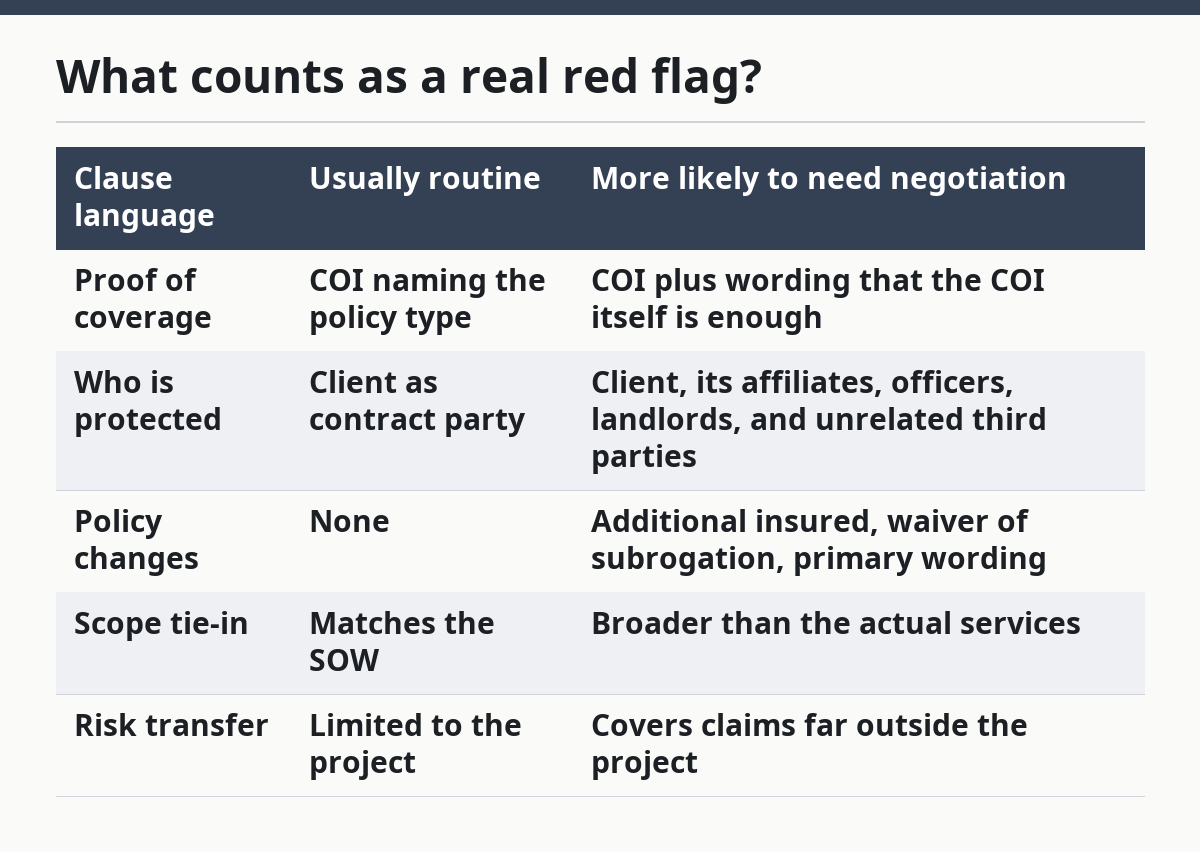
The comparison matters because many people focus only on whether a policy exists. The real issue is whether the clause matches the policy in force and the work described in the SOW.
How do I spot a mismatch in the MSA or SOW?
You spot a mismatch by reading the insurance clause against the services description line by line, then checking whether the clause reaches beyond that scope. Start with the MSA, because that usually holds the boilerplate, then check the SOW for project-specific changes. If the MSA asks for broader insurance than the SOW describes, the mismatch is often the entire problem.
Use this process in order:
- Mark the exact insurance sentence. Copy the clause into a note and circle every policy name, endorsement, and deadline. Verify whether the client asks for a COI, an endorsement, or both. A problem shows up if the clause says “proof of insurance” but later demands policy changes not shown on the COI.
- Match the clause to the work. Compare the insurance text with the SOW description of services, deliverables, and locations. Verify whether the project is office-based, on-site, digital, or public-facing. A problem shows up if the clause assumes site work, vehicle use, or physical damage when the SOW does not.
- Check for extra parties. Look for “additional insured,” “affiliates,” “successors,” “landlords,” or “any other party required by contract.” Verify who actually needs protection under the deal. A problem shows up if the list is open-ended or far wider than the named client.
- Look for endorsement demands. Identify whether the client wants a waiver of subrogation, primary and noncontributory wording, or a specific form number. Verify whether those endorsements exist on your current policy. A problem shows up if the clause names a form or endorsement your insurer has never issued on your line of coverage.
- Check the timing. Read any deadline for sending the COI or updated endorsement, such as “prior to commencement” or “within 10 days.” Verify whether that timeline fits how fast your insurer can issue documents. A problem shows up if the contract requires paperwork before the policy change can realistically be processed.
- Find the limit trap. Notice whether the clause names fixed limits or says “no less than” a certain amount. Verify whether those limits are tied to the risk in the SOW or are simply copied from a larger vendor form. A problem shows up if the limit language is higher than the project risk and has no reason in the contract.
- Check the order of clauses. See whether the insurance section conflicts with indemnity, limitation of liability, or warranty language elsewhere in the MSA. Verify which section controls if the documents disagree. A problem shows up if the contract tries to make insurance cover obligations that the liability cap elsewhere appears to limit.
This is also where a clause can look routine and still deserve a closer look. A simple request for a COI may be fine, while the same section plus a broad additional insured requirement may change the deal. The wording, not the label, is what matters.
Which wording usually needs a second look?
Wording usually needs a second look when it uses broad labels that hide a bigger promise. “As required by client policy” can sound ordinary, but it can also mean the client wants whatever its own insurer would ask for, even if that has nothing to do with your work. That is not a stable target for a freelancer.

The phrase “including but not limited to” is another warning sign when it appears before insured parties, covered claims, or required endorsements. It can turn a narrow clause into an open-ended one. If you cannot tell where the list ends after one reading, the client may not have a precise insurance requirement either.
Watch for terms that blend insurance and liability in the same sentence. If the clause says you must name the client as additional insured for “all claims arising out of or relating to” the project, the phrase may be broader than the actual fault standard in your contract. That is a risk-allocation issue, not just an insurance issue.
Two authoritative references help here: the U.S. Small Business Administration explains the general role of insurance in business risk management, and the International Risk Management Institute is a standard reference for insurance wording and endorsements. Those sources do not decide your contract, but they help anchor the terms in real policy language. For additional insured wording, the language used by insurers and standards bodies matters more than the client’s shorthand.
A practical sign of trouble is when the insurance text requires a change but never says which policy should carry it. If the clause wants a waiver of subrogation but does not say whether that applies to general liability, professional liability, or another line, the demand is underspecified. Ambiguity at this stage usually becomes delay later.
When should I stop and get qualified help?
You should stop when the clause is asking for policy changes, risk shifts, or legal promises that you cannot verify against the actual policy forms. That is the point where a contract question becomes a coverage question, and coverage questions can have consequences that are hard to unwind after signature.

The clause requires additional insured status: this changes who gets protection under the policy and on what terms — ask the insurer or a qualified adviser to confirm whether the endorsement exists and what it covers.
The contract demands a waiver of subrogation: this can affect what the insurer may recover after paying a claim — confirm the policy line and the endorsement before agreeing.
The MSA and SOW conflict: one document may require more coverage than the other describes — pause and ask which text controls the insurance obligation.
The clause names limits you do not carry: the requirement may exceed the policy you actually hold — verify the number against the real declarations page, not a memory of prior work.
The client wants to be named with affiliates or landlords: the request may go beyond the contracting party — ask for a narrower name if the broader list has no clear project link.
The deadline is before your insurer can issue changes: the timing may make compliance impossible — do not promise documents you cannot get on that schedule.
The clause ties insurance to indemnity that seems uncapped: insurance may be asked to support a liability promise the policy was not built to cover — get the wording reviewed before you sign.
If any of those situations appears, a cautious next step is to slow the signature process and get the wording checked by someone qualified to read both the contract and the policy. That is usually faster than fixing a bad clause after the deal is signed.
What mistakes cause the most trouble?
The biggest mistake is treating the certificate of insurance as if it solves every requirement. A COI is evidence that a policy exists on a date; it is not proof that every endorsement has been issued or that every contract term is satisfied. The consequence is simple: you can sign and still be out of compliance.
A second mistake is ignoring the SOW because the insurance section looks boilerplate. That can leave you agreeing to a clause built for on-site work, product delivery, or physical damage when the project is advisory or digital. The fix is to read the insurance language against the actual service description, not against habit.
A third mistake is assuming “additional insured” always means the same thing across policies. The wording can differ by line of coverage and by endorsement form. If you skip the form number and only read the headline, you may miss a restriction that matters.
A fourth mistake is missing the risk-allocation link between insurance and indemnity. If the contract makes you responsible for claims that are not caused by you, the insurance clause may be doing more than covering risk; it may be moving it. That can change the economics of the job.
A fifth mistake is letting vague timing language pass, such as “upon request” or “prior to commencement,” without checking whether the insurer can issue the needed paper in time. The consequence is delay, rework, or a dispute before the project even starts. A specific deadline and a specific policy form should line up before signature.
What if the clause looks standard but still feels off?
A clause can look standard and still be wrong for the project because standard language is not the same as suitable language. In many contracts, the issue is not that a term is unusual on its face; it is that the term is common in a different line of work. A 2-page vendor form for a site contractor may be a poor fit for a 1-page consulting SOW.
The standard approach also needs modification when the client wants insurance tied to a subcontractor chain. If the clause pushes your obligations down the chain, the wording may need to be tighter because you cannot control every downstream party the same way you control your own policy. That is especially true when the contract uses broad words like “agents,” “representatives,” or “any party acting on behalf of contractor.”
It also needs modification when the MSA has one insurance clause and the SOW has another. In that case, the question is not which one is longer; it is which one actually governs the current project. A conflict like that should not be waved away as standard boilerplate, because the whole point of the insurance review is to find the sentence that changes the risk.
For readers who want the broader framework, the hub article on freelance client contract insurance requirements sits above this page and shows how the pieces fit together. This page is narrower: it helps identify the clauses that need a closer look before signature.
Which client insurance requirements are negotiable?
Client insurance requirements are negotiable when they ask for wording, parties, or endorsements that do not match the job. A request for additional insured status, a waiver of subrogation, or a higher limit than the SOW supports is often a negotiation point, not a fixed rule. The contract language and the policy form both matter.
How do I know if a contract insurance term is unusual?
A contract insurance term is unusual when it asks for more than proof of coverage and moves into policy design. Look for broad named parties, special endorsements, or language that seems copied from another industry’s MSA. If the sentence is hard to map to the actual work in the SOW, that is a sign it needs a second look.
What should I flag before agreeing to client insurance terms?
Flag anything that asks for additional insured status, waiver of subrogation, primary wording, or limits that do not fit the project. Also flag conflicts between the MSA and the SOW, short deadlines for insurance paperwork, and any clause that turns a simple certificate of insurance into a promise about endorsements. Those are the places where the contract can move faster than the policy can follow.
Drafted with AI; not yet reviewed by a person.
