
Last updated: November 21, 2026
Quick Answer: In a freelance subcontractor agreement, review 3 things first: who must insure the work, what proof is required, and what happens if coverage is late or missing. This guide is for a freelancer who has already drafted or received an agreement and wants to check the insurance duties before signing. It is information, not financial advice; a qualified adviser should be consulted for your own situation.
Key takeaways
- Read the insurance section as a risk-transfer map, not as boilerplate.
- Check who must carry a general liability policy, a professional liability policy, or both.
- Look for proof rules: certificate of insurance, notice timing, and any named coverage terms.
- Watch for flow-down clauses that copy the main client’s demands into the subcontract.
- If the terms are impossible to meet, stop and fix the wording before work starts.
- The wrong clause can shift a claim, a delay, or a cost onto the subcontractor.
Who should review the agreement?
This review is for a freelancer who is hiring a subcontractor or being asked to sign as one, and who already has the full agreement in hand. It assumes the reader can spot basic contract parts such as the parties, scope of work, fee terms, and signatures, but may not know how insurance language changes the risk. If the deal involves a large project, a high-risk site, or insurance terms that refer to an unfamiliar statute, insurer endorsement, or indemnity cap, a qualified legal or insurance professional should review it before signing.
The key point is simple: the insurance section is not just paperwork. It tells you who must carry coverage, who must prove it, and who pays if a claim appears after the job is done. A clause that looks ordinary can still push a claim onto the wrong side of the relationship. That is why the review should happen before work begins, not after the first invoice.
For a broader contract context, the hub on freelancer insurance and client contracts is the right companion page.
What should the insurance section say?
The insurance section should say what coverage exists, what limits or conditions apply, and how proof gets delivered. In plain terms, it should answer: who insures the work, who names whom, and who gets notified if the insurance lapses. That may sound routine, but the wording decides whether the clause is workable or vague.
The most common policies named in this kind of agreement are a general liability policy and a professional liability policy. General liability usually addresses bodily injury or property damage claims tied to the worksite or physical operations. Professional liability usually addresses claims tied to advice, design, errors, omissions, or other service mistakes. A subcontractor agreement may require one, the other, or both, depending on the work.
A useful way to review the clause is to compare the moving parts side by side:
| Clause item | What it does | What to verify | What looks off |
|---|---|---|---|
| General liability policy | Covers common third-party injury or property claims | The agreement names it clearly and ties it to the work | It is required even when the work is purely advisory |
| Professional liability policy | Covers service errors or omissions | The clause matches the actual service, not a different trade | The term is used loosely with no clear scope |
| Certificate of insurance | Shows current coverage details | The agreement says who gets it and when | It asks for proof but gives no delivery method |
| Additional insured request | Extends certain rights to another party, if the policy allows it | The wording matches the project need and the insurer’s rules | It is demanded without saying why or on which policy |
| Indemnity | Shifts a loss from one party to another | The insurance duty and the indemnity duty do not contradict each other | The subcontractor must indemnify for everything, even outside its work |
| Flow-down clause | Copies terms from the main client into the subcontract | Only the needed terms flow down | It imports every upstream duty without limits |
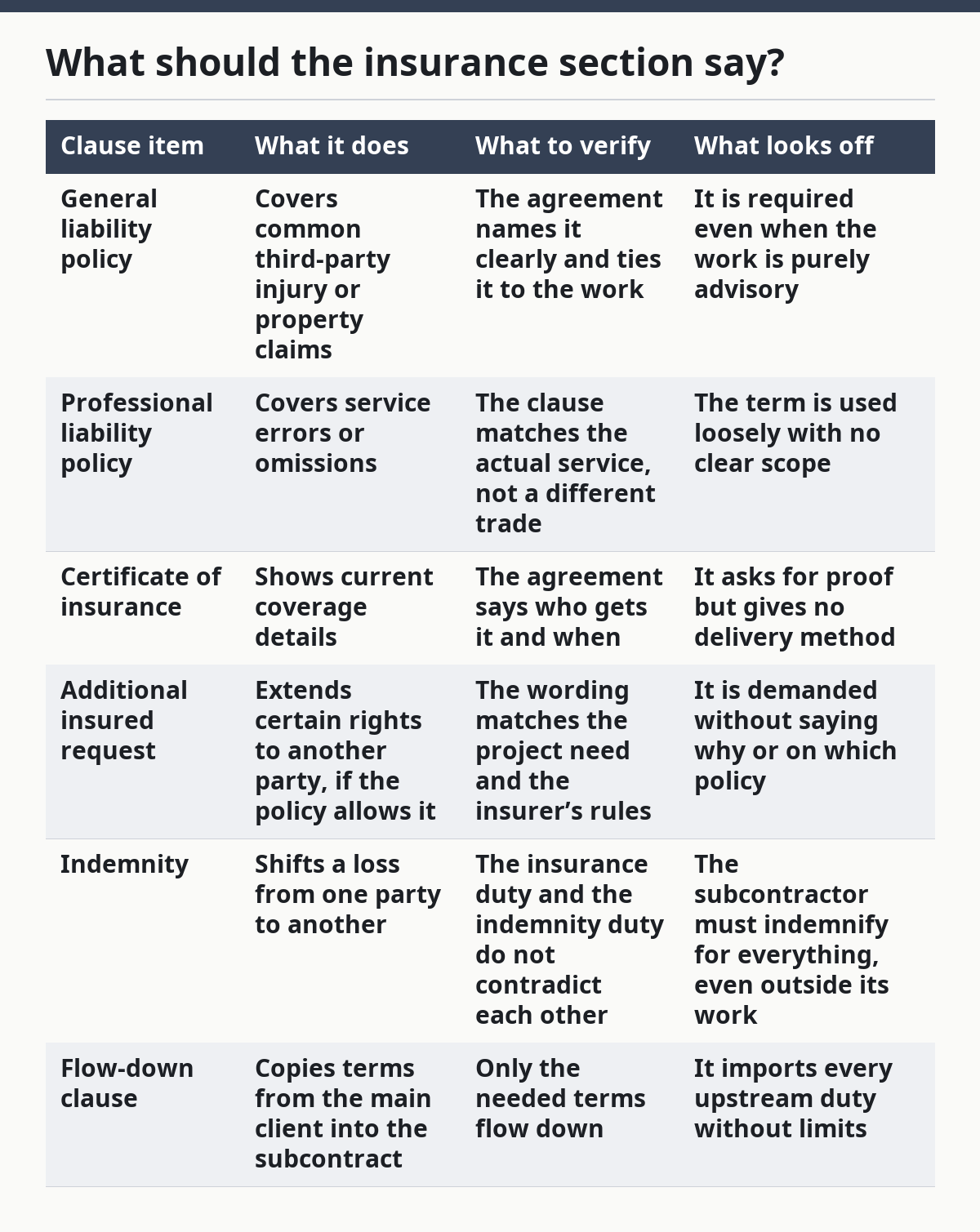
The cleanest clauses are precise. The weak ones use broad words like “all required insurance” without naming the policy type, the proof format, or the timing. That matters because “required” can mean the client’s preference, the prime agreement, or local law, and those are not the same thing.
For a broader contract context, the hub on insurance requirements is the right companion page.
How do you review the clause step by step?
Review the agreement in order: coverage, proof, timing, flow-down, indemnity, exceptions, and default. This keeps the insurance duties tied to the actual project instead of to a vague checklist. Use the agreement itself, the insurer’s declarations page if you have it, and any referenced attachment or schedule.
- Find every insurance reference in the draft. Mark each line that mentions insurance, a certificate of insurance, a policy, an endorsement, or an indemnity term. If the document uses more than one term for the same duty, verify whether they mean the same thing or two different duties. A problem shows up when one clause says “insurance,” another says “proof,” and a third says “coverage” without defining any of them.
- Identify who must carry each policy. Check whether the subcontractor, the freelancer, or both must maintain a general liability policy or a professional liability policy. If the clause says the subcontractor must maintain coverage for the full project term, verify whether that includes any closeout period or post-completion period named in the agreement. A problem exists if the duty begins before work starts but no time limit is stated after completion.
- Check the scope against the work. Match the insurance duty to the actual services in the subcontract. Advice, design, coding, editing, field work, and physical labor do not carry the same exposure. If the clause requires a policy type that does not fit the service, note the mismatch. A problem exists when the agreement demands coverage for hazards that the subcontractor will not create.
- Review the proof requirement. A certificate of insurance should be asked for in a way the subcontractor can actually provide. Look for who receives it, when it is due, and whether updated proof is needed on renewal. A problem exists if the agreement demands proof “on request” but never says whether that means before work starts, at renewal, or after a change in scope.
- Read any additional insured language with care. If the agreement asks for additional insured status, check whether it ties that request to the right policy and the right project. That term means another party may get certain protection under the policy, if the policy form allows it. A problem exists if the clause assumes the status can be added on any policy without regard to insurer rules.
- Trace the flow-down clause. If the subcontract says the subcontractor must follow the main client’s insurance terms, compare the two documents line by line. Keep only the terms that fit the subcontract’s role and duration. A problem exists when the subcontract silently copies a prime contract that the subcontractor never saw, or cannot meet, or that was written for a different trade.
- Match indemnity to insurance. Read the indemnity clause beside the insurance clause, not apart from it. If the subcontractor must cover loss caused by its own work, the insurance duties should line up with that risk and not expand it beyond the work. A problem exists if the indemnity is broader than the policy may reasonably support, leaving the subcontractor exposed to uninsured loss.
- Check default and cure language. Find out what happens if proof is late, a policy lapses, or a named requirement cannot be met. Look for a cure period, suspension right, or termination trigger. A problem exists when the agreement treats a missing certificate the same as no insurance at all, without giving a chance to fix a clerical delay. When this clause is unclear, consult a qualified legal or insurance professional. For background, see NAIC consumer guidance and IRMI.
This review does not require guessing. It requires reading each duty against the actual job and the actual paper trail. If a term is vague, the safer move is to ask for a clearer sentence before signatures go on the page.
Can a freelancer pass insurance duties down to a subcontractor?
A freelancer can pass some insurance duties down, but only if the subcontract and the main agreement actually support that transfer. This is where people get tripped up. A flow-down clause can copy duties from the upstream client into the subcontract, but it does not change the laws of insurance or make an insurer agree to wording that the policy does not allow.
The practical question is whether the downstream obligation matches the work. If a subcontractor is doing design work, a professional liability policy may matter more than a general liability policy. If the work is hands-on, site-based, or may affect property, general liability may matter more. The agreement should reflect that difference instead of forcing a one-size-fits-all clause.
A second issue is evidence. A certificate of insurance is proof that a policy exists on the date shown, not a promise that every loss will be covered. That is why the agreement should describe the proof it wants without treating the certificate as the insurance itself. If the clause mixes those two ideas, the wording is too loose. See the Insurance Information Institute for a plain-language summary of certificates of insurance.
The third issue is indemnity. If the subcontractor is asked to bear losses caused by its own work, that may be ordinary in many project contracts. But if the clause pushes loss for someone else’s mistake, or for risks outside the subcontractor’s scope, the paperwork may be trying to transfer more than the job justifies. That is the kind of mismatch that should be fixed before work begins, not after a claim.
When should you stop and get help?
You should stop and get qualified help when the agreement asks for coverage or proof that does not fit the project, the insurer’s rules, or the subcontractor’s role. On a money-and-contract question like this, guesswork is expensive. For general contract reading, the indemnity clause guide can help frame the issue.
The agreement requires additional insured status but gives no project-specific reason: this can signal a broad risk transfer that may not match the job — get the wording checked before signing.
The subcontract imports the entire main client agreement by reference: you may be accepting duties you have not seen in full — ask for the upstream terms before agreeing.
The clause demands a certificate of insurance before work starts, but the subcontractor has no active policy yet: the job may be delayed or the document may be impossible to provide — fix the timing or pause the start date.
The indemnity is broader than the insured work: the policy may not line up with the promise being made — have the clause reviewed before any signature.
The agreement uses terms like “all risk,” “full coverage,” or “any and all claims” without detail: those words can hide obligations that are too broad to measure — insist on specifics.
The subcontractor works across borders or in a different country: coverage terms, certificates, and policy forms can change by jurisdiction — get local advice before relying on a standard form.
This is also the point where a financial or insurance adviser may need to look at the project structure itself. The question is not just whether the clause sounds normal, but whether it fits the real arrangement.
What do people get wrong most often?
The most common mistake is treating the certificate of insurance as the whole answer. A certificate is only proof that a policy was in place on a date; it is not the policy itself and it does not rewrite the contract. The fix is to compare the certificate with the actual insurance duty and the policy type named in the agreement. For a neutral reference, see the Insurance Information Institute and NAIC consumer guidance.
A second mistake is accepting a flow-down clause without reading the upstream terms it imports. That can pull in obligations that were written for a general contractor, not for a freelance subcontractor. The result can be a duty the subcontractor cannot meet, which creates delay and friction before the work even starts.
A third mistake is using the same insurance language for every project. A writing job, a design job, and a site-based job do not raise the same exposure. When the clause does not match the work, the contract may demand the wrong policy or omit the right one.
A fourth mistake is letting indemnity and insurance drift apart. If the subcontract says one thing and the insurance clause says another, a claim may land in the gap between them. The better move is to read both clauses together and make the risk transfer consistent.
A fifth mistake is ignoring renewal timing. If the agreement says proof is needed for the term of the job, a certificate from the start date may not be enough. A clear renewal or update rule helps reduce the chance of a dispute.
What if the standard wording does not fit?
The standard wording does not fit when the work, the timing, or the jurisdictions do not match a normal freelance setup. A short subcontract for a single task may not need the same insurance language as a long-running, multi-phase project. If the agreement assumes a policy term, a renewal cycle, or a project location that does not exist, the clause needs revision before signing.
Edge cases often show up in four places. First, a subcontractor may be working entirely online, making some physical-risk language irrelevant. Second, the client may ask for a policy type that the subcontractor does not carry because the service is advisory rather than physical. Third, the work may span multiple dates, so a one-time certificate does not show the full period of coverage. Fourth, the project may borrow terms from a different industry, such as construction, when the actual task is creative or technical.
When that happens, the fix is not to force the clause to fit by guessing. The fix is to rewrite the specific duty, identify the exact policy type, and define the proof needed in plain language. A clean clause is usually shorter than a copied one, because it names only the risks that belong to the job.
FAQ
What insurance should a subcontractor agreement require?
A subcontractor agreement should require the insurance that matches the work, usually a general liability policy, a professional liability policy, or both. The clause should also say what proof is needed, often a certificate of insurance, and whether any additional insured request applies. The right mix depends on the service, the risk, and the project structure.
Can a freelancer pass insurance duties down to a subcontractor?
A freelancer can pass some insurance duties down if the subcontract clearly does so and the upstream agreement allows it. The pass-through should match the subcontractor’s actual work and the insurer’s terms. If the clause copies a broader project agreement without checking the scope, it can create an obligation that is hard to satisfy.
What if my subcontractor cannot meet the insurance terms?
If the subcontractor cannot meet the insurance terms, the clause should be revised before work starts. That may mean narrowing the required coverage, changing the proof timing, or removing a demand that does not fit the job. If the term is left in place without a fix, the result can be a delayed start, a breach claim, or a disputed loss.
Drafted with AI; not yet reviewed by a person.
