

Last updated: November 25, 2026
Use the document that actually sets the insurance duty, and if the Master Services Agreement and the Statement of Work do not match, follow the more specific term unless the contracts say the MSA controls. This is information, not financial advice; contract language and insurance rules change by country, so a qualified adviser should review your own freelance contract before you rely on it.
Key takeaways
- The MSA usually sets the baseline rules for the client relationship, while the SOW often sets the project details.
- The insurance requirement belongs to the document that clearly names it, and the wording decides whether it is general or project-specific.
- A later SOW can tighten an earlier MSA, but only if the documents give it that power.
- If one document says the MSA controls and the other says the SOW governs the project, the conflict is the real risk, not the insurance label.
- The safest habit is to compare both documents before you treat any insurance clause as final.
How do MSA and SOW split the insurance job?
The MSA sets the standing insurance rule; the SOW sets the project rule. In a freelance contract, that split matters because the insurance obligation may appear once in the MSA and then get repeated, narrowed, or raised in a 1-off SOW.
Start by asking which document creates the duty and which one only adds project terms. An MSA usually governs the client relationship for multiple jobs over time, while a SOW often names the task, deadline, deliverable, and any extra insurance requirement tied to that 1 assignment.
The cleanest way to read the pair is to treat the MSA as the default and the SOW as the exception only when the wording says so. That means a SOW can change the insurance result if it clearly says it applies to that project, or if the MSA gives later statements of work control over project terms.
This is where many readers get tripped up: the label alone does not decide anything. A document called a SOW can still leave the MSA in charge, and a long MSA can still be overridden on a single insurance point by a later, more specific SOW. General contract rules often favor the more specific and later term, but the exact wording controls.
For client contract requirements, this is the right page to read alongside the hub on freelance insurance for client contract requirements, because the question here is not what insurance is in general. The question is which paper sets the obligation when the client splits terms across 2 documents.
What do I check first in the MSA?
The MSA wins first review because it often contains the standing insurance clause that applies across all work. If the MSA is silent on insurance, that silence does not end the search; it only means the duty may sit in the SOW or another exhibit.

Look for 3 things in the MSA: the insurance type named, the trigger that makes it required, and the clause that says how later project papers work. Phrases like “as required in a Statement of Work” or “unless otherwise stated in an SOW” tell you the MSA is not acting alone.
The main strength of the MSA is stability. Once the baseline is set, you can use the same rule across repeat client work instead of re-reading every project from scratch. That matters for freelancers who do several jobs for the same client over 6 months or longer.
The weakness is that the MSA can be broad. A broad clause may require insurance for all services, even if one small project looks low risk. It can also leave the amount, scope, or proof of coverage to later documents, which means the MSA may be the start of the answer, not the full answer.
This approach fits freelancers doing ongoing work for 1 client, especially when vendor terms renew each year and the parties want the same contract to cover new assignments. It is a poor fit when the MSA is old, vague, or written to give the client wide control through later exhibits.
When does the SOW control the insurance?
The SOW controls the insurance requirement when it is written as the project-specific rule or when the MSA gives it that power. That is the usual answer for a single engagement that needs a different risk profile, a different deliverable, or a different proof-of-insurance request.

A SOW is strongest when it names the exact project and ties insurance to that project only. For example, a SOW may require a certificate of insurance for a one-month assignment, while the MSA only says insurance must be maintained if the work involves client sites, data, or subcontractors.
The strength of the SOW is precision. It can add a short-term obligation without rewriting the whole freelance contract. That helps when the client wants 1 project covered differently from the rest of the relationship, or when a vendor term is being renewed with new terms for a specific job.
The weakness is fragility. If the SOW conflicts with the MSA and the contract does not say how conflicts are resolved, the reader has to sort out priority rules, and that adds risk. A vague SOW can also create a surprise obligation by referring to “all standard insurance” without naming the policy type or the trigger.
Choose the SOW when the job is isolated and the wording is clear enough to stand on its own. Skip that reading if the SOW is only a work order, a scope page, or a pricing sheet with no insurance language at all, because then it may not change the obligation.
The honest side-by-side
The right choice depends on where the insurance rule is written, how specific it is, and whether the contract says one document overrides the other. The table below shows where each document usually wins.
| Criteria | MSA | SOW | Winner for [condition] |
|---|---|---|---|
| Applies across repeat work | Usually yes | Usually no | MSA for ongoing vendor terms |
| Project-specific insurance trigger | Often broad | Usually exact | SOW for 1 project |
| Baseline obligation | Usually sets it | Usually follows it | MSA for standard coverage |
| Changes tied to a single job | Less likely | More likely | SOW for special risk work |
| Conflict resolution | May control if it says so | May control if it says so | Whichever document has priority wording |
| Clarity of insurance scope | Can be general | Can be narrow | SOW when the job needs exact limits |
| Ease of repeat use | Higher | Lower | MSA for same client over time |
| Risk of hidden extra duty | Moderate | Moderate | Neither; read both before signing |
| Best document for proof request | Sometimes | Often | SOW when the client wants proof for 1 assignment |
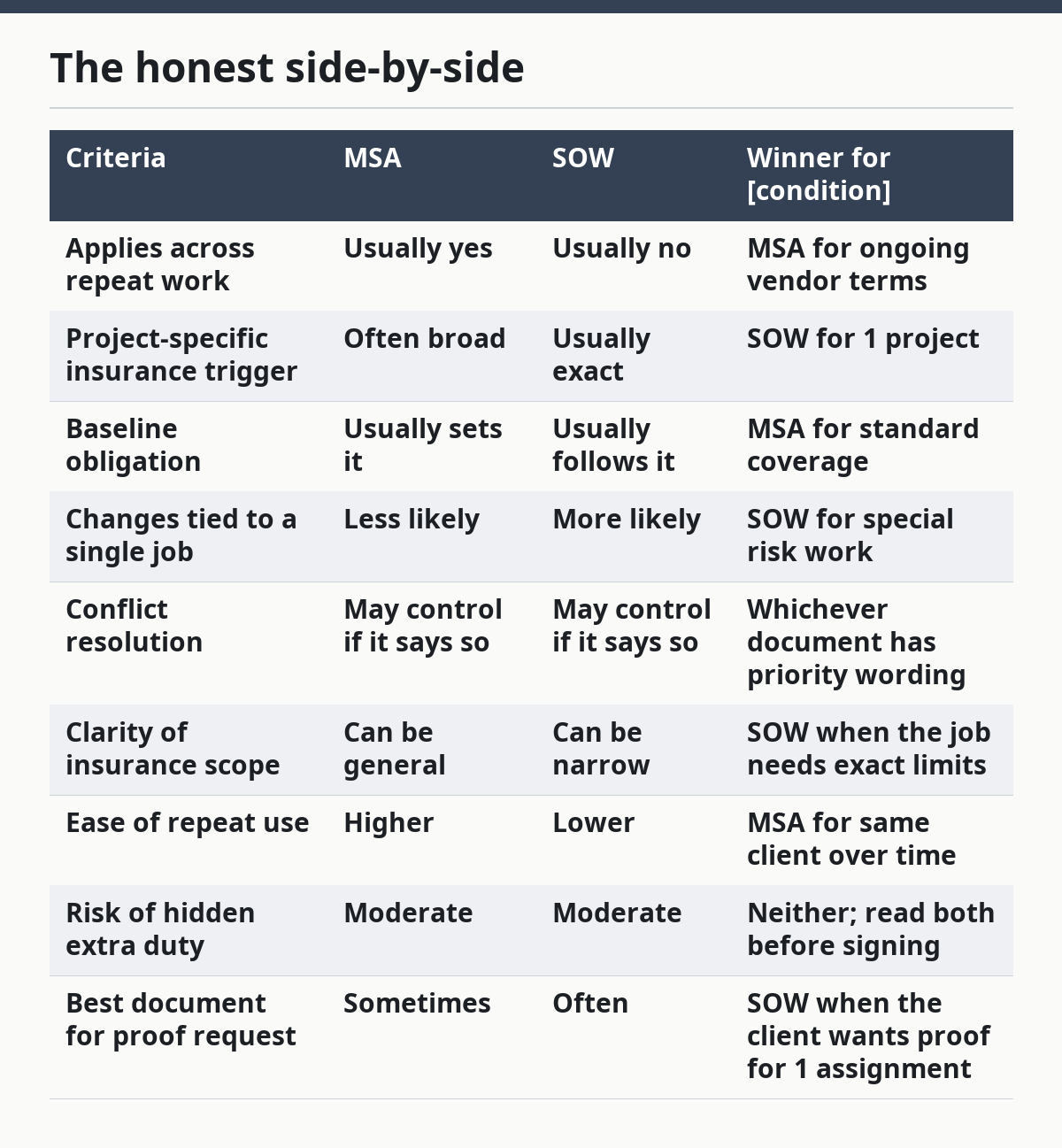
The table does not mean one document is always better. It means the document with the clearer insurance language usually wins for that condition, and the priority clause still matters if the two papers clash.
What are the exception scenarios?
The verdict flips in 4 common cases: the contract says the SOW prevails, the MSA says later project papers override it, the SOW repeats the insurance term with tighter wording, or the MSA leaves the issue entirely to later exhibits.
The first exception is express priority language. If the MSA says a SOW controls the project and the SOW names the insurance term, the SOW is the better reading even if the MSA has a general clause. A clause like that can change the result in 1 sentence.
The second exception is a narrow project risk. If the job involves client premises, data handling, or subcontractors, the SOW may add a project-specific obligation that the MSA did not spell out. That matters because the trigger is tied to the work, not just to the client relationship.
The third exception is renewing vendor terms. A client may keep the MSA in place for a year and then issue a new SOW with updated insurance wording for each 2026 project cycle. In that setup, the renewal paper can be the document that matters most for that assignment.
The fourth exception is conflict without guidance. If the MSA and SOW point in different directions and neither says who wins, do not assume the shorter document or the newer one is always right. That is the point where a qualified adviser should review the contract before you treat one clause as final.
Which one should a freelancer follow?
Choose the MSA if it sets the standing insurance duty for repeated client work and the SOW does not clearly replace it. Choose the SOW if it is the only place the client names a project-specific insurance requirement or if it clearly overrides the MSA for that job. Neither if the two documents conflict and neither one says which term controls.
That is the practical rule for a freelance contract split across 2 papers. The wrong move is to read only the one that feels shorter or easier. The safer move is to match the insurance clause to the document that actually governs the obligation, then check the other paper for an override.
For contract reading, the best habit is simple: read the MSA first, then the SOW, then the conflict clause, then the insurance language again. That 4-step pass catches the cases where a general clause and a project clause point in different directions.
How to match the insurance term to the right document
Use the MSA when the insurance rule is general, ongoing, or tied to the whole client relationship. Use the SOW when the insurance rule is specific to one job, one site, or one delivery window.
- Open the MSA and find the insurance clause, the priority clause, and any wording that sends you to a SOW.
- Open the SOW and check whether it repeats, narrows, or raises the insurance requirement.
- Compare both papers for conflict language such as “controls,” “prevails,” or “unless otherwise stated.”
- Match the trigger to the work, not the title, so a project risk rule stays with the project paper.
- Ask a qualified adviser if the documents disagree or if your country’s contract rules may change the result.
For freelancers, that is the fastest way to avoid treating a side note as a binding insurance duty. It also keeps you from missing a project-specific requirement hidden in a later SOW.
What if the wording is unclear?
Unclear wording means the answer is not safe to guess. If the MSA says “insurance as required” and the SOW says nothing, the client may still expect the MSA requirement to apply, but the exact obligation can depend on the rest of the contract and the law that governs it.
That is why the phrase “as required by the client” should make you stop and look for the named document, the trigger, and the proof request. A vague clause can be enough to create a duty, but it may not tell you when the duty starts or which project paper controls it.
If the contract uses a form from one of the big standards bodies or a well-known industry template, the same reading rule still applies: find the priority clause first, then the insurance clause, then the SOW. The template name does not beat the actual wording on the page.
Which contract controls the insurance requirement, MSA or SOW?
The contract that controls is the one with the clearer priority language, and that is often the more specific project paper. If the MSA says it governs unless a later SOW changes the terms, the SOW can control for that assignment. If the SOW is silent and the MSA sets the baseline, the MSA usually carries the insurance rule.
Do I need to review both documents for insurance language?
Yes, because either document can contain the requirement, and one can change the other. A freelancer can miss a project-specific obligation by reading only the MSA, or miss a standing requirement by reading only the SOW. The extra pass takes minutes, not hours, and it is the only way to see the full insurance picture.
Can a statement of work change my insurance obligation?
Yes, if the SOW is written to do that or if the MSA gives later project documents that power. A SOW can add a one-project insurance duty, narrow the scope, or raise the proof requirement for that job. If the documents conflict and neither one explains priority, get the wording checked before you rely on the SOW alone.
Drafted with AI; not yet reviewed by a person.
