

Last updated: November 25, 2026
How to Respond When a Freelance Client Demands a Refund, Rework, or Chargeback
Quick Answer: respond in writing within 24 hours, review the contract, and send your evidence packet before the chargeback deadline. If you are working through How to Respond When a Freelance Client Demands a Refund, Rework, or Chargeback, the safest order is: gather the contract, invoice, brief, delivery proof, and message thread; then answer with facts, not emotion. If the work was delivered as agreed, do not admit fault or promise a refund on the spot; if the work missed the contract, offer the fix that the contract allows. A refund demand is a dispute about money, not a reason to panic.
For a chargeback, timing matters because card networks and payment processors usually require a fast response. For example, the Consumer Financial Protection Bureau explains that billing error disputes are time-sensitive, and card issuers set their own deadlines for disputes. In practice, that means you need to act in hours, not weeks.
Key takeaways
- Start with the contract, not the client’s tone. The delivery terms, revision limit, and refund clause matter more than the complaint itself.
- A fast written reply can stop a small issue from turning into a chargeback or a long email fight.
- Your evidence packet should show what was agreed, what was delivered, and when each step happened.
- Rework and refund are not the same ask. One may fit the contract; the other may not.
- If the payment processor opens a dispute, answer it in the format it requests and keep every file in one place.
What should I do first after a client demands a refund?
Reply in writing and pause the money talk until you have the facts. The first move is to collect the contract, the invoice, the brief, the delivery file, and the message where the client first complained. If you answer from memory, you may concede something the contract does not require.
A clean first reply can be short: confirm that you received the complaint, say you are reviewing the project against the agreed scope, and ask for the exact problem in one message. If the client is asking for a refund because they “changed their mind,” that is different from a failure to deliver. If the client says the work is wrong, ask what specific part is wrong and whether they want rework or cancellation.
Use a single folder for the case. Keep the contract, invoice, proofs of delivery, revision notes, and all email or platform messages together. A 24-hour pause is often enough to stop a rushed reply; it also gives you time to read the refund clause before you answer.
Do not argue about feelings. A sentence like “You are being unfair” only turns a refund demand into a customer escalation. Stick to dates, file names, and terms. If you need help finding the exact clause, search the contract for words like “revision,” “acceptance,” “termination,” and “refund.”
How do I tell refund, rework, and chargeback apart?
A refund demand comes from the client, rework is a request to change the work, and a chargeback is a payment processor dispute. They can happen in the same week, but they follow different paths and need different replies.
| Issue | Who starts it | What it usually asks for | What you respond with |
|---|---|---|---|
| Refund demand | Client | Money back | Contract terms, delivery proof, and a settlement option if needed |
| Rework request | Client | Changes to the deliverable | Scope, revision limit, and what can still be changed |
| Chargeback | Cardholder through payment processor | Reversal of the payment | Evidence packet in the processor’s required format |
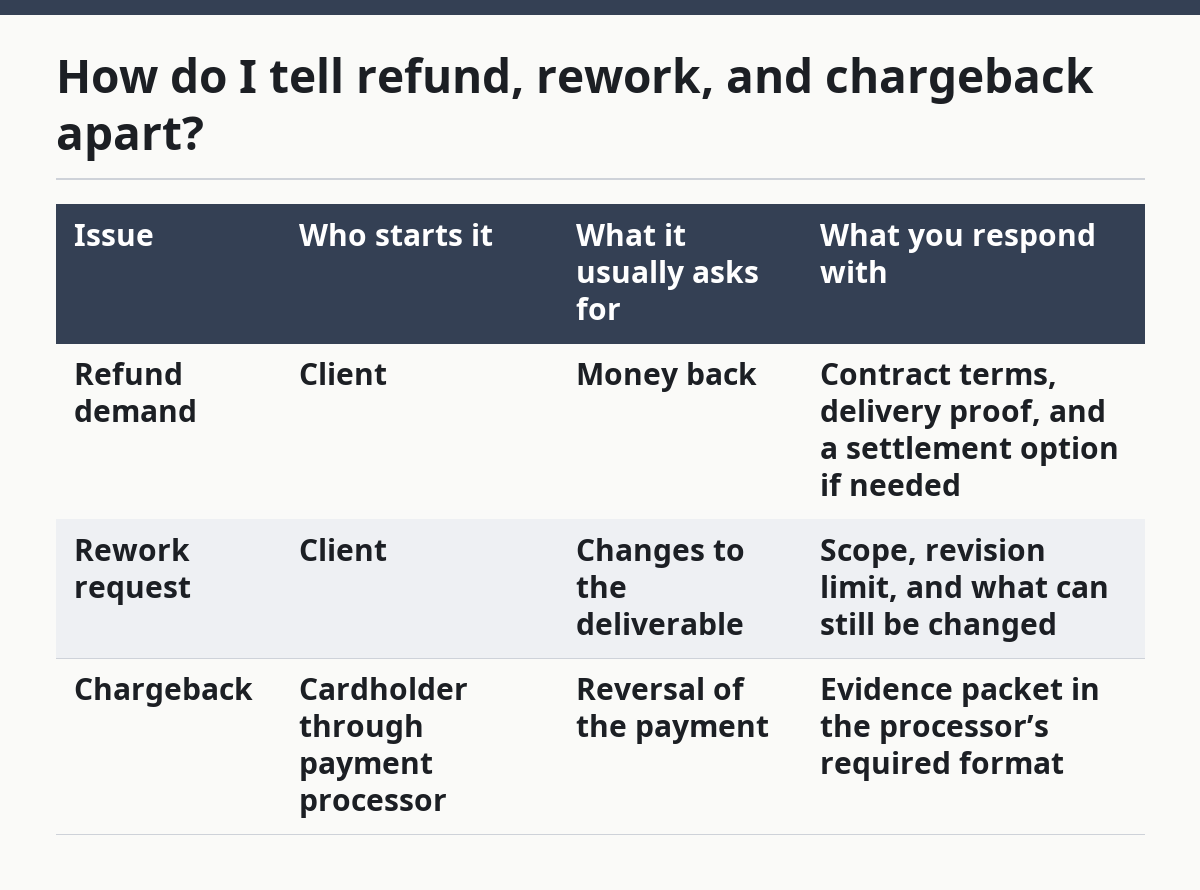
A refund demand is often the first signal. It may stay informal if you settle it quickly. A chargeback usually starts after the client contacts the card issuer or uses the payment processor’s dispute tool. Once that happens, the clock matters; many processors give a short window to answer, and missing it can leave you with no practical defense.
Rework is not the same as “doing the job again.” If your contract includes two rounds of revisions and you already used them, the client may still want more edits, but you are not required to provide unlimited changes unless the contract says so. If the problem is a clear miss on your side, a limited rework may solve the issue faster than a refund.
Therefore, many freelancers make the wrong call when they treat a polite request like a legal threat, or they treat a formal dispute like a casual email. If you are unsure whether the request crosses into a legal or regulatory issue, consult a qualified professional before you concede anything. The fix is to match the response to the type of demand. A refund ask gets a settlement decision. A processor dispute gets evidence. A rework request gets scope control.
What goes in an evidence packet?
An evidence packet should show the agreement, the work, the delivery, and the client’s receipt of it. Keep it simple and dated. The goal is not to tell a story; the goal is to make the payment processor see that the charge was earned under the contract.
Use this order:
- Open the contract PDF and mark the clauses on scope, revisions, approval, payment, and refunds.
- Save the brief or proposal that shows what was promised in the first place.
- Export the invoice with the service date, amount, and payment status.
- Attach the delivery proof such as file share logs, platform timestamps, or sent emails.
- Collect the client messages where they approved the work, requested edits, or accepted delivery.
- Add the final deliverable or a screenshot of the relevant output.
- Write a one-page summary that matches the processor’s dispute form and sticks to dates and facts.
The packet should answer three questions quickly: Was there a contract? Was the work delivered? Did the client know what they were buying? If the processor asks for a character limit or file type, follow that exactly. A strong packet in the wrong format can still lose.
Do not stuff the file with noise. A 40-page attachment dump often weakens the case because the reviewer has to hunt for the important parts. Choose the 5 to 10 items that prove your point. If the processor accepts screenshots, use them only where the full document would be too long.
For extra guidance, the Consumer Financial Protection Bureau has public material on card dispute and billing error processes, and the FTC explains how card disputes work for consumers. Those pages are about the payment side of the problem, not your contract, but they help explain why timing and written records matter. See also the CFPB’s dispute guidance and the FTC’s consumer billing dispute pages for the 30-day style deadlines and written-record basics that often govern card complaints.
When should I offer rework instead of a refund?
Offer rework when the problem is fixable, the scope is still open, and the contract allows another round of changes. A limited fix is often cheaper than a refund, and it can keep the relationship alive.
Use rework when the client points to a concrete defect: a missing file, a typo, the wrong format, a broken link, a missed spec, or a design that does not match the brief. If the issue is subjective, like “I don’t like the feel,” the answer depends on the contract and the approval history. If the work was approved in writing, that approval matters.
Set a firm boundary. Say what you will change, how long it will take, and what is outside scope. If the client asks for a total rewrite after signing off on a draft, that is not a simple correction. If you agree to fix one section, write that down in the same thread so the next complaint does not turn into a moving target.
Rework is the wrong choice when the client wants free labor far beyond the brief, or when the dispute is really about nonpayment. It is also the wrong choice if the client has already filed a chargeback and is using rework as a way to delay the dispute. At that stage, keep the response tied to the payment processor case and the contract.
What should I say to the client?
Say less than you feel and more than a shrug. A calm, specific reply lowers the chance of a longer escalation and helps if the payment processor later reviews the thread.
A useful reply has four parts: acknowledgment, fact, option, and deadline. For example: confirm the message, state that the project was delivered on the agreed date, point to the contract clause or revision limit, and offer one next step. That next step might be a revision, a partial adjustment, or a formal review of the disputed point.
A short, calm reply that asks for the exact issue gives you time to review the file and, if the situation looks legally sensitive, consult a qualified professional before you make a concession. That step also prevents a rushed admission from becoming the basis for a chargeback response later.
Avoid these common errors:
- Admitting fault too early. That can weaken your defense if the dispute turns into a chargeback.
- Refunding in exchange for silence. If the client still disputes the charge, the money may not end the problem.
- Sending a messy file dump. Reviewers often miss the point when the evidence is scattered.
- Arguing by emotion. A heated message can make you look unreliable even if the work was solid.
A simple script is often enough: “I received your request. I am reviewing the project against the signed scope and delivery record. If the issue is a fix within the agreed revisions, I can address that by [date]. If you want a refund, I will need to follow the contract terms and the processor process if one is opened.” That gives the client a path without giving away your position.
How do I handle the payment processor dispute?
Answer the payment processor with facts, not a long defense. A dispute form is not the place for a full argument; it is the place for a clean record that proves the charge was valid.
Read the dispute reason first. A “not as described” claim needs different proof than an “unauthorized” claim or a “service not received” claim. Then match your packet to that reason. If the processor wants proof of delivery, send the delivery record. If it wants proof of agreement, send the contract and brief. If it wants communication history, include the thread where the client approved the work.
Keep the tone neutral. Say what happened, when it happened, and what was delivered. Do not guess at the client’s motive. Do not insult the payment processor. Do not attach a fresh argument in the middle of the evidence. If the processor gives a form with fields, fill them in exactly as asked.
This is also where you decide whether to push back or settle. If the contract is weak, the proof is thin, or the client has a clear service complaint, a partial refund may be cheaper than a long dispute. If the contract is strong and the delivery record is clean, a processor dispute is often worth fighting. That is a business call, not a moral one.
What should I do after the dispute ends?
Close the file, write down the lesson, and tighten the contract before the next project. A lost or won dispute still leaves a paper trail that should change how you work next time.
Review the weak spot in the process. If the problem was vague scope, add a clearer deliverable list. If it was endless edits, set a revision cap in plain language. If it was unclear approval, add a sign-off step before final delivery. If the issue was payment timing, make the invoice terms harder to miss.
Keep the records for at least 1 year or longer if your contract, processor rules, or local rules require it. Even if the client disappears, the file matters later if the same pattern shows up again. A dated record is cheaper than rebuilding a case from scratch.
This page fits the broader hub on freelance claims, incidents, and loss response, but it stays focused on the refund, rework, and chargeback response itself. That split matters because a payment fight is not the same thing as an insured claim, and mixing those paths can slow both.
Is a chargeback an insurance claim?
No, a chargeback is usually a payment dispute, not an insurance claim. It runs through the client’s card issuer or payment processor, while insurance follows a different process and a different notice path. If a dispute might also involve a claim issue, keep the records separate and follow the correct route for each.
What should I do first after a client demands a refund?
Check the contract, then answer in writing. Look for the scope, revision, approval, and refund terms before you promise anything. A short, calm reply that asks for the exact issue gives you time to review the file and prevents a rushed concession.
Can a chargeback become a professional liability issue?
Yes, sometimes it can overlap with a professional liability problem, but the two are not the same thing. A payment dispute can turn into a bigger issue if the client alleges real harm from the work itself. If that happens, keep the contract, messages, and delivery proof together and follow the proper incident path for that separate issue.
Drafted with AI; not yet reviewed by a person.
