
Last updated: November 25, 2026
Quick Answer: in 3 checks, you can tell whether a primary and noncontributory clause changes payment order, not coverage scope. This guide on How to Read an Insurance Clause That Requires Primary and Noncontributory Coverage shows you how to read the clause, compare it with the policy, and see whether the contract is asking for something your insurer actually wrote. For a fuller overview, see the freelance insurance hub and the additional insured guide.
A primary and noncontributory clause tells you which policy pays first if a loss triggers more than one policy, and it tells you that your coverage should not be dragged in until the other insurance has paid. Read it by checking three things in the exact sentence: who must provide it, what policy is primary, and what other insurance is supposed to stay out of the claim.
Key takeaways
- The clause is about payment order, not about who is named on the certificate.
- “Primary” means your policy responds before another policy does.
- “Noncontributory” means your policy does not share the loss with certain other insurance.
- The clause often appears in a client contract beside, but not the same as, additional insured wording.
- If the clause names a policy you do not have, or conflicts with another clause, the contract may not be asking for the same thing your insurer will write.
Who this applies to
This applies to freelancers who get a client contract with insurance wording and need to tell whether the clause is asking for payment order, extra insured status, or both. It assumes you already have the contract language in front of you and know the names of your policies, even if you do not know the insurance jargon yet.
This is information, not financial advice. Insurance wording affects money and legal rights, so a qualified adviser should be consulted for your own situation if the contract is high value, crosses borders, or uses unusual policy terms. For policy-language comparisons, see the ISO overview of other insurance clauses and the NAIC consumer insurance resources. Consult a licensed broker or attorney if the wording is disputed.
A primary and noncontributory clause usually shows up in a client contract that also mentions an additional insured, a certificate of insurance, or an indemnity paragraph. It matters because the insurer will read the wording as a request about which policy must answer first, and that can change how a claim is handled if two policies are involved.
This page is not the right tool if you want help adding an endorsement or verifying a certificate line by line. It also does not cover the broader contract review process. For that larger picture, the hub on freelance insurance for client contract requirements sits one level up and explains how these clauses fit together without turning every contract into a law school exam.
What does the clause actually mean?
A primary and noncontributory clause means your policy should be first in line and should not ask another policy to contribute until your own coverage has been used in the way the contract requires. In plain terms, “primary” is the order of payment, and “noncontributory” is the no-sharing part.
The word primary addresses priority. If the contract says your insurance is primary, the insurer for your policy cannot point to another policy and say, “That one should pay first.” The word noncontributory is narrower. It says your insurer should not chip in alongside another policy for the same covered loss, at least for the situation described in the contract.
That matters because many insurance forms already contain an “other insurance” clause, which is the policy language that decides how two policies share a claim. A client contract can try to change that order. If the contract says primary and noncontributory, it is trying to push your policy to the front of the line and keep it there for the covered event.
A clause like this is not the same thing as broad coverage. It does not guarantee that every loss is covered. It only changes how the insurer should treat covered loss when more than one policy could respond, but a licensed broker, claims professional, or attorney should confirm how the policy form works.
How do you read the sentence?
You read the sentence by breaking it into the exact parties, the covered policy, and the trigger words that change the payment order. A careful 7-step pass through the wording is often the clearest way to do that, one clause at a time.
- Circle the named party: identify whether the contract says “freelancer,” “vendor,” “subcontractor,” or a business name, then verify that the named party matches the entity on the policy declarations page; if the names do not match, the clause may not attach the way the client expects.
- Highlight the policy type: find whether the clause points to general liability, professional liability, or another policy line, then verify the line is actually listed on the certificate; if the policy type is missing, the clause may be impossible to satisfy as written.
- Underline “primary”: check whether the contract says the coverage must be primary “with respect to” the client, the client’s insurance, or a third party; if the wording is broad and says primary for all loss, that is a red flag for a mismatch with standard policy language.
- Underline “noncontributory”: confirm whether the clause says the policy will not contribute with “any other insurance,” “other valid and collectible insurance,” or a narrower class of policies; if the clause is silent on the other policy, the scope may be uncertain.
- Read the trigger event: look for the conduct that activates the clause, such as work performed for the client, a location, or a contract date; if no trigger appears, the clause may be broader than the insurer intended.
- Check the timing language: note whether the clause applies “for the duration of the agreement,” “until completion,” or another stated period; if the timing reaches beyond the service period, coverage may need to outlast the job itself.
- Match it to the other-insurance rule: compare the contract sentence with the policy’s other insurance clause, because that paragraph controls how the insurer treats competing coverage; if the two clash, the contract may demand something the policy does not promise, so ask a broker or attorney to review it.
A good result is simple: the contract sentence and the policy wording point in the same direction. A problem shows up when the contract says one thing, the certificate says another, and the policy form uses a different rule altogether.
What should you check before you decide it is fine?
You should check the clause against the policy form, the certificate, and the rest of the contract before you assume it is satisfied. The clause can look harmless in a 2-line sentence and still conflict with the policy language that actually controls a claim.
Start with the policy’s other insurance clause. That part tells you whether the policy is excess, pro rata, or primary when another policy is also available. If the contract asks for primary and noncontributory coverage but the policy form says something different, the contract may be asking for a promise the policy has not made.
Then check whether the clause ties to additional insured wording. These are related but not identical. Additional insured status is about who gets covered under the policy; primary and noncontributory wording is about who pays first and whether another policy contributes. A contract can ask for one, the other, or both.
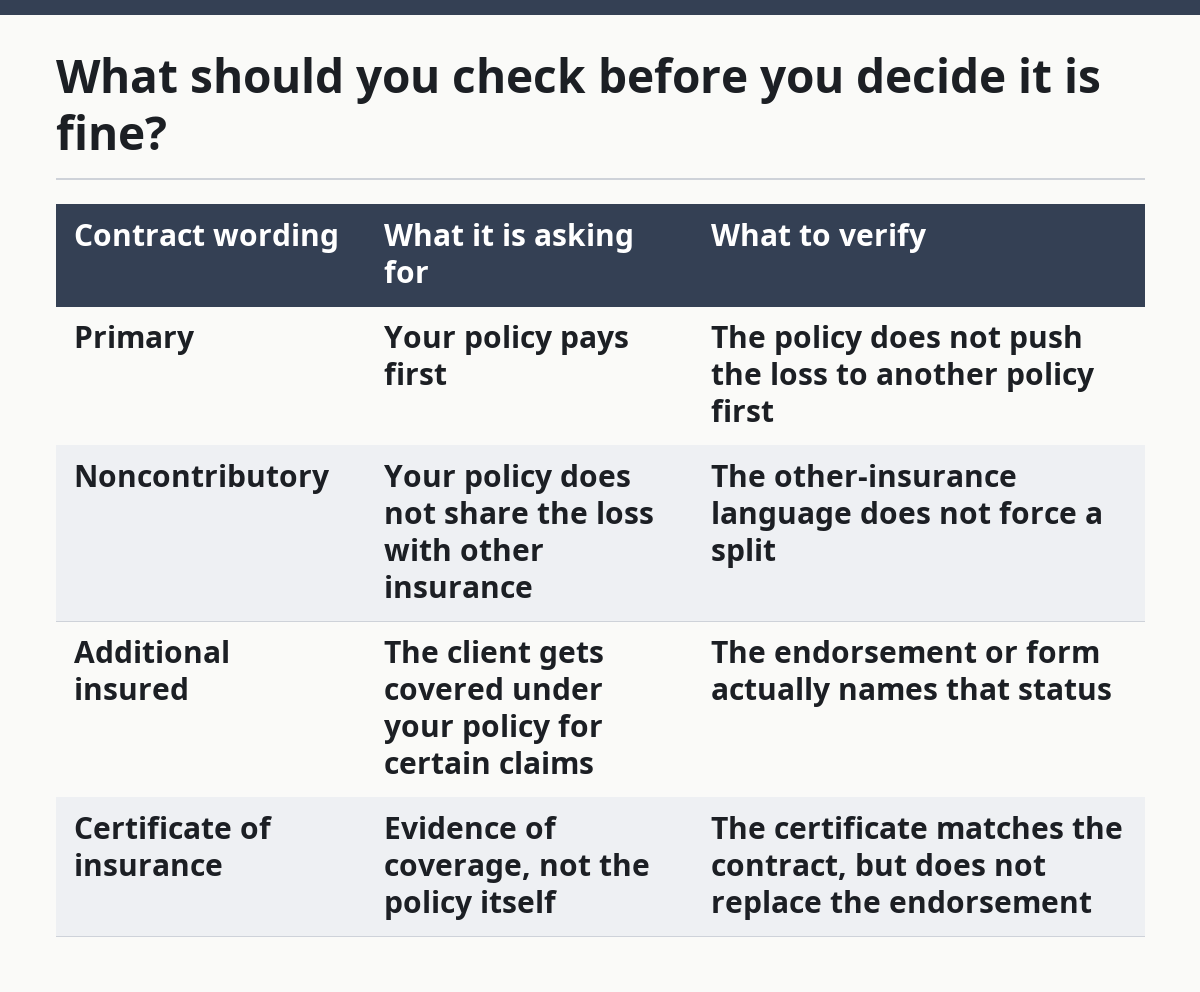
A practical check is to compare the words line by line:
| Contract wording | What it is asking for | What to verify |
|---|---|---|
| Primary | Your policy pays first | The policy does not push the loss to another policy first |
| Noncontributory | Your policy does not share the loss with other insurance | The other-insurance language does not force a split |
| Additional insured | The client gets covered under your policy for certain claims | The endorsement or form actually names that status |
| Certificate of insurance | Evidence of coverage, not the policy itself | The certificate matches the contract, but does not replace the endorsement |
A certificate alone is not enough if the contract needs policy wording. A certificate can describe coverage, but the insurer relies on the policy form and endorsements when a claim arrives. For contract review, the certificate of insurance guide and the endorsement checklist can help.
When does this wording cause trouble?
This wording causes trouble when the contract asks for more than the policy is built to say, or when it uses the phrase to cover a different risk than the insurer intended. The problem is usually not the word count; it is the conflict between 2 documents that each seem clear on their own.
The contract names “all insurance” rather than one policy line: that can pull in policies the insurer never meant to rank first — the fix is to limit the wording to the specific policy the contract is really about.
The clause points to “other valid and collectible insurance” without limits: that phrase can be broader than the reader expects — the fix is to check whether the policy’s other insurance clause uses the same wording.
The client wants primary and noncontributory wording for professional liability: that can be harder to fit than general liability wording — ask a broker or attorney to confirm whether the request fits the policy form before you treat it as satisfied.
The contract also requires additional insured status: that does not automatically make the policy primary and noncontributory — the fix is to read both requirements separately, because one does not replace the other.
The policy has an exclusion or carve-back that changes the order of payment: the clause may look satisfied until a claim hits that excluded area — the fix is to read the exception, not just the headline language.
The contract uses the clause for a period after the work ends: that can extend the obligation past the project date — the fix is to check the contract term and any post-completion language together.
A lot of readers miss the consequence here: a clause that looks “standard” can still create a contract compliance problem if the insurer’s wording and the client’s wording do not line up. That can leave the freelancer with a contract promise that is larger than the policy promise.
What mistakes do people make most often?
People usually make 4 mistakes with this clause, and each one has a different cost. The error is often not in reading the words, but in assuming one insurance term means another.
First, they treat primary and noncontributory as if it were just another way to say additional insured. That can lead to the wrong box being checked on a certificate and the wrong endorsement being requested. The correct move is to separate “who is covered” from “who pays first.”
Second, they stop at the certificate of insurance. A certificate can show dates, limits, and named insureds, but it is not the policy form. The fix is to compare the certificate with the actual policy wording and the endorsement, if one exists.
Third, they read only the first line of the clause. Many contract clauses bury the important part in the phrase that follows “with respect to” or “for claims arising out of.” The fix is to read the whole sentence and the neighboring insurance paragraph, not just the first 10 words.
Fourth, they ignore the client’s own insurance request and only check their own policy. If the client also wants to be an additional insured, the clause may be asking for 2 separate items at once. The fix is to check each requirement on its own terms and not assume one satisfies the other.
When should you pause and get qualified help?
You should pause when the wording is wider than a normal project clause, when more than one policy is involved, or when the contract and policy disagree on who pays first. In those situations, the issue is no longer just reading; it is how the clause will be enforced if there is a claim.
The contract mentions a client’s umbrella or excess policy: that means the payment order may involve more than 2 policies — stop and get qualified help if you cannot map the hierarchy clearly.
The clause is tied to a public contract, a lease, or a long form vendor agreement: those documents often use fixed wording that is hard to alter — stop if the clause cannot be matched to the policy language without changes.
The policy line is professional liability rather than general liability: that often changes how primary wording works — stop if you are unsure whether the clause even belongs on that policy form.
The contract asks for a result the insurer will not describe in writing: that is a sign of a compliance gap, not a paperwork gap — stop before you assume a certificate can solve it.
The clause crosses borders or uses a country-specific insurance term: rules differ by country and can change, so consult local counsel or a broker rather than treating the wording as universal.
In short, this is a reading problem until it becomes a contract mismatch. Once it becomes a mismatch, the safe next step is to confirm the wording with a qualified professional rather than guessing. Freelance insurance contract review can help frame the issue before you escalate.
How does this fit with other insurance clauses?
It fits as one piece of the contract’s insurance puzzle, not the whole puzzle. The clause deals with payment order, while other clauses deal with who is insured, what is covered, and who must be defended.
The most common neighbor is additional insured wording. A client may want both: the client wants to be named as an additional insured, and it wants your coverage to pay first and not share the claim with the client’s own insurance. Those are different asks. One changes the insured status, the other changes the order of payment.
Another neighbor is the “other insurance” clause in the policy itself. That clause is usually in the policy form and can control whether your coverage is excess or primary when another policy exists. A contract cannot rewrite the policy by itself, but it can create a compliance obligation that your policy may or may not match.
A third neighbor is indemnity language. Indemnity decides who owes money to whom under the contract; primary and noncontributory decides which insurance pays first if a covered claim lands. Those ideas often sit in the same page, but they are not the same sentence.
FAQ
What does primary and noncontributory mean in a contract?
It means the policy named in the contract should pay before another policy and should not be forced to share the loss with that other insurance. The exact effect depends on the policy form and the other insurance clause, so the wording has to be read with the policy, not in isolation.
When does a freelancer need primary and noncontributory wording?
A freelancer needs to notice it whenever a client contract asks for it, especially if the contract also mentions additional insured status or another insurer. The need is not about buying something new by default; it is about checking whether the existing policy language matches the contract’s payment-order requirement.
Is this the same as additional insured coverage?
No, it is not the same thing. Additional insured coverage is about adding the client or another party to the policy for certain claims, while primary and noncontributory wording is about which policy pays first and whether another policy contributes. A contract can require one, the other, or both.
Drafted with AI; not yet reviewed by a person.
