

Last updated: November 25, 2026
How to Buy Freelance Insurance Through a Broker vs a Direct Carrier
Quick answer: if you want to compare 2 or more quotes, a broker is usually the better fit; if you want 1 insurer, fewer handoffs, and a more self-serve process, a direct carrier is usually the cleaner choice. This article explains How to Buy Freelance Insurance Through a Broker vs a Direct Carrier and is information, not financial advice; for your own situation, a qualified adviser should review the details before you buy.
How to Buy Freelance Insurance Through a Broker vs a Direct Carrier is easiest to understand as a service-model choice, not a price-only choice. The right channel depends on how much help you need, how many quotes you want to compare, and how much policy service you expect after bind.
Key takeaways
- Brokers add human help at the quote stage and often stay involved when the policy needs changes.
- Direct carriers keep the process more self-serve, which can work well if your coverage need is simple.
- The biggest difference is not price alone; it is service model, advice, and who helps after the policy is issued.
- If you are unsure about limits, endorsements, or paperwork, the broker path usually fits better.
- If you want fewer handoffs and are comfortable reading policy documents, a direct carrier can be the cleaner route.
What is the real difference?
The real difference is who does the work: a broker helps shop the market, while a direct carrier sells its own policy and handles service inside one company. That changes how you get a quote, how much advice you receive, and who helps after the policy starts.
A broker sits between you and one or more insurers. The broker can compare options, explain policy terms, and help with placement support if a carrier asks for extra information. A direct carrier is the insurer itself, so the quote comes from the company that may also handle billing, certificates, and policy service.
That difference matters most during the messy parts of buying freelance insurance: naming the right business activity, matching limits to contract terms, and fixing errors after bind. A 1-page application may feel simple at first, but the wrong class code or wrong coverage wording can create trouble later.
For this topic, the main comparison is not “online vs offline.” It is service model versus self-service. The broker model trades more human help for more back-and-forth. The direct carrier model trades that help for a simpler chain of contact.
For readers who want the larger buying map, the hub on freelance insurance buying decisions is the right next stop. This page stays focused on broker versus direct carrier, not the full channel landscape.
Broker vs direct carrier: how they compare
How to Buy Freelance Insurance Through a Broker vs a Direct Carrier usually comes down to guidance versus simplicity. A broker usually wins on guidance, while a direct carrier usually wins on process. The right choice depends on how much help you want during quote, placement, and policy service.
| Criteria | Broker | Direct carrier | Winner for [condition] |
|---|---|---|---|
| Quote comparison | Can shop more than 1 option | Quotes only its own policy | Broker if comparison matters |
| Advice | More guidance on fit and wording | Usually more limited to that carrier’s product | Broker if you want help interpreting terms |
| Self-service quoting | Less self-service, more back-and-forth | More self-service and fewer intermediaries | Direct carrier if you want a cleaner solo process |
| Placement support | Can help match you to a carrier | No outside placement help | Broker if the policy is harder to place |
| Policy service | May help with changes and renewals | Handled by the carrier’s own service team | Broker if you want a human contact |
| Speed for simple needs | Can be slower because of extra review | Often faster for straightforward cases | Direct carrier for simple coverage needs |
| Access to more than one carrier | Yes, depending on the broker’s market access | No | Broker for breadth |
| Best fit for a new freelancer | Useful when the business is new and the wording is unclear | Works when the need is already clear | Broker for first-time buyers |
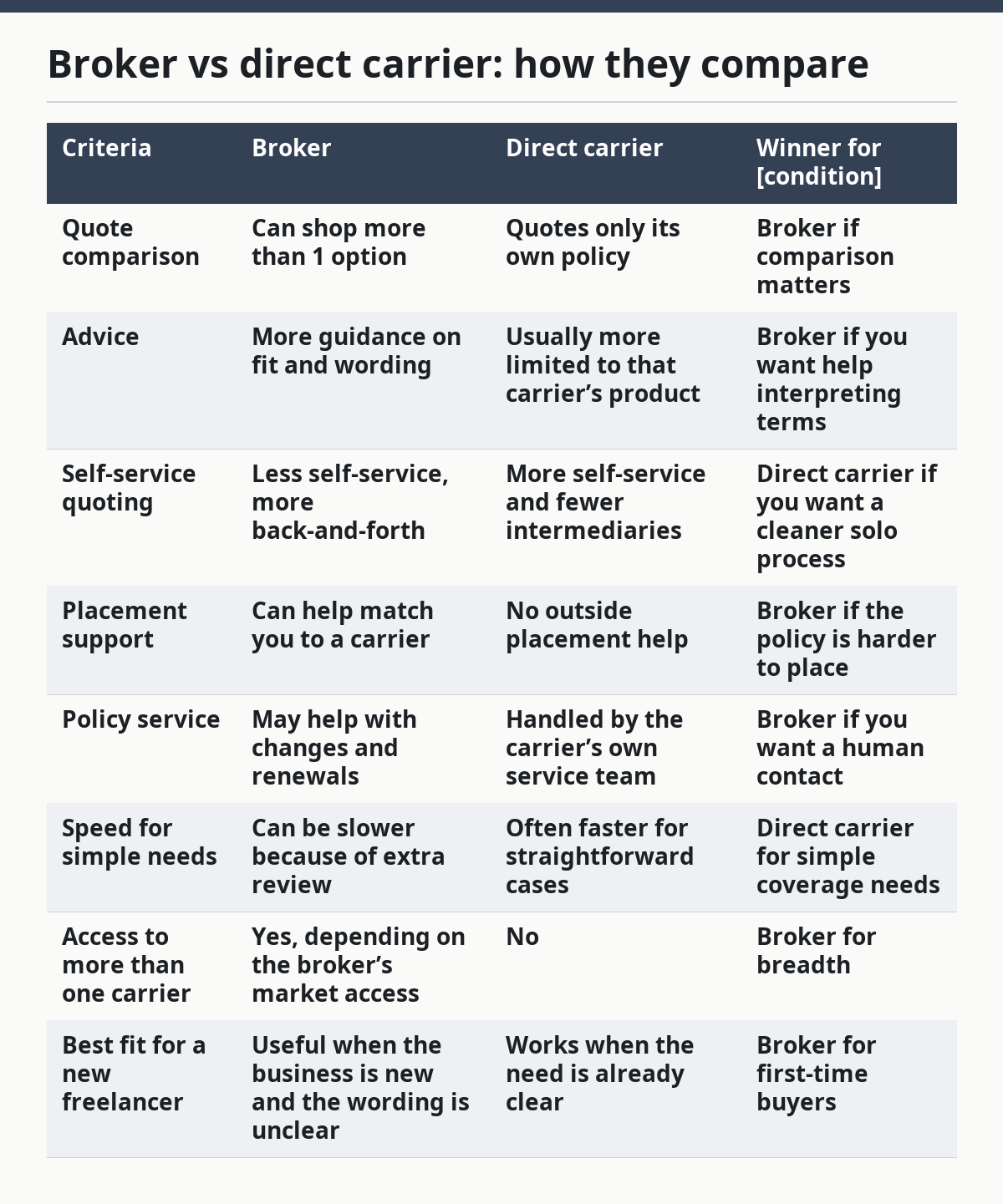
The table points to the core trade-off: broker for guidance and market access, direct carrier for a direct line to one insurer. The table does not claim one is always cheaper or always better, because that depends on the insurer, the policy type, and the market available where you live.
A generic article often gets this wrong by treating “broker” as if it means a faster price and “direct” as if it means less help. If your situation is unclear, consult a licensed professional and check the National Association of Insurance Commissioners consumer pages or your state regulator before you buy. The real split is more practical: do you want someone to help compare, or do you want to handle the comparison yourself?
When does a broker make more sense?
A broker makes more sense when you need help turning a freelance business into an insurable risk. That is especially true if you are unsure which business description, limit level, or policy wording fits your work.

Brokers are strongest when the case is not neat. If you do design work, consulting, writing, or other freelance work with shifting contracts, a broker can help with placement support when one insurer declines or wants more detail. That matters because some policies are sold with narrow underwriting rules, and not every direct carrier will be a fit.
The other advantage is policy service. If you need to update a contract, add a new service line, or fix a name change, a broker can sometimes act as the first call before you go back to the insurer. That does not make the process instant, but it can reduce the chance that a small wording issue sits untouched.
The weakness is speed and handoffs. A broker can ask for more details than a direct carrier would, and that can add time. Some buyers also expect a broker to find “the best” policy without doing any reading themselves. That is a bad assumption. A broker can explain choices, but the final policy still depends on the insurer’s terms.
Use a broker if you value advice, have a contract that asks for specific terms, or want help comparing more than 1 quote. Skip the broker if you already know the policy you need and would rather avoid another layer in the process.
Pros of a broker
- Helps compare 2 or more quotes
- Can explain policy language in plain terms
- Can help with placement support when the case is harder to place
- Often useful for first-time freelancers
Cons of a broker
- More back-and-forth before bind
- May be slower for simple needs
- Service quality can vary by broker, just as it can vary by carrier
- Not every broker works with every insurer
When does a direct carrier make more sense?
A direct carrier makes more sense when the coverage need is straightforward and you want fewer people in the chain. That usually fits freelancers who already know the basic policy they need and are comfortable reading the quote and policy documents themselves.
The direct carrier path can be cleaner because the quote, the underwriting questions, and the policy service all stay inside one company. There is no middle layer translating questions back and forth. For a 1-policy purchase, that can be easier to track, especially if you dislike having to repeat the same facts to multiple people.
The downside is obvious: a direct carrier only sells its own product. If its terms do not fit your work, you do not get a second carrier through the same channel. You also get less outside advice at the quote stage, so mistakes in job description, business activity, or endorsement choices can stay buried until later.
A direct carrier is not the right answer for a freelancer with uncertain coverage needs, a complicated contract, or a history of being declined. It is better for a buyer who wants a straightforward relationship with one insurer and is ready to manage the details.
Pros of a direct carrier
- Fewer handoffs
- Often better for self-service quoting
- One company handles the quote and policy service
- Can feel simpler for a clear, basic need
Cons of a direct carrier
- No outside comparison
- Less advice if you are unsure what to ask for
- No broker to help with placement support
- Not a good fit when your case is more complex
Which one is better for policy service?
A broker is usually better for policy service if you expect changes after the sale, while a direct carrier is better if you want one company to handle everything without an outside intermediary. The service model is different, and that affects the whole life of the policy, not just the quote.

Policy service means the work that happens after bind: billing questions, address changes, name changes, adding documentation, or renewing coverage. With a broker, that service can start with the broker and then move to the insurer. That gives you a human first contact, but it can also add a step.
With a direct carrier, there is no middle layer. That can make the process easier to follow, but it also means you are working within that carrier’s own rules and service hours. If the company is slow to respond, there is no alternate channel through the same buy path.
The right pick here depends on how often your freelance work changes. If you expect your client mix, services, or contract wording to shift over the next 12 months, broker support can be worth it. If your setup is stable and your policy is routine, a direct carrier’s simpler service path may be enough.
This is where many comparison pages stay vague. They say a broker offers “more help” and a direct carrier offers “more control,” but they do not say what that means after the policy is sold. Policy service is the answer.
What should a freelancer choose?
Choose a broker if you want help comparing quotes, checking fit, and handling placement support. Choose a direct carrier if you already know the policy you need and want a simpler self-service quote with one insurer. Neither if your situation is unclear enough that you are guessing at the coverage details.

That is the clean call. For most first-time freelancers, the broker path is the safer fit from a process point of view because the buyer usually needs more explanation than a direct quote screen provides. For a freelancer who already understands the policy terms and only needs to finish the purchase, the direct carrier path is often the faster one.
When the case is unusually simple, a direct carrier can be enough. A solo freelancer with a stable service and no special contract terms may do fine with that route. When the case is unusually messy, a broker is often better. A freelancer with multiple contract requirements, a prior decline, or a change in business activity often benefits from placement support.
The wrong choice is the one that leaves the buyer with too little help for the level of risk. Buying directly is not automatically smarter, and using a broker is not always overkill. The question is whether the channel matches the complexity of the policy.
When should you rethink the channel choice?
You should rethink the channel choice if the quote keeps changing after 2 rounds of questions, if the policy language does not match your contracts, or if you cannot get clear answers on service after bind. Those are signs the channel is not fitting the case.
A broker can be the wrong fit when the policy is simple and the buyer wants speed above all else. In that case, the extra email chain can feel like drag. A direct carrier can be the wrong fit when the buyer needs advice on coverage wording, because the carrier’s job is to sell its own policy, not compare 2 or 3 options side by side.
Another warning sign is confusion about who is responsible for what. If you do not know who to call for changes, cancellations, or certificates, the process is already too unclear. That confusion matters more than any one quote page. A freelancer needs a channel that can handle the next step, not just the first one.
A final check: if you are making a decision based on price alone, pause. The quoted premium is only one part of the buy decision, and rates differ by country and change often. A lower quote that does not fit the policy terms can cost more in time and trouble later.
Sources to check before you buy
Because there is no single “best” outside reference for every buyer, start with the National Association of Insurance Commissioners and your local insurance regulator. Their consumer pages explain how brokers, agents, and insurers differ, and they are a better starting point than a sales page.
For a plain-language overview of insurance licensing and consumer help, the National Association of Insurance Commissioners has consumer pages that are worth reading: https://content.naic.org/consumer. For a general explainer on how insurance markets and distribution work, the Insurance Information Institute also has consumer material: https://www.iii.org/. If you need a local rule on licensing or complaints, your state insurance department is the most direct source.
Those pages will not choose a broker or direct carrier for you. They do help you understand the service model, the licensing issue, and why policy service can differ after you buy.
Should I use a broker for freelance insurance?
A broker is a good fit if you want help comparing more than 1 quote or if you are not sure which policy language matches your freelance work. The broker can assist with advice, placement support, and policy service questions after bind. If your case is simple and you already know the exact product you want, a direct carrier can be easier.
What is the difference between a broker and a direct carrier?
A broker sells or places insurance through more than 1 insurer, while a direct carrier sells its own policy directly. The broker model adds comparison and advice; the direct carrier model keeps the process inside one company. That difference affects quotes, service, and how much help you get before and after the policy starts.
When does a freelancer need an agent?
A freelancer needs an agent when the buying process is no longer simple enough to handle alone. That usually means the coverage terms are unclear, the contract has specific insurance requirements, or a previous quote did not fit the business. In those cases, an agent or broker can help with placement support and policy service.
Drafted with AI; not yet reviewed by a person.
