
Last updated: November 20, 2026
How to Document Coverage Needs for a New Freelance Service Line starts with a risk change, then gives your insurer or underwriter a short, specific summary of what you will do, what can go wrong, and which policy terms may need a policy endorsement. This is information, not financial advice; a qualified adviser should review your own situation before you change coverage. For policy definitions and consumer guidance, see the Insurance Information Institute and the NAIC consumer resources.
Key takeaways
- Write down the new work in plain language before you ask for a policy change.
- Focus on how the service changes claims risk, not on marketing language.
- Match each task to the policy that might be affected: professional liability policy, general liability policy, or both.
- Keep the scope of work, client type, delivery method, and payment model in the same packet.
- If the new work touches legal, medical, tax, or security issues, slow down and get expert help before you bind coverage.
Who needs this document?
This document is for a freelancer who is adding a new service line and needs to show an insurer what has changed. It assumes you already have a current policy, know your existing scope of work, and can describe the new service in one or two sentences. It also assumes you are not guessing from a brochure; you are documenting the real work you plan to do.
This is most useful when the new offer changes your exposure analysis, meaning the set of ways a claim could arise from the work. A writer adding editing, a designer adding brand strategy, or a developer adding managed support all change the risk picture in different ways. The point is not to label the work “higher risk” in a vague sense; the point is to show the underwriter what now sits inside the policy’s protection area and what sits outside it.
A generic note that says “I added consulting” is too thin. An insurer needs to know whether the work is advice, implementation, representation, access to client systems, or physical work at a site. That distinction can matter to a professional liability policy, which usually responds to alleged professional mistakes, and a general liability policy, which usually responds to bodily injury, property damage, or some personal and advertising injury claims. For a broader explanation of those categories, the Insurance Information Institute and the NAIC both provide plain-language overviews.
If the new service line involves regulated advice, client money, data handling, or work that can create bodily injury or property damage, do not rely on a short email alone. Use the document as a basis for a policy review with a qualified adviser or broker who can compare your facts against the wording of the policy form and any endorsements. For the policy language itself, see the NAIC consumer resources.
What should go in the document?
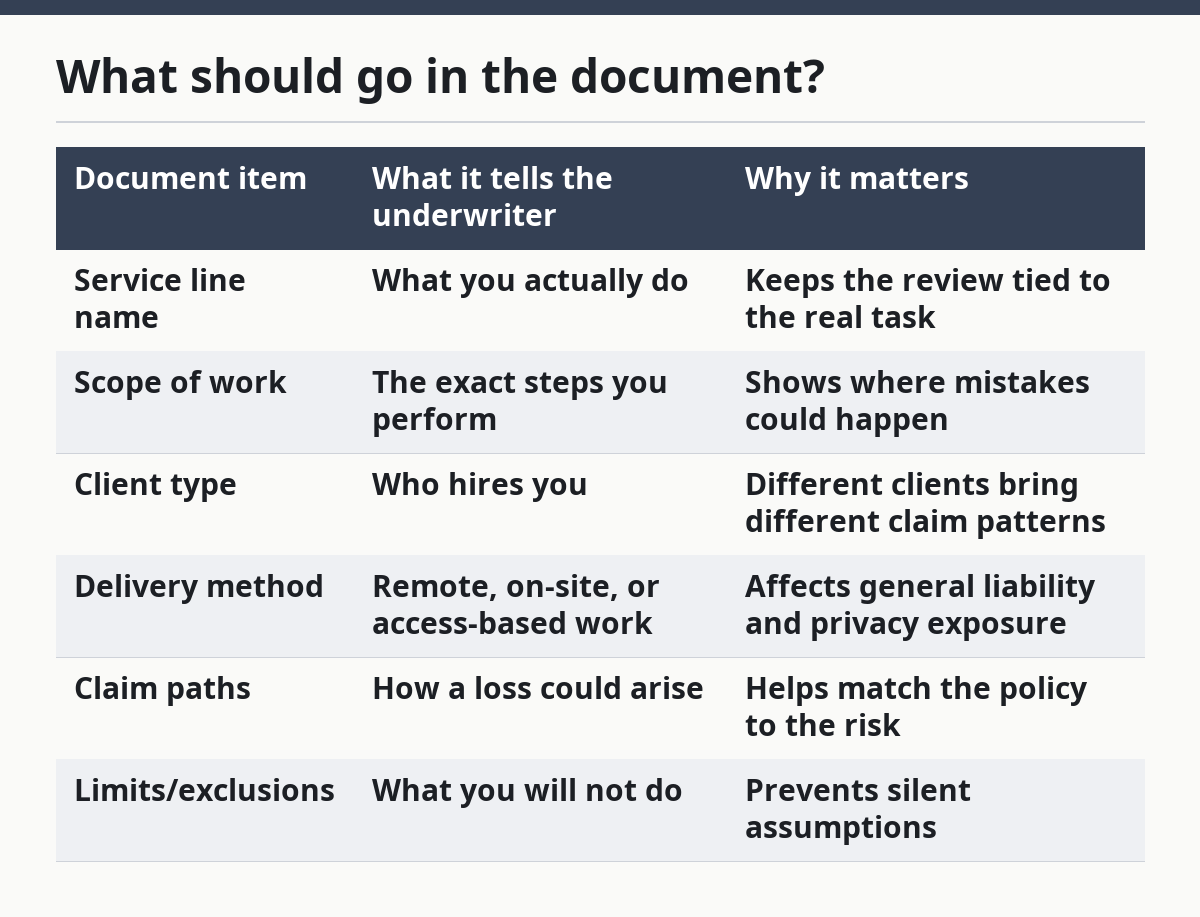
The document should show the service line, the scope of work, the likely claim paths, and the policy questions in one page or a short packet. That packet should be concrete enough that an underwriter can tell whether the new work belongs on the existing form or needs an endorsement, which is an amendment that changes the policy terms.
Start with the service line name in plain language. Then add the actual tasks, the type of client, where the work happens, how you deliver it, and whether you touch client systems, property, or confidential information. A line like “I now offer monthly SEO audits for small businesses” is better than “I offer digital strategy,” because the first line describes a real service and the second leaves too much open.
The document should also note any limits you plan to keep. For example, if you will not make legal decisions, handle payroll, or store payment cards, say so. Limits matter because they narrow the path to a claim and help the underwriter see the service as it is, not as a worst-case guess.
For a useful comparison, think of the document as a map rather than a pitch deck. A pitch deck sells the service. A coverage document shows the insurer where a claim could land.
| Document item | What it tells the underwriter | Why it matters |
|---|---|---|
| Service line name | What you actually do | Keeps the review tied to the real task |
| Scope of work | The exact steps you perform | Shows where mistakes could happen |
| Client type | Who hires you | Different clients bring different claim patterns |
| Delivery method | Remote, on-site, or access-based work | Affects general liability and privacy exposure |
| Claim paths | How a loss could arise | Helps match the policy to the risk |
| Limits/exclusions | What you will not do | Prevents silent assumptions |
For general background on policy terms, the Insurance Information Institute and the NAIC consumer resources are good starting points; if you use a link, make sure it points to the specific page you need, not a generic homepage. The key is still your own facts, not the source list.
How do I document the new service line step by step?
You document it by turning the new service into a short risk memo and then checking each fact against the policy language. The goal is to give the underwriter enough detail to answer one question: does this new service change the insurance need enough to warrant a policy endorsement or other update?
- Name the service line in one sentence. Write the exact service in 15 to 25 words, such as “monthly website maintenance for local nonprofits” or “contract bookkeeping cleanup for sole traders.” Verify that the line matches the work you will actually sell. If the sentence sounds broad enough to cover half a business, that is a problem.
- List the core tasks in 3 to 5 bullets. Separate advice, drafting, implementation, access, and any on-site work. Verify that each task is concrete enough to observe in practice. If you cannot point to a real action, the task is too vague to help with underwriting.
- Define the client profile. State whether clients are consumers, small businesses, nonprofits, or larger firms, and note any regulated industries. Verify whether the client type changes the kind of claim you could face. If the service can reach sectors with special rules, the document is incomplete without that fact.
- Describe how the work is delivered. Note whether the work is remote, in person, inside client systems, or through subcontractors. Verify where physical injury, data loss, or service interruption could occur. If you omit the delivery channel, the insurer may miss a general liability issue or a cyber issue.
- Map each task to a claim path. For every task, ask what could trigger a claim: missed deadline, incorrect advice, damaged property, data breach, or advertising complaint. Verify that each claim path fits a real policy category. If a task has no clear claim path, it may still matter because it can hide the real exposure.
- Note limits and exclusions you will keep. State what you will not do, such as financial advice, legal review, or handling cash. Verify that the limits are real business rules, not hopeful intentions. If the limits are not written down, they are easy to forget later.
- List current policies and any known endorsements. Include the policy names, renewal date, and any special endorsements already on the account. Verify which policy might respond first and where the new work might sit outside the current wording. If you cannot identify the policy form, you do not yet know enough to ask the right question.
- Write the exact questions for the underwriter. Ask whether the new service changes the professional liability policy, the general liability policy, or both, and whether a policy endorsement is needed. Verify that each question is answerable from the facts you supplied. If the question still sounds like “Can I be covered for everything?”, it is too broad.
A good result is short, direct, and usable in one review. It should let the insurer see the service line, the likely exposure change, and the policy issue without reading a marketing page or a full business plan. A poor result is a vague paragraph that could describe almost any freelance work.
What risk changes matter most?
The risk changes that matter most are the ones that alter who can claim, what the claim is about, and which policy might respond. That usually means changes in advice content, client access, physical contact, data handling, or the size and type of project.
A new service line can change the claim path even if it feels similar to the old one. A graphic designer who starts offering print production now has a different property and vendor risk than a designer who only creates files. A consultant who begins sitting inside a client’s workflow may create a stronger professional liability issue than a consultant who only delivers written notes.
The underwriter is usually looking for four things: the scope of work, the client base, the delivery method, and the loss pattern that could follow. If the new service creates the chance of bodily injury or property damage, that is a different question from a mistake in advice or a missed deadline. If it creates access to sensitive data, the question changes again.
That is why the same service line can affect both a professional liability policy and a general liability policy. One policy form may fit the main exposure, but another may still matter because the work has moved outside the old boundary. The document should make that boundary visible.
Use the policy language if you have it. Terms such as “professional services,” “occurrence,” “personal and advertising injury,” and “endorsement” have specific meanings in insurance forms, and those meanings control the result more than the name of the service line does. If the wording is unclear, that is a sign to slow down and get the form reviewed.
When should I stop and get qualified help?
You should stop and get qualified help when the new service crosses into regulated advice, client money handling, physical risk, or data-heavy work that you do not fully understand. Those are the situations where a short self-made note is not enough, because the wrong description can leave a real gap between the work and the policy.
The new service includes legal, tax, investment, or medical advice: that can move the work into a regulated area — have a qualified adviser review the service description and the policy wording before you change coverage.
The work gives you access to client systems, passwords, or personal data: that often creates a separate exposure path, but a broker or adviser should confirm how your own policy form treats privacy, cyber issues, and third-party vendor work. See the NAIC consumer resources on data and cyber protection.
You will visit client sites or handle tools, equipment, or property: that may trigger general liability issues — verify whether the new work sits inside the current form or needs a change.
You plan to subcontract part of the new service: that can shift responsibility and add another layer of risk — confirm whether subcontractor work is included or excluded.
The service line is much broader than your old one: for example, moving from copywriting to campaign strategy or from bookkeeping cleanup to ongoing finance support — that can change the professional standard you are judged against, so get the wording checked.
You cannot describe the service in one concrete paragraph: that means the scope is still loose — do not ask for coverage changes until the work itself is clear.
A quick answer from an adviser is often cheaper than a claim dispute later. The document is not a substitute for reading the policy form, and it is not a guarantee that the carrier will agree with your description. It is a tool to make the question precise.
What mistakes do people make?
The biggest mistake is writing a sales description instead of a coverage description. That can hide the real claim path and leave the underwriter guessing. The correct alternative is a plain list of tasks, client type, and delivery method.
A second mistake is leaving out the parts of the work that feel minor, such as access to files, site visits, or subcontractors. Those details often matter more than the headline service name. If the packet omits them, the insurer may miss the exposure change tied to a professional liability policy or a general liability policy.
A third mistake is saying the service is “the same as before, just expanded.” That sounds tidy, but it can be wrong. A service line that adds implementation, advice, or physical access is not the same as a service line that only adds more volume.
A fourth mistake is asking for a yes-or-no answer without the facts that support it. Underwriters answer based on wording and exposure, not on a guess about the business model. If the question is vague, the answer will be vague too.
A fifth mistake is waiting until renewal day to document the change. That leaves little time to correct the scope of work, ask follow-up questions, or request an endorsement. A short lead time can turn a simple update into a scramble.
A sixth mistake is forgetting that policy wording changes over time. Renewal terms, endorsements, and exclusions can differ from one policy period to the next, even for the same freelancer. If the new service is important to the business, keep a dated record of the document each time you renew.
How should I package this for the underwriter?
You should package it as one short summary, one task list, one risk map, and one list of policy questions. That format is easier to review than a long narrative, and it helps the underwriter focus on the facts that affect the policy. A clean packet usually fits in 1 to 2 pages plus any attached scope of work.
Start with the service line summary, then attach the scope of work if you have one in writing. A scope of work is the document that states what the freelancer will do, what is out of scope, and how the work will be delivered. If you already use a scope document with clients, that can often be a strong starting point for the insurer to read.
Next, add a short risk note with the main claim paths. Keep it practical: advice error, missed deadline, damaged property, data issue, or advertising issue. If the service line changes more than one policy area, say so directly. That can save time and reduce back-and-forth.
End with three direct questions: does this change the professional liability policy, does it affect the general liability policy, and is a policy endorsement needed before the new service starts? Keep the wording tied to the facts you supplied. If the underwriter asks for more detail, answer with the same format rather than sending a long free-form message.
For general process support, the broader Freelancer insurance policy selection hub can sit above this page. This page’s job is narrower: turn a new service line into facts an insurer can use.
FAQ
Do I need a new policy for a new service?
A new service does not always mean a new policy, but it can mean your current policy needs review. The key issue is whether the new work changes the claim pattern enough to affect the professional liability policy, the general liability policy, or both. A qualified adviser should review the wording for your situation. For policy terminology, the Insurance Information Institute is a useful reference.
How does a new service affect insurance?
A new service can change what kind of loss is most likely, who could claim, and which policy form applies. A service that adds advice, access, or physical work often creates a different exposure than the old one. That is why the service line, scope of work, and delivery method should be documented before the insurer reviews it.
What should I tell my insurer about a new offering?
Tell the insurer the exact service, the main tasks, the type of client, where the work happens, and what could go wrong. Include whether the work touches client systems, property, or sensitive data, and whether you will use subcontractors. The clearer the facts, the easier it is for the underwriter to judge whether a policy endorsement is needed.
Drafted with AI; not yet reviewed by a person.
