
Last updated: November 20, 2026
Ask the claims adjuster for a reserve review in writing, then tie the request to the claim estimate, the reserve letter, and any change in the file status. A claim reserve is the insurer’s set-aside for what it expects the claim may cost, and the number can move before settlement. This is information, not financial advice; a qualified adviser should be consulted for your own situation.
Key takeaways
- A reserve update is a request for a review of the insurer’s internal estimate, not a demand for payment.
- The clearest request names the claim number, the reserve figure if you have it, and the reason you think the file changed.
- The adjuster’s reply may show a change, explain why nothing changed, or point to the policy limit, deductible, or claim file status.
- Reserve questions are worth asking when the loss grows, the facts shift, or the reserve letter no longer matches the claim estimate.
- If the file has coverage disputes, a deadlocked adjuster, or a hard policy issue, the reserve question is only part of the problem.
Who should ask for a reserve update?

A freelancer should ask for a reserve update when the claim estimate has changed or the reserve letter no longer fits the file. This applies to people with a live claim, an assigned claims adjuster, and a way to contact the insurer by email, portal, or phone.
This page assumes you already know your claim number, the policy limit, and the deductible, and that you have at least one document showing why the estimate may have moved. If you have no claim file status yet, or you are still building the loss details, the reserve question may be premature. For broader help with the claims process, the hub on Freelancer insurance claims management is the right starting point.
A reserve update is usually useful when the loss has not settled, the adjuster has not issued a final figure, and the reserve appears too low or too high for the facts in the file. It is less useful if you are really asking about coverage, payment timing, or whether the insurer must pay a certain amount. Those are different questions, even if they travel in the same email.
A generic article gets this wrong by treating every claim as if the same rule applies. It does not. A freelance liability claim can involve client invoices, project delays, third-party injury, or professional error, and each one can affect the reserve in a different way.
How do I ask for a reserve update?
You ask for a reserve update by sending one clear request to the claims adjuster and asking for a review of the current claim reserve, the reserve letter, and the claim estimate. The cleanest approach is a short email or portal message that asks for the file to be rechecked against the latest facts.
Use this order, because it keeps the request tied to the file instead of to emotion or guesswork:
- Open the claims portal, email thread, or adjuster letter and confirm the claim number, the adjuster’s name, and the date of the last reserve letter.
- Write one subject line that names the file, such as “Request for reserve review — claim [number].” Keep it under 10 words if the email tool cuts long lines.
- State the current reserve issue in 2 sentences: say what changed, such as a larger estimate, new invoices, or a changed loss description, and name the amount if you have it.
- Attach only the 1 to 3 documents that explain the change, such as an updated claim estimate or an invoice summary. Do not send a long bundle unless the adjuster asked for it.
- Ask for the reserve to be reviewed against the policy limit and deductible so the file reflects the current exposure.
- Request a written reply that explains whether the reserve changed, when the file was last reviewed, and whether the claim file status has changed.
- Verify that your message includes the date, the contact name, and one sentence asking for confirmation. If any of those pieces are missing, the adjuster can answer loosely and the record becomes harder to use later.
A problem shows up when the request is vague, buried under 12 attachments, or framed as a complaint about the insurer instead of a file review. Adjusters work from the file, not from tone. If the reserve changed because the exposure changed, you want that reason in writing.
If you speak by phone first, follow up in writing the same day. A phone call can speed the conversation, but the written note is what shows exactly what was asked. For a general framework on insurer communication, the Insurance Information Institute and the National Association of Insurance Commissioners both publish consumer guidance on claims handling.
What should I check before I send it?
You should check the claim reserve, the claim estimate, the deductible, and the policy limit before you ask for a review. That is the minimum set of numbers that helps you ask a specific question instead of a broad one.
Use a simple 3-part check:
- Compare the latest reserve letter with the last estimate you sent.
- Note whether the reserve seems to track the same loss facts.
- Check whether the deductible or policy limit changes the meaning of the reserve.
If the reserve letter uses language like “pending review,” “partial evaluation,” or “reserve only,” the file may still be open and the number may still move. If it says the file is at limit or that coverage is being reviewed, a reserve update may not solve the core issue. That difference matters.
| Way to ask | Best for | Main strength | Main weakness |
|---|---|---|---|
| A paper trail | Easy to save and forward | Can be slow if the file is busy | |
| Claims portal message | Files with a portal | Stays inside the claim record | Message boxes can be short |
| Phone call plus follow-up email | Urgent clarification | Faster conversation | The record is weak if you skip the follow-up |
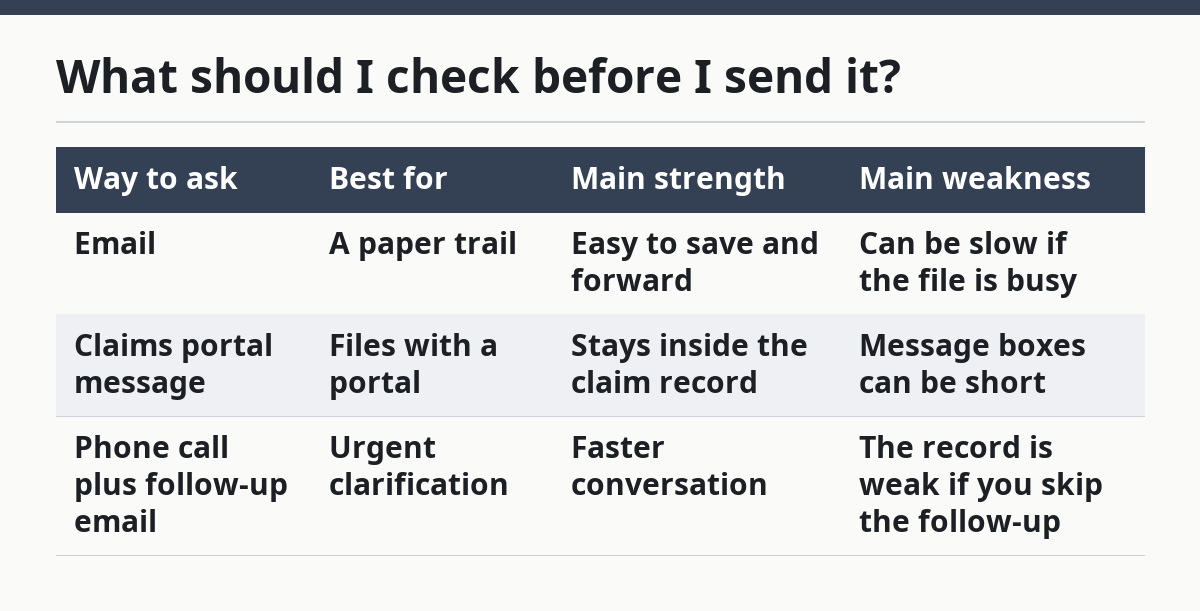
A weak article would tell you to “just ask nicely” and leave it there. That misses the real point. The reserve only makes sense in the context of the file, and the file is driven by the claim estimate, the policy limit, and the deductible.
What does a reserve change mean for my claim?
A reserve change means the insurer’s internal estimate has shifted, not that the claim has been approved or denied. The reserve is a file-management number first, and a payment signal only in a loose sense.
A higher reserve can mean the insurer thinks the exposure is larger than before, the loss facts have changed, or the file now has more uncertainty. A lower reserve can mean part of the loss has been closed out, a claim item was removed, or the adjuster believes the exposure narrowed. Neither change tells you everything by itself.
That is why a reserve update should be read together with the claim file status. If the status still shows investigation, the reserve may be fluid. If the status shows settlement talks, the reserve may already be close to the final range. If the status shows closure, the reserve question may be less useful than a request for the closing explanation.
This is also where people make a false jump: they assume the reserve is the payout. It is not. It is an internal estimate that can sit above or below the final payment depending on the facts, the deductible, the policy limit, and what the insurer decides is covered.
When should I stop and get help?
You should stop the DIY approach when the reserve question turns into a coverage dispute, a deadline problem, or a policy-limit issue. At that point, the file needs a qualified review rather than a better email.
The adjuster will not confirm the reserve in writing: That usually means the file is still fluid or the insurer does not want to commit in writing — escalate through the claims portal and ask for the file review status, not just the number.
The claim estimate keeps changing without explanation: The reserve may be tracking unresolved facts — ask for the reason, and if the explanation is inconsistent, get qualified help to review the file.
The policy limit is close to the reserve figure: The reserve may be signaling a limit issue — the next step is a careful policy review, because the amount left under the limit can affect the whole claim.
The deductible is being applied in a way you do not understand: The reserve may look high because the insurer is reserving against the full exposure — ask for the calculation in writing and confirm how the deductible is treated.
The file status says coverage is disputed: The reserve may be only one piece of a bigger dispute — the better next step is professional advice on the claim posture, not another round of informal follow-up.
You need to rely on the reserve for a business decision within 7 days: A reserve is not a settled number — use it cautiously and get qualified advice before you act on it.
This section is not a legal warning label. It is the practical line where a simple request stops being simple. If the reserve sits inside a broader insurance problem, the wrong follow-up can waste time and muddy the file.
What mistakes slow the request down?
The most common mistake is asking for “an update” without naming the reserve. That usually leads to a general status reply instead of a review of the claim reserve. The fix is simple: name the reserve, the reserve letter, or the claim estimate in the first sentence.
Another mistake is sending 8 or 9 attachments with no explanation. The adjuster then has to guess which document matters. Keep the request tight and point to the 1 or 2 pages that show the change.
A third mistake is mixing the reserve question with unrelated arguments about blame or payment speed. That can pull the conversation away from the file mechanics. Separate the topics and ask for the reserve review first.
A fourth mistake is failing to save the reply. If the adjuster answers by phone and you do not follow up in writing, the file record can become fuzzy. Always ask for confirmation by email or portal message.
A fifth mistake is assuming the reserve must rise just because your own cost estimate rose. It may, but it may not. The insurer may see a different coverage picture, a different deductible effect, or a different exposure under the policy limit.
What if the claim file is unusual?
You should modify the request when the file has more than one claimant, more than one loss item, or a partial denial. In those files, a single reserve number may cover several pieces of exposure, so the update has to be more precise.
If there are multiple invoices, ask which line item the reserve covers. If the file includes both property damage and lost income, ask whether the reserve applies to one part or to the whole claim. If the adjuster says the reserve is “global,” that means the number covers the file as a whole, not a single invoice or service line.
When the file is unusual, the request should ask for the reserve basis, the current claim file status, and any change to the policy limit or deductible treatment. That is a better question than “Why is the reserve so high?” because it gives the adjuster a way to answer in the record.
A plain claim can usually be handled in one message. A complex file often cannot. The more moving parts there are, the more important it is to keep the request tied to the document trail and not to a rough memory of a prior call.
FAQ
What is a claim reserve?
A claim reserve is the insurer’s internal estimate of what a claim may cost before it is fully closed. It is not the same thing as a settlement payment, and it can change as the file changes. The number may reflect the claim estimate, the policy limit, the deductible, and open questions in the file.
Can a freelancer ask for a reserve review?
Yes, a freelancer can ask for a reserve review on an open claim. The request works best when it is tied to a specific change in the file, such as a new estimate, a new invoice, or a shift in claim file status. A short written request is usually better than a long phone conversation.
Does a reserve affect my policy?
A reserve can affect how the insurer views the file, but it does not by itself settle the claim. It may also matter if the reserve is close to the policy limit or if the deductible changes the exposure. Because policy terms differ by country and by contract, a qualified adviser should review your own policy language.
Drafted with AI; not yet reviewed by a person.
