

Last updated: November 20, 2026
Update your freelance insurance as soon as you hire a subcontractor by checking your independent contractor agreement, collecting a certificate of insurance, and confirming whether your general liability policy or professional liability policy needs an endorsement. This is information, not financial advice, and a qualified insurance adviser should be consulted for your own situation.
Key takeaways
- Hiring help can change how risk is divided between you and the subcontractor.
- A written independent contractor agreement should say who carries which policy and who names whom, if anyone, as an additional insured.
- A certificate of insurance is proof of coverage; it is not the policy itself.
- General liability and professional liability do different jobs, so one does not replace the other.
- If the work is high-risk, unclear, or outside the subcontractor’s normal trade, stop and get qualified help before work starts.
Who this applies to
This applies to a freelancer who has hired a subcontractor and needs to update freelance insurance after hiring a subcontractor before the work begins. It assumes you already have at least one active policy, such as a general liability policy or a professional liability policy, and that you use an independent contractor agreement or a scope of work. If the subcontractor will work unsupervised, handle client contact, or create deliverables under your name, the insurance review matters more, not less.
This is not the right page for adding a new policyholder to a policy, changing your service line, or handling a client’s request for proof of insurance. Those are different questions. The issue here is the insurance update triggered by bringing in help, and the main job is to make sure the subcontractor’s role matches the coverage on both sides. If the project involves licensing rules, regulated advice, or unusual contract terms, qualified help is worth getting before you sign anything.
What changes when you hire help?
Hiring a subcontractor changes who can create the loss, who can be blamed for it, and whose policy may respond first. A subcontractor is a person or business you hire to perform part of your project, often under a separate agreement, and not as your employee. That distinction matters because the policy wording, the contract wording, and the real work all need to line up.
The biggest shift is that your insurance no longer protects only your own mistakes. It may also need to account for work done by another party, especially if the subcontractor handles client files, delivers advice, or works on-site. In many cases, the subcontractor should carry their own coverage, and the agreement should say so in plain terms. If the subcontractor has no insurance, the gap can land back on you when a client asks for payment, correction, or defense.
Two policies deserve a close look. A general liability policy usually relates to bodily injury, property damage, and some personal injury claims. A professional liability policy usually relates to errors, omissions, or advice-related losses. If the subcontractor changes how the job is performed, either policy may need a review. A short project can still create a long claim.
How do I update the insurance?
You update it by matching the contract, the work, and the insurance paperwork in one pass. The practical sequence is simple, but each step matters because one missing detail can leave the rest of the file useless.
- List the exact subcontracted tasks. Write down the scope of work in 1 document, not across email threads. Verify whether the subcontractor will do production, client communication, site visits, design, advice, or data handling. If the task list is vague, the insurance review is already incomplete.
- Check the independent contractor agreement first. Confirm whether the agreement says the subcontractor must maintain their own general liability policy, professional liability policy, or both. Look for language about certificates of insurance, indemnity, and any additional insured request. If the agreement is silent, the risk split is unclear.
- Ask for a certificate of insurance before work starts. A certificate of insurance, often issued on an ACORD 25 form, is a summary of coverage, not the policy itself. Verify the named insured, policy dates, carrier name, and the type of coverage listed. If the dates have expired or the named insured is wrong, the certificate does not help.
- Compare the subcontractor’s policy limits to the job’s exposure. You do not need to guess a number; you need to confirm that the coverage type fits the work. Check whether the subcontractor carries a general liability policy, a professional liability policy, or both, and whether any exclusions appear to remove the exact task they will perform. A mismatch between task and policy is a warning sign.
- Review your own policy wording for subcontractor work. Read the sections on subcontractors, contractors, and insured operations. Some policies treat subcontracted work differently from your own labor. If the wording is unclear, the problem is not the subcontractor’s certificate; it is your policy language.
- Decide whether your carrier needs to know about the subcontractor. Some policies require notice when you bring in outside help. Others only care if the work changes materially. If the policy asks about payroll, revenue, or subcontracted operations, verify whether the answer has changed. A silent change can become a coverage dispute later.
- Update the project file with 3 items. Keep the signed agreement, the certificate of insurance, and the current scope of work together. If any one of the 3 is missing, you may not be able to show who was responsible for what when a claim arrives.
- Recheck before the subcontractor starts. Confirm the effective date, the exact services, and whether the subcontractor is supposed to name you as an additional insured. If the work starts before these details are aligned, the first 1 or 2 weeks can be the riskiest part of the job.
One useful way to think about the update is this:
| Item | What it tells you | What it does not tell you |
|---|---|---|
| Independent contractor agreement | Who agreed to do what | Whether the policy actually covers the work |
| Certificate of insurance | That coverage appears to exist on the stated date | Whether the policy will pay a claim |
| Scope of work | What the subcontractor will actually do | Who will be legally responsible if something goes wrong |
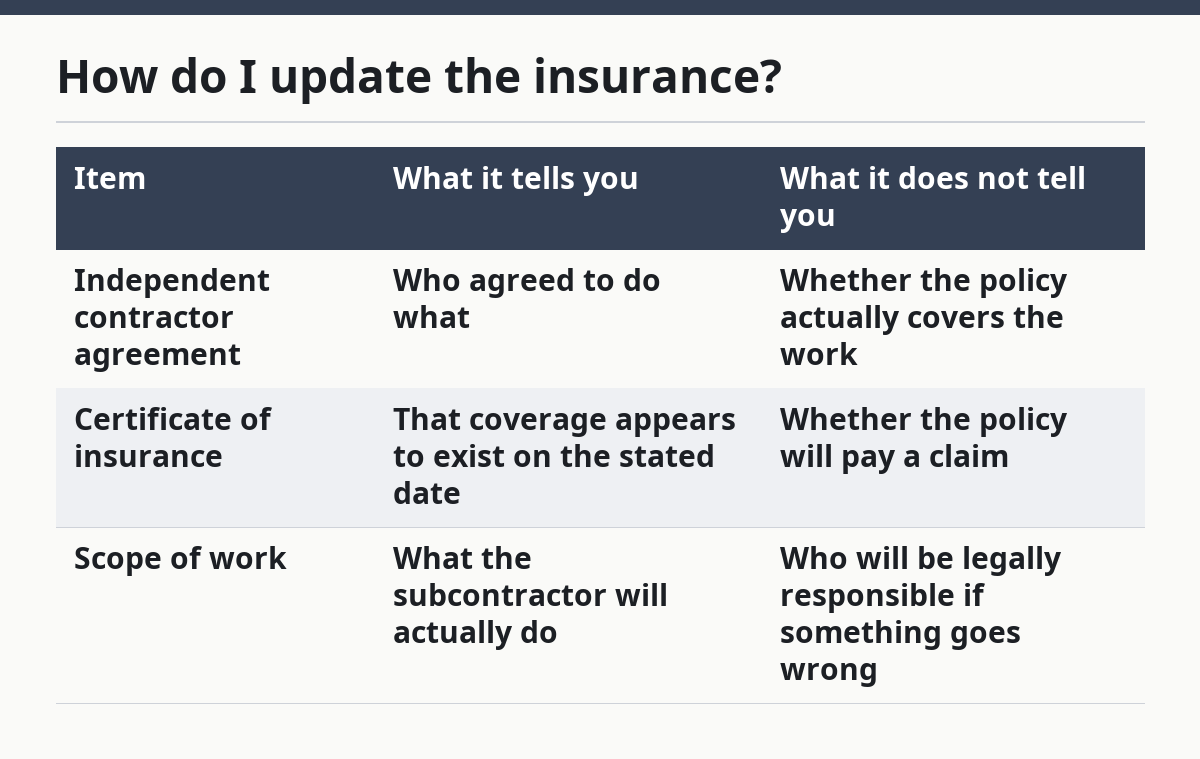
This is where many freelancers get tripped up. The contract may say one thing, the certificate another, and the real work a third thing entirely. If those three do not match, the insurance update is not finished.
What should the subcontractor carry?
The subcontractor should usually carry the same type of coverage that matches the work, not a random policy chosen for convenience. If the subcontractor’s job is physical or on-site, general liability policy language matters. If the job is advice, editing, design, coding, or another service where the harm is financial rather than physical, professional liability policy language matters more.
The point is not to force every subcontractor into every policy type. The point is to make the coverage follow the risk. A graphic designer subcontractor does not need the same exposure as a tradesperson on a job site, and an editor is not the same as a consultant giving technical advice. Your agreement should reflect that difference in 1 or 2 sentences, not in a vague promise to “be insured.”
If the subcontractor cannot provide proof of their own coverage, that is a business problem, not just a paperwork delay. It can change your price, your timeline, or your decision to use them at all. For some projects, especially those with client contracts attached, that gap can stop the job before it starts. This is one of the clearest places where the standard approach does not apply: if the subcontractor’s work is central and uninsured, the paperwork is not the fix.
When should you stop and get help?
You should stop and get qualified help when the contract, the policy, or the work itself no longer matches a simple freelance setup. This section is about the moments when a DIY insurance update is the wrong tool.
The subcontractor has no certificate of insurance: There is no basic proof that coverage exists — pause the project until you have documentation or revise the scope so the risk is smaller.
The subcontractor will do work outside their usual trade: The policy may exclude unfamiliar work — get the coverage wording checked before you let them start.
Your agreement asks for additional insured status: That request changes how the insurance relationship works — confirm the wording and limits before assuming a certificate is enough.
Your own policy asks about subcontracted operations and you are unsure how to answer: The application or renewal answer may affect coverage — ask a qualified adviser before you submit the form.
The project involves regulated advice, access to sensitive data, or a client contract with insurance clauses: The risk is no longer routine — have the documents reviewed before you sign or begin work.
These situations matter because a later claim is not the moment to find out the paperwork was incomplete. Once the work is done, the cleanest fix may no longer be available.
What mistakes do freelancers make here?
Freelancers usually make 1 of 5 mistakes, and each one has a different cost. The problem is rarely lack of effort; it is treating the insurance update like a formality.
First, they assume the certificate of insurance equals actual protection. It does not. A certificate can be accurate and still leave out an exclusion that matters, so the correct move is to compare the certificate with the policy terms and the subcontractor’s scope.
Second, they use a broad independent contractor agreement that never mentions insurance. That leaves the risk split vague, which makes disputes harder to sort out. The better alternative is a short clause that says who carries coverage and what proof must be provided.
Third, they forget that a general liability policy and a professional liability policy are not interchangeable. A slip-and-fall claim and a bad-advice claim live in different parts of the insurance world. The fix is to identify the actual risk type before deciding what to ask for.
Fourth, they let work start before the subcontractor’s paperwork is complete. That can create a gap during the most exposed part of the project. The safer alternative is to collect the certificate and confirm the agreement first, then start.
Fifth, they fail to update their own records after the subcontractor is added. If a claim or audit happens months later, scattered emails are weak evidence. Keep the agreement, the scope of work, and the certificate in one file from day 1.
For a broader view of freelance policy choices, the hub page on Freelancer insurance policy selection is the right companion piece.
What if the setup is unusual?
The standard approach needs modification when the subcontractor is part of a larger team, the work crosses state lines, or the client contract sets extra insurance terms. In those cases, a 1-page checklist is not enough because the policy language may interact with more than one contract or jurisdiction.
If the subcontractor works in a different location, check whether the policy territory still fits. If the project has multiple deliverables, split the scope of work by task so one person’s error does not get mixed with another’s. If the subcontractor is effectively acting like a partner rather than a temporary helper, the insurance picture may no longer fit a simple vendor model.
A useful standard here is to keep the written scope to one project and one role at a time. If the work starts to sound like “whatever comes up,” the insurance review should stop and be redone. A vague role makes a vague claim, and vague claims are where coverage disputes grow.
For background on worker classification and contractor status, the IRS page on independent contractor rules is a useful public reference, and the U.S. Department of Labor’s guidance on employee versus contractor status is also worth reading. Those pages do not answer your insurance question, but they help explain why the job structure matters.
How do I know the update is complete?
The update is complete when the contract, the scope, and the proof of coverage all match the same project. That means the independent contractor agreement says who is responsible for insurance, the certificate of insurance is current, and your own policy file reflects the subcontracted work without surprises.
A good result is boring in the best way: no unclear roles, no missing dates, no unexplained coverage gaps, and no assumption that one policy covers every issue. If any part of that chain is uncertain, the update is not done yet. Insurance works best when the paperwork is plain enough that another person could read it 6 months later and understand the setup.
This is where a quick review can prevent a long problem. A 10-minute check now is much easier than sorting out who was covered after a loss.
Do subcontractors need to be added to my policy?
Usually, no one is automatically added just because you hired a subcontractor. The more important question is whether your policy needs to reflect subcontracted work and whether the subcontractor should carry their own coverage. The answer depends on the policy wording, the project, and the contract terms.
Does hiring help change my insurance needs?
Yes, hiring help can change your insurance needs because it changes who performs the work and how the risk is shared. A general liability policy may still be the right base, but the subcontractor’s role can trigger a review of endorsements, exclusions, and contract language. The change is about exposure, not just headcount.
What insurance proof should a subcontractor provide?
A subcontractor should usually provide a certificate of insurance that shows the named insured, policy dates, and the relevant coverage types. An ACORD 25 certificate is a common format, but the form alone is not enough if the dates are wrong or the coverage type does not match the job. If the work is specialized, ask for the exact policy details that support the certificate.
Drafted with AI; not yet reviewed by a person.
