

Last updated: November 20, 2026
Quick answer: a freelance insurance file for renewal review should contain 5 core documents. This guide explains how to build a freelance insurance file for renewal review so you can check whether your current policy still fits your work, compare the current terms with the last renewal, and flag anything that needs qualified help. It is right for freelancers who already have a policy, a renewal notice, and a client contract to check; it is not enough if your cover changed after a claim, a new service line, or a client’s insurance requirement changed. This is information, not financial advice, and a qualified adviser should be consulted for your own situation.
Table of contents
- Key takeaways
- Who this is for
- What goes in the file?
- How do I prepare for an insurance renewal?
- What should I review before renewing freelancer insurance?
- When should I stop and get qualified help?
- What mistakes do freelancers make with renewal files?
- When does the standard approach need to change?
- What does a good renewal file look like?
Key takeaways
- Keep the file narrow: the renewal notice, declarations page, endorsement schedule, claims history, and client contract do most of the work.
- Check what changed, not just what stayed the same. Renewal review is about differences in limits, exclusions, endorsements, and client terms.
- A file that does not show claims history or contract requirements can hide a gap that matters at renewal.
- If the policy was altered mid-term, the endorsement schedule matters as much as the declarations page.
- Skip the DIY review alone if the work changed, a claim is active, or a client contract now asks for wording you do not understand.
Who this is for

This file is for a freelancer who wants to review a policy in 15 to 30 minutes before renewal, not rebuild the whole insurance picture from scratch. It assumes you already have the renewal notice, the declarations page, any endorsement schedule, a claims history summary, and at least one client contract that names insurance terms.
It is also the right tool if you want a clean paper trail for a broker, insurer, or adviser. It is not the right tool if you do not know what work the policy covers, if the business has changed shape in the last 12 months, or if the policy has had several endorsements and you cannot tell which version is current. In those cases, the file alone will not settle the issue, and a qualified adviser should review the wording.
A good renewal file does one job: it shows what was promised, what changed, and what the client now requires. That is why the file should stay small. If it turns into a dumping ground for every email and invoice, the important parts get buried. For this reason, I would treat it as a working file, not an archive, but if you are unsure how to organize insurance records for your situation, consult a qualified adviser or broker. Keep the file lean and review it with the freelancer insurance policy selection hub in mind, because renewal review sits one step before a bigger choice about what kind of cover the business needs next.
What goes in the file?
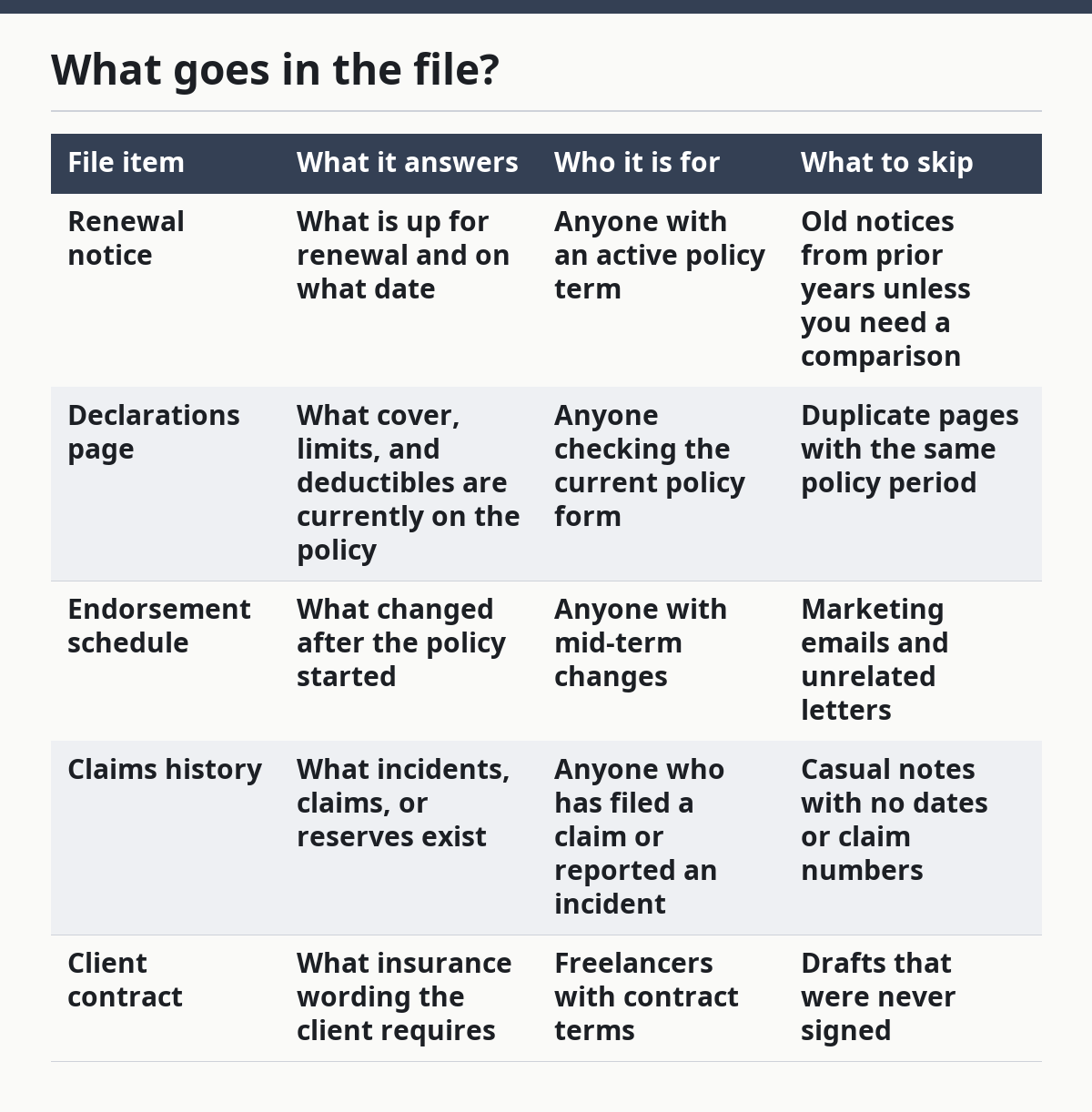
A useful freelance insurance file for renewal review usually holds 5 core items, and each one answers a different question. The renewal notice tells you what the insurer is renewing and when. The declarations page shows the named insured, coverage types, limits, deductibles, and policy period. The endorsement schedule lists changes made after the policy was first issued.
Claims history tells you whether there were incidents, open claims, or reserves that could matter at renewal. A client contract shows what your client asked for in writing, such as minimum limits, additional insured wording, or a certificate requirement. If any of those pieces are missing, the review gets blurry.
| File item | What it answers | Who it is for | What to skip |
|---|---|---|---|
| Renewal notice | What is up for renewal and on what date | Anyone with an active policy term | Old notices from prior years unless you need a comparison |
| Declarations page | What cover, limits, and deductibles are currently on the policy | Anyone checking the current policy form | Duplicate pages with the same policy period |
| Endorsement schedule | What changed after the policy started | Anyone with mid-term changes | Marketing emails and unrelated letters |
| Claims history | What incidents, claims, or reserves exist | Anyone who has filed a claim or reported an incident | Casual notes with no dates or claim numbers |
| Client contract | What insurance wording the client requires | Freelancers with contract terms | Drafts that were never signed |
This is also the point to use the broader freelancer insurance policy selection hub for context, because renewal review sits one step before a bigger choice about what kind of cover the business needs next.
How do I prepare for an insurance renewal?

You prepare for an insurance renewal by assembling the file, comparing the current terms with the last set of terms, and checking for any change in claims, clients, or work scope. That process is most reliable when you follow the same order most of the time, because a consistent sequence makes missing pages easier to spot.
- Start with the renewal notice and policy period. Record the renewal date, the policy period, and the named insured exactly as they appear on the notice. Verify that the policy period is a full 12 months or whatever term the policy uses, and flag any mismatch in the legal name or business name. A mismatch is a problem because the policy may not match the contract or the certificate request.
- Pull the declarations page next. Check the coverage type, policy number, limits, and deductibles on one page. Verify that the main limit is shown in the same currency and format the client contract expects, and that each deductible or excess is still acceptable. If you cannot match the limit wording to the renewal notice, the file is incomplete.
- Attach the endorsement schedule. List every endorsement that changed the policy during the term, including coverage additions, exclusions, or limit changes. Verify the effective dates on each endorsement, because an endorsement dated after a claim or contract signature can change the result. A missing endorsement schedule is a red flag for a partial file.
- Add claims history with dates and status. Record any claim, notice, or incident with the date reported, the claim number if there is one, and whether it is open or closed. Verify that nothing is missing from the last 12 months and that any reserve or unresolved matter is easy to find. A claim history that only says “one claim” is too thin to review.
- File the client contract or insurance schedule. Keep the signed version, not a draft, and highlight the insurance wording that matters. Verify the requirements for limits, additional insured status, waivers, or notice wording. If the contract uses language you cannot match to the policy form, the file should stop there until someone qualified reads it.
- Compare the current cover with the last renewal. Put the current declarations page beside the prior one and compare the 3 biggest items: limits, deductibles, and excluded work. Verify whether anything changed after a claim, a new service, or a new client clause. If nothing changed on paper but the work changed in real life, the file is misleading.
- Mark the questions that need an answer before renewal. Write down anything you cannot verify in the file, such as an endorsement you do not recognize or a client term that seems inconsistent. Verify that each question names the document where the answer should appear. If a question cannot be answered from the file, do not treat the file as complete; consult a qualified adviser or broker before you decide.
A strong renewal file does not need 20 tabs. It needs the right 5 to 7 pieces of paper in the right order, with the dates visible. If a document does not help you answer “what changed?” or “what does the client require?”, it does not belong in the working file.
What should I review before renewing freelancer insurance?
Before renewing freelancer insurance, review coverage changes, claims history, client requirements, policy limits, and endorsements. That list sounds simple, but the problem is usually not the policy itself; it is the gap between the policy and the work the freelancer actually does.
Start with coverage changes. If the business added a new service, new software, or a new type of client work, the old wording may not fit. Then check claims history, because even one open or closed claim can matter at renewal when the insurer looks at frequency, severity, or unresolved issues. After that, compare client requirements against the policy form, since a signed contract can demand wording that the policy does not clearly provide.
Policy limits deserve special attention because the client may ask for a specific minimum, and the declarations page is where the number usually appears. Endorsements can change the meaning of the policy without changing the broad title on the front page. A freelancer who reads only the policy name can miss an exclusion added 6 months earlier.
One practical rule helps here: if the answer depends on a contract term, check the contract first; if it depends on actual cover, check the endorsement schedule first. That keeps the review from drifting into guesswork.
For a related checklist, see the freelancer insurance contract checklist, the certificate of insurance guide, and how endorsements change policy wording.
When should I stop and get qualified help?
You should stop and get qualified help when the file shows a mismatch that you cannot resolve from the documents on hand. On a money topic, that is the point where guesswork can cost real money or leave a gap in cover.
The policy has multiple endorsements and you cannot tell which one controls: this means the form history is too messy for a plain self-review — get the insurer, broker, or adviser to confirm the current wording.
The client contract asks for wording you cannot match to the policy: this means the contract and the cover may not line up — do not assume a certificate will fix it.
There is an open claim, reserve, or recent incident: this means the renewal may be affected by loss history — ask for help before you rely on a clean renewal assumption.
The business added a new service, platform, or line of work: this means the old file may describe the wrong activity — review the policy form with a qualified person.
The named insured, business structure, or trading name changed: this means the policy identity may not match the real business — stop and confirm the legal naming on the declarations page.
You cannot find the declarations page or endorsement schedule: this may mean the file is not complete enough for a renewal decision — consult the insurer, broker, or adviser before relying on the renewal notice alone as proof of cover.
A good rule is simple: if the file cannot answer a direct question in under 2 minutes, the problem is no longer organization. It is interpretation.
What mistakes do freelancers make with renewal files?
The most common mistake is filing everything except the key pages. That creates a thick folder and a thin review. The consequence is a missed change in a deductible, an exclusion, or a client requirement. The better alternative is to keep just the renewal notice, declarations page, endorsement schedule, claims history, and contract, then discard duplicates.
Another mistake is using last year’s file without checking the current dates. A 12-month policy can change a lot in one term, and a stale endorsement can make the file misleading. The consequence is relying on terms that no longer apply. The fix is to verify the policy period on every page before comparing anything.
A third mistake is treating the certificate of insurance as the policy. A certificate is not the same as the declarations page, and it rarely carries the full wording. The consequence is thinking a client requirement is covered when the underlying policy says something else. The better alternative is to use the certificate only as a cross-check, not as the main document; if you are unsure, consult the insurer, broker, or adviser and compare it with the policy documents.
A fourth mistake is ignoring claims history because the claim is “old” or “small.” That can backfire if the issue was never fully closed, or if the insurer still sees it as relevant at renewal. The consequence is surprise questions at renewal time. The fix is to keep the claim number, date, and status in the file.
A fifth mistake is letting client contracts sit outside the renewal file. That leaves the review blind to the exact wording a client expects. The consequence is a policy that looks fine on its own but fails a contract check. The correct alternative is to keep the signed contract in the same folder as the declarations page.
When does the standard approach need to change?
The standard 5-document file needs adjustment when the freelance business has outgrown a simple service model. If the work now includes subcontractors, multiple client types, or a new service line, add the related contract pages and any extra endorsements that mention that work. A 1-page checklist is no longer enough.
If the policy term is not 12 months, the file should show the actual term length and the dates on every endorsement. Short terms can create gaps if you rely on a yearly rhythm that does not fit the policy. In that case, the renewal file should be updated at each term boundary, not just once a year.
If the client uses special wording, such as a contract schedule or project-specific requirement, keep that document beside the contract itself. A generic client agreement may not show the exact insurance wording you need to compare against the policy. That is especially true when a certificate request is attached to the contract.
For freelancers with more than one policy, the file should stay separate by policy number. Mixing liability, property, and cyber documents in one pile makes the renewal check hard to read. The safer method is one file per policy, even if the papers live in the same box.
What does a good renewal file look like?
A good renewal file lets you answer 3 questions in under 5 minutes: what changed, what the client requires, and whether the current policy still lines up. It has the current renewal notice, the current declarations page, the endorsement schedule, the claims history, and the signed client contract, all dated and easy to compare.
It also shows its limits. If the file raises a question you cannot answer from the documents, that is useful. It means the file is doing its job by exposing the gap before renewal, not after a claim. A clean file is not the one with the most pages; it is the one that makes the next decision easier and more honest.
For broader context on choosing the right policy shape, use the freelancer insurance policy selection hub.
According to the National Association of Insurance Commissioners, policy language and declarations are central to understanding coverage, and the Insurance Information Institute also explains why endorsements and evidence of insurance should not be treated as the same thing as the policy itself.
Drafted with AI; not yet reviewed by a person.
