
Last updated: November 20, 2026
Quick answer: a single freelancer policy can respond to 2 or more claims, but the policy may still treat them as one related claim, so the per claim limit, deductible, and aggregate limit can change fast. If the claims land in the same policy period or tie back to the same act, error, or project, they may be treated as one claim for coverage purposes; because policy wording varies, check the actual form and consult a qualified insurance professional or lawyer before you assume the second matter is separate. See IRMI’s explanation of claims-made coverage and the NAIC consumer guide to liability insurance for general background.
Key takeaways
- Two claims can look separate on paper and still count as one claim if the policy treats them as related claims; if that question is unclear, consult a professional and check the policy wording.
- The per claim limit caps one covered claim; the aggregate limit caps the total paid across the whole policy period.
- A deductible can apply once or more than once, depending on how the policy groups the losses.
- The main job is to read the policy language before a second notice is filed.
- If the claims share the same client, error, or work product, the policy wording matters more than the invoice dates. See IRMI’s related-claims discussion for general context.
Who this applies to
This applies to freelancers who already have a liability policy and now face 2 or more claims, notices, or demands under that same policy period. It assumes the reader knows the claim has been reported, has the declarations page, and can find the sections on per claim limit, aggregate limit, deductible, and related claims.
This is not the right starting point if the policy has expired, if the insurer has already denied coverage, or if the situation involves a dispute over deadlines in a country with strict notice rules. Those cases often need qualified help because a small wording mistake can change whether a claim is covered at all. A 1-page certificate is not enough here; the actual policy wording is.
A single freelancer policy can respond to more than one claim, but the policy may not treat those claims as separate events. The word “claim” usually means a demand for money, defense, or other covered relief, while “policy period” means the time window the policy covers, often 12 months. The problem starts when the second claim is tied to the first by facts, dates, or work product, so a qualified professional should review the wording before coverage is assumed.
One useful anchor is the wording in the policy, not the number of emails received. A complaint sent on Tuesday and another on Friday may still be one insured event if the policy says related claims are treated as one claim first made on the date of the earliest notice.
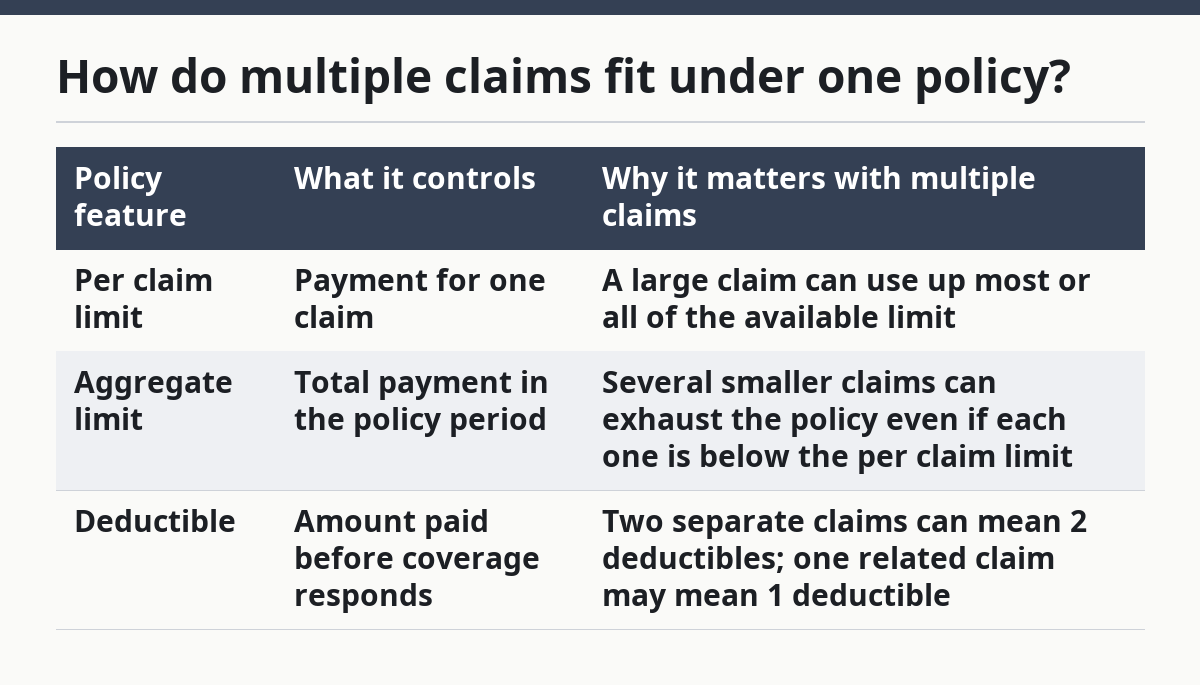
How do multiple claims fit under one policy?
Multiple claims fit under one policy by being measured against 3 limits at once: the per claim limit, the aggregate limit, and the deductible. The insurer first asks whether each matter is separate or related, then asks how much remains under the policy for the rest of the period.
The per claim limit is the most the policy will pay for one covered claim. The aggregate limit is the most the policy will pay for all covered claims combined during the policy period. A deductible is the amount the insured must absorb before the policy starts to pay. If 2 matters are treated as one related claim, one deductible may apply; if they are separate, more than one deductible may apply, depending on the wording, so consult a professional if the form is unclear.
| Policy feature | What it controls | Why it matters with multiple claims |
|---|---|---|
| Per claim limit | Payment for one claim | A large claim can use up most or all of the available limit |
| Aggregate limit | Total payment in the policy period | Several smaller claims can exhaust the policy even if each one is below the per claim limit |
| Deductible | Amount paid before coverage responds | Two separate claims can mean 2 deductibles; one related claim may mean 1 deductible |
The hard part is that the same facts can produce different results under different wordings. One policy may group claims that arise from the same act, omission, or series of related acts. Another may use a broader “related claims” clause that also sweeps in work for the same client or project. That is why a second notice should not be filed on guesswork.
For the reader, the practical question is simple: does the second matter create a new claim number, or does it sit under the first one? The answer usually depends less on timing than on the policy’s relation test, which is why a professional review is often the safest step.
What should I check first?
The first thing to check is the policy language that defines related claims and the policy period. That is the most direct way to see whether the second matter may be treated as part of the first.
Read 4 places on the policy or endorsement, in this order:
- Definition of claim — confirm what counts as a claim, demand, suit, or notice.
- Related claims clause — look for words like “same or related facts,” “arising out of,” or “series of related acts.”
- Per claim limit and aggregate limit — note whether the amounts are the same or different and whether defense costs reduce the limits.
- Deductible wording — check whether it applies per claim, per incident, or per policy period.
A policy can list a $1,000,000 aggregate limit and still pay less than expected if defense costs count against that limit. It can also list a deductible that applies to each claim separately, which matters when 2 matters arrive 30 days apart. The declarations page alone does not answer the coverage question.
If the second claim involves the same client, the same deliverable, or the same mistake repeated in more than 1 file, mark that as a warning sign. That does not prove the claims are related, but it does mean the policy wording needs close reading before any admission of liability or settlement talk.
The basic check is short, but the result can change the whole file. If the policy language is unclear, the safest move is to slow down and ask for a written coverage view before the record is widened by a second notice.
How do I handle the second claim step by step?
The second claim is handled by logging it, matching it against the first claim, and checking the policy language before coverage assumptions are made. The process below works best when the reader already has the first claim notice, the policy wording, and the claim dates in front of them.
- Write down the date and source of each claim. Record the notice date, the person making the demand, and the project name within 24 hours. Verify whether both notices fall inside the same policy period; if one is outside it, coverage may be a problem. A mismatch between dates and the policy period is the first red flag.
- Compare the facts line by line. List the client, contract, file, deliverable, and alleged error for both matters. Verify whether the same act or omission appears in both. If the claims share the same core mistake, they may be related under the policy wording.
- Find the related claims clause. Read the exact sentence that groups claims together, including any wording on “arising out of” or “series of acts.” Verify whether the clause is narrow or broad. If the clause is missing or unclear, do not guess; ambiguity often matters more than the claim count.
- Check the deductible rule. See whether the deductible applies once per claim, once per related claim, or once per policy period. Verify the amount and whether it must be paid before the insurer defends. A second deductible can change the economics fast.
- Check the per claim limit and the aggregate limit. Compare the likely size of each claim with the limit on the declarations page. Verify whether defense costs reduce those limits. If 1 claim is large enough to consume most of the per claim limit, the second claim may have less room left.
- Avoid separate statements that contradict each other. Keep the facts consistent across notices, emails, and claim forms. Verify that the description of the work and the timeline do not shift. If the story changes between notices, the insurer may question whether the matters are related or separate.
- Ask for a written coverage position if the relation test is uncertain. Request the insurer’s view in writing before settlement talks or admissions. Verify that the response addresses the related claims clause and the limit issue, not just the claim count. A vague answer is a warning sign, not a resolution.
One practical example helps: if 2 demands come from the same website build, and the second alleges a problem in the same code base, the policy may treat both as one related claim. If the claims involve different clients, different contracts, and different work dates, the policy may treat them as separate, but only if the wording allows that split.
The point is not to chase labels. It is to preserve the facts the insurer will use when it decides whether 1 limit, 1 deductible, or 1 combined claim applies.
When should you stop and get help?
You should stop and get qualified help when the policy wording, the claim facts, or the timing makes the coverage result uncertain. On a liability policy, a wrong guess can affect the insured’s rights as much as the insurer’s payout.
The second claim alleges the same mistake, file, or deliverable: this may be a related claim, which can change the limit and deductible treatment — get a written coverage view before responding.
The notice date is close to the end of the policy period: late reporting can change coverage entirely — ask for help right away and do not rely on memory alone.
The first claim has already used a large share of the per claim limit: the second claim may have less room under the policy than it appears — check the limit wording before any settlement discussion.
The deductible language is unclear or uses more than one trigger: the policy may require more than one deductible payment — have the wording read before money is paid.
The insurer says the claims are related, but the facts look separate: that can shrink coverage by grouping the matters together — ask for a reasoned explanation in writing.
The claim involves multiple years or more than one policy period: allocation between periods can become a coverage issue — get qualified review instead of guessing which year applies.
This is also the point to stop if the reader is being asked to sign a release, admit fault, or answer a demand that changes the facts on record. Once a statement is made, it can be hard to undo. A 10-minute check now can save a much larger dispute later.
What mistakes do people make?
People usually make the same 5 mistakes, and each one can reduce coverage or create a coverage fight that did not need to happen.
First, they assume 2 emails mean 2 separate claims. That can lead to the wrong deductible or the wrong expectation about available limits. The better move is to compare the facts, not the inbox count.
Second, they ignore the related claims clause because the second demand looks new. That can backfire if the policy treats a series of acts as one claim. The better move is to test the second matter against the policy wording before reporting it as separate.
Third, they focus on the per claim limit and forget the aggregate limit. A freelancer can have enough room for 1 matter and still run out of coverage when a second claim arrives in the same policy period. The better move is to check both limits together, not 1 at a time.
Fourth, they send different versions of the timeline to different people. That can make the insurer doubt whether the claims are really related or separate. The better move is to keep the facts fixed and use the same dates, project names, and error description across notices.
Fifth, they wait to ask for a coverage position until after they have accepted liability or negotiated a fix. Once that happens, the insurer may argue the facts were changed too late. The better move is to ask for the coverage view early, while the record is still clean.
A sixth mistake is treating a policy as if it works the same way in every country. It does not. Rates, limits, and claim rules can differ by jurisdiction and by policy form, so a wording that seems familiar may still work differently.
What changes when the claims are related?
Related claims are treated as one claim when the policy says they arise from the same or linked facts, acts, or omissions. That usually means the policy looks back to the first related notice date, then applies 1 set of limits and 1 deductible rule to the group.
This matters because related claims can be broad. 2 claims may involve different letters, different deadlines, or even different plaintiffs, yet still count as 1 if they come from the same project or mistake. Some policies use narrow wording, while others use language wide enough to capture a chain of events over months or years.
The trade-off is simple: related-claims wording can prevent a claim from being split into pieces, but it can also bunch together separate losses. That can be helpful when the facts are clearly 1 problem, and harmful when the later matter is only loosely connected. The reader should not assume “related” is a good or bad label without reading the clause.
If the policy does not define “related” in plain terms, the safer reading is not to assume the insurer will separate the claims the way a freelancer would separate invoices. The policy cares about causation and wording, not bookkeeping convenience.
For readers who need a broader background on the claim process, the hub page on Freelancer insurance claims management is the right place to go next.
FAQ
Can one policy have multiple claims?
Yes, one policy can have multiple claims if the policy period, notice rules, and wording allow it. The catch is that the insurer may still group some of those claims together as related claims, which means they are handled as one claim for limit and deductible purposes.
How do multiple claims affect a freelancer policy?
Multiple claims can use up the per claim limit, the aggregate limit, or both, depending on how the policy is written. They can also trigger more than one deductible if the claims are separate. If the claims are related, the policy may treat them as one matter from the first notice date.
What is a related claim?
A related claim is a claim the policy links to another claim because both arise from the same or connected facts, acts, omissions, or project work. The exact test comes from the policy wording, not from the claim count. A related claim can change which limit applies and when the claim is considered first made.
Drafted with AI; not yet reviewed by a person.
