

Last updated: November 20, 2026
The right questions are the ones that reveal whether a freelance insurance application review matches your real work: client contracts, equipment, subcontractors, and the places you work. If the answers do not line up with your day-to-day jobs, the policy can leave gaps even when the premium looks fine. This is information, not financial advice; for your own situation, a qualified adviser should review the final choice.
Key takeaways
- Ask about the work you actually do, not the job title on your invoice.
- Check how the policy treats client contracts, certificates of insurance, and exclusions.
- Make sure your equipment, subcontractors, and work locations are named clearly.
- A vague answer from an insurance carrier or insurance broker is a warning sign.
- The best review leaves no doubt about what would happen after a claim.
Who this applies to

This applies to freelancers who want to check coverage before they sign an application, accept a quote, or send a certificate of insurance to a client. It assumes you already know your main services, the gear you use, and whether you work from home, on site, or in more than one place. For people with unusual contracts, multiple business lines, or work in regulated fields, a qualified adviser should review the application before it is sent.
A freelance insurance application review is not about hunting for the cheapest line on a quote sheet. It is about asking whether the policy language fits the work you actually do over a 12-month period, including occasional jobs that are easy to forget. That matters because many problems show up only after a claim, when exclusions and limits are already fixed.
What should I ask before I sign the application?
You should ask whether the policy matches your work, your contracts, and your risk exposures before you sign anything. Start with the basics: what business activities are covered, what is excluded, and whether the carrier treats your freelance work as one service or several separate ones.
Use the questions below in the application review, because they surface the parts of a policy that are easy to miss:
| Coverage question | What it tells you | What can go wrong |
|---|---|---|
| What exact services are covered? | Whether the policy matches your actual freelance tasks | A side service may be left out |
| What exclusions apply to my work? | Which claims the insurer will not pay | A common job task may be excluded |
| Do I need to list client contract terms? | Whether the insurer wants to know about indemnity or insurance clauses | A contract promise may conflict with the policy |
| Does the policy cover subcontractors? | Whether hired help is included or must be added | A subcontractor’s mistake may fall outside coverage |
| What evidence is needed for a certificate of insurance? | Whether you can show proof to a client | A client may reject the certificate |
| Where am I covered? | Whether home, client sites, and travel are included | Work outside the named location may be uninsured |
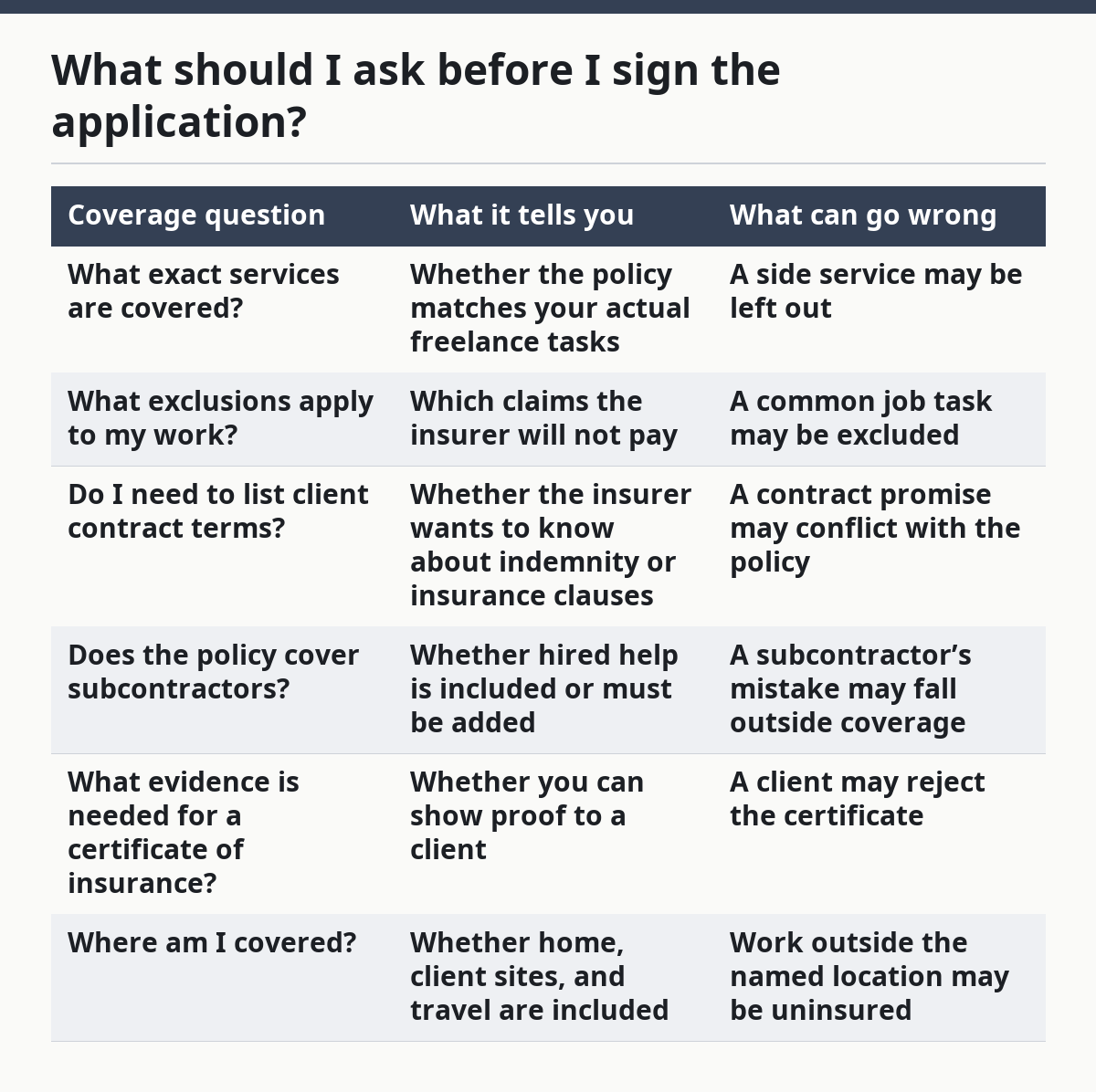
The first sentence you want to hear is a plain one: “Yes, that work is covered under this form.” If the answer turns into a long explanation, ask for the exact policy section and the exact wording. A clear response now is better than a surprise after a claim.
How do I review the coverage questions step by step?
You review the coverage questions by matching the policy to your work line by line, then checking every place the policy can narrow that coverage. The point is to find gaps before the insurer does.
- Write down every service you sell, including one-off jobs: List the work you do over the next 12 months, not just your main title. Verify that each service appears in the application or policy description. A problem shows up if a task is only implied, because that task may be treated as outside the covered business.
- Check the policy exclusions first: Read the exclusions before you read the marketing language. Verify whether any exclusion names your industry, media type, advice work, physical work, or client claims. A problem shows up if the exclusion list is broad enough to swallow the work you plan to do.
- Match client contract terms to the policy: Pull out contract clauses on indemnity, additional insured status, and required limits. Verify that the policy can support those promises. A problem shows up if the contract asks you to cover another party for losses your policy does not name.
- Ask how certificates of insurance are issued: Confirm what proof a client gets, who issues it, and whether the certificate reflects the policy form. Verify that the certificate does not promise more than the policy itself. A problem shows up if the certificate is treated like coverage instead of proof of coverage.
- List every place you work: Include home, client offices, co-working spaces, public locations, and travel for jobs. Verify whether each location is inside the covered territory and whether the policy treats off-site work differently. A problem shows up if a job site is outside the named setting.
- Count the equipment you depend on: Note laptops, cameras, tools, storage devices, and any rented gear. Verify whether the policy covers owned, borrowed, or rented equipment and whether it includes theft, breakage, or transit. A problem shows up if a key item is not listed or is only covered in one narrow setting.
- Check subcontractor language carefully: State whether you hire assistants, editors, designers, coders, or any other subcontractor. Verify whether they are covered automatically or only if they meet a condition in the policy. A problem shows up if their work creates liability that falls back on you.
- Ask what changes require an update: Confirm whether a new service, new city, new client type, or larger project size must be reported before work starts. Verify how the carrier wants updates handled and whether the policy can be changed mid-term. A problem shows up if your business has already changed and the application still describes last year’s work.
That process sounds slow, but it is usually faster than fixing a claim dispute later. A 20-minute review with the carrier or broker can expose a missing term that would have taken much longer to unwind after a loss.
Which coverage terms matter most?
The terms that matter most are the ones that control what the insurer pays, what it refuses, and what proof your client will demand. The big ones are exclusions, limits, certificates of insurance, and any special wording tied to subcontractors or locations.
A quick comparison helps:
| Term | What it means in practice | Why freelancers miss it |
|---|---|---|
| Policy exclusions | Clauses that remove certain claims from coverage | They are often buried after the promise of coverage |
| Certificate of insurance | A document that shows proof of insurance | Clients may treat it like a guarantee, but it is not the policy itself |
| Client contract terms | Promises you make in writing to a client | They can demand more than the policy covers |
| Subcontractor wording | Rules for other people doing work for you | A freelancer may assume helpers are covered automatically |
| Work location | Where the policy says the work happens | Home, travel, and client sites can be treated differently |
If a term is unclear, ask for the page, section, or endorsement that controls it. An endorsement is a written change to the policy, and it matters because it can narrow or expand coverage. A vague “that should be fine” is not enough.
For broader setup help, this page supports the hub on Freelancer insurance policy setup and coverage design, which is where the wider policy structure belongs.
What should I ask about client contracts?
You should ask whether your contract language creates a gap between what you promised and what the policy covers. The risk is not just the project itself; it is the legal language attached to it.
Watch for three common contract issues. First, ask whether an indemnity clause makes you responsible for losses caused by someone else. Second, ask whether the client requires additional insured status, which means the client wants its own protection under your policy. Third, ask whether the contract demands a level of coverage or proof that your policy cannot meet.
If the client’s form has a 3-page insurance schedule, read it before the work starts. A freelancer who signs first and checks later may find the policy cannot support the deal. In that case, the problem is not the project; it is the mismatch between the contract and the policy.
What should I ask about equipment and locations?
You should ask where the gear is covered and where the work is covered, because those are not always the same thing. A policy may handle a laptop in one place and fail to handle the same laptop in another place or while it is being moved.
Ask whether owned equipment, rented gear, and borrowed tools are treated the same way. Then ask about theft, accidental damage, and transit, since those are common pressure points for freelancers who carry equipment between sites. If you work in more than one location, ask whether the policy names only one address or follows the business wherever you work.
This question matters even for office-based freelancers. A home office, a client site, and a short trip to deliver equipment are three different settings in many policies. If the answer changes from one location to the next, ask for the exact condition in writing.
When should I stop and get more help?
You should stop when the policy terms no longer match a simple freelance setup. That is the point where a freelancer insurance application review needs a qualified adviser, because the gap is usually in the wording, not the premium.
Your contract requires you to cover another party’s losses: That can create liability your policy may not accept — get the contract reviewed before you sign.
You hire subcontractors on a regular basis: Their work may create separate exposure — ask for a precise answer on whether they are covered and under what conditions.
You work in more than one location, including client sites or travel: Location wording can change the claim outcome — confirm the covered territory and any off-site limits.
Your equipment is central to the work: If one laptop, camera, or tool set keeps the business running, a gap in equipment coverage can disrupt income — check the exact property language.
The carrier or broker gives only a general answer: That usually means the policy language is not clear enough for your situation — ask for the wording in the policy or endorsement.
Your work changed after the application was drafted: A new service or larger client can make the old description inaccurate — update the application before work starts.
What mistakes do freelancers make most often?
The most common mistake is treating the application as a formality. That can leave out a service, a location, or a subcontractor and create a gap that only appears after a claim.
Another mistake is reading the quote but not the exclusions. The quote can look fine while the exclusions remove the exact type of loss the freelancer worries about. The correct move is to check the exclusion section first, then confirm the covered work.
A third mistake is assuming a certificate of insurance equals full coverage. A certificate is proof that a policy exists; it does not rewrite the policy. If a client wants special wording, the policy itself must support it.
A fourth mistake is forgetting one-off work. A single workshop, trip, or side service can change the risk profile even if it happens only once. If the policy review does not mention it, ask about it.
A fifth mistake is answering the application too quickly because the form looks routine. Routine forms still control claims. If a question asks about revenue, services, locations, or prior claims, answer it carefully and consistently.
What if my work does not fit a standard form?
Your work may need a closer review if it blends services, crosses locations, or depends on nonstandard contract terms. That is common for freelancers who do both creative and advisory work, use rented gear, or serve clients with their own insurance rules.
In those cases, the standard form may need an endorsement, a different class description, or a clearer list of operations. The goal is not to force the business into a neat label. The goal is to make the policy description match the actual risk over the next policy period, which is often 6 or 12 months depending on the policy structure.
If the form cannot describe the work without leaving out a major part of it, that is a sign to pause. A policy built on a narrow job title can fail when the claim involves a broader service.
Where can I read more about the basics?
You can read the public guidance from the U.S. Small Business Administration on getting business insurance and from the National Association of Insurance Commissioners on consumer insurance basics. Those sources help with general language, even though rates, forms, and rules differ by country and change over time.
For broader policy structure, the next step is the hub on Freelancer insurance policy setup and coverage design, since this page only covers the questions that show whether the policy fits. That is the right place to compare the larger pieces after the application review is clear.
What should I ask before buying freelancer insurance?
Ask what work is covered, what is excluded, and whether the policy matches your contracts, equipment, subcontractors, and work locations. Those are the questions that expose gaps before you sign. If the answers are vague, ask for the policy wording or get a qualified adviser to review it.
What information do insurers need from freelancers?
Insurers usually need a clear description of services, where you work, what equipment you use, whether you hire subcontractors, and any client terms that affect liability. They may also ask about prior claims or changes in your business. If any answer is incomplete, the policy can be built on the wrong facts.
How do I prepare to buy coverage?
Prepare by listing your services, contracts, equipment, locations, and helpers in one place before you speak to an insurance carrier or insurance broker. Then compare that list to the application and the exclusions. If a key part of the business is missing, stop and correct it before moving forward.
Drafted with AI; not yet reviewed by a person.
