

Last updated: November 21, 2026
Quick answer: Use 3 moves. If you are working through How to Handle a Client Insurance Clause You Cannot Meet, do not sign as-is. Mark the exact mismatch, explain it in 1 short note, and offer 1 narrow fallback that matches the policy you actually carry. This is information, not financial advice; a qualified adviser should be consulted for your own situation. For policy basics, see the Insurance Information Institute and the NAIC.
Key takeaways
- A client insurance clause is only useful if it matches your real policy limits and policy type.
- The fastest safe response is usually to identify the exact mismatch, not to argue in general terms.
- A redline works best when it narrows the clause to the work you will actually perform.
- A fallback should fit the contract as a whole, including any indemnity clause and any general liability insurance or professional liability insurance you already have.
- If the clause asks for 2 policies, 1 certificate, or limits above your coverage, treat that as a contract issue, not a paperwork issue, and consult a qualified professional if you are unsure. See the NAIC and the Insurance Information Institute for general policy guidance.
Who this applies to
However, this applies to freelancers and small contractors who have a client contract with an insurance clause they cannot satisfy today. It assumes you already know the clause is in the draft, you know your current policy limits, and you can tell the difference between general liability insurance, professional liability insurance, and an indemnity clause. If you do not know what your policy covers, stop there and check the policy declarations page first. You can also compare the wording with a certificate of insurance and your policy forms before you answer.
This is not the right approach if the client is asking for a certificate you can already provide exactly as written. It is also not a fit if the clause is tied to a regulated project, a 3rd-party site rule, or a contract value large enough that one wrong edit could shift real loss onto you. In those cases, a qualified adviser can help you judge the risk under your own facts.
Therefore, the main mistake is to treat the insurance clause as a formality, and if you are unsure, consult a qualified adviser before you sign. It is not. It allocates loss if a claim happens, and the words in the clause can matter as much as the policy itself. The Insurance Information Institute explains why policy type and limits matter.
What should I check first?
You should check the exact mismatch before you respond, because the fix depends on whether the problem is the policy type, the limit, or the wording. Read the clause line by line and compare it with your certificate of insurance and declarations page.
Start by finding four things: the required policy type, the required limit, any named-insured or additional-insured language, and any deadline for proof. Then compare those details with your own coverage. If the clause asks for professional liability insurance and you only carry general liability insurance, that is a coverage gap, not a wording gap. The III and III pages summarize the difference.
Also check whether the clause bundles in an indemnity clause. A clause can demand both insurance and broad repayment obligations, and those are not the same thing. If the indemnity is wider than the work in the client contract, the clause may need a narrower scope even if the insurance request is modest.
If you can, print or mark the clause and note the exact sentence that causes the problem. A phrase like “at all times during the term and for 2 years after completion” may create a gap even when the limit itself looks manageable. The more precise the note, the easier the redline is to write.
How do I handle the clause step by step?
Therefore, you handle it by isolating the gap, proposing a narrow fix, and keeping the contract tied to the work you actually perform. Use the contract draft, your policy documents, and a redline tool or track changes so every edit is visible. For drafting terms, you can also compare with a contract redline checklist and your own insurer’s forms.
- Mark the clause. Highlight the exact sentence that fails, such as a policy type, a limit, or an additional-insured demand, and verify whether the issue is one word or the whole clause. A problem is any clause that cannot be matched by your current policy.
- Compare the clause. Place the insurance clause next to your declarations page and certificate, and verify the policy type, named insured, and term dates. A problem is any request that reaches beyond the policy period or the listed cover.
- Map the risk. Write 1 short line for the client’s risk and 1 short line for your risk, using plain terms like “property damage,” “professional error,” or “contract claim.” A problem is a clause that shifts broad loss to you while the work is low-margin or limited in scope.
- Draft the redline. Edit only the part that exceeds your coverage and keep the rest of the insurance clause intact. A problem is a full rewrite that changes more than the insurance point and creates a new contract issue.
- Add fallback language. Offer language that ties the duty to “commercially reasonable” coverage, “if available at standard terms,” or “to the extent covered by your policy.” A problem is fallback wording that promises a policy feature you still do not have.
- Limit the scope. If the clause is too broad, tie coverage to the actual services, project site, and contract term, and verify the language matches the work order. A problem is an open-ended promise that covers work outside the client contract.
- Check the indemnity clause. Make sure the indemnity clause does not quietly require more than the insurance clause. A problem is a contract that asks for limited insurance but unlimited reimbursement for claims, losses, or defense costs.
- Send the issue in one note. State the gap, the reason, and the proposed fallback in a single message, and verify the client can see the exact edit. A problem is a long email that explains the issue but gives no usable contract language.
Next, a useful fallback often does 3 things at once: it narrows the policy type, ties the duty to your actual services, and limits the obligation to the insurance you can obtain on normal terms. That keeps the contract practical instead of theoretical. It also gives the other side a document they can review in 10 minutes, not 10 days.
What fallback language usually works?
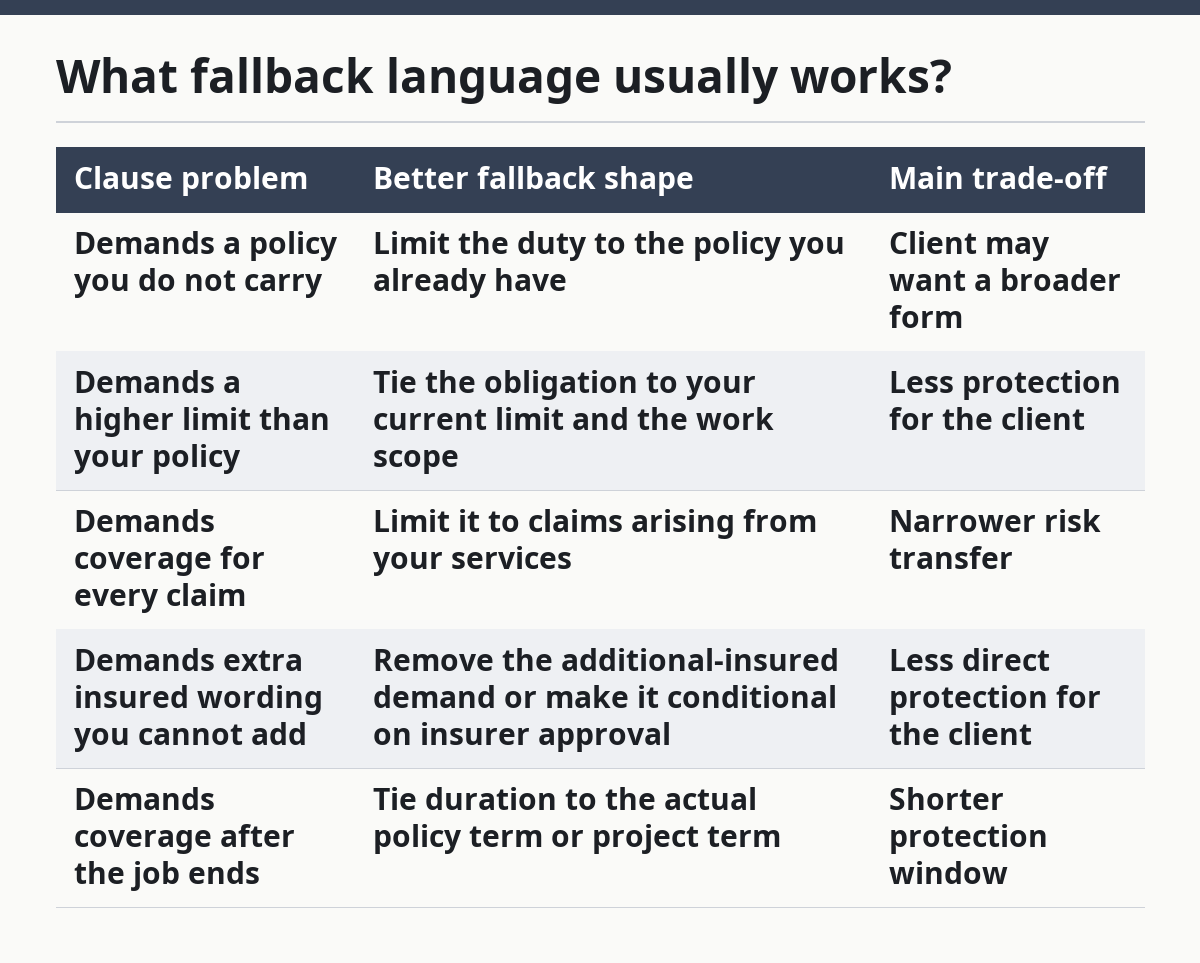
However, fallback language works when it keeps the promise tied to what exists, rather than to what the client wishes existed. The best fallback is often narrow, specific, and honest about the limit.
| Clause problem | Better fallback shape | Main trade-off |
|---|---|---|
| Demands a policy you do not carry | Limit the duty to the policy you already have | Client may want a broader form |
| Demands a higher limit than your policy | Tie the obligation to your current limit and the work scope | Less protection for the client |
| Demands coverage for every claim | Limit it to claims arising from your services | Narrower risk transfer |
| Demands extra insured wording you cannot add | Remove the additional-insured demand or make it conditional on insurer approval | Less direct protection for the client |
| Demands coverage after the job ends | Tie duration to the actual policy term or project term | Shorter protection window |
Then, a practical fallback might say that you will maintain the insurance you currently carry, that the coverage applies only to the services in the contract, and that any extra endorsement is subject to insurer approval. That kind of wording is honest because it does not promise a policy feature that does not exist.
A weak fallback says “we will comply where possible” and stops there. That sounds cooperative, but it gives no boundary and no measurable end point. A stronger fallback points to one specific policy, one specific term, and one specific service scope.
When should I stop and get help?
So, you should stop when the clause creates a legal or financial exposure that is larger than a simple edit can fix. On a money-and-contract issue like this, the wrong redline can change the risk more than the original clause. If you are unsure, consult a qualified adviser before you sign.
The clause asks for a policy type you do not understand: This means you may be comparing the wrong cover, such as general liability insurance versus professional liability insurance — pause and get qualified help. A mistaken edit can leave the client thinking the clause is fixed when it is not.
The clause requires a higher limit than your current policy: This means the contract is asking for more protection than you can show today — do not guess at language. A bad workaround can create a breach if the client later asks for proof.
The clause names an additional insured or a certificate format your insurer will not issue: This means the wording depends on insurer approval, not just your signature — stop and verify the policy terms. A wrong promise can become a contract default even if no claim is filed. See the III for a plain-English overview.
The clause sits beside a broad indemnity clause: This means the contract may shift loss, defense costs, and settlement duties in more than 1 place — have the whole clause reviewed. A narrow insurance fix may not touch the larger repayment duty.
The work is regulated, high-value, or tied to 3rd-party site rules: This means one small gap can affect more than the contract with the client — do not rely on a generic fallback. A specialist adviser can help align the contract with the real project risk.
A good rule is simple: if you cannot explain the clause in one paragraph, do not sign it in one minute.
What mistakes cost the most?
Overall, the biggest mistakes are rushing, overpromising, and fixing the wrong sentence. Each one can leave you with a signed client contract that still does not match your policy.
First, people say “I’m insured” without naming the policy type. That can mislead the client if they asked for professional liability insurance and you only carry general liability insurance. The better move is to say exactly what policy you have and what part of the clause it does not satisfy.
Second, people accept the clause and hope the insurer will sort it out later. That can fail because insurance is bound by policy terms, not by contract wishes. The correct alternative is to confirm what your insurer will and will not endorse before you accept the clause.
Third, people rewrite the whole clause and bury the issue in a big redline. That can trigger new objections because it changes more than the insurance point. The correct alternative is a narrow redline that touches only the unmet requirement.
Fourth, people ignore the indemnity clause because it sits in a different paragraph. That is risky because the indemnity clause can shift defense and loss even when the insurance request looks modest. The correct alternative is to read both clauses together and make sure they match.
Fifth, people treat a verbal “that’s fine” as approval. That can vanish the moment a claim or invoice appears, so a written note is safer and a qualified adviser can help if the stakes are unclear. The correct alternative is to get the fallback in the contract itself, or at least in tracked changes or a written confirmation.
How does this change for edge cases?
So edge cases need tighter wording, because the standard fix can miss the real risk. If the project has a short term, a narrow scope, or a split vendor chain, the insurance clause may need a different kind of fallback.
If the work is only 1 project phase, tie the clause to that phase and not to future work. If the clause says “for all services now or later,” narrow it to the signed scope and any written change order. That avoids accidental coverage for work you never priced.
If the client wants proof before work starts, give the current certificate only if it truly matches the clause, and state that any change to the policy type or limit is subject to policy terms. If the client wants proof at renewal, note the renewal date carefully and avoid implying a longer policy term than you have.
If the contract includes subcontracted work, make sure the insurance clause does not assume every subcontractor carries the same cover. That is a common mismatch in a client contract. A better clause says who is responsible for which insurance duty and for which 12-month period.
If the clause uses broad words like “all damages,” narrow the wording to direct loss arising from your services, if that is the only risk your policy addresses. Broad words can swallow exclusions that neither side noticed.
So, keep the clause tied to the actual job. Narrow words keep the clause tied to the actual job. If the contract still goes beyond your policy, the issue is not wording alone and a qualified adviser should review it.
What does a good result look like?
Ultimately, a good result is a clause you can actually satisfy, a redline the client can read in 1 pass, and a record that matches your policy. The end state is not “the client got everything they asked for”; it is “the contract now matches the coverage you have or can honestly maintain.”
A workable outcome usually has 3 parts. First, the client contract names the right policy type. Second, the limit and timing match your policy documents. Third, any indemnity clause and fallback language stay within the work scope and the policy term.
The result is not perfect when the client wants more than your current insurance can support. It is good when the document stops pretending that you carry coverage you do not have. That honesty protects both sides better than a polished but inaccurate clause.
What do I say if I cannot meet a client insurance requirement?
In short, say exactly which part you cannot meet and offer a narrow fallback. A direct line works best: the clause asks for a policy term, limit, or endorsement that is not in your current coverage, and you can revise the language to match your existing policy and project scope. Keep the message short and specific. If the client wants a legal judgment on the wording, consult a qualified adviser.
Should I redline the insurance clause?
Yes, if the problem is in the wording and not in a broader business decision. A redline shows the client exactly what changes, which is faster than a long explanation. Keep the edit narrow and tie it to the unmet requirement, the policy type, or the project scope. If you are unsure, compare the draft with your policy declarations page and a certificate of insurance.
Can I offer a workaround if I lack a policy?
Yes, if the workaround does not promise coverage you do not have. A common approach is to limit the obligation to your current policy terms, make any extra endorsement subject to insurer approval, or narrow the clause to the services in the contract. If the client needs a different risk allocation, a qualified adviser should review the draft.
Drafted with AI; not yet reviewed by a person.
