

Last updated: November 20, 2026
Quick answer: for most freelancers, the risk picture has 2 layers — the legal structure and the insurance policy. In Freelancer business structures and insurance liability — The Complete Guide, the main question is not just “Should I get insurance?” It is also “What is the legal wrapper around my work, and what still reaches my personal bank account if something goes wrong?”
This is general information, not financial advice. Tax, liability, and insurance rules vary by country and change over time, so a qualified adviser should be consulted for your own situation. For setup basics, see the U.S. Small Business Administration and IRS guidance on business structures.
Key takeaways
- A sole proprietorship usually leaves the freelancer and the business legally fused, so personal assets can be exposed.
- A limited liability company, or LLC, can separate business assets from personal assets, but it does not erase every claim.
- Insurance protects against covered losses; it does not replace a legal structure, and it does not cover every mistake.
- Professional liability insurance and general liability insurance cover different risks, so structure and coverage need to fit the work.
- A partnership can spread business duties across more than one person, but it can also spread legal exposure in ways that surprise people.
What does business structure change?
Business structure changes who is legally on the hook when a claim lands. In a sole proprietorship, the freelancer and the business are usually treated as the same legal person, so business debts and many claims can reach personal assets such as a personal bank account or car, depending on local law. A source such as the IRS business structures page can help confirm the broad setup, but a local professional should confirm how that works where you live.
An LLC, short for limited liability company, usually creates a legal separation between the business and the owner. That separation matters because a claimant may pursue business assets first, not automatically every personal asset. A general partnership works differently again: two or more people may share control, profit, and liability, and one partner’s actions can create exposure for the other partner.
This is the point many generic articles miss: structure changes the target of a claim, but it does not erase the claim itself. A contract dispute, a negligence claim, or an injury claim can still exist even if the business is wrapped in an LLC. If the wrong entity name appears on contracts, invoices, or policy documents, the separation can weaken fast.
The structure also affects how insurers read the risk. Underwriters look at the legal entity, who performs the work, whether subcontractors are used, and whether the business and personal finances are kept apart. A clean structure is not a magic shield; it is one factor in how the insurer prices and phrases the policy. For policy basics, see professional liability insurance and general liability insurance.
Which structure fits a freelancer?
A sole proprietorship is the simplest structure, but it offers the least separation. It is often the default when someone starts freelancing, which is why it is so common for designers, writers, consultants, and solo developers. The trade-off is direct exposure: if the business cannot pay, personal assets may still be in play.
A limited liability company is built for separation. If the freelancer keeps business money in a business account, signs contracts in the business name, and respects the entity, the LLC can help keep a claim against the business from automatically reaching personal assets. That said, the protection is not unlimited. Personal guarantees, fraud, commingling funds, or personal negligence can still create exposure. A local business lawyer or accountant should confirm the setup.
A general partnership is usually the least forgiving when two people work together informally. If one partner signs a bad contract or causes loss, the other may feel the effect. A written partnership agreement helps define duties, but it does not erase partnership liability by itself.
| Structure | Legal separation | Typical exposure pattern | Main weakness |
|---|---|---|---|
| Sole proprietorship | Low | Owner and business are often treated as one | Personal assets can be exposed |
| LLC | Higher | Business assets are usually the first target | Separation can be weakened by poor recordkeeping |
| General partnership | Mixed | Partners may share liability for business acts | One partner’s decision can affect the other |
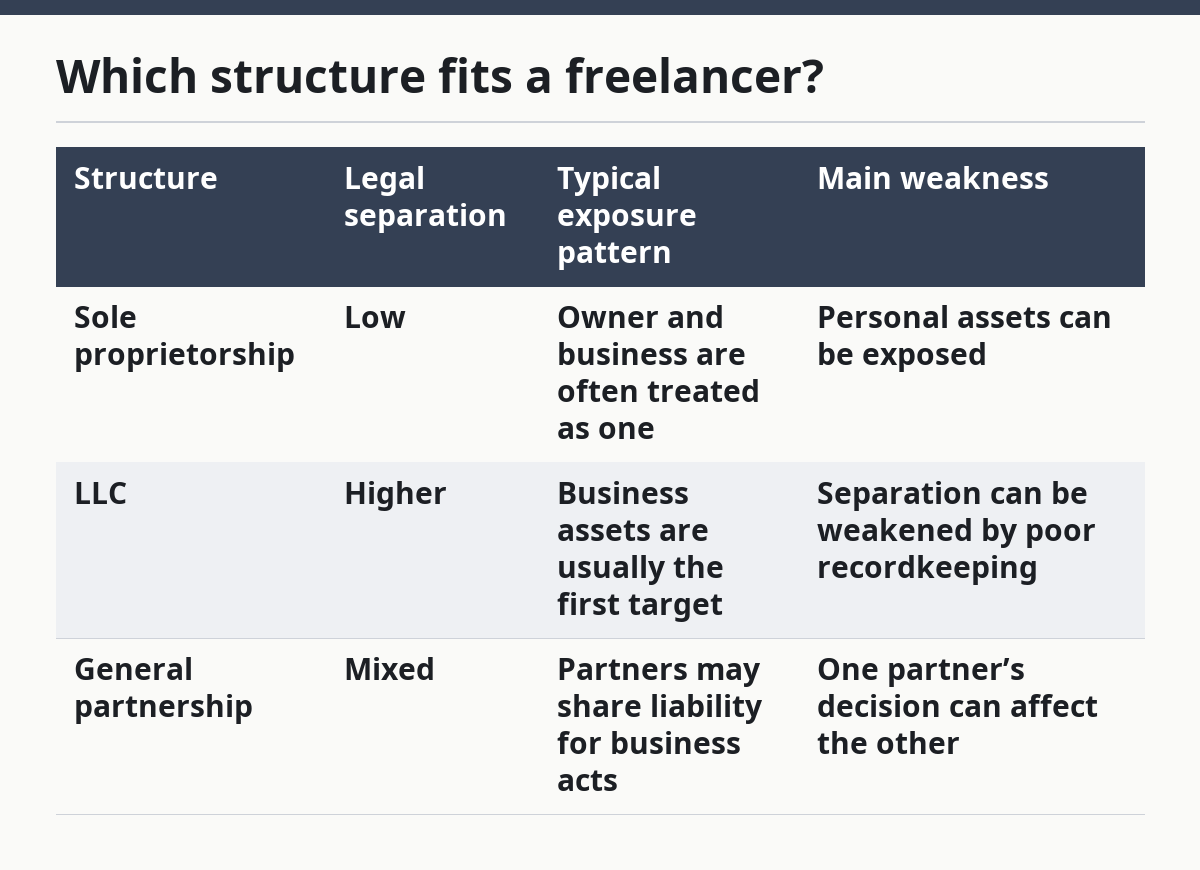
The right structure depends on the work, the contracts, and the local legal rules. A writer with one client and low overhead has a different exposure pattern from a freelancer managing projects with subcontractors and client data. The structure should match the shape of the risk, not just the paperwork. For setup help, see LLC formation basics and partnership agreement basics.
How do insurance and liability fit together?
Insurance pays for covered losses; liability is the legal responsibility behind the loss. That distinction matters because a freelancer can have strong insurance and still face a claim that falls outside the policy wording. The policy is a contract, and the legal structure is the entity that the contract and the claimant point to.
Professional liability insurance, often called errors and omissions insurance, is the policy type that usually responds when a client says the freelancer made a mistake, missed a deadline, or gave bad professional advice. General liability insurance usually addresses bodily injury, property damage, or some personal-and-advertising injury claims tied to the business premises or operations. They are not interchangeable.
Here is the cleanest way to think about it: business structure says who owns the risk; insurance says who helps pay if a covered loss happens. An LLC does not make a policy unnecessary, and a policy does not make the LLC pointless. The two tools solve different problems.
A policy can also be written in a way that reflects the entity. If the policy names the wrong business, the wrong insured, or a person instead of the actual company, a claim may become harder to handle. That is why the exact legal name matters, even for a one-person business.
What should a freelancer check before buying coverage?
A freelancer should check the policy wording, the insured entity, the work description, and the exclusions before any coverage decision. This is the practical step that can prevent painful surprises later, but a licensed broker or lawyer should review the final decision. A policy that sounds broad can still exclude the one type of claim that fits the freelancer’s actual job.
The first check is the entity name. The declarations page should match the business structure: sole proprietor, LLC, or partnership, as applicable. If the policy names only the person when the contracts are in the company name, or vice versa, the gap can matter at claim time.
The second check is whether the policy matches the work. A graphic designer, bookkeeper, marketing consultant, and software freelancer do not face the same claim pattern. A general liability policy may help with a client injury at a workspace, but it usually does not answer a pure professional mistake claim. A professional liability policy is the one tied more directly to service errors.
The third check is exclusions. Common exclusions often include intentional acts, prior known issues, and some contractual liabilities. If a contract expands liability beyond what the policy contemplates, the insurance may not follow the contract word-for-word. That is one reason contract review matters as much as the certificate of insurance.
The fourth check is the claims-made feature used in many professional liability policies. Claims-made means the policy generally responds when the claim is made during the policy period, subject to its terms. That is different from an occurrence form, which is tied to when the event happened. The difference is not a footnote; it changes how a freelancer handles timing.
Before anything else, a reader should compare the policy to the actual business setup line by line. A mismatch of 1 word in the named insured can be more important than a long list of marketing promises.
When should the standard setup stop and get looked at?
The standard setup should stop when the business facts and the legal wrapper no longer match. That is the moment to get qualified help, because the problem is no longer “buy a policy” but “which entity, which contract, and which coverage language fits this exact risk?”
There are subcontractors on the job: This can shift responsibility, supervision duties, and claim paths — review the contract chain and the policy language before work starts.
Client money is held in your account: This can blur the line between business assets and personal assets — separate accounts and records matter immediately.
You sign contracts in your personal name but invoice through an LLC: This can weaken the liability separation — align the signature block, invoice name, and policy name.
The work includes advice, design, code, or other professional judgment: This raises the chance of a professional liability claim — general liability alone is often not the right fit.
A client demands a specific indemnity clause or insurance certificate wording: This can expand obligations beyond the standard policy — the contract should be checked against the policy before signing.
The business has a partner, not just one freelancer: This creates shared liability questions — a general partnership can expose both people if the structure is not set clearly.
These are not abstract warnings. They are the spots where a one-person setup often becomes a two-layer problem: entity risk and insurance wording risk. Once both layers move at once, a general article stops being enough.
What mistakes do freelancers make most often?
Freelancers most often mistake a paper shield for real separation. An LLC formed on paper but run through a personal checking account, personal signature blocks, and mixed expenses may not give the protection the owner expects. The correct alternative is to keep business assets separate and use the entity name consistently.
A second mistake is buying the wrong policy type. Many people hear “insurance” and stop there, but general liability and professional liability address different losses. If the risk is a client alleging bad advice or a bad deliverable, the policy form matters more than the label.
A third mistake is assuming one policy covers every claim. It does not. A policy can exclude prior work, subcontractor issues, data-related loss, or contractual promises. The correct alternative is to read the exclusions and the insured duties, not just the summary page.
A fourth mistake is ignoring the partnership problem. Two freelancers can act like independent contractors while still creating a de facto partnership in the eyes of a claim. That can pull both people into the dispute. A written agreement, separate billing, and clear authority lines reduce that risk, though they do not erase it.
A fifth mistake is treating insurance as a substitute for contracts. A contract that clearly states scope, deliverables, and limits on responsibility can reduce the size of a claim before insurance ever enters the picture. That matters because policies are not designed to fix vague scopes after the fact. A lawyer or broker should review any high-value contract.
When does the usual answer not fit?
The usual answer does not fit when the freelancer’s work is small on paper but large in risk. A solo consultant with one laptop may still face a serious claim if the work involves advice, access to sensitive systems, or client deadlines tied to money. The size of the business is not the same thing as the size of the exposure.
It also does not fit when the freelancer crosses borders. Business structure, tax treatment, and insurance language can change by country, and often by state or province. A structure that works well in one place can create a different result in another. A local professional should check the rules before anything is filed.
The usual answer also breaks down when the freelancer uses a platform, a subcontractor, or a client-owned system. Those arrangements can change who owes whom, who controls the work, and which policy should respond first. The legal entity may be only one piece of a larger chain.
Finally, the standard answer is incomplete if the freelancer expects insurance to solve a contract problem. Insurance pays covered losses under policy terms; it does not rewrite a bad indemnity clause or erase an admitted error. That is why structure, contract language, and coverage need to be read together.
What does a good setup look like?
A good setup is the one that matches the real business, not the one that sounds simplest on a form. For a solo freelancer, that may be a sole proprietorship with careful records and the right policy language. For another, it may be an LLC with separate accounts, a clean signature line, and coverage that names the entity correctly.
The best sign of a sound setup is consistency. The entity name on the contract, invoice, insurance declarations page, and bank records should line up. The risk categories should also line up: property and injury risk for general liability, service error risk for professional liability, and shared authority risk if there is more than one owner.
This guide is not saying every freelancer must choose the same structure. It is saying the structure changes the legal target of a claim, and the insurance changes who helps pay for a covered one. Those are different tools, and one cannot replace the other.
Does an LLC protect a freelancer from insurance claims?
An LLC does not stop an insurance claim from being made. It can change which assets are reached if the claim succeeds, but the insurance question still depends on the policy terms, the insured name, and the type of loss. A covered claim can still be paid under the policy, and an uncovered one can still be pursued outside it.
Does business structure change freelancer insurance needs?
Business structure changes the insurance conversation, yes. A sole proprietorship, LLC, and partnership can face different exposure patterns, and the policy should match the entity and the work. A freelancer with an LLC still needs to ask whether the risk is professional, general, or both.
Should a freelancer form an LLC before buying insurance?
A freelancer can buy insurance before or after forming an LLC, but the policy should match the legal entity that actually exists. If the structure is not settled yet, the named insured can be wrong and the paperwork can become messy. For the personal situation, a qualified adviser should be consulted before making a final choice.
Drafted with AI; not yet reviewed by a person.
