
Last updated: November 27, 2026
Quick Answer: in most cases, the answer is to verify 3 things in writing: transit coverage, loading and unloading, and rented gear. This article explains how to handle a freelance contract that requires insurance for equipment in transit, and it does so by matching the contract language to an inland marine policy. If the wording is unclear or the contract asks for limits, named parties, or proof language you cannot verify, stop and ask a qualified insurance adviser to review your situation; this is information, not financial advice. For background on policy forms, see the NAIC and the Insurance Information Institute.
Key takeaways
- The phrase “equipment in transit” usually points to cover for gear while it is being moved, not just while it sits at one address.
- The key policy term to check is often inland marine insurance, which can cover movable property.
- A certificate of insurance can show that coverage exists, but it does not usually rewrite the policy terms.
- Gear moved in a vehicle, handed to a courier, or loaded and unloaded at a site can fall into gaps if the wording is narrow.
- Rental gear needs special attention because the contract may require cover for rented equipment as well as owned tools.
What does “equipment in transit” mean?
“Equipment in transit” means the contract wants insurance for your gear while it is being moved from one place to another, not just while it is stored at a fixed location. In practice, that can include tools in a van, camera cases in a trunk, cases handed to a courier, and the loading or unloading step at each end.
The exact meaning depends on the contract, the policy wording, and the country you are in. Insurers use terms like inland marine insurance, which is a policy form used for movable property, and equipment floater, which is a common label for coverage on items that travel. A general liability insurance policy is usually about injury or property damage to others, not your own gear in transit. See the NAIC consumer resources and the III general liability overview.
Who this applies to?
This applies to freelancers who move equipment for client work and have a contract that asks for proof of transit coverage. It assumes you already know what gear the job uses and have access to the contract, your current policy declarations page, and any certificate of insurance you can request from an insurer or broker.
It is not a DIY fit for every case. If the contract names specific limits, asks for additional insured wording, or ties coverage to a shipment method, a qualified adviser should read the exact language because small wording changes can leave a gap. This is especially true when the job uses high-value rental gear or crosses more than one policy form.
How do you handle it step by step?
You handle it by reading the contract first, then checking whether your policy actually covers the travel phase. The process is mechanical, and each step should produce one yes-or-no answer.
- Mark the contract clause and circle the exact transit words, such as “in transit,” “while being transported,” or “during loading and unloading,” then verify whether the clause names owned gear, rented equipment, or both; if the clause is vague, that is the problem.
- List every item that will travel, including cases, stands, lenses, drives, and rented equipment, then verify the list against the job schedule and the trip count; if the list changes after you review it, the coverage check is incomplete.
- Review the declarations page and policy form for inland marine insurance, an equipment floater, or other transit wording, then verify whether the policy names movable equipment rather than only a fixed address; if the policy only names a studio or office, that is a warning sign.
- Check the exclusions for vehicle loading and unloading, overnight storage in a vehicle, and unattended stops, then verify whether those situations are covered or excluded; if the policy excludes one of those phases, the transit chain has a gap.
- Confirm the treatment of rented gear with a qualified insurance adviser, then verify whether the contract’s rented equipment requirement matches the policy’s rental language; if the policy covers owned tools but not rented items, the contract is not satisfied. See the III commercial property overview.
- Request a certificate of insurance, then verify that the certificate names the right insured, dates, and policy type; if the certificate makes a promise the policy does not make, the certificate is only a summary and not proof of the full wording.
- Compare the contract wording with the policy wording, then verify that the same risk appears in both documents; if the contract says “equipment in transit” and the policy only says “general liability,” the documents do not match.
- Escalate the file to a qualified adviser if any term is unclear, then verify the revised wording before the job starts; if you are still guessing after one read-through, the contract is not ready to sign.
What should you check before you sign?
You should check whether the contract is asking for transit coverage, proof of coverage, or a broader promise than your policy gives. One clause can sound simple and still require several different protections, especially if the job uses rented equipment, courier transport, or repeated loading and unloading at more than one site.
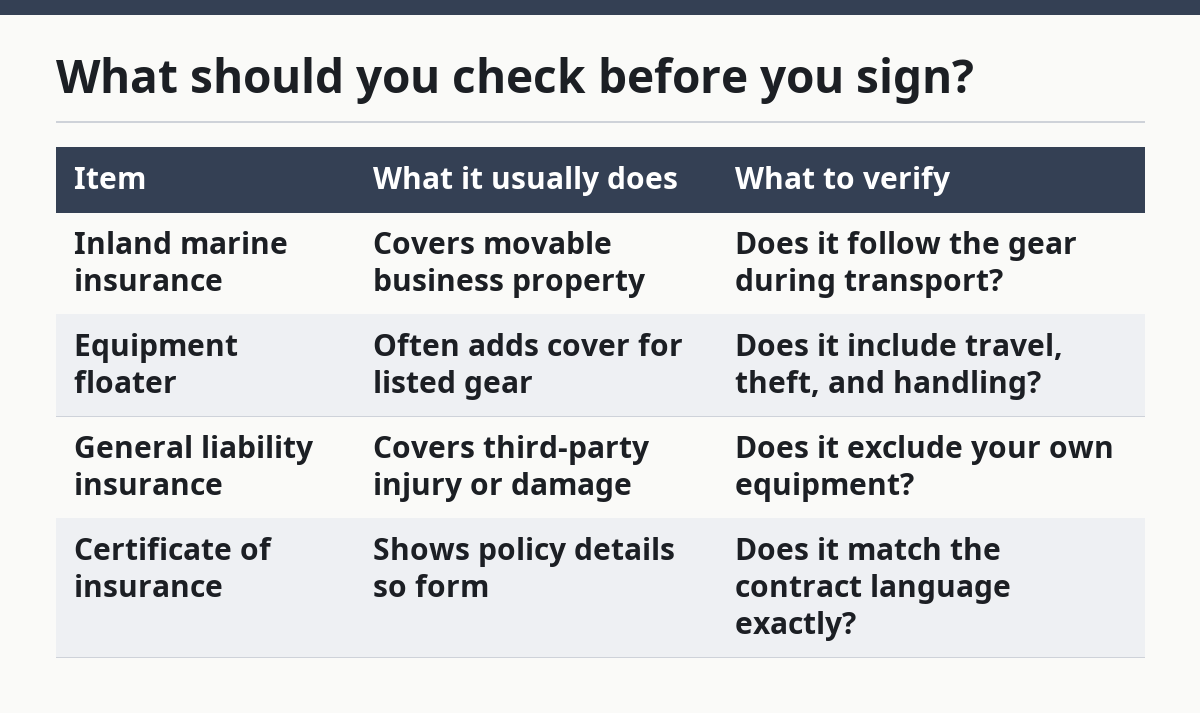
A useful way to compare the documents is below.
| Item | What it usually does | What to verify |
|---|---|---|
| Inland marine insurance | Covers movable business property | Does it follow the gear during transport? |
| Equipment floater | Often adds cover for listed gear | Does it include travel, theft, and handling? |
| General liability insurance | Covers third-party injury or damage | Does it exclude your own equipment? |
| Certificate of insurance | Shows policy details so form | Does it match the contract language exactly? |
If the contract wants evidence of transit cover, do not stop at the certificate. The certificate can help show that a policy exists, but it does not usually expand the policy’s own terms. If you need wording on loading, unloading, or rented gear, that wording has to appear somewhere in the policy documents or endorsements.
When should you stop and get help?
You should stop when the contract asks for something the policy wording does not clearly provide. The problem is not only missing cover; it is also a mismatch between the promise in the contract and the promise in the policy. That mismatch can matter even if you already hold a general liability policy.
The contract names loading and unloading, but your policy does not: this leaves a gap at the handoff point — get the wording checked before you sign.
The gear is rented, but the policy only discusses owned property: rented equipment can sit outside the cover you thought applied — ask for the rental language in writing.
The clause requires a specific certificate statement you cannot verify: the certificate may be too thin to prove the requirement — ask for the underlying policy wording.
The trip involves a vehicle overnight or multiple stops: those details can trigger exclusions or limits — have the transit chain reviewed as a whole.
The contract uses unfamiliar terms like “blanket,” “scheduled,” or “additional insured”: those words can change the risk structure — do not guess at their meaning.
The value or fragility of the gear is high relative to the trip: the practical exposure is larger, and one missing exclusion can matter — get a qualified adviser to check the file.
What mistakes cause trouble?
The biggest mistakes are usually paperwork mistakes, not dramatic failures. The contract may be fine, but the wrong policy phrase or a missing endorsement can make the coverage useless for the exact trip you were hired to do.
First, people assume general liability insurance covers their own gear. It usually does not, because that type of policy is aimed at damage to other people and their property. The correct alternative is to check the inland marine or similar movable-property wording.
Second, people read only the certificate. A certificate can show dates and named cover, but it often leaves out exclusions, travel limits, and rental terms. The correct alternative is to compare the certificate with the policy form and any endorsement.
Third, people forget loading and unloading. A policy may cover the road leg but not the handoff. The correct alternative is to look for those words in the policy and treat a missing mention as a gap, not a minor detail, unless a qualified adviser confirms the wording covers that risk.
Fourth, people ignore rented equipment. If the job uses a rented lens, rig, or tool, the rental clause matters. The correct alternative is to confirm that the policy says how rented equipment is treated before the gear leaves the supplier, and to ask an adviser to confirm the reading if the wording is unclear.
Fifth, people sign before the wording is settled. Once the contract is signed, the pressure to “make it work” grows. The correct alternative is to resolve the transit requirement first, or at least get a written answer from a qualified adviser before work begins.
What if the contract language is unusual?
Unusual contract language means the standard transit check needs a closer read, not a guess. If the clause mentions a specific shipping method, a named carrier, or a proof standard that may differ from the policy’s usual wording, the safest move is to compare each noun in the contract with the policy form line by line.
A common edge case is a job that mixes owned and rented gear in the same trip. Another is a contract that asks for cover while the gear is left in a vehicle for a short stop. A third is a client that wants proof for a date range longer than the actual job. Each one changes the exposure, and each one can expose a gap if the policy was written for a simpler setup.
This is also where country matters. Rates, limits, and policy forms differ by country and can change over time, so the same transit requirement may be handled differently in another market. That is another reason this is information rather than financial advice, and why a qualified adviser should review the exact contract and policy before you rely on them.
Does the contract ask for more than transit cover?
Yes, sometimes it does, and that is where many freelancers get tripped up. A contract can ask for equipment in transit, but the real need may include ownership of the gear, rental gear, proof language, and the rule for loading and unloading in one package.
A plain reading helps: if the contract only wants proof that gear is insured during movement, focus on transit wording. If it also asks for proof of damage, theft, named parties, or special documents, the requirement has moved beyond simple transit cover. That is the point where a general liability policy alone is often the wrong document to rely on.
The practical test is simple: if you cannot point to one policy sentence that covers the risk while the gear is moving, the requirement is not yet satisfied. If you can only point to a certificate, the job may still be exposed.
What should you keep on file?
You should keep the contract clause, the policy wording, the declarations page, and the certificate together in one file. A one-page certificate alone is too thin for a transit requirement, because the real answer is usually in the policy language, not the summary page.
Keep the latest version of the contract and the exact date the job starts. Keep a list of the gear that moves, including rented equipment, because that list shows what the transit risk actually is. If the policy or contract changes, the older file should not be treated as current without a fresh review.
Does general liability cover equipment in transit?
No, general liability insurance usually does not cover your own equipment while it is being moved. It is typically aimed at third-party injury and third-party property damage, not loss or damage to the freelancer’s tools.
The policy wording controls the answer, so you need to check the declarations page and the form itself. If the contract is about your gear in motion, the more relevant question is whether your policy includes inland marine insurance or another movable-property form. See the III commercial property overview.
What policy covers gear while traveling between locations?
A policy that mentions inland marine insurance is the usual place to look for gear that moves, because that coverage is built for movable business property. An equipment floater may also be part of the answer when the policy lists or follows specific items of gear.
The exact fit depends on the wording. If the policy covers transport, loading, unloading, and rented equipment, it may match the contract. If it only covers a fixed location, it does not answer the transit requirement.
Can a certificate show transit coverage?
A certificate can show that some coverage exists, but it usually cannot create transit coverage by itself. The certificate is a summary, while the policy and endorsements carry the real rules.
If the contract requires proof of equipment in transit, the certificate should match the underlying policy wording. If the certificate says one thing and the policy says another, the policy controls the coverage question, and a qualified adviser should review the mismatch before the job starts.
Drafted with AI; not yet reviewed by a person.
