

Last updated: November 26, 2026
Quick answer: most client-site-only freelance businesses start with general liability insurance, and many also need professional liability insurance if advice, design, measurements, or errors could cost a client money. How to Insure a Freelance Business That Works at Client Sites Only comes down to matching the policy to off-premises exposure, site access rules, and any vendor requirements before you step onto a job site. This is information, not financial advice; a qualified adviser should be consulted for your own situation. For a broader overview, see the freelance insurance hub, the general liability guide, and the professional liability guide.
Who this applies to
This applies to a freelance business that works only at client sites, not from a home office or a separate studio. It assumes you already know the kind of work you do, the kind of places you enter, and whether clients ask for a certificate of insurance or additional insured status. If you do not know those details yet, gather them before you ask for quotes.
In particular, this approach is best for solo freelancers who move between client locations but are not asking about a home-based office, a fully remote setup, or travel between many sites in the same region. It is also the wrong tool if your work involves heavy equipment, vehicles, or employees; those add different exposures and often different policies. For the broader picture, the freelance insurance hub can sit above this page.
A client-site-only business has two main exposures in plain terms: someone can be hurt or property can be damaged at the site, and your work can still cause a loss after the job is done. A dropped tool, a spill, or a mistaken measurement can trigger a claim even when you never own the site. That is why field service liability is not just a phrase; it is the real risk profile here. For definitions of common business policy terms, see the certificate of insurance guide and the additional insured guide.
What coverage matters first?
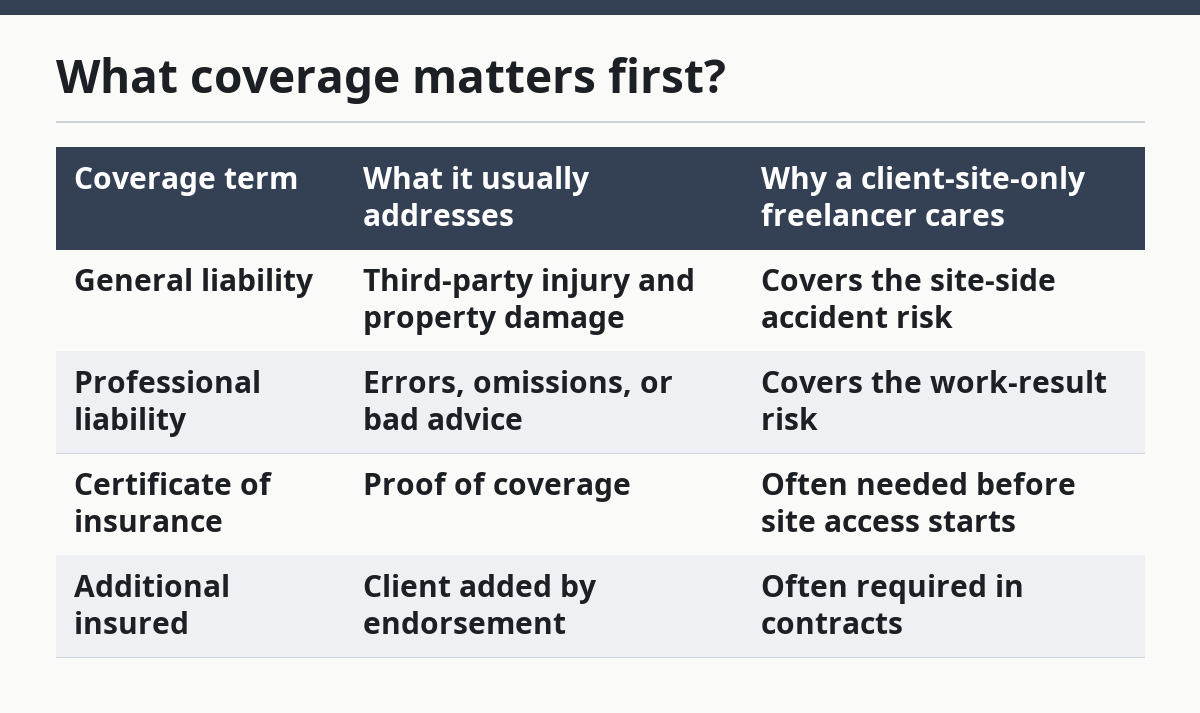
General liability insurance matters first for most client-site-only freelancers because it is built for bodily injury, property damage, and related claims that happen away from your own premises. Professional liability insurance matters when the work is advisory, technical, or judgment-based, because it is aimed at alleged mistakes, omissions, or failed professional services.
These are different tools. General liability usually addresses a broken fixture, a trip hazard, or damage caused while you are on the premises. Professional liability is about the result of your work, such as a wrong specification or a missed step that forces rework. A client can require both, and a certificate of insurance may list both lines if the contract asks for them.
A certificate of insurance is proof that coverage exists on a given date; it is not the policy itself. Additional insured status means the client is added to the policy for some covered claims, usually where the contract calls for it. That request is common in vendor requirements, but the exact wording matters, because not every endorsement gives the same protection. For a plain-language reference, see the certificate of insurance guide and the additional insured guide. The Insurance Information Institute also explains how commercial general liability works on its business insurance pages.
| Coverage term | What it usually addresses | Why a client-site-only freelancer cares |
|---|---|---|
| General liability | Third-party injury and property damage | Covers the site-side accident risk |
| Professional liability | Errors, omissions, or bad advice | Covers the work-result risk |
| Certificate of insurance | Proof of coverage | Often needed before site access starts |
| Additional insured | Client added by endorsement | Often required in contracts |
How do I build the policy step by step?
Build the insurance around the site rules, the contract, and the work itself, not around a generic freelancer label.

- List each client-site task: Write down every service you perform at a site, including setup, work time, and cleanup, and note where it happens indoors or outdoors; verify whether any task involves tools, ladders, chemicals, or sensitive equipment; a problem sign is any task you cannot describe clearly in one line.
- Review the contract: Check the client agreement for insurance language, minimum limits, waiver wording, and additional insured requests, then compare those terms with the work you actually do; verify whether the contract names a certificate of insurance and a notice period; a problem sign is a clause you do not understand or cannot meet.
- Match general liability to site exposure: Ask for a policy that covers off-premises operations and field service liability, then verify it is not limited to a home office or premises-only setup; a problem sign is a policy that excludes the exact location where you work.
- Add professional liability if advice matters: Include this coverage when a mistake in your judgment, plans, measurements, or recommendations could create a loss; verify the policy language fits your service type and does not exclude the core work; a problem sign is a policy written for a different profession.
- Request certificate wording early: Ask for the certificate before the first site visit if the client needs it, and confirm the client’s legal name, site name, and endorsement wording are correct; a problem sign is a certificate with the wrong holder name or missing line of coverage.
- Check additional insured terms: If the client requires it, verify whether the endorsement applies only to ongoing operations, completed work, or both, because those are not the same; a problem sign is a contract that demands status the policy does not grant.
- Review exclusions line by line: Look for exclusions tied to tools, property in your care, vehicle use, subcontractors, or specific site hazards; verify you know which claims are outside the policy; a problem sign is an exclusion that matches your daily work.
- Confirm renewal and change dates: Recheck the policy before each renewal and whenever a client changes site rules, because vendor requirements can change without warning; verify the certificate still matches the contract; a problem sign is an expired policy or a new site rule that is not reflected in the documents.
These steps sound plain, but the order matters. If you ask for a certificate before you know the contract terms, you may end up with the wrong wording and no time to fix it.
If you buy coverage before you know the work, you may pay for a policy that does not fit the actual risk. The same problem shows up in small-business insurance reviews on the business coverage checklist.
What should I check before I apply?
Check the site access rules, the contract language, and the exact work scope before you apply for coverage. Those three items determine whether your business looks like a low-risk visiting service or a higher-risk field service operation.

Start with the site rules. Some clients require badges, named visitors, safety training, or proof of insurance before a 1-day visit; others want a certificate 48 hours before arrival. If you work in places with restricted entry, your policy has to be ready before the first access window closes, not after.
Then check the work itself. A person who only reviews plans on a tablet has a different exposure from someone who installs, measures, inspects, repairs, or handles client property. The more your work touches physical items or live conditions, the more you need to think about property damage, completed operations, and professional liability.
Also check whether any portion of the job is subcontracted. If another person does the hands-on work, the contract may still place the insurance obligation on you. That can change the policy design, because a client can still ask for proof that the business behind the job carries the required cover.
If you cannot answer these questions in one sitting, the policy is not ready yet. That is not a failure; it is a sign that the work profile is still unclear. Insurance works best when the risk description is specific, not vague. The SBA’s small business insurance guidance is a useful cross-check.
When should I stop and get qualified help?
Get qualified help when the contract, site rules, or work scope do not fit a standard small-business policy. The issue is not whether you can read a form; it is whether the form matches the real exposure.
The client demands a broad additional insured endorsement: This can change the wording and the risk the insurer accepts — ask a qualified adviser or broker to review the exact endorsement language before you accept the job.
Your work involves tools, ladders, chemicals, or other site hazards: That raises bodily injury and property damage exposure — get help matching the policy to the actual field work rather than assuming a basic office-style policy will do.
The client wants a certificate before site access is granted: That turns insurance into a timing issue, not just a coverage issue — confirm the policy is active and the certificate names are correct before the visit date.
You are unsure whether the risk is general liability or professional liability: That means the business can be misclassified — ask for a review, because the wrong classification can leave a gap where you expected protection.
The contract requires wording you cannot explain in plain English: That is usually a sign the obligation is more specific than it first looked — stop and have the terms explained before you sign.
This is also the point where a policy comparison can go wrong fast. A cheaper policy that misses the site risk is not a bargain. A match between contract, field service liability, and completed work terms is the real goal. For contract wording help, see the certificate of insurance guide and the additional insured guide.
What mistakes cost freelancers the most?
The biggest mistake is buying a policy that only fits a home office when the business actually lives on client property. That can leave a gap on the exact day a claim happens, because the location is wrong even if the business name is right.

A second mistake is treating the certificate of insurance as if it were coverage itself. A certificate proves that a policy exists; it does not rewrite exclusions or grant every promise a client asks for. If the underlying policy is wrong, a certificate does not fix it. The NAIC’s consumer insurance resources and the III’s commercial coverage pages both make that basic distinction clear. See the certificate of insurance guide for a practical checklist.
A third mistake is ignoring additional insured wording. Clients often use that phrase loosely, but the endorsement can be narrow, and narrow wording can matter when a claim is made. If the contract requires more than the policy gives, the business still carries the mismatch.
A fourth mistake is leaving out professional liability because the work happens on-site. Physical location does not remove judgment risk. If the job includes recommendations, measurements, inspection notes, or design choices, the error can still create a money loss after the visit is over.
A fifth mistake is waiting until the day of site access to gather documents. Certificates, endorsements, and client names take time to match. A same-day scramble is where simple errors, like a wrong legal name or an expired policy, are most likely to happen.
What if the site rules are unusual?
Unusual site rules mean the standard policy language may need a closer look, not that the business should guess its way through. The common issue is not the site itself but the proof the client wants from you.
If the site requires a certificate with the client named exactly as the contract states, match that wording line by line. If it requires additional insured status, check whether that status applies to ongoing operations, completed operations, or both. If the work is inside a secure facility, verify with the client or a qualified adviser whether the site treats your business as a vendor, contractor, or consultant, because that can affect the wording they expect.
If the client asks for a minimum level of insurance and you do not know how the policy measures up, stop there. The wrong response is to assume the claim will be small enough to ignore. The correct response is to compare the contract against the actual policy documents, not against a marketing summary.
This is also where working only at client sites differs from other freelance setups. The site’s access rules, not your desk location, drive the insurance conversation. That is why a business can be fully mobile and still need careful attention to proof, wording, and exclusions.
How do I know the setup is working?
The setup is working when the policy matches the contract, the certificate is accepted, and the coverage language fits the actual tasks at the site. A good result is simple: you can explain what is covered, what is excluded, and what proof the client needs before access starts.
You should be able to answer three questions without guessing. First, does the business carry general liability for site-side injury and property damage? Second, does it carry professional liability if the work involves judgment or advice? Third, can it produce a certificate and, if required, additional insured wording in time?
If any answer is vague, the setup is not complete. The right fix is usually a document check, a policy review, or a contract review, not a bigger claim limit by default. On a money topic, a cautious answer is not always the correct one, so verify the documents before you treat them as final.
Key takeaways
- A client-site-only freelance business usually starts with two core coverages: general liability and, when the work is advisory or technical, professional liability.
- The contract matters as much as the policy, because vendor requirements can demand a certificate of insurance or additional insured wording.
- Off-premises exposure is the main issue here; the risk comes from what happens at the client site, not from an office at home.
- It is easy to create a gap if you buy coverage before reading the site rules and the exact service agreement.
- If the work, wording, or site access rules are unclear, the job needs a closer review before the policy is finalized.
FAQ
Do I need an office if I work only at client sites?
No, not as a starting point for insurance logic. The policy should follow where the work happens and what the contract requires, not whether you rent an office. If your client-site work creates bodily injury, property damage, or professional error exposure, that still needs to be addressed in the coverage structure.
What coverage matters most for on-site freelance work?
General liability matters most for most client-site-only freelancers because it addresses injury and property damage at the site. Professional liability becomes important when the work includes advice, plans, measurements, or other judgment calls. The right mix depends on the service, the contract, and the site’s vendor rules.
How do I prove coverage to a client site manager?
Use a certificate of insurance that matches the client’s legal name and the required coverage lines. If the contract asks for additional insured status, make sure the endorsement is in place before the site visit. A manager usually wants current proof, not a promise that the policy will be fixed later.
Drafted with AI; not yet reviewed by a person.
