

Last updated: November 26, 2026
Quick answer: most freelancers paid through an online platform should review 3 policies — professional liability insurance, cyber insurance, and general liability insurance — and then match them to the platform’s refund and dispute rules. If you are building a plan for How to Insure a Freelance Business That Receives Payments Through an Online Platform, this is information, not financial advice, and a qualified adviser should be consulted for your own situation.
Key takeaways
- Payment through a platform changes your risk because disputes, reversals, and payout delays can hit cash flow, not just the work itself.
- The main policy types to review are professional liability, cyber, and general liability; each covers a different problem.
- The platform’s terms matter as much as the insurance form, because chargebacks and payout holds can leave gaps.
- A good setup starts with the exact way money moves: card, wallet, escrow, or bank transfer.
- The wrong policy fit can leave you paying twice for the same loss, or paying for a gap you did not notice.
Who this applies to
This applies to freelancers who get paid through a payment platform such as Stripe, PayPal, Upwork, Fiverr, or a similar service, and who sell work that is delivered digitally or after a short project cycle. It assumes you already know what you sell, how you invoice, and whether the platform sends money straight to your bank account or holds it first.
If you only use the platform as a simple bank transfer tool, your insurance needs may be closer to a normal solo business. If the platform handles card payments, customer refunds, or buyer complaints, the risk picture changes. That is where payment disputes, chargeback exposure, and payout delays start to matter, even if your work itself is low risk.
This is not the right place for a client-data breach plan after the fact, and it is not the place to decide whether to buy through a broker or handle the purchase yourself. The goal here is narrower: understand how platform payments affect the insurance you already need. For the broader solo-business picture, the hub on freelance insurance for solo businesses is the right starting point.
How does a payment platform change my insurance needs?
A payment platform changes your insurance needs because it adds a second layer of risk between the client and your bank account. The work can be fine, but the money can still be frozen, reversed, or disputed after delivery. That means the claim trigger may come from the payment flow, not only from the service itself.
The key terms matter. A chargeback is a cardholder-initiated reversal through the card network. A platform payout is the transfer from the platform to your account, often after fees, holds, or review periods. A platform can also keep funds in reserve, which means money you have earned is not yet fully available.
A generic freelance policy may not spell out how disputes tied to online payments are treated, so a qualified adviser should review the wording if online payouts are central to your business. That is why the insurer, the policy wording, and the platform terms all need to line up. For background on platform and payment security, the PCI Security Standards Council and the FTC both publish material worth reading.
How do I check the right coverage?
You check the right coverage by mapping each payment risk to one policy type and then reading the exclusions that sit under it. The work is mostly comparison, not guesswork. A policy that looks broad may still miss a platform-specific dispute or a digital-delivery issue.
| Policy type | What it usually addresses | Where the online platform connection shows up | Common gap to watch |
|---|---|---|---|
| Professional liability insurance | Claims that your work caused a financial loss, mistake, or missed duty | A client disputes the quality or timing of the deliverable | Pure payment fights may not fit if no work error is alleged |
| Cyber insurance | Digital threats, data incidents, and some tech-related losses | Account takeover, phishing, credential misuse, or platform-linked access loss | Policy may focus on data exposure, not every payment reversal |
| General liability insurance | Bodily injury, property damage, or personal injury claims | Usually separate from online payments, but still part of a solo business package | Often does not cover digital-only disputes or card reversals |
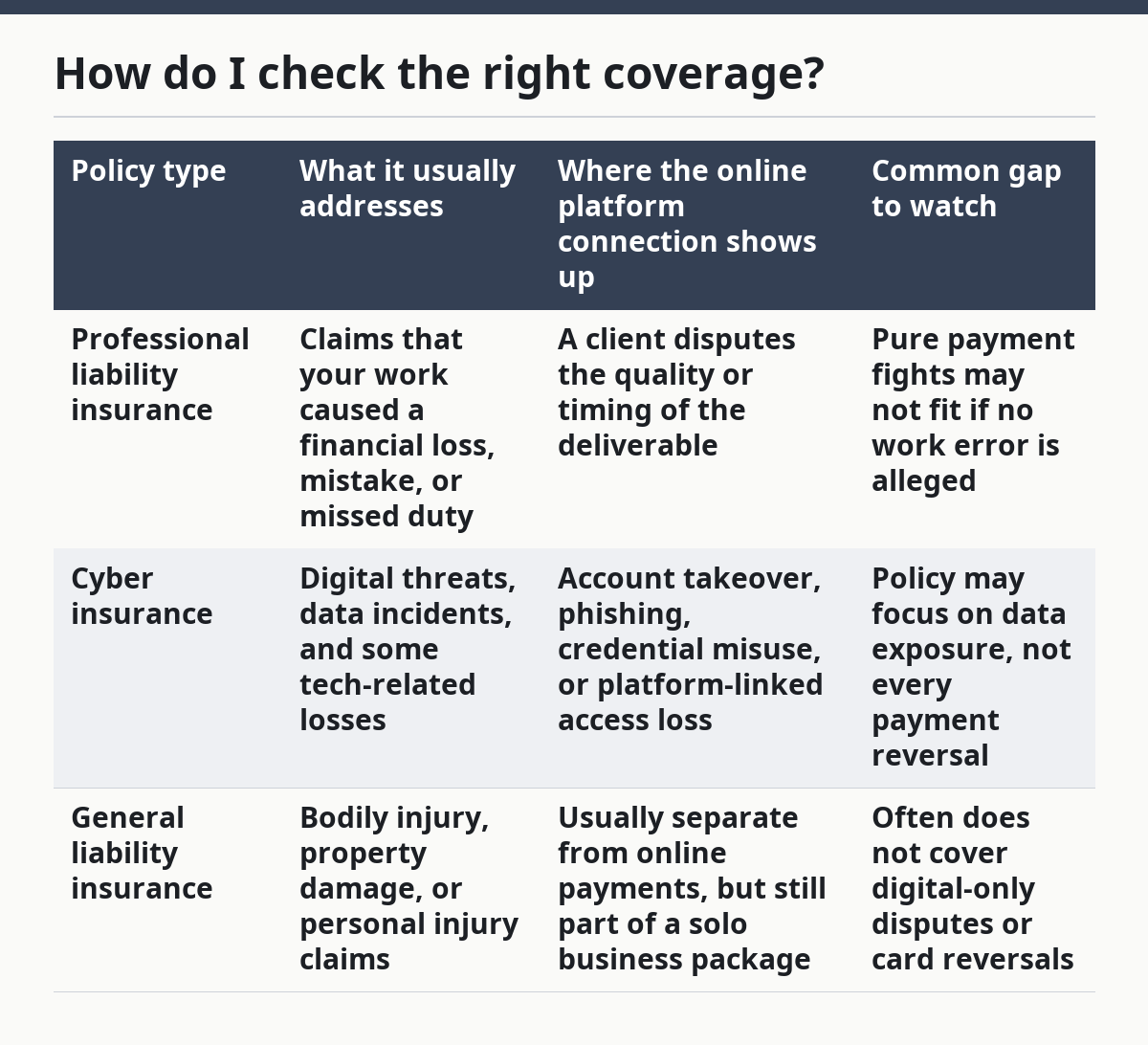
The point is not to pile on every policy. It is to avoid a false match. A freelancer who only sells digital work may need more attention on professional liability and cyber insurance than on a policy built for physical premises. A freelancer who also meets clients in person may still need general liability insurance because the payment platform does not change the risk of a visitor slipping in a studio.
What steps should I take first?
You should start with the platform’s payment rules, then match those rules to the policy wording before you buy or renew anything. The order matters because the platform controls how money moves, and the policy controls what loss is covered. A mismatch can leave you with a gap in the exact place you assumed was protected.
- List the platform you use, then write down whether it takes card payments, holds funds, or releases payouts on a schedule of days rather than instantly; verify the payout path in the platform dashboard, and flag any reserve, delay, or review period as a problem.
- Check professional liability insurance by reading the section on claims tied to errors, omissions, missed deadlines, and failed deliverables; verify that the policy names the kind of service you provide, and consult a qualified adviser if the wording is unclear, because insurer forms often turn on exclusions and definitions. The Insurance Information Institute is a good place to confirm basic policy terms.
- Check cyber insurance for account compromise, phishing, fraudulent instructions, and digital transfer loss; verify whether the form covers the platform account itself, and note any requirement for multi-factor authentication because weak login controls can create a gap.
- Check general liability insurance if you meet clients, store equipment, or use a shared workspace; verify whether it covers bodily injury, property damage, and personal injury, and consult a qualified adviser if the policy only addresses online activity, because general liability often does not fit digital payment disputes.
- Match dispute language in the policy to the platform’s refund, dispute, and chargeback rules; verify whether the insurer treats a platform reversal as a covered claim or just a payment event, and consult a qualified adviser if the wording is vague, because the platform may not follow the same claim standard as the insurer.
- Document your digital delivery process by saving file timestamps, approval emails, and upload confirmations for each project; verify you can prove delivery within 24 hours if needed, and see missing records as a problem because disputes often turn on proof.
- Review payout timing against your cash flow so you know how long a hold can last; verify whether your business can absorb a delay of several days or longer, and consult a qualified adviser if your income depends on instant access, because payout rules can change the real cash gap.
- Ask a qualified adviser to review the final policy wording if the platform is your main income source or if you sell high-value digital work; verify the adviser sees the actual policy and platform terms, and treat unclear advice as a problem rather than a decision rule.
A strong result is simple: the policy answers the same loss you are actually exposed to, and the platform terms do not create a blind spot. If the insurer talks only about “services rendered” while the platform can reverse money after delivery, the fit is not yet good enough.
What should I watch for with disputes and chargebacks?
You should watch for disputes and chargebacks because they can turn a completed job into a payment loss even when the client used the work. The platform may side with the buyer first, hold the payout, or move the money back before you have a chance to respond. That is why records matter almost as much as coverage.
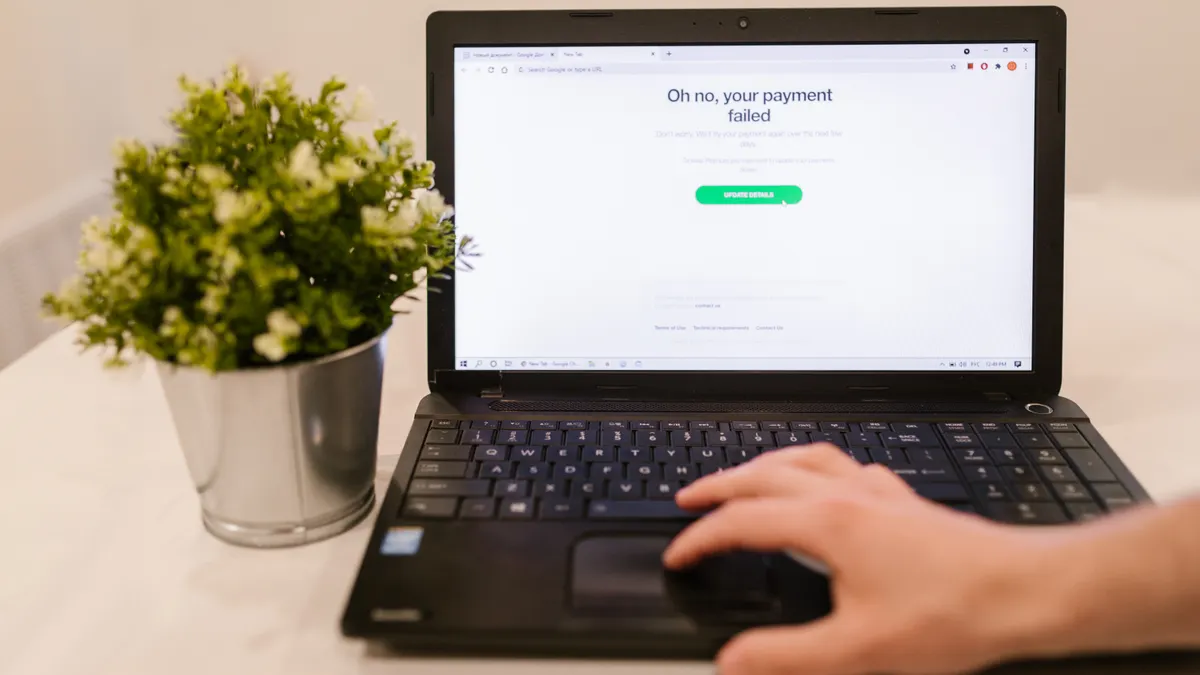
Keep proof of delivery in a form you can find fast: file timestamps, platform messages, signed approval, and copies of the final version. If the platform lets you attach evidence, use the exact file name and date. A weak paper trail can make an otherwise defendable claim harder to show to the insurer.
Professional liability insurance is the policy most likely to respond if the dispute is framed as a mistake in the work. Cyber insurance may matter if the dispute starts with a compromised account or fraudulent access. General liability usually does not solve a digital payment reversal by itself, because it is aimed at physical injury or property damage, not a cardholder fight.
When should I stop and get help?
You should stop using a one-size-fits-all approach when the payment flow, the contract, and the policy no longer point to the same risk. In money matters, a wrong assumption can cost you a denied claim, a missed exclusion, or a gap in cover. These are the main situations where a qualified adviser should review the facts before you rely on a policy.
The platform holds funds for weeks: This means your cash flow is exposed to delay, reserve, or review risk — check whether your policy reacts to loss of income, a claim event, or neither before you depend on the payout date.
The platform can reverse completed payments: This means a delivered job can still turn into a refund or chargeback — ask whether the policy treats that as a covered dispute or an uncovered payment issue.
Your work is mainly digital and client-facing: This means the loss may come from a service error rather than property damage — focus on professional liability wording before you spend time on general liability forms.
You store login credentials or client files in the platform: This means account access matters as much as the job itself — review cyber insurance wording for account compromise and credential misuse.
The platform terms and your contract say different things: This means the insurer may look at both documents when deciding a claim — get the wording compared before a dispute happens.
Your income depends on one platform: This means a hold or reversal can affect a large share of your cash flow — ask for help if the policy leaves the platform risk unclear or if replacing that income would be hard.
What mistakes do freelancers make here?
Freelancers usually make the same few mistakes, and each one creates a specific gap. The problem is rarely “no insurance at all.” It is more often the wrong policy type, the wrong assumption about what a platform handles, or the wrong records.
The first mistake is treating the platform as if it provides insurance. Most payment platforms process money; they do not automatically protect your business against every dispute. The result is a false sense of cover, and the fix is to read the platform terms as payment terms, not protection terms.
The second mistake is assuming professional liability insurance covers any loss tied to a client complaint. It does not. If the loss is purely a refund, a chargeback, or a payout hold with no allegation about your work, the claim may sit outside that policy.
The third mistake is ignoring cyber insurance because the business is “just freelance.” A platform account is still a business account, and a login problem can interrupt payments in a way that looks small until it blocks access to funds. The fix is to review whether the policy covers digital access events, not just data theft.
The fourth mistake is using general liability as a catch-all. That can leave the exact online payment problem untouched, because general liability is built for physical injury, property damage, and similar claims. The correct alternative is to pair it with the policy that matches the payment risk.
The fifth mistake is keeping poor records of delivery and approval. A claim can fail on proof, not on the quality of the work. Saving the timestamps, messages, and final files is part of risk control, not admin clutter.
What if my setup is unusual?
You need to adjust the usual approach if your platform setup is unusual, because the payment path can change the risk more than the job title does. A freelancer who takes deposits through a platform, then finishes work off-platform, has a different exposure from someone whose full project and payment stay inside one dashboard. The same is true for split payouts, subscriptions, and milestone payments.
If the platform lets clients pay in stages, match each stage to the work delivered at that point. That makes disputes easier to trace and reduces confusion over what was owed when. If the platform pays in a currency other than the one you spend in, you also need to watch for timing gaps between payout and use, because currency movement can affect your cash position even when the fee itself is not disputed.
If you work across borders, country rules, tax rules, and contract enforcement can differ. That is another reason not to rely on a blanket answer. Read the policy wording, the platform terms, and the client contract together, then get qualified help if they do not point in the same direction.
Does payment processing change my insurance needs?
Yes. Payment processing changes the risk profile because it adds holds, reversals, and platform rules on top of the work itself. That means you may need a closer look at professional liability insurance and cyber insurance, not just a basic general liability form.
Do platforms cover freelancer disputes?
Usually not in the way an insurance policy would. Platforms may run a dispute process, freeze funds, or decide a payment reversal, but that is not the same as paying for your legal or business loss. Read the platform terms as a payment policy, not as insurance coverage.
Should I add cyber insurance if I get paid online?
Often yes, especially if your platform account is central to your business. Cyber insurance can matter when a login is stolen, a payment instruction is altered, or access to the account is lost. The policy wording should be checked carefully, because some forms focus on data events more than payment interruption.
Drafted with AI; not yet reviewed by a person.
