

Last updated: November 26, 2026
Handle it by checking whether the clause asks for cyber insurance, professional liability insurance, or both, then compare that language against your policy’s privacy and breach terms before you sign. This is information, not financial advice; a qualified adviser should review your own situation if the contract is binding, the limits are high, or the data involved is sensitive.
Key takeaways
- A “confidentiality breach” clause is often broader than a simple non-disclosure agreement.
- The contract may be asking for coverage that only some cyber policies or professional liability policies include.
- The exact wording matters more than the label on the policy.
- If the clause demands coverage your policy excludes, the gap is usually a contract issue first and an insurance issue second.
- You should not guess. Compare the clause, the declarations page, and the exclusions line by line.
Who should use this approach?
This approach fits freelancers who already have a contract, a non-disclosure agreement, or both, and who need to check whether a confidentiality breach insurance requirement matches their current cover. It assumes you can read a policy summary, spot terms like “privacy claim,” “confidential information,” and “data breach,” and ask a client for revised wording if needed.
It is not a fit if the contract is already signed and you are trying to fix a coverage gap after the fact, or if the work involves regulated data that your policy clearly excludes. If the clause is tied to a large enterprise client, a healthcare file set, or another setting where a privacy mistake could trigger formal notice duties, bring in a qualified insurance adviser or lawyer before you sign anything. That is especially true when the contract uses exact limits, indemnity wording, or a certificate of insurance with no room to negotiate.
The basic problem is simple. A client may want proof that you can respond if confidential information is exposed, but insurers do not all define that risk the same way. One policy may treat it as part of cyber coverage, another may tuck part of it into professional liability insurance, and a third may exclude it entirely. The job here is to match the contract to the policy, not to hope the labels line up.
How do I check the clause against my policy?
You check it by comparing the contract’s trigger words to the policy’s covered claims, exclusions, and any privacy endorsement on the declarations page. The useful question is not “Do I have insurance?” but “Does this policy answer the exact risk named in the contract?”
Start with the clause itself. Look for words like confidential information, privacy breach, unauthorized disclosure, misuse of client data, and any promise to carry cyber insurance or professional liability insurance. Then read your policy’s insuring agreement, exclusions, and definitions. In insurance language, a definition is the section that says what a term means inside that policy, and it can change the whole result.
| What the contract says | What to verify in the policy | Common mismatch |
|---|---|---|
| Confidentiality breach | Privacy claims, network security claims, media liability, or data breach response | The policy covers cyber events but not contract-based privacy claims |
| Non-disclosure agreement | Contractual liability, breach of contract exclusions, and carve-outs | The policy pays for negligence but not for a pure contract promise |
| Confidential information | The policy definition of “personal data,” “private information,” or “confidential information” | The policy uses a narrower definition than the contract |
| Data breach | Incident response, notification costs, and claim defense | The policy covers response costs but not indemnity for the client’s loss |
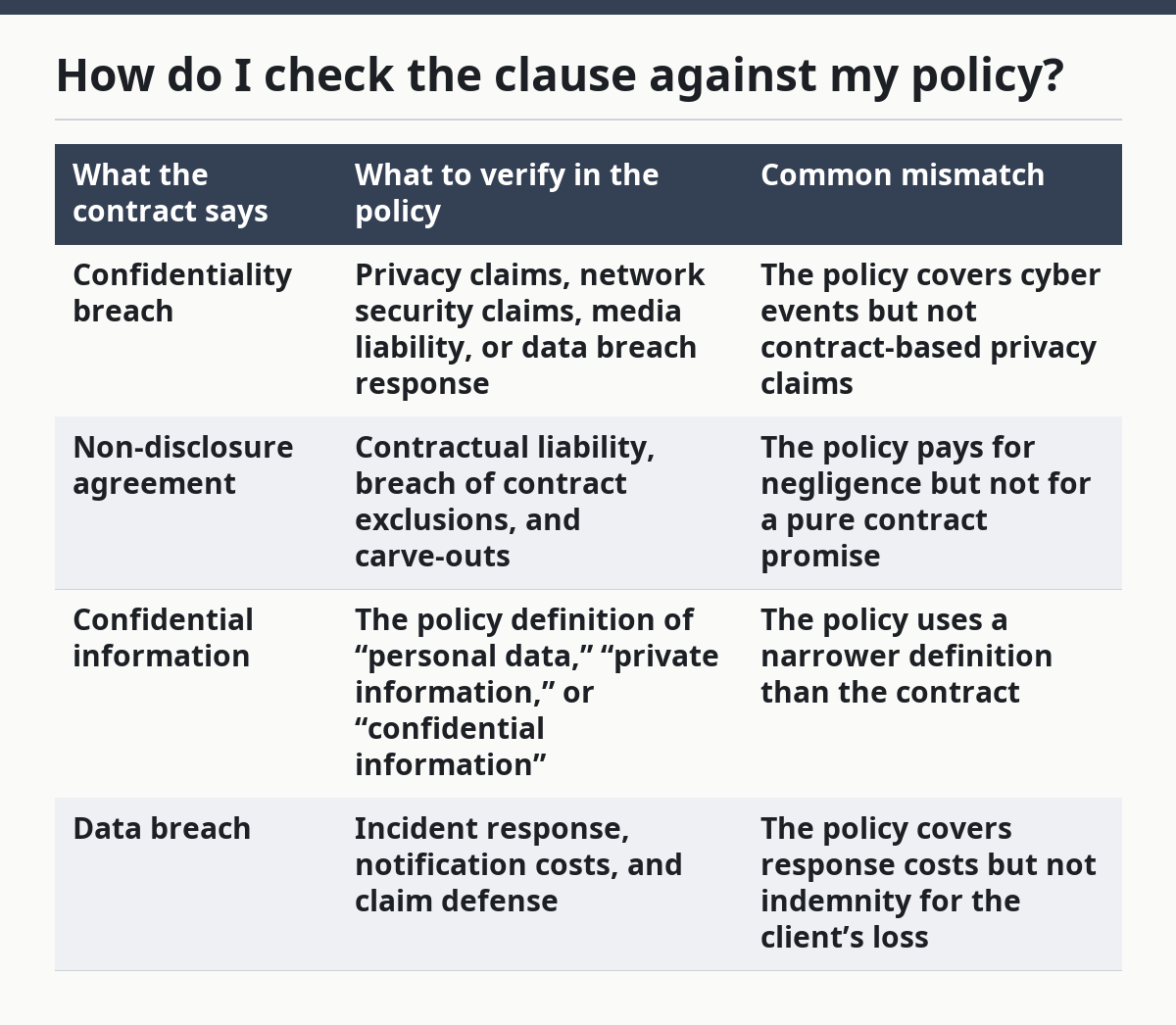
A client contract often sounds broad on purpose. A policy is narrower by design. That is why you need to check whether the insurer defines a privacy claim as an error, an omission, a network event, or a breach of duty. If the policy does not clearly cover the claim type the contract names, the problem is not solved by assuming the terms are close enough.
What should I ask the insurer or broker?
You should ask for a plain answer on coverage, exclusions, and any endorsement that changes privacy protection. Keep the question short and specific: does this policy respond to a claim for confidentiality breach, unauthorized disclosure, or failure to protect client data under a contract like this?
Use the insurer’s or broker’s wording in writing, not a phone memory. Ask for the policy form number, any privacy endorsement, and the exact exclusion that might apply. If the answer depends on whether the claim is framed as negligence, breach of contract, or a cyber event, you need that distinction in writing. A verbal “that should be fine” is not enough when the contract can trigger a dispute.
Ask about three things in one pass: defense costs, damages, and first-party response costs. Defense costs are what the insurer spends to defend a claim; damages are what a court or settlement may require you to pay; response costs can include notice, monitoring, forensic work, or similar steps if the policy covers them. A policy may cover one and not the others.
The best time to ask is before signing, not after a client has already sent a redline. If you wait until a claim exists, the conversation changes from “Can this be covered?” to “What does the policy already say?” That is a worse place to be.
How do I handle the contract step by step?
You handle it by reading the clause, matching it to the policy, then negotiating the gap before you sign. Do each step in order, and stop if one of them exposes a mismatch you cannot fix.
- Extract the exact clause from the contract and mark every sentence that mentions confidentiality, privacy, data breach, indemnity, or insurance within 1 page. Verify whether the clause requires a specific policy type, such as cyber insurance or professional liability insurance; a problem exists if the wording is broader than your current cover.
- Collect the policy declarations page, insuring agreement, exclusions, and endorsements in one file within 10 minutes. Verify the policy number, limits, and policy period; a problem exists if you only have a summary and not the actual form language.
- Compare the contract trigger words to the policy definitions line by line for terms such as confidential information, privacy claim, and data breach. Verify whether the policy uses the same definition or a narrower one; a problem exists if the policy excludes contract-based claims or limits “confidential information” to personal data only.
- Check the exclusions section for contractual liability, prior acts, media liability, unencrypted data, or privacy-related carve-outs. Verify whether any exclusion would apply to the client’s required coverage; a problem exists if the exclusion is likely to remove the very risk the client wants insured.
- Ask the insurer or broker in writing whether the contract’s clause would fit the current policy form, using the policy form number and the clause language. Verify that the answer names the exact coverage part, not just the policy brand; a problem exists if the reply is vague or avoids the clause wording.
- Negotiate the contract redlines so the clause matches what the policy actually covers, usually by narrowing the wording or by limiting the insurance promise to existing coverage. Verify that the revised clause no longer asks for a promise the policy cannot make; a problem exists if the client refuses any change.
- Document the final version of the clause, the policy documents, and the written insurer response in one folder before signing. Verify that the dates line up with the contract term and any required evidence period; a problem exists if the contract starts before the policy period or requires proof you cannot provide.
- Review renewal timing if the contract lasts longer than one policy period, because a 12-month policy may not cover a later contract extension. Verify that you can keep the required cover in force for the full term; a problem exists if the client expects continuous proof and your policy may lapse.
This sequence is slower than signing and hoping, but it is much faster than arguing after a privacy claim lands. The core skill is matching the promise in the contract to the promise in the policy.
What if the clause is broader than my policy?
If the clause is broader than your policy, you either narrow the contract wording or accept that the clause is not a good fit for the work. That mismatch is common with confidentiality breach insurance requirement language because clients often write for broad protection while policies stay narrow.

The cleanest fix is to replace absolute wording with wording tied to existing coverage. For example, a contract may say you will maintain “insurance covering any confidentiality breach,” but your policy may only cover certain privacy claims under a cyber policy and some professional liability claims tied to negligence. If the contract can be revised, the safer move is to align it with what the policy actually says rather than promise a blanket result the insurer never sold.
Here is the trade-off in plain terms. Broader contract language may help the client feel protected, but it can create a promise you cannot keep. Narrower language may be easier to insure, but some clients will push back because they want certainty. That tension is normal; what matters is that the paper reflects the real risk transfer, not a wish.
This is also where the difference between cyber insurance and professional liability insurance matters. Cyber insurance often focuses on privacy events, network security incidents, and response costs. Professional liability insurance often focuses on errors, omissions, and service failures. Some policies overlap, but overlap is not the same as guaranteed fit.
When should I stop and get qualified help?
You should stop and get qualified help when the clause creates a legal or coverage problem that cannot be solved by a simple redline. The warning signs are specific.

The contract demands unlimited or uncapped coverage: that can create exposure far beyond a normal policy structure — pause and get advice before signing.
The clause requires coverage for breach of contract itself: many policies treat that differently from negligence or a privacy claim — ask for a formal coverage review.
The client wants proof for regulated data, such as health or financial records: those settings can trigger special privacy duties and tighter exclusions — do not guess at the fit.
Your policy has a privacy or contractual liability exclusion: that may remove the very claim the client wants covered — ask whether the exclusion can be endorsed, or whether the contract must change.
The project involves multiple countries or cross-border data handling: privacy obligations can change by country and by contract — get local advice if the data path is unclear.
The client insists on a certificate of insurance as if it were the policy: a certificate is not the same as actual coverage — do not rely on the certificate alone.
When any of those show up, the issue is no longer just contract housekeeping. It is a coverage interpretation problem with money on the line, and a qualified adviser should review your documents.
What mistakes do people make here?
People usually make five mistakes, and each one creates a different kind of gap. The fix is usually simpler than the mistake.
First, they assume cyber insurance and professional liability insurance are interchangeable. They are not. One may cover privacy events and response costs while the other focuses on service errors, so the correct alternative is to read the insuring agreement instead of the label.
Second, they rely on the client’s wording instead of the policy wording. The consequence is a clause that looks covered but is not. The correct alternative is to test the exact clause against the exact exclusions.
Third, they treat an NDA as if it automatically means insurable risk. An NDA sets a duty of confidentiality; it does not force an insurer to cover every breach of that duty. The correct alternative is to check whether the policy covers contract-based liability or only certain privacy claims.
Fourth, they accept a certificate of insurance as proof of fit. A certificate often shows existence of insurance, not the full scope. The correct alternative is to review the actual policy form and endorsements.
Fifth, they ignore renewal dates. A clause that looks fine for 12 months can fail if the contract runs longer than the policy period. The correct alternative is to match the contract term to the insurance term and confirm renewal expectations in writing.
How does this differ from cyber coverage?
It differs because a confidentiality breach clause can demand a promise that is broader than standard cyber insurance alone. Cyber insurance usually speaks the language of privacy claims, network events, and data breach response, while a confidentiality breach clause may also reach service errors, contract promises, and non-disclosure duties.
That is why the same contract can touch both cyber insurance and professional liability insurance. A freelancer who edits, consults, designs, writes, or handles client files may have a claim that starts as a privacy issue but is pleaded as a breach of contract. The policy that answers one version of the claim may not answer the other.
The right comparison is not “Which one is better?” It is “Which wording matches this clause?” That question matters because a client may ask for evidence of broad confidentiality protection when the actual exposure sits in one narrow part of the policy. If the policy covers only certain privacy claims, say that plainly and do not let the client assume it covers all confidentiality disputes.
FAQ
Is confidentiality breach coverage the same as cyber insurance?
No, it is not always the same. Cyber insurance often covers privacy events, network security incidents, and some response costs, but a confidentiality breach clause may also involve contract liability or professional liability terms. The only reliable answer is to compare the policy definitions and exclusions to the contract wording.
What if my policy excludes privacy claims?
If your policy excludes privacy claims, the clause may not fit your current cover. That means you should not treat the contract as “covered” just because you have insurance in general. The next step is to ask whether the clause can be narrowed, or whether another policy part already responds to the risk.
Can I negotiate this clause before signing?
Yes, you can often negotiate it before signing. The cleanest change is usually to tie the obligation to the insurance you already carry, instead of promising a broader form of coverage. If the client will not change the clause and the policy does not match, that is a real warning sign, not a paperwork detail.
Drafted with AI; not yet reviewed by a person.
