

Last updated: November 27, 2026
Quick answer: there are 2 main choices in how to choose between a professional liability policy and a business owner’s policy for freelancers. Choose a professional liability policy if your main risk is a client saying your work caused a money loss. Choose a business owner’s policy, or BOP, if you also need general liability insurance and commercial property insurance for tools, stock, or a home office setup. This comparison is general information for choosing between the two policy types.
Key takeaways
- A professional liability policy is narrower and usually fits service work where advice, design, coding, writing, or strategy can trigger a claim over mistakes.
- A BOP is broader because it packages general liability insurance with commercial property insurance in one policy structure.
- If you only need protection for your professional work, the narrower policy is usually easier to match to the risk.
- If you have business property to protect, a BOP can cover more ground at once, but it is not a substitute for every kind of business risk.
- The right choice turns on what could go wrong first: a client dispute over your work, or damage to the place and things you use to run the business.
What is the real difference?
The real difference is that professional liability insurance protects against alleged work mistakes, while a BOP protects against a mix of property damage and third-party injury claims plus business property loss. In plain terms, one policy is built around the quality of your professional service, and the other is built around the business space and equipment that support that service.
That difference matters because freelancers often think they are choosing between two versions of the same product. They are not. A freelancer who drafts contracts, designs brands, edits video, builds websites, or advises clients can face claims that are about the outcome of the work itself. A BOP does not replace that kind of protection just because it is a business policy.
The BOP can still be the better structure when the freelancer has a real property footprint. A home office with computers, furniture, inventory, or client-facing space changes the decision. General liability insurance and commercial property insurance live inside the BOP framework, so the policy can handle the business premises side of the risk. For more on the wider set of options, the hub on freelance insurance policy options and buying decisions is the right next step.
Here is the clean split: if the risk is “my work cost a client money,” look first at professional liability. If the risk is “my business setup or premises caused damage or suffered damage,” look first at a BOP.
How does a professional liability policy fit a freelancer?
A professional liability policy fits freelancers whose biggest exposure is a claim tied to professional judgment, advice, or work product. That usually means the dispute is about an error, omission, missed deadline, or poor result, not a broken chair, a fire, or a visitor slipping in the office.
That narrower fit is its strength. If you work from a laptop and your business has little physical property, there may be no reason to pay for commercial property insurance you do not need. A sole freelance writer, consultant, bookkeeper, developer, or designer often has this kind of risk profile.
However, the weakness is just as clear. This policy does not turn into a catch-all business package. If you keep expensive equipment, receive clients at home, or store business property that would hurt to replace, the policy may leave a gap on the physical side. It also does not solve every contractual dispute, and it does not change the terms of a client contract.
Professional liability is wrong for freelancers who think any business policy will cover every loss. It is also a poor match for someone whose main concern is the physical setup of the business rather than the service itself. For that reader, the policy can feel too narrow on the exact day they need broader protection.
When does a business owner’s policy make more sense?
A BOP makes more sense when the freelancer has both liability exposure and business property to protect. The bundle matters because it combines general liability insurance with commercial property insurance, which means the policy structure is built for the physical side of the business as well as some common third-party claims.
Therefore, it is a stronger match for freelancers who use a home office, see clients in person, store inventory, or rely on equipment that would be costly to replace. A photographer with lights, a maker with stock, or a consultant with a dedicated office area has a very different risk picture from a freelancer who only needs to cover errors in advice or service.
The trade-off is that a BOP can be broader than the freelancer needs. If your business is basically a laptop, a phone, and a service contract, the property part may add complexity without solving the main risk. A BOP also does not replace professional liability insurance when the issue is the quality of the service itself. That is the most common mistake in this comparison.
For a freelancer, the BOP wins when the business has real things to protect and real visitor or premises risk. It loses when the business is mostly intangible and the real exposure sits in the work product.
Professional liability policy vs BOP: head-to-head
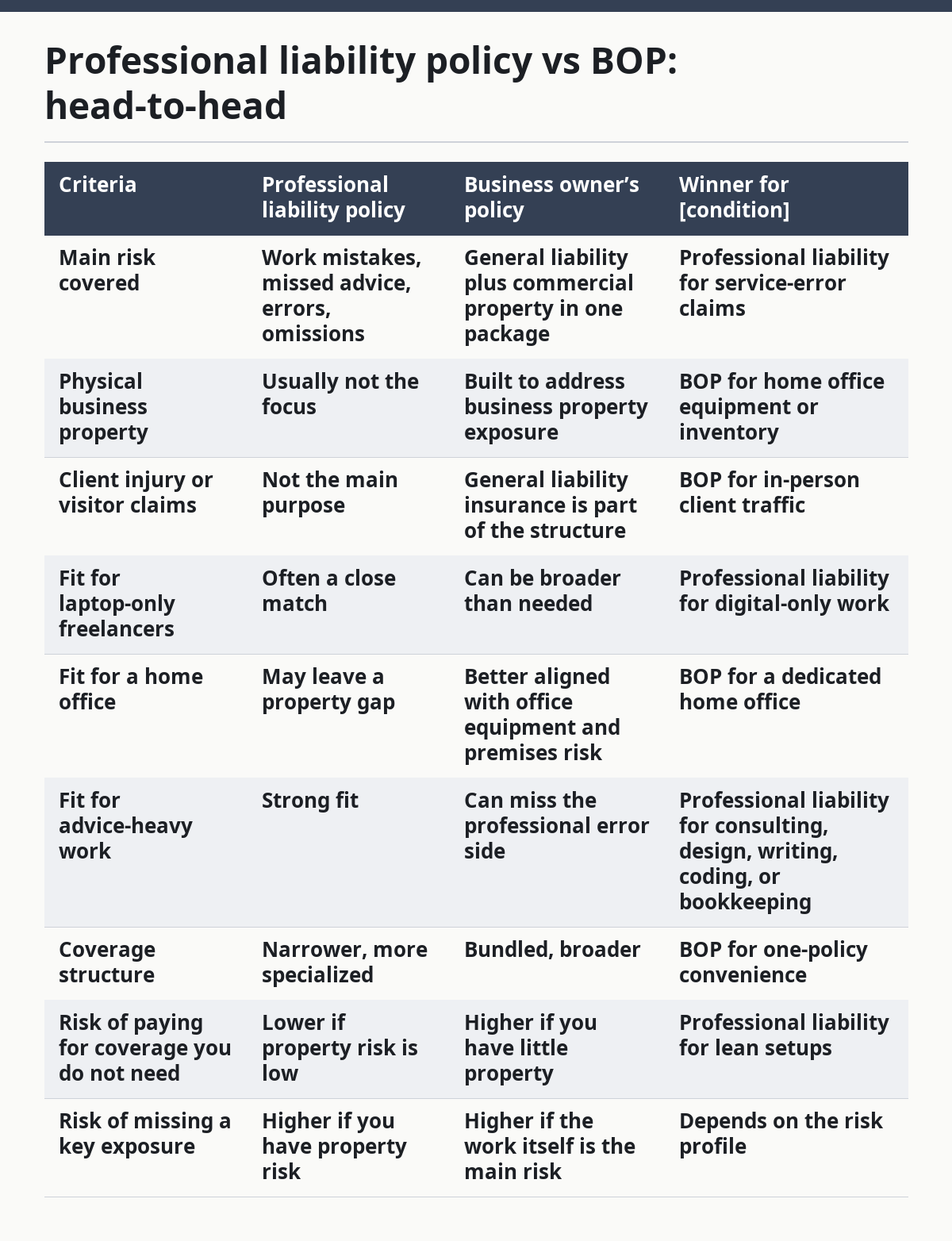
The table below is the most direct way to choose. The winner column changes by condition, because the better policy depends on the claim type or loss that is most likely to hit first.
| Criteria | Professional liability policy | Business owner’s policy | Winner for [condition] |
|---|---|---|---|
| Main risk covered | Work mistakes, missed advice, errors, omissions | General liability plus commercial property in one package | Professional liability for service-error claims |
| Physical business property | Usually not the focus | Built to address business property exposure | BOP for home office equipment or inventory |
| Client injury or visitor claims | Not the main purpose | General liability insurance is part of the structure | BOP for in-person client traffic |
| Fit for laptop-only freelancers | Often a close match | Can be broader than needed | Professional liability for digital-only work |
| Fit for a home office | May leave a property gap | Better aligned with office equipment and premises risk | BOP for a dedicated home office |
| Fit for advice-heavy work | Strong fit | Can miss the professional error side | Professional liability for consulting, design, writing, coding, or bookkeeping |
| Coverage structure | Narrower, more specialized | Bundled, broader | BOP for one-policy convenience |
| Risk of paying for coverage you do not need | Lower if property risk is low | Higher if you have little property | Professional liability for lean setups |
| Risk of missing a key exposure | Higher if you have property risk | Higher if the work itself is the main risk | Depends on the risk profile |
Why would a freelancer choose professional liability over a BOP?
A freelancer should choose professional liability over a BOP when the business risk is mostly about the service, not the space. That is the cleanest answer for people who sell expertise, advice, or creative output and keep little more than a computer, a desk, and a few files.
The strength is precision. The policy is aimed at the claim that matters most in many freelance businesses: “Your work caused my loss.” That matters because a BOP can be excellent on the property side and still miss the core exposure that comes from the job itself. A policy that does not match the claim type is a bad bargain even if it looks broader on paper.
The weakness is the gap on physical loss. If you work from a home office and own business property, professional liability alone may not answer the question of what happens if equipment is damaged or the business space itself creates a claim. That can leave a freelancer exposed to a loss that has nothing to do with service quality.
This is the better option for a freelancer with a low-property business model. It is not usually the right fit for someone with a room full of gear, stock, or a steady stream of in-person visits.
Why would a freelancer choose a BOP instead?
A freelancer should choose a BOP instead when the business has a meaningful physical footprint. That can mean commercial property, a dedicated home office, or regular client visits that make general liability insurance part of the decision.
The strength is breadth. A BOP combines general liability insurance with commercial property insurance, so it can address both sides of a business that lives in the real world, not just in documents and files. That matters for freelancers who store tools, display work, meet clients, or keep inventory.
The weakness is that the bundle can miss the heart of a professional-services business. A BOP is not designed to stand in for professional liability insurance when the dispute is about advice, design, strategy, or another service error. If the freelancer assumes the bundle covers all business mistakes, that assumption can be wrong at the worst time.
A BOP is the better fit for freelancers whose business looks and behaves like a small business with property, not just a service contract with a laptop. It is usually a poor fit for a lean, digital-only operation with little or no business property.
Which option is better for home office property?
A BOP is usually better for home office property because it is built around commercial property insurance as part of the package. That is the clearest structural advantage in this comparison.
A home office changes the insurance question because the freelancer is no longer asking only about professional mistakes. The office itself now contains business property, and that property may need a policy structure that recognizes it as business-use equipment rather than personal household belongings. A BOP is designed to sit closer to that need than a stand-alone professional liability policy.
However, “home office property” is not one simple thing. Some freelancers have only a desk, a laptop, and a printer. Others keep larger equipment, inventory, or tools. This page does not answer how to decide whether a freelancer needs a scheduled equipment policy or a blanket property limit, and that question deserves its own analysis.
So the rule here is limited but useful: if the home office is part of the business risk, the BOP has the clearer fit. If the home office is just the place where the work happens and the main risk is the work itself, professional liability stays the more precise match.
What are the exception cases where the verdict changes?
The overall verdict flips in a few specific cases. The first is when a freelancer’s business has almost no property but a high risk of client claims over the work itself. In that case, professional liability is the stronger choice even if the freelancer likes the idea of a bundle.
The second is when the freelancer has a real office setup, inventory, or regular in-person client traffic. Then the BOP can move ahead because general liability insurance and commercial property insurance answer more than one risk at once.
The third is when the business is mixed. A freelance photographer, maker, or consultant may need a BOP for the space and equipment side, but still need a separate answer for professional liability if the work creates a claims risk that the bundle does not cover. In that case, one policy choice is not enough to explain the whole picture.
The fourth is when the freelancer is chasing simplicity and has not mapped the risk. That is the wrong time to buy by label. A policy name tells you almost nothing unless you know whether the claim is about the work, the property, or both.
So which one should a freelancer pick?
Choose professional liability if your business is mainly advice, design, writing, coding, bookkeeping, or another service where the main fear is a client claim about your work. Choose a BOP if your freelance business also needs general liability insurance and commercial property insurance for a home office, gear, inventory, or client visits. Neither if you are trying to make one policy cover every possible business risk without checking what it actually includes.
For the official wording around business insurance types, the U.S. Small Business Administration and the National Association of Insurance Commissioners both provide useful background on commercial coverage categories. The U.S. Small Business Administration and the National Association of Insurance Commissioners both explain business insurance terms in plain language. That background helps compare how the two policy types differ.
The better decision is the one that matches the claim type that would hurt most. A freelancer who understands that split can compare policies with a clear eye instead of buying a bundle that sounds complete but leaves the main risk behind.
Drafted with AI; not yet reviewed by a person.
