
Last updated: November 26, 2026
How to Insure Freelance Work When You Use a Home Office for Client Meetings
Quick answer: cover the setup with three checks—your home policy, your liability coverage, and your business property limits. For How to Insure Freelance Work When You Use a Home Office for Client Meetings, the main risk is that a client visit can trigger a business exposure that a standard homeowners or renters policy may not fully treat the same way as ordinary household use.
Homeowners insurance or rental insurance may not fully treat a client visit as a business exposure, so many freelancers check whether they need general liability insurance, business personal property coverage, or a business use endorsement before they host anyone at home. Because policy language varies, consult your insurer or a licensed professional before you rely on any general summary. The Insurance Information Institute notes that business-use exclusions can change how a loss is handled, so wording matters as much as the policy type.
Key takeaways
- A home office can create two risks at once: damage to your own gear and injury to a visitor.
- The main policy words to know are homeowners insurance, rental insurance, general liability insurance, business personal property, and business use endorsement.
- A client stepping inside your home is a different risk from a client staying at the door or meeting on video.
- The right coverage depends on how often clients visit, what property you use for work, and what your current policy already excludes.
- This is information, not financial advice. For your own situation, a qualified adviser should review the policy language and your local rules.
Who this applies to
This applies to freelancers who meet clients in a home office, keep business gear at home, and want to understand which insurance layer covers which risk. It assumes you already have a homeowners insurance policy or rental insurance policy, or you are about to ask for one, and that you know your work involves in-person meetings at home rather than only remote calls.
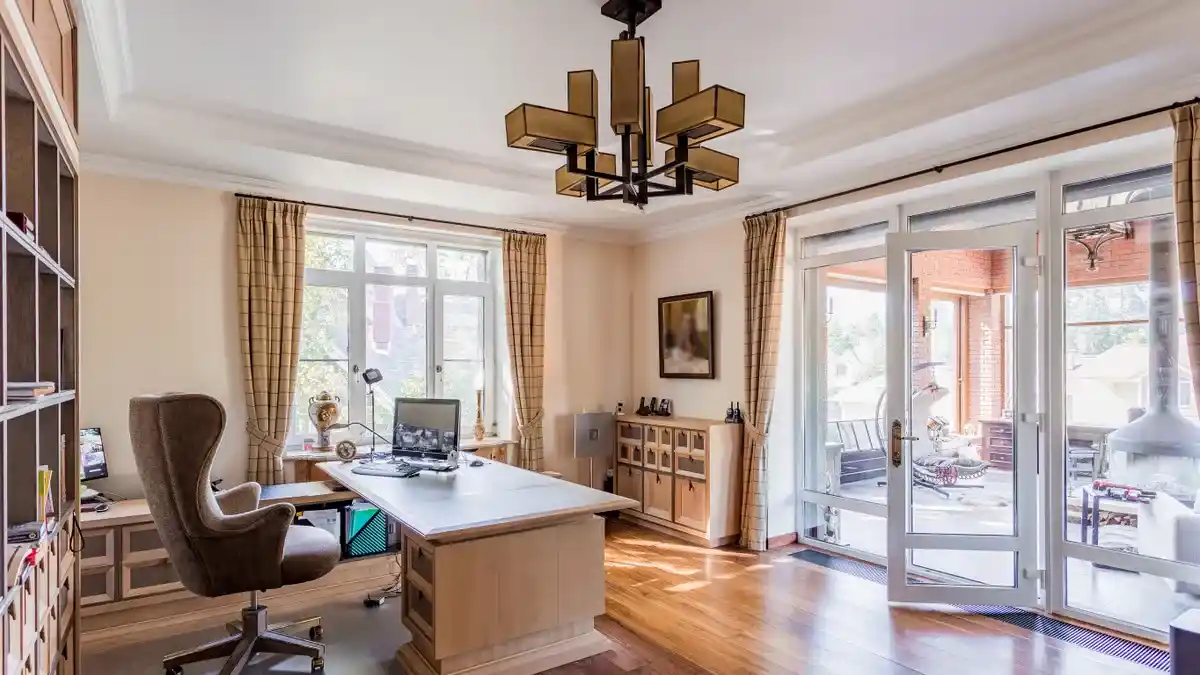
The main issue is simple: a home office used for client meetings creates a visitor risk that is not the same as ordinary household use. A laptop, printer, camera, samples, or other business personal property can also be treated differently from personal items if there is a theft, fire, or water loss. Because insurers define business use differently, consult a professional before you assume the personal policy covers it all. The overlap is where many claims get messy.
This page is for learning how the coverage pieces fit together. If your home is also a studio, showroom, or frequent meeting place, or if your lease or mortgage terms restrict business use, the policy review can become case-specific fast. In that case, a qualified insurance adviser should read the policy wording with you.
For a broader map of the topic, the hub on freelance insurance for solo businesses gives the wider context around business models and coverage choices. The SBA also has a general overview of business insurance basics on its business insurance guidance page.
How do I insure a home office for client meetings?
You insulate the business side from the household side by checking three layers: your home policy, your liability cover, and the equipment you keep there. The process is about matching the policy to the way clients actually enter your space, not about buying every policy type in sight.
-
Review your homeowners insurance or rental insurance declarations page and exclusions for business activity.
Check whether the policy mentions business pursuits, office use, or limits on client traffic. If the wording is silent, that is not a guarantee of coverage. A problem sign is any exclusion that may treat business visitors or business property differently from ordinary household use. Because policy wording varies, consult a professional before you assume a claim will be covered. -
List every item of business personal property you keep at home.
Include computers, monitors, printers, lighting, sample materials, filing cabinets, and any tool used for client work. Verify whether the policy covers those items at replacement value or only up to a small sublimit. A problem sign is a gap between what you use for work and what the policy says it insures. The IRS home office guidance on Publication 587 is useful for the tax side, but it does not replace your insurance review. -
Check whether general liability insurance is part of your freelance setup.
General liability insurance usually addresses bodily injury and property damage claims tied to your business activity. Verify that a client slipping on a floor, tripping over a cord, or damaging a third party’s property during a visit would not be left to your personal policy alone. A problem sign is discovering that your home policy excludes business visitor claims. -
Ask for a business use endorsement if your insurer offers one.
A business use endorsement is an add-on that can adjust a homeowners insurance or rental insurance policy for limited business use. Verify the endorsement’s scope, because it may cover some office equipment or limited business traffic but not every liability issue. A problem sign is assuming one endorsement fixes both property and liability exposures. The National Association of Insurance Commissioners explains that endorsements change coverage terms, so the exact wording matters. -
Match the meeting pattern to the exposure level.
If clients visit only rarely, your insurer may treat the risk differently than if your office has steady in-person traffic. Verify whether your policy language changes when a room is used mainly for business rather than mixed household use. A problem sign is regular client traffic in a space the insurer still treats as purely domestic. Because insurers vary, consult a professional before you rely on a general rule. -
Document the room, the equipment, and the visitor setup.
Keep a simple record of the office room, the business items kept there, and basic safety steps like clear walk paths and secured cords. Verify that photos or lists would help support a claim if a loss happens within a 12-month policy period. A problem sign is having no record of what was in the room or how the space was arranged. Keep the record simple and current. -
Compare the policy terms before client meetings start.
Do not wait for the first visitor to discover a gap. Verify the deductible, exclusions, and any business use threshold in writing. A problem sign is a policy that sounds fine in conversation but says something narrower on paper.
For background on small-business coverage concepts, the U.S. Small Business Administration has general insurance guidance, and the IRS explains home office rules for U.S. taxpayers on Publication 587. The NAIC also offers consumer guidance on understanding insurance policies and endorsements. Those pages do not replace your policy wording, but they show how the business side of a home setup is usually treated.
What does homeowners insurance usually miss?
Homeowners insurance usually misses the business part of the risk, especially when a client is there on business and not as a social guest. The policy may still protect the house as a dwelling, but that is not the same thing as covering a business injury or business equipment loss.
That gap shows up in two places. First, a claim for a client’s injury may be questioned if the visit was part of your freelance work rather than ordinary living. Second, laptops, cameras, and other business personal property can face tighter limits than household items, or need an endorsement to be treated properly.
Rental insurance works in a similar way. It can protect your contents and personal liability, but it may not automatically treat business meetings as part of the covered use. The key is not the label on the policy, but the policy language about business activity, visitors, and property used for work.
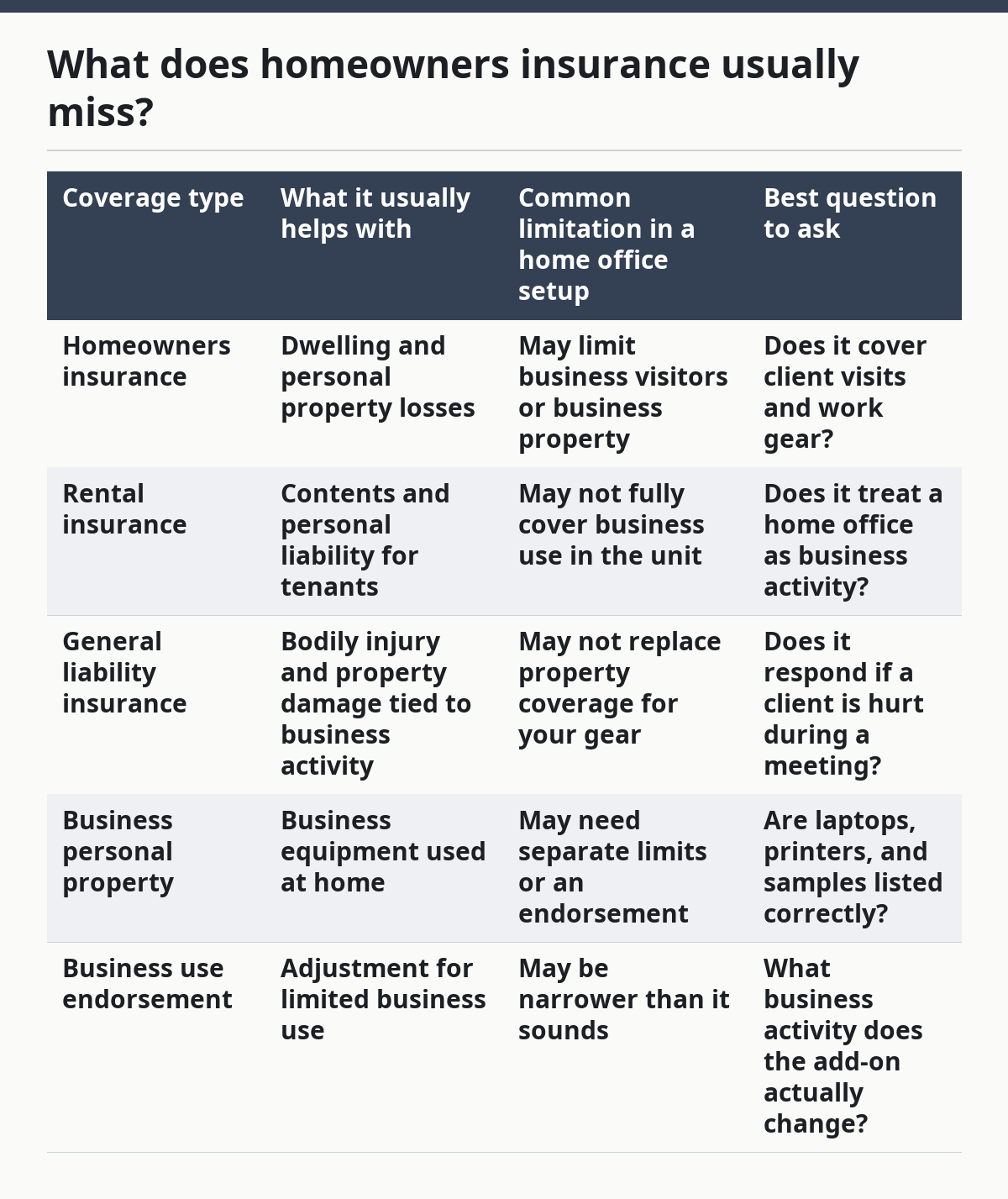
Here is the practical comparison:
| Coverage type | What it usually helps with | Common limitation in a home office setup | Best question to ask |
|---|---|---|---|
| Homeowners insurance | Dwelling and personal property losses | May limit business visitors or business property | Does it cover client visits and work gear? |
| Rental insurance | Contents and personal liability for tenants | May not fully cover business use in the unit | Does it treat a home office as business activity? |
| General liability insurance | Bodily injury and property damage tied to business activity | May not replace property coverage for your gear | Does it respond if a client is hurt during a meeting? |
| Business personal property | Business equipment used at home | May need separate limits or an endorsement | Are laptops, printers, and samples listed correctly? |
| Business use endorsement | Adjustment for limited business use | May be narrower than it sounds | What business activity does the add-on actually change? |
What should I check before clients visit?
You should check the path, the room, and the policy wording before the first client walks in. A clean floor does not fix a coverage gap, and a good policy does not fix a bad setup.
Start with the physical space. Make sure cords, bags, and samples do not create a trip point, because slip and fall exposure is the most obvious visitor risk in a home office. Then check what the insurer says about business activity inside the home. Some policies draw a line between ordinary household guests and clients who come for work.
Then check the business items in the room. If your home office contains more than a laptop and chair, list the equipment and note whether any item is expensive enough that a loss would hurt cash flow. If the answer is yes, business personal property needs attention in writing, not just in memory.
Finally, check local rules and lease or mortgage terms if they apply. A landlord, lender, or local rule can affect whether client meetings are allowed at all. That is not the same as insurance coverage, but the two issues often get mixed together.
When should I stop and get help?
You should stop using a generic policy answer and get qualified help when the facts stop being ordinary. The closer your setup gets to a true business location, the less useful a quick online summary becomes.
Clients come and go every week: This means your home is functioning partly as a business venue — ask an adviser to review liability and property wording before the next policy renewal.
The office contains high-value gear: This means a loss could be material even if the room is small — check whether business personal property needs separate limits or a schedule.
Your policy mentions business exclusions: This means the insurer has already warned that ordinary home coverage may not fit — get the exact wording explained before you rely on it.
The lease or homeowners association restricts business use: This means a coverage question may turn into a permission question — resolve the property rules first.
Clients will wait in common areas: This means visitor risk extends beyond the office door — review stairways, hallways, and entry paths for liability exposure.
Your work involves samples, prototypes, or third-party property: This means a loss could involve more than your own gear — confirm how property damage is handled, not just injury claims.
What mistakes do freelancers make with home office coverage?
Freelancers usually make the same few mistakes, and each one can leave a gap at claim time. The mistake is often not that they bought nothing; it is that they assumed the wrong policy would do the whole job.
Mistake 1: Treating client visits like casual drop-ins. The consequence is that the insurer may view the meeting as business activity, not household use. The correct alternative is to ask how the policy treats business visitors before anyone arrives.
Mistake 2: Forgetting to list business personal property. The consequence is underinsurance for laptops, printers, and other tools. The correct alternative is to inventory the gear and confirm whether the policy covers it as business property.
Mistake 3: Assuming general liability insurance replaces home coverage. The consequence is a false sense that every loss is handled by one policy. The correct alternative is to separate liability protection from property protection and read both forms.
Mistake 4: Ignoring the room setup. The consequence is higher slip and fall exposure from cords, rugs, or clutter. The correct alternative is to keep visitor paths clear and document the layout.
Mistake 5: Waiting until after a claim to ask about exclusions. The consequence is the worst time to learn a policy excludes your business use. The correct alternative is to ask for the exclusion list before the first meeting.
What if clients never come inside my home?
If clients never enter your home, the visitor risk is lower, but the property and liability questions do not disappear. A doorstep handoff, porch meeting, or garage exchange can still create a business-use issue, depending on how your policy is written and how often the contact happens.
The practical difference is that the most obvious slip and fall exposure drops when nobody crosses the threshold. That said, your business personal property is still at home, and your policy may still treat the office space as a work area rather than ordinary personal living space. A one-time porch meeting and a weekly in-person consultation are not the same exposure.
If the arrangement stays fully outside the home and rare, the policy conversation is often simpler. If the pattern starts changing, the coverage question changes with it. That is the point where a business use endorsement or a broader liability review may become relevant.
FAQ
Does a home office change my liability risk?
Yes. A home office changes liability risk because client visits add a visitor exposure that remote work does not create. The main issue is slip and fall risk, but property damage and business-use exclusions can also matter. A qualified adviser should review your policy language for your own situation.
Will my homeowners policy cover client visits?
Maybe, but not always in the way you expect. Some homeowners insurance policies cover the house as a home and still limit claims tied to business activity or business visitors. The exact answer depends on the wording, the frequency of visits, and whether the insurer offers a business use endorsement.
What if clients never come inside my home?
That lowers the visitor risk, but it does not remove every coverage issue. Business personal property can still be stored at home, and a porch, garage, or doorway meeting may still count as business use under some policies. The policy language, not the location alone, decides the exposure.
The bottom line for a home office with client meetings
The safest way to think about home office freelance insurance is to split the problem into three questions: who comes to the house, what work property stays there, and what your current policy says about business use. If the answer to any one of those is unclear, the insurance setup is not finished yet.
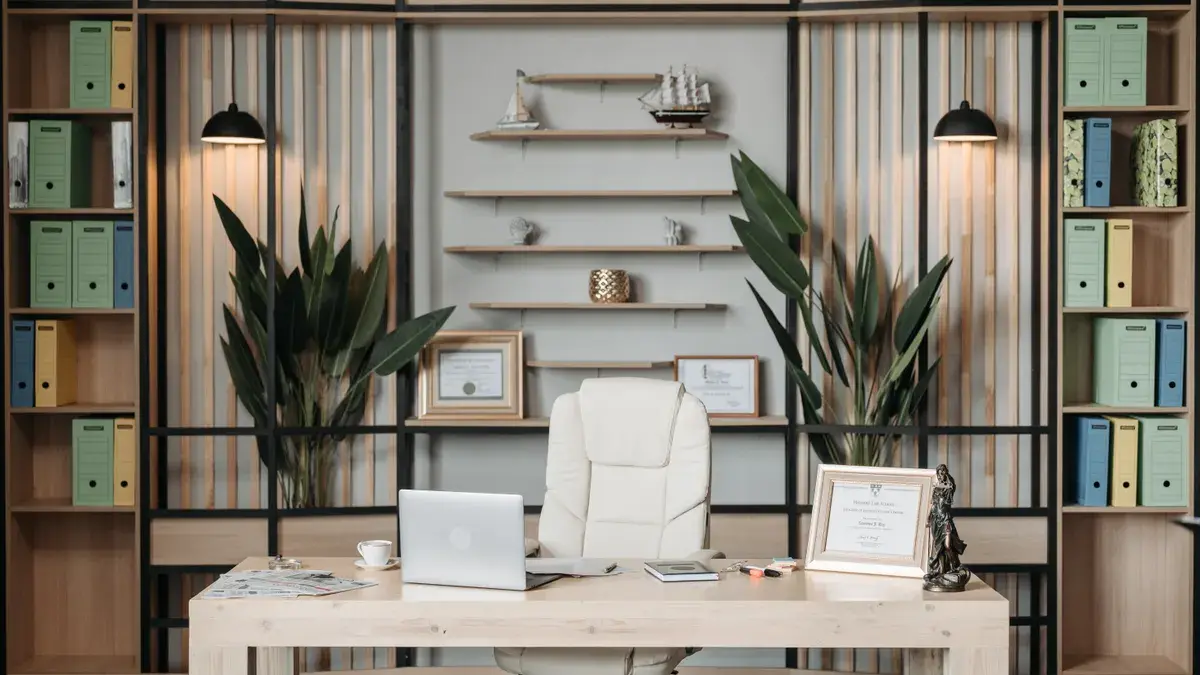
For a freelancer who meets clients at home, the right coverage discussion is usually about overlap, not about one magic policy. Homeowners insurance or rental insurance may handle the home, general liability insurance may address injury claims, and business personal property plus a business use endorsement may fill in the gaps. The details differ by country and by policy, so the policy wording should be checked against your own setup.
Drafted with AI; not yet reviewed by a person.
