
Last updated: November 26, 2026
Quick answer: most freelance recruiters need 3 core policies — professional liability insurance, cyber liability insurance, and general liability insurance. Those three cover the main ways a freelance recruiting business can get hit: bad placement advice, candidate record issues, and physical or third-party injury claims tied to your work. This is information, not financial advice, and a qualified adviser should be consulted for your own situation.
Key takeaways
- Freelance recruiting work creates risk even when you never set foot in a client office.
- Professional liability is the cover that speaks to errors in placement advice and similar service mistakes.
- Cyber liability matters because candidate records often contain personal information.
- General liability is still useful for face-to-face work, meetings, and property damage claims.
- The right cover depends on how you work, what data you hold, and what your client contracts say.
What does a freelance recruiter actually need?
A freelance recruiter needs insurance that matches how recruiting services work, not a generic freelancer bundle with no thought behind it. The core exposures are candidate information, placement advice, and discrimination-related allegations, so the policy set should start there.
Professional liability insurance is the first layer to understand. It is the policy type that responds to claims that a service was wrong, incomplete, or caused a financial loss. For a freelance recruiter, that can mean a candidate was placed poorly, advice was misleading, or a client says the hiring process was handled badly.
Cyber liability insurance is the second layer. If you store candidate records, even simple resumes and contact details, you are handling data that can create a breach response problem. Cyber liability is designed around data incidents, not slip-and-fall events.
General liability insurance is the third common piece. It covers many everyday business claims that are not about the advice itself, such as a client injury during a meeting or property damage linked to your business activities. A freelance recruiter who works entirely online may still need it if the work includes in-person meetings or occasional visits.
The mistake is to assume one policy answers everything. It usually does not. Recruiting is a service business with people, data, and judgment at the center, so the cover needs to match each part.
How do the main policies fit together?
The 3 policies work best when each one handles a different kind of claim. Professional liability addresses service errors, cyber liability addresses data events, and general liability addresses bodily injury or property damage claims.
| Policy type | Main risk it addresses | Typical recruiting trigger | What it does not mainly cover |
|---|---|---|---|
| Professional liability insurance | Errors in professional services | Placement advice, hiring recommendations, service mistakes | Data breaches, injury claims |
| Cyber liability insurance | Data and systems incidents | Candidate records, email compromise, stolen files | Advice mistakes, bodily injury |
| General liability insurance | Third-party injury or property damage | In-person meetings, accidental damage | Professional mistakes, cyber events |
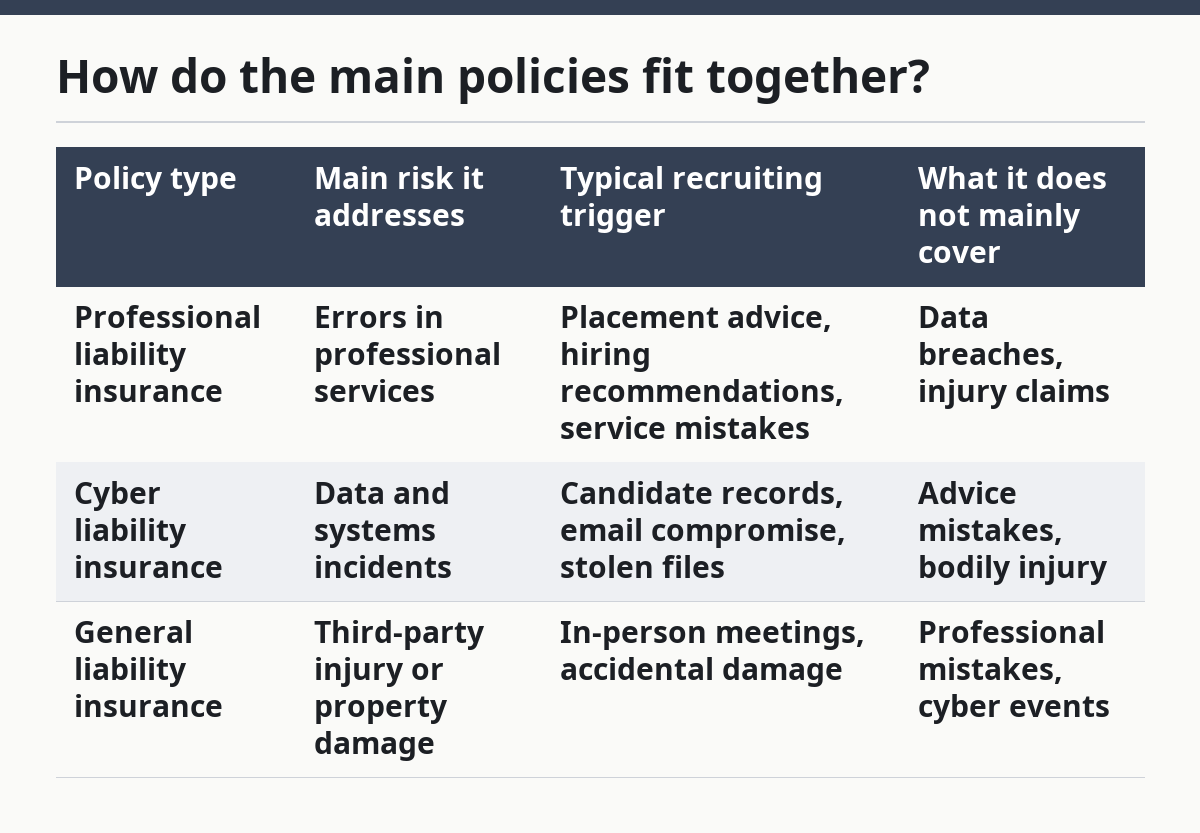
A freelance recruiter should read this as a division of labor, not as a menu. If candidate data is on your laptop or in cloud folders, cyber liability is not optional in spirit just because you do not process payments. If your client work includes judgment about candidates, professional liability is the piece that speaks to that risk.
Another point matters here: insurance companies are rated by agencies such as AM Best, and independent rating agencies provide information on an insurer’s financial viability, according to the insurance industry descriptions in the research facts. That does not tell you which policy to pick, but it does mean the insurer’s strength is part of the decision, not just the premium.
What should be on the checklist before you buy?
A freelance recruiter should check the job mix, the data trail, and the contract language before any policy is added. That means looking at at least 3 things: what recruiting services you provide, what candidate records you keep, and what your client agreements say about liability.
Start with your service scope. If you only make introductions, your exposure is different from someone who screens candidates, advises on hiring decisions, and helps shape offers. The more advice you give, the more important professional liability becomes.
Next, map the data. Candidate records may include CVs, contact details, interview notes, and salary discussions. If those records sit in email, cloud folders, or a laptop, cyber liability deserves attention because a data event can spread across several systems at once.
Then read the contract. Some client agreements use broad language around errors, confidentiality, or compliance, and that language can shift the risk back toward you. If the contract asks you to take on duties that go beyond simple sourcing, the insurance discussion changes with it.
State rules and rating structures can also vary. Prices are based on rating plans that may vary by state, according to State Farm, and rating structures reflect market trends rather than individual loss experience, according to the insurance facts. That is one reason the same freelance recruiting business can see different terms in different places.
What problems are people trying to insure against?
The main problem is not one giant lawsuit. It is the chain of smaller claims that can grow out of everyday recruiting work.
Professional liability helps with claims tied to placement advice. A client may say a candidate was unsuitable, a recommendation was careless, or the recruiting process caused a hiring loss. Those are service disputes, and they belong in the professional liability lane.
Cyber liability helps when candidate information is exposed, lost, or misused. A recruiter may hold records for dozens or hundreds of candidates, and those files can contain personal data that should not end up in the wrong place. Even a basic compromise can trigger response costs and notification work.
General liability helps when the claim is not about your advice or your files. If a client visits your space and is injured, or you damage property during a meeting, that is a different kind of risk. It may have nothing to do with recruiting itself, but it still comes from running a business.
A generic article often misses discrimination-related allegations, and that is a serious gap here. Recruiters can be accused of bias in screening or recommendation decisions, so consult a qualified insurance professional and, if the issue involves employment law exposure, a lawyer or other professional adviser. The U.S. Equal Employment Opportunity Commission says employment agencies can be covered under federal anti-discrimination law, so the risk is not theoretical. Insurance does not erase the claim, but the policy structure has to be able to respond to that kind of allegation if it arises. Source: EEOC, Title VII of the Civil Rights Act of 1964.
When does the standard approach not apply?
The standard 3-policy setup does not fit every freelance recruiter, and a few situations need closer review before you assume the same answer fits you.
You hold no candidate records at all: That reduces cyber exposure, but it does not remove it if your email, calendar, or device still stores personal data — review what actually sits in your systems before deciding the cyber piece is unnecessary.
Your work is limited to introductions with no placement advice: That lowers professional liability exposure, but it does not erase it if your communication shapes hiring decisions — check whether your role is truly administrative or partly advisory.
You work under a client contract that shifts liability to you: That can change the risk profile fast — read the contract line by line before relying on a standard policy set.
You meet clients in person only a few times a year: General liability still matters, but the way it matters changes — the issue is the occasional meeting, not a daily office routine.
You handle sensitive candidate information across multiple tools: That makes cyber liability more important, not less — scattered records raise the chance of an incident across email, cloud storage, and devices.
A practical way to think about this is that the same title, “freelance recruiter,” can hide very different workflows. Someone who sources candidates all day and stores detailed notes has a different risk pattern from someone who only brokers warm introductions. If the work has drifted over time, the insurance should be reviewed again rather than assumed.
What mistakes do freelance recruiters make?
Freelance recruiters usually make 5 avoidable mistakes, and each one leaves a different gap.
1. They treat recruiting as “just consulting.” That can lead to ignoring professional liability. The safer approach is to match the policy to the service work, especially if placement advice is part of the job. If the role is unclear, consult a qualified insurance professional before deciding.
2. They ignore candidate records because they do not process payments. That is a cyber mistake. The correct alternative is to look at all personal data stored in inboxes, folders, and cloud apps, not only financial data.
3. They skip general liability because they work from home. That can leave a gap for client visits or property damage claims. The correct alternative is to ask whether any third-party contact or in-person meeting exists at all.
4. They buy a policy without checking the contract. That can leave them exposed to duties they did not expect. The correct alternative is to compare the agreement with the policy wording before signing both.
5. They assume one policy covers every allegation. That is usually false in a business with advice, data, and third-party contact. The correct alternative is to separate the risks and assign each one to the right policy type.
These mistakes are common because freelance recruiting feels low-gear on the surface. It is not. Once client money, candidate data, and hiring decisions are in play, small errors can turn into claims.
How do insurance prices get set?
Insurance prices are shaped by rating plans, and those plans may vary by state according to State Farm. For large commercial accounts, retrospectively rated insurance sets a premium after the fact, and the rating formula is guaranteed in the insurance contract, according to the insurance facts.
That matters because a freelance recruiter should not assume every quote is built the same way. One policy may rely on a standard rating structure, while another may reflect the insurer’s market view of the risk rather than the recruiter’s own loss history. According to the insurance facts, rating structures reflect market trends rather than individual loss experience.
The practical point is simple: if the policy language is unfamiliar, slow down. A lower price does not help if it leaves out the kind of claim a recruiter is most likely to face. A higher price is not automatically better either if the cover does not match the actual work.
What does a good result look like?
A good result is a policy setup that matches the way the recruiter really works. It should reflect whether the business gives placement advice, stores candidate records, and has any face-to-face contact with clients.
The result should also be boring in the right way. The cover should not be built around guesswork or a vague idea of “freelance risk.” It should track the actual service, the actual data, and the actual client relationship. If those 3 pieces are clear, the insurance conversation gets much easier.
This page sits under the broader guide to freelance insurance for solo businesses, because the right answer for a solo business starts with the work itself. For freelance recruiters, that usually means professional liability, cyber liability, and general liability, with the details shaped by contracts and data handling.
Do freelance recruiters need professional liability insurance?
Yes, freelance recruiters usually need professional liability insurance if they give placement advice, screening opinions, or other hiring-related guidance. That policy is the one most directly connected to allegations that the service was wrong, incomplete, or caused a financial loss. If the recruiter’s role is limited and purely administrative, the need may be lower, but it does not disappear automatically.
Does recruiting need cyber liability coverage?
Yes, recruiting can need cyber liability coverage because candidate records often contain personal information. That includes resumes, contact details, interview notes, and other files kept in email or cloud storage. If those records are exposed, lost, or misused, cyber liability is the policy that speaks to that kind of event.
What insurance covers recruiter errors?
Professional liability insurance is the main cover for recruiter errors tied to service work. It is designed for claims about bad advice, mistakes in placement, or other professional missteps. General liability and cyber liability may still matter, but they do not mainly respond to errors in recruiting judgment.
Drafted with AI; not yet reviewed by a person.
