

Last updated: November 20, 2026
Accept it only if the add-on fits your current policy, your carrier will allow it, and the cost and deadline still make sense for the job. A client’s insurance add-on request can be fine, impossible, or not worth the friction, depending on the wording, your carrier’s rules, and what the contract actually requires.
Key takeaways
- Treat the request as a contract and policy check, not a gut decision.
- The three biggest filters are compatibility, cost impact, and timing.
- “Additional insured” and “waiver of subrogation” are not the same thing.
- A broker can explain whether an endorsement is feasible, but the carrier makes the final call.
- If the request changes your risk or delays the work, that matters as much as the premium.
This is information, not financial advice. Because insurance terms and contract rules vary by country and change often, a qualified adviser should review your own situation before you sign anything.
What is the request really asking for?
A client’s insurance add-on request is usually asking for one extra promise from your policy, not a whole new policy. The most common requests are to name the client as an additional insured or to add a waiver of subrogation, which means your insurer gives up some right to recover costs from another party after paying a claim.
That wording matters because the same job can look cheap on paper and expensive in practice. A request that only needs a certificate of insurance is different from one that needs an endorsement, because an endorsement changes the policy form and usually has to go through the carrier. If the client wants both an additional insured status and a waiver of subrogation, the request is already more than a simple paperwork task.
A useful first question is: does the add-on change the risk only on paper, or does it change how the policy would respond after a claim? If it changes the policy response, then the request needs closer review. If it only changes the certificate wording, the decision is usually simpler, but it still should match what the policy allows.
For background reading, the hub page on Freelancer insurance and client contracts covers the wider contract side. This page stays on one job: deciding whether the add-on request is worth accepting.
How do I evaluate an extra insurance request?
You evaluate an extra insurance request by checking the wording, the policy, the carrier’s rules, the cost, and the deadline in that order. A rushed yes can create a contract mismatch, and a rushed no can cost you the job.
- Read the exact clause, not the summary. Pull the clause from the client’s contract or vendor form and copy the exact terms. Verify whether the request is for an additional insured, a waiver of subrogation, or both; a problem shows up when the clause uses broad language like “any and all claims” without matching policy support.
- Match the request to the policy form. Check whether your current policy already allows the endorsement type. Verify the policy name, the line of insurance, and whether the add-on fits that form; a problem shows up when the client asks for a feature your policy class does not normally include.
- Ask your broker or carrier for endorsement feasibility. Send the exact wording and ask whether the carrier will issue it. Verify whether the carrier can issue the endorsement at all, because only the carrier can approve it; a problem shows up when a broker can explain the request but cannot place the change.
- Check the cost impact before you agree. Ask whether the endorsement changes premium, fees, or renewal terms. Verify the full cost, not just the first invoice; a problem shows up if the request adds expense that wipes out the job margin.
- Check whether the request changes your exposure. Some endorsements widen the chance that a claim lands on your policy. Verify whether the add-on affects your defense or reimbursement position; a problem shows up when the added promise creates a new route for losses to reach your policy.
- Test the deadline against real processing time. Ask how long the carrier needs to issue the endorsement and the certificate. Verify whether the client needs the document before work starts or before payment; a problem shows up when the request is due in 24 hours and the carrier needs longer.
- Check for hidden contract language. Look for indemnity, primary and noncontributory wording, or “any insured contract” language that can change the meaning. Verify whether the add-on is tied to these clauses; a problem shows up when the insurance request is only one piece of a much larger obligation.
- Decide whether the job still makes sense. Weigh the whole package: scope, margin, policy fit, and timing. Verify that you can still perform without giving away more protection than the contract is worth; a problem shows up when the add-on turns a normal client into a high-friction client for the same fee.
A simple rule helps here: if the request is easy to explain but hard to issue, treat that as a warning sign. The harder the endorsement is to place, the more likely the client’s form was built for large vendors, not freelancers.
What should I check before saying yes?
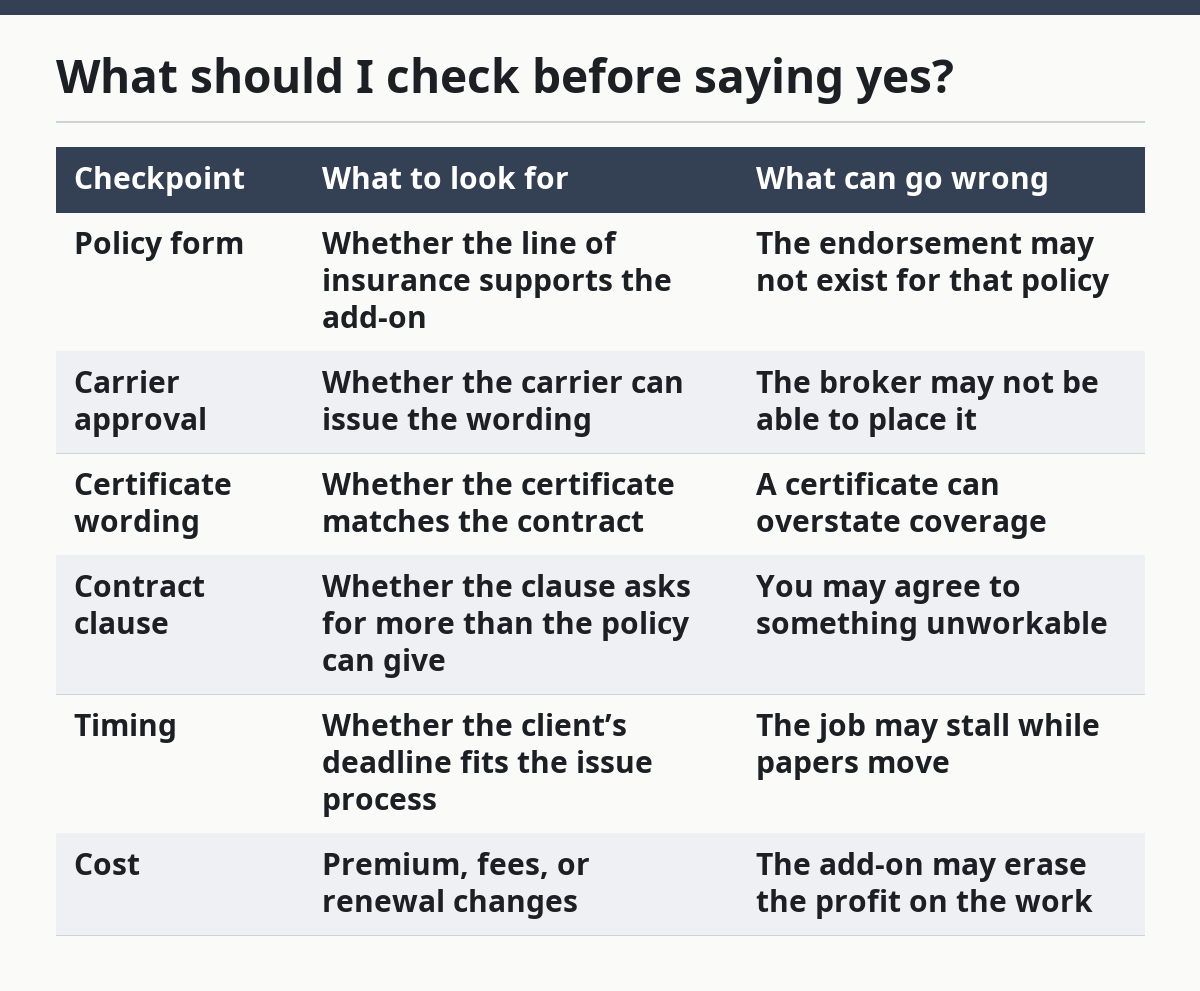
You should check the policy, the carrier, the certificate, and the contract together before saying yes. A single document rarely tells the whole story.
| Checkpoint | What to look for | What can go wrong |
|---|---|---|
| Policy form | Whether the line of insurance supports the add-on | The endorsement may not exist for that policy |
| Carrier approval | Whether the carrier can issue the wording | The broker may not be able to place it |
| Certificate wording | Whether the certificate matches the contract | A certificate can overstate coverage |
| Contract clause | Whether the clause asks for more than the policy can give | You may agree to something unworkable |
| Timing | Whether the client’s deadline fits the issue process | The job may stall while papers move |
| Cost | Premium, fees, or renewal changes | The add-on may erase the profit on the work |
The most common technical terms deserve plain-English checks. Additional insured means the client gets some direct protection under your policy for certain claims tied to your work. A waiver of subrogation means your insurer gives up a right to chase another party after paying a claim. A contract amendment is a formal change to the agreement, and if the insurance clause changes, the amendment should match the policy reality.
If the client uses a vendor portal or standard form, do not assume the form is negotiable. Some forms ask for broad wording because that is how the client buys all services, from large contractors to a one-person freelance shop. The question is not whether the form is common; the question is whether your policy can support it without creating a mismatch.
Two reference points can help with terminology. The Insurance Information Institute explains basic policy terms, and the National Association of Insurance Commissioners publishes consumer insurance guidance. If you check outside sources, make sure the page you read matches the exact endorsement type you are being asked to add.
When should I stop and get help?
You should stop when the request no longer looks like a routine endorsement and starts looking like a contract-risk problem. That is the point where a broker, carrier, or qualified adviser should review the exact wording.
The carrier will not issue the endorsement: The request is not just inconvenient; it is unavailable under that policy form — Ask for a revised clause or decide whether the work still fits your risk tolerance.
The client wants both additional insured status and a waiver of subrogation on a short deadline: The request may be feasible, but the timing is tight — Pause before promising delivery, because fast promises often fail at the carrier step.
The contract uses broad wording like “any claim arising out of the work”: The clause may reach beyond the specific job — Have the wording reviewed before you agree to a contract amendment.
The request appears to change your liability beyond the job value: The insurance demand may be bigger than the service fee — Recheck the scope and decide whether the assignment is still worth taking.
The client insists on paperwork before there is time to confirm policy fit: The deadline pressure is the real issue — Do not guess; ask for more time or a narrower form.
The certificate wording has to be different from the policy wording: The paperwork may be creating a false picture — Make sure the certificate does not promise what the policy cannot support.
There is one limit worth stating plainly: if the contract requirement is the real problem, a paperwork fix will not solve it. A perfect certificate does not change a mismatched clause.
What mistakes cost freelancers the most?
The costliest mistake is treating the request as a form-filling task instead of a policy decision. That often leads to a bad fit, a delay, or a promise that cannot be kept.
A common error is assuming all add-ons are the same. An additional insured request and a waiver of subrogation do different things, and a policy may support one but not the other. The consequence is a rushed yes to a request the carrier will not approve.
Another mistake is relying on a certificate of insurance alone. A certificate shows evidence of insurance, but it does not rewrite the policy. The correct alternative is to confirm the endorsement itself, not just the certificate.
A third mistake is ignoring the timing gap. A client may want proof in 1 day, while the carrier may need longer. The consequence is a missed start date or a scrambled contract change; the correct alternative is to check the deadline before you agree to work.
A fourth mistake is focusing only on premium. A request can be cheap and still be a poor fit if it broadens your exposure or complicates future renewals. The right alternative is to compare the total burden: cost, paperwork, and risk.
A fifth mistake is letting the broker guess. Brokers are useful, but they still need the exact contract language and carrier rules. The consequence is a wrong answer based on incomplete wording; the correct alternative is to send the exact clause, not a paraphrase.
When does the standard approach not apply?
The standard approach does not apply when the add-on is tied to a larger contract change. In that case, the insurance request is only one piece of the deal, and the rest of the clause may matter more.
It also does not apply when the client’s form is a template built for larger suppliers. A template may ask for broad protection, a primary coverage position, or wording that a small freelancer policy does not usually carry. That does not mean you must refuse automatically, but it does mean the standard yes/no check is too simple.
The standard approach also breaks down when the request arrives at the last minute. A 24-hour deadline is not a policy feature; it is a process problem. If you cannot verify the endorsement in time, the real choice is whether to wait, amend the contract, or walk away from the work.
One more exception matters: if your policy year is close to renewal, the carrier may treat the add-on differently at renewal than mid-term. That can change the cost, the timing, or both. The decision should be based on the current policy term, not on what a future term might allow.
The honest downside of any add-on is that it can create more administration for a small job. That is not a reason to refuse every request. It is a reason to accept only the requests that are clear, supported, and worth the trouble.
FAQ
Should I accept a client insurance request?
You should accept it only if the request matches your policy and the carrier can issue it without forcing a bad contract fit. If the request is clear, affordable, and timely, it may be reasonable; if it is vague, costly, or unsupported, it needs more review before you agree.
When can I refuse a client insurance demand?
You can refuse when the request cannot be issued under your policy, when the deadline is too tight to verify it, or when the clause asks for more than you are willing to carry. Refusal is also reasonable when the add-on changes the job into a much bigger risk than the fee supports.
How do I evaluate an extra insurance request?
You evaluate it by reading the exact clause, checking the policy form, asking the broker or carrier about endorsement feasibility, and comparing the cost against the work. The request is workable only if the paperwork, timing, and contract language all line up with the policy you already have.
Drafted with AI; not yet reviewed by a person.
