
Last updated: November 29, 2026
Professional liability insurance helps pay for claims that your service caused financial loss, usually through a mistake, missed deadline, or bad advice. It matters when a client says your work fell below the standard of your professional services and cost them money. This is information, not financial advice; a qualified adviser should be consulted for your own situation.
Key takeaways
- Freelance claims usually start with a client saying a service error caused money to be lost.
- The claim often turns on negligence, not on whether the work was done in good faith.
- A claims-made policy can be triggered by when the claim is filed, not just when the mistake happened.
- The paper trail matters: contract terms, revisions, delivery dates, and client sign-off can shape the claim.
- Some disputes are business problems first and insurance claims only later.
What does professional liability mean for freelancers?
Professional liability insurance covers allegations that your professional services caused a client financial loss. In plain terms, it is for work that goes wrong in advice, design, strategy, writing, coding, consulting, or another paid service, not for a broken chair or spilled coffee.
The phrase “professional services” matters because the policy is tied to the service you sold, not every mistake you could make in daily business. A freelance editor who publishes the wrong version of a manuscript, a designer who misses a required spec, or a consultant whose recommendation leads to a lost contract may all face the same core issue: a client says the service error cost money.
The legal label you will see often is negligence. Negligence is the claim that you failed to use reasonable care for the kind of work you were hired to do. A claim can still happen even if there was no intent to harm and no fraud. The issue is the result, not your motive.
A good way to think about the coverage is that it follows the money trail of the mistake. If the client says the error caused a financial loss, the policy may respond to defense costs and covered damages, depending on the policy wording. If the complaint is only that the client is unhappy, the issue may never become a covered claim.
Which service mistakes turn into claims?
A service mistake turns into a claim when the client says the mistake caused a measurable loss. That loss can be a missed sale, extra rework, a lost deadline, or the cost to fix a defective deliverable.
The most common claim themes are easy to name because they show up in contracts and dispute letters:
- Missed deadlines: The project lands after the date the client needed it, and the client says that delay cost them business.
- Defective advice: A recommendation is wrong, incomplete, or based on bad assumptions, and the client says they acted on it.
- Faulty deliverables: The work has errors, misses a spec, or cannot be used as promised.
- Failure to follow instructions: The service does not match the brief, scope, or agreed process.
- Poor communication tied to loss: Silence or a bad handoff leads to a missed filing, launch, or publication date.
Not every complaint becomes a claim. A client may be angry about quality without proving loss. Insurance usually becomes relevant when the client asks for money, threatens a lawsuit, or sends a formal demand tied to a service error.
This is where many freelancers get caught off guard. A small mistake can become a claim if the client has a paper trail showing dates, scope, and loss. A one-line email, a revised invoice, or a missed milestone can matter more than the size of the project.
How does a claims-made policy work?
A claims-made policy is usually triggered by when the claim is made, not only when the work was done. That timing rule is one reason professional liability coverage for freelancers needs careful reading before a claim appears.
Here is the basic process, step by step:
- Identify the service you sold. List the exact professional service, such as copywriting, design, coding, bookkeeping, or strategy. Verify that the policy wording names or clearly fits that service. A mismatch is a warning sign if the work falls outside the listed professional services.
- Map the possible error. Write down the most likely service mistake, such as a missed deadline, bad recommendation, or incorrect deliverable. Verify that the loss would be tied to your work, not to a product failure or unrelated business problem. If the loss comes from a physical injury or property damage, that is a different path.
- Check when the claim would be filed. Claims-made coverage looks at the date the claim is first made against you during the policy period. Verify the policy period and the reporting rule. If a demand arrives after the policy ends, the timing may matter more than the date of the original mistake.
- Read the retroactive date if one exists. Some policies only cover work done after a stated date. Verify that your past projects fall within that window. If the date is too recent, older work may be outside coverage even if the claim is made now.
- Check the defense promise. See whether the insurer pays defense costs inside or outside the limits. Verify what counts as defense and whether the policy covers a lawyer from the start. A weak defense clause can leave a freelancer exposed even before any settlement talks.
- Match the deductible or retention to cash flow. A retention is the amount you must absorb before the policy pays. Verify that you could actually cover that amount during a dispute. If you cannot, the policy may look better on paper than in a real claim.
- Review exclusions line by line. Exclusions are the carve-outs that remove coverage for certain events, such as intentional acts or known disputes. Verify that the mistake you worry about is not carved out. If the exclusion list is broad, the policy may not answer the risk you think it does.
- Save proof of notice. Keep the email, portal notice, or letter showing when the claim was first reported. Verify the insurer received it on time. Late notice can create a coverage problem even when the underlying claim would otherwise fit.
The main problem with claims-made coverage is timing. A freelancer can make the mistake in one year and get the demand letter in another. If the policy is no longer active or the reporting rule is missed, the claim can become a coverage fight instead of a defense payment.
For a general overview of the policy form, the Insurance Information Institute and the National Association of Insurance Commissioners are useful places to look up standard insurance terms and consumer guidance.
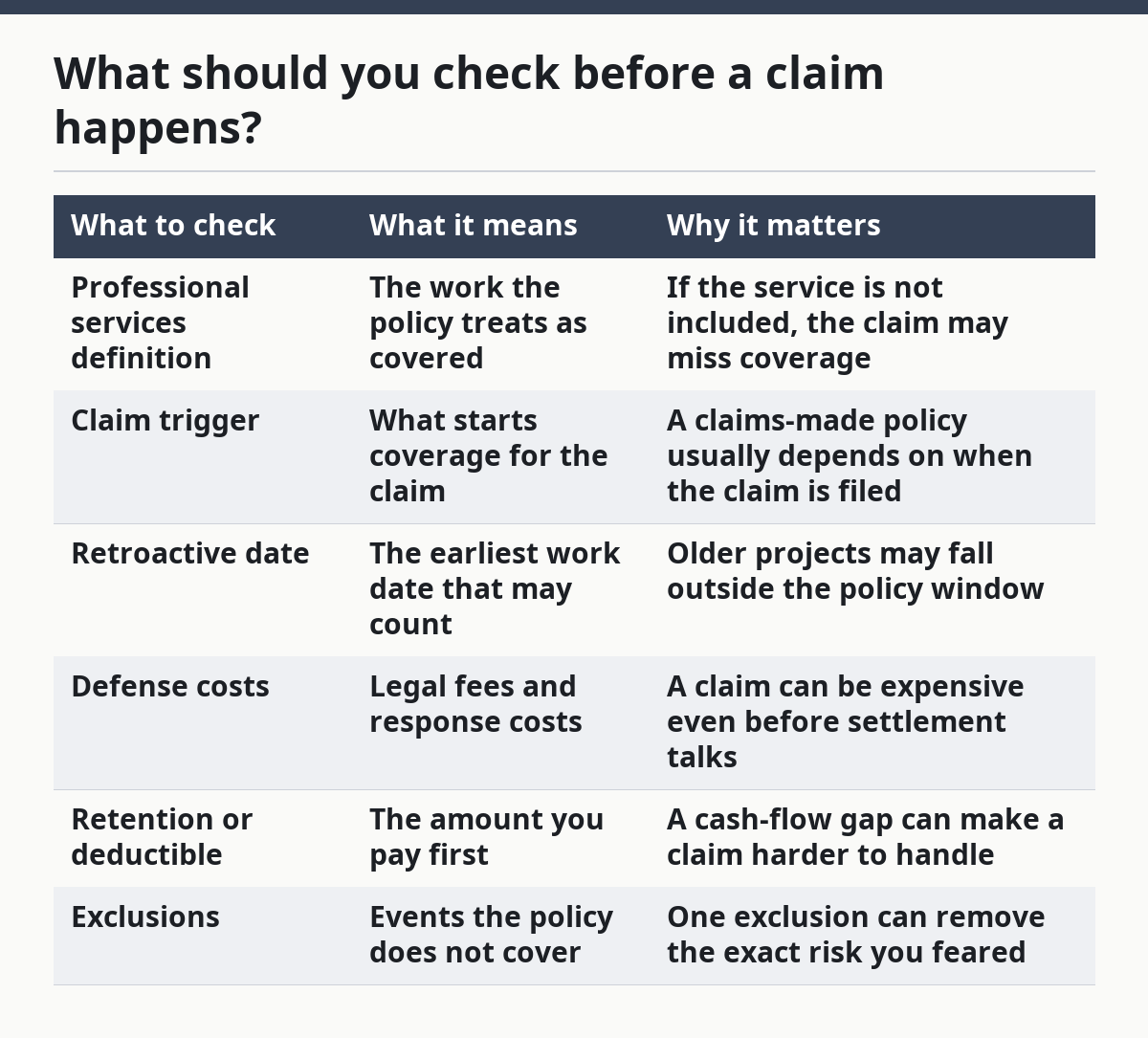
What should you check before a claim happens?
You should check the policy wording, the service scope, and the claim-reporting rule before any dispute starts. That is where most gaps hide.
Use this table to compare the moving parts that matter most when a client says your work caused loss:
| What to check | What it means | Why it matters |
|---|---|---|
| Professional services definition | The work the policy treats as covered | If the service is not included, the claim may miss coverage |
| Claim trigger | What starts coverage for the claim | A claims-made policy usually depends on when the claim is filed |
| Retroactive date | The earliest work date that may count | Older projects may fall outside the policy window |
| Defense costs | Legal fees and response costs | A claim can be expensive even before settlement talks |
| Retention or deductible | The amount you pay first | A cash-flow gap can make a claim harder to handle |
| Exclusions | Events the policy does not cover | One exclusion can remove the exact risk you feared |
A freelancer should also keep project records for at least the length of time the policy could still be triggered by a later claim. That means contracts, briefs, draft versions, final files, invoice dates, and client approval emails. A clean file can help show what was agreed, what was delivered, and when the client knew about it.
If your contracts use hard deadlines, approval steps, or performance promises, read them beside the policy. A contract that promises a result you cannot control can create a mismatch. The policy may respond to a service error, but not to every business promise you wrote down.
When should you stop and get qualified help?
You should stop treating the problem as a simple insurance question when the dispute already involves a demand letter, a threatened lawsuit, or a contract that shifts risk in a way you do not understand.
A demand letter has arrived: This means the issue may already be a claim, not a hypothetical risk — notify the insurer promptly and get qualified help on the wording before you reply.
The client says the mistake caused a large financial loss: The claim may involve damages and defense costs that depend on policy language — do not guess at coverage from the headline alone.
The work was done before the policy started: Timing may block coverage, especially under a claims-made policy — check the retroactive date and reporting rule with a qualified adviser.
The dispute involves fraud, theft, or an intentional act allegation: These accusations are often treated differently from ordinary negligence — ask for help before admitting anything in writing.
The contract has unusual indemnity language: You may have promised more than the policy covers — have the wording reviewed so you understand the risk transfer.
You cannot tell whether the loss came from advice, a product, or a physical accident: The coverage line can change quickly — get a professional to sort the issue before you file a claim under the wrong section.
The wrong move is to wait until the client is furious and then read the policy for the first time. By then, the notice deadline may already be a problem, and a missed notice can hurt a claim even if the underlying mistake was covered.
What mistakes do freelancers make most often?
Freelancers usually make the same five mistakes, and each one can turn a manageable dispute into a coverage headache.
First, they assume any unhappy client equals a covered claim. That is wrong because insurance looks for a service error tied to financial loss, not just frustration. The better move is to keep the project record and look for a demand tied to money.
Second, they wait to report the dispute. That can matter a lot under a claims-made policy, where late notice may put the claim outside the reporting rule. The better move is to notify the insurer as soon as the demand looks real.
Third, they treat “I meant well” as a defense. Good intent does not erase negligence allegations. The better move is to focus on what was agreed, what was delivered, and what loss the client says followed.
Fourth, they rely on an email thread instead of the policy wording. A client may call it “just a mistake,” while the policy uses narrower terms like professional services, exclusions, and retroactive date. The better move is to read the policy language, not the summary alone.
Fifth, they confuse fixing the work with fixing the claim. Re-doing the deliverable may help the client, but it does not automatically end the insurance issue. The better move is to repair the work if appropriate, then preserve the paper trail and report the matter if required.
The honest limitation here is that professional liability coverage is not a cure-all. It is built for service mistakes that become money disputes. It is not meant for every bad outcome, and it can leave gaps when the wrong risk was assumed at the start.
What if the mistake is old or partly fixed?
Old mistakes and partially fixed mistakes still need the same timing check, but the facts around notice and loss become more important. A later repair does not always erase the original claim, and a later complaint can still fall under a claims-made policy if the claim is first made during the active period.
If the project was corrected before the client complained, keep both versions. That shows what changed, when it changed, and whether the client accepted the fix. If the client says the repair still caused loss, the issue can still become a claim even if the final deliverable now looks fine.
If the work crosses several months, date each milestone. A 6-month project with 3 rounds of revision can create separate points of failure: scope, deadline, and final approval. That paper trail helps show whether the problem was a single error or a chain of events.
FAQ
What does professional liability cover for freelancers?
Professional liability usually covers claims that a freelancer’s professional services caused financial loss. That can include negligence allegations, missed deadlines, bad advice, or faulty deliverables, depending on the policy wording. It is aimed at the service mistake itself, not at every business dispute or every unhappy client.
Is professional liability required for freelancers?
Professional liability is not universally required for freelancers, but some clients, contracts, or licensing rules may ask for it. Requirements differ by country and industry, and they change often. A qualified adviser should check the rule that applies to your situation before you rely on a contract summary or a general website answer.
What mistakes are excluded from professional liability?
Common exclusions often include intentional acts, fraud, and some known disputes, but the wording varies a lot. A policy may also exclude risks outside the defined professional services or claims tied to a past issue that was not reported on time. The exclusion list matters as much as the coverage grant.
Drafted with AI; not yet reviewed by a person.
