

Last updated: November 28, 2026
Quick answer: this request is usually about a policy endorsement, not a certificate, and the key issue is the wording. Additional insured for freelancers: when clients ask for it and why matters because the client may want some protection under your liability policy for a specific job, site, or contract.
This is information, not financial advice. Insurance terms vary by country, carrier, and policy form, so a qualified adviser should be consulted about your own situation.
Key takeaways
- Additional insured status is not the same as naming a client on a certificate of insurance.
- The client is usually asking for risk transfer, not just paperwork.
- Your policy must allow the endorsement before the carrier can add the client.
- The exact wording matters because it controls which losses, defense costs, and projects are included.
- Some requests fit a freelance job well; others are a poor match for a small policy or narrow service.
What does additional insured mean?
However, additional insured means a person or company gets some of the protection of your liability policy through an endorsement, which is a written change to the policy. In plain English, the client is asking to be covered under your policy for certain claims tied to your work.
That is different from the client being a named insured, which would make the client a full policyholder. An additional insured usually gets more limited protection, and the carrier may cover the client only for claims connected to your acts, your work site, or your contract. The details sit in the endorsement form, not in the client’s email.
For freelancers, this request appears most often in fields where a project touches a third party or a physical location, such as design, media production, consulting, events, or creative work done on a client’s premises. A client may want to reduce the chance that it must pay for a claim first and sort it out later.
Meanwhile, the main trade-off is simple. The client gets a layer of protection, but your policy may have to respond to a wider set of claims. That can affect defense costs, claim handling, and how your insurance carrier reads the contract. The National Association of Insurance Commissioners and industry groups such as the Insurance Information Institute both say policy wording is the part that matters most; see the NAIC and III. If the wording is unclear, consult a licensed insurance professional.
Why do clients ask for it?
Therefore, clients ask for additional insured status because they want their own risk shifted onto the policy tied to the work. That is the heart of risk transfer, which means moving some financial exposure from one party to another through a contract and insurance form.
A client may ask for it after a contract review, after a site-owner requirement, or after a risk manager checks the project terms. In many cases, the client is trying to make sure that if a claim starts with your work, the client does not have to fund the defense alone. The request can also help the client satisfy a lease, vendor rule, or project requirement tied to its own insurance program.
However, the request does not always mean the client expects trouble; it is often just a standard condition in a larger organization’s contract template. A bank, agency, venue, or property owner may ask for the same clause from a solo freelancer and from a large vendor.
Because of that, not every request maps neatly onto a freelance job. If your work is purely advisory and never touches the client’s premises or third-party property, the client may still ask, but the fit is less natural. That is one reason the endorsement language matters more than the title alone.
Can a freelancer add a client as additional insured?
Yes, a freelancer can sometimes add a client as additional insured, but only if the policy and the insurer’s endorsement form allow it. The carrier controls the form, and the policy controls the scope.
The first check is the policy itself. Many commercial general liability policies use standard endorsement language, often tied to an insured contract, a written agreement, or a specific project. If your policy does not permit the addition, the client cannot be added just because both sides want it. The second check is the insurer’s process, because some carriers require the client’s exact legal name and sometimes a project description before issuing the endorsement.
Here is the practical sequence a freelancer usually needs to understand:
| Item to check | What it means | Why it matters |
|---|---|---|
| Policy form | The base contract with the carrier | It controls what can be endorsed |
| Endorsement | The written change to the policy | It creates the additional insured status |
| Certificate of insurance | Proof of coverage, not coverage itself | It does not add rights by itself |
| Contract language | The wording in the client agreement | It may trigger or limit the request |
| Carrier approval | The insurer’s sign-off | Without it, the endorsement may not exist |
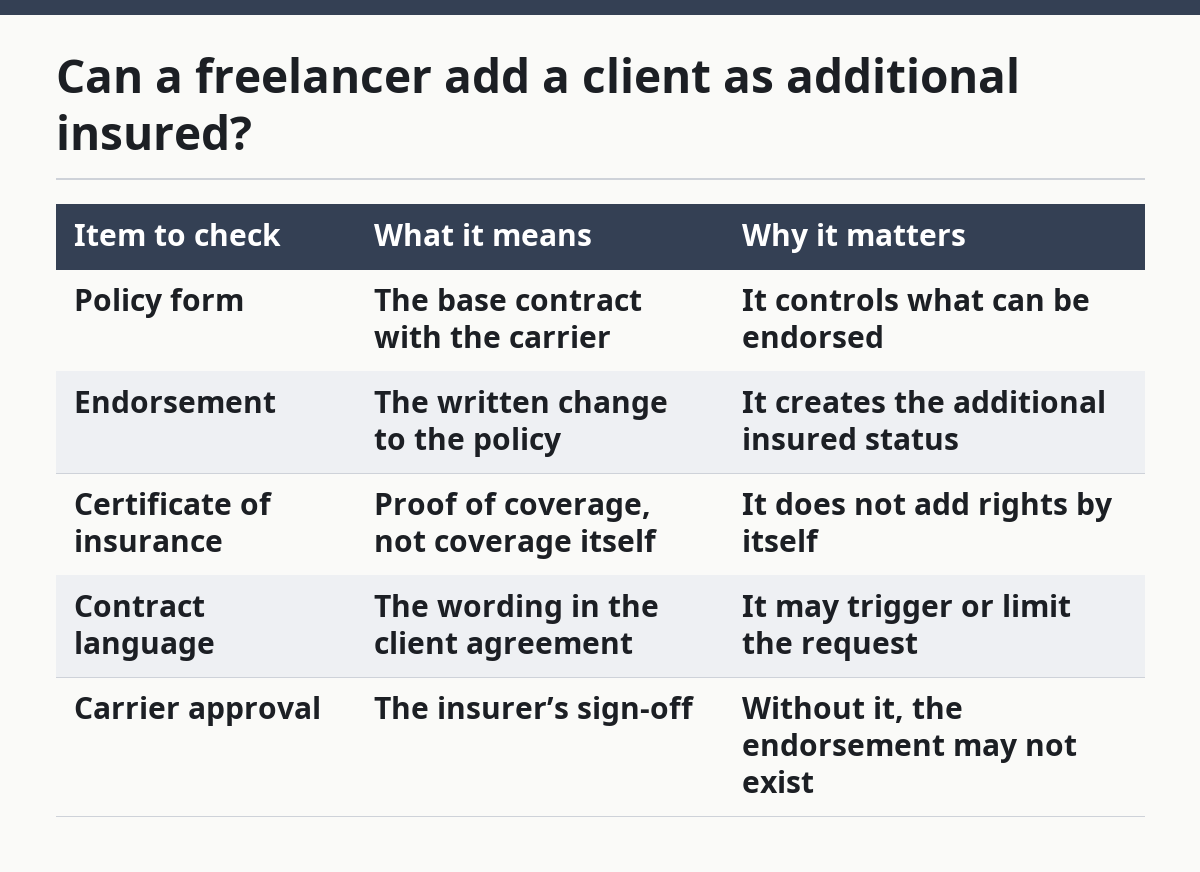
For example, a lot of confusion comes from mixing up the certificate and the endorsement. A certificate holder only receives evidence that insurance exists. An additional insured receives a separate status under the policy, if the endorsement says so. A client can ask for both, but they are not the same thing.
If the request is broad, such as “add us for any and all claims,” that can be a problem. If the policy only covers liability arising from your operations, the client may want more than the carrier will grant. In that case, the form, not the email, decides the outcome.
What should you check before agreeing?
Before any endorsement is requested, the exact wording, the policy type, and the scope of the client’s ask should all be checked. Those three items decide whether the request is ordinary, narrow, or too broad for the policy.
Start with the policy period. If the client asks for coverage for work done outside the current policy year, the endorsement may not respond the way the client expects. Then look at the class of insurance. A general liability policy may not behave like professional liability, and many freelance mistakes live in the second category, not the first. A graphic designer, consultant, or writer may face a claim about advice or content, which is a different risk from bodily injury or property damage.
Next, read the contract language that triggers the request. If the agreement says the client must be added as additional insured only “to the extent caused by the freelancer’s work,” that is narrower than language demanding broad client protection. The phrase “to the extent caused by” limits the reach of the endorsement to a connection with your work.
Then compare the requested name with the client’s legal name. A trade name, brand name, or informal label can create a mismatch at claim time. One typo in the endorsement may not sound serious, but it can create a dispute when the insurance carrier checks the file.
Finally, ask whether the request is for one project or for the entire business relationship. A project-specific endorsement is often cleaner than a blanket request that follows every job for 12 months. Blanket wording may be easier for the client, but it can be harder for a freelancer’s policy to absorb.
When is this request too broad?
However, this request is too broad when it tries to cover losses that do not come from your work, or when it asks for rights your policy does not grant. That is the point where the request stops being ordinary paperwork and starts becoming a mismatch.
A client wants to be added for “any claim whatsoever”: That is broader than a normal freelance endorsement — ask for the exact policy wording to be checked by the carrier or a qualified adviser.
The client’s name is not the legal entity that signed the contract: The endorsement may cover the wrong party — use the exact legal name before the carrier issues anything.
The work is purely advisory, editorial, or digital and the request seems built for a construction job: The risk profile may not match the policy — verify that the requested status fits the actual service.
The policy is not a commercial general liability policy: The endorsement may not sit on the right form — confirm whether the client is asking for protection under the correct policy line.
The request is to cover past work already finished months ago: The policy period may not align — check dates and the carrier’s rules before anything is issued.
The contract demands “primary and noncontributory” treatment: That wording changes how the policy responds, so a qualified adviser should review it before you assume a standard endorsement already does that.
The consequence of a broad or mismatched request is usually not instant denial; it is uncertainty. That uncertainty can lead to delays, an incomplete certificate, or a dispute after a claim. If the wording looks bigger than the work, the policy, or the carrier’s form, stop there and get qualified help.
What are the common mistakes freelancers make?
The common mistakes are mostly paperwork errors, but each one can change claim handling in a real way. A 1-line mistake can matter more than a 1-page contract.
However, freelancers often treat a certificate of insurance like proof that the client is actually additional insured. The certificate only shows that coverage exists or has been requested; it does not create the endorsement by itself. The fix is to get the endorsement from the carrier, not just a certificate form. If you are unsure, consult the carrier or a licensed insurance adviser.
Second, they accept a client’s preferred wording without checking the policy. That can lead to a request the carrier will narrow or refuse. The better move is to compare the contract wording with the policy form before sending anything.
Third, they use the client’s brand name instead of its legal entity name. That sounds minor, but it can slow down issuance or create a mismatch in a claim file. The correct alternative is the exact legal name that appears on the agreement.
Fourth, they assume every freelance policy can add every client. Some policies and endorsements are narrower than others, and some work types fit poorly with additional insured status. The right response is to verify the endorsement route before relying on it.
Finally, they confuse risk transfer with a cure-all. Additional insured status does not erase your own duty to carry the right insurance, and it does not make every dispute vanish. The client may still come back to you for a claim tied to your work.
When should a freelancer pause and get qualified help?
A freelancer should pause when the request moves beyond a simple endorsement and into a contract or policy interpretation issue. Insurance wording can change who pays defense costs, who gets notified first, and how broad the protection runs.
Pause if the client wants broad coverage for claims unrelated to your work. Pause if the endorsement has to cover more than one site, state, or project. Pause if the policy is a specialized form with limits that do not look like standard commercial general liability coverage. Pause if the client asks for wording that the carrier has not approved. Pause if the agreement also includes indemnity, hold harmless language, or other risk-transfer terms that change the balance of the deal.
Those are the moments when the request is no longer just “add the client.” It becomes a question of how the insurance carrier will read the endorsement and whether the policy can support the contract at all. That is where advice from a qualified insurance professional or legal adviser is more useful than guesswork.
For a broader view of how liability cover fits into freelance work, the Freelancer Liability Insurance hub covers the rest of the topic.
FAQ
Can a freelancer add a client as additional insured?
Yes, sometimes, if the policy and the insurer’s endorsement allow it. The carrier has to issue the endorsement, and the client’s exact legal name usually has to match the request. If the policy does not allow the status, a freelancer cannot create it by wording alone.
Is additional insured the same as a certificate holder?
No, they are different roles with different effects. A certificate holder only gets proof that insurance exists, while an additional insured gets some protection under the policy through an endorsement. A certificate can support the request, but it does not replace the endorsement.
When should a client be added as additional insured?
A client is usually added when the contract, site rules, or project risk calls for it. That is common when the work touches the client’s premises, involves third-party exposure, or is part of a larger vendor requirement. If the request is broad or does not fit the policy, it should be checked before anything is issued.
Drafted with AI; not yet reviewed by a person.
