
Last updated: November 26, 2026
Quick answer: 4 checks decide most freelance insurance claims: policy form, notice rule, exclusions, and evidence. Freelance insurance by risk event and claims response — The Complete Guide focuses on what happens after a loss, which policy responds, and how to notify the insurer without creating a late-report dispute. This is information, not financial advice; rates, limits, tax rules, and claim rules vary by country, so a qualified adviser should be consulted for your own situation.
Key takeaways
- A freelance policy is not one thing. Different risks point to different cover, and the claim process depends on the policy form.
- The first job after an incident is not “explain everything.” It is to stop the loss, save evidence, and read the notice rule.
- Claims-made policies care about when the claim is first made and often when it is reported; occurrence policies care about when the event happened.
- A delay of even a few days can matter if the policy requires prompt notice, written notice, or insurer consent before any payment.
- The best result is not always a payout; sometimes the right response is to notify, preserve evidence, and let the insurer handle defence costs or settlement talks.
Who is freelance insurance for?
Freelance insurance by risk event and claims response — The Complete Guide is for self-employed people whose work can create a bill, a claim, or a project stop after one bad event. That includes designers, writers, developers, consultants, photographers, marketers, and other independent contractors who face client complaints, data loss, injury claims, or equipment damage.
This guide assumes you already know the basic idea that insurance spreads risk across many insureds. It also assumes you want to understand what happens after a loss, not just what a policy name means. If your work involves regulated advice, medical claims, legal work, or custody of client money, the claim path can be more complicated than a standard freelancer policy, and a qualified adviser or broker should review the details before you rely on any one policy.
A generic article often treats “freelance insurance” as a single product, but consult a professional because policy wording and reporting duties differ by country and by insurer. For general consumer guidance on insurance contracts and complaint routes, the UK Financial Conduct Authority and the National Association of Insurance Commissioners both publish useful material: FCA insurance guidance and NAIC consumer insurance basics. Country rules still differ, and a local adviser should check the wording that applies to your policy.
The practical question is not “Do I need insurance?” The practical question is “Which event is most likely to hurt me, and what does the insurer expect me to do in the first 24 hours, 7 days, and 30 days?” That timing matters because many claims fail on procedure, not because the loss never happened.
For general consumer guidance on insurance contracts and complaint routes, the UK Financial Conduct Authority and the National Association of Insurance Commissioners both publish useful material: FCA insurance guidance and NAIC consumer insurance basics. Country rules still differ, and a local adviser should check the wording that applies to your policy.
Which risk events trigger a claim?
A claim starts when a covered event hits the policy, not when you feel ready to report it. That event could be a client alleging your work caused loss, a third party saying your files exposed their data, a stolen laptop, or an injury tied to your work setup.
The event matters because each risk category maps to a different policy trigger. Professional indemnity usually responds to negligent advice or work errors. Public liability usually responds to injury or property damage suffered by someone else in connection with your business. Cyber cover, where included, may respond to data breach response costs, notification costs, or system restoration. Business equipment cover may respond to theft, fire, or accidental damage, often with conditions about storage and proof of ownership.
The first question after an event is whether it is a “claim,” a “circumstance,” or only a potential loss. A claim is a demand for money, correction, or defence. A circumstance is a fact that could later become a claim, such as a client email complaining about a defect or a missed deadline. Many claims-made policies want both types reported quickly, even when no lawsuit exists yet, so a qualified adviser should check the wording before you decide to wait.
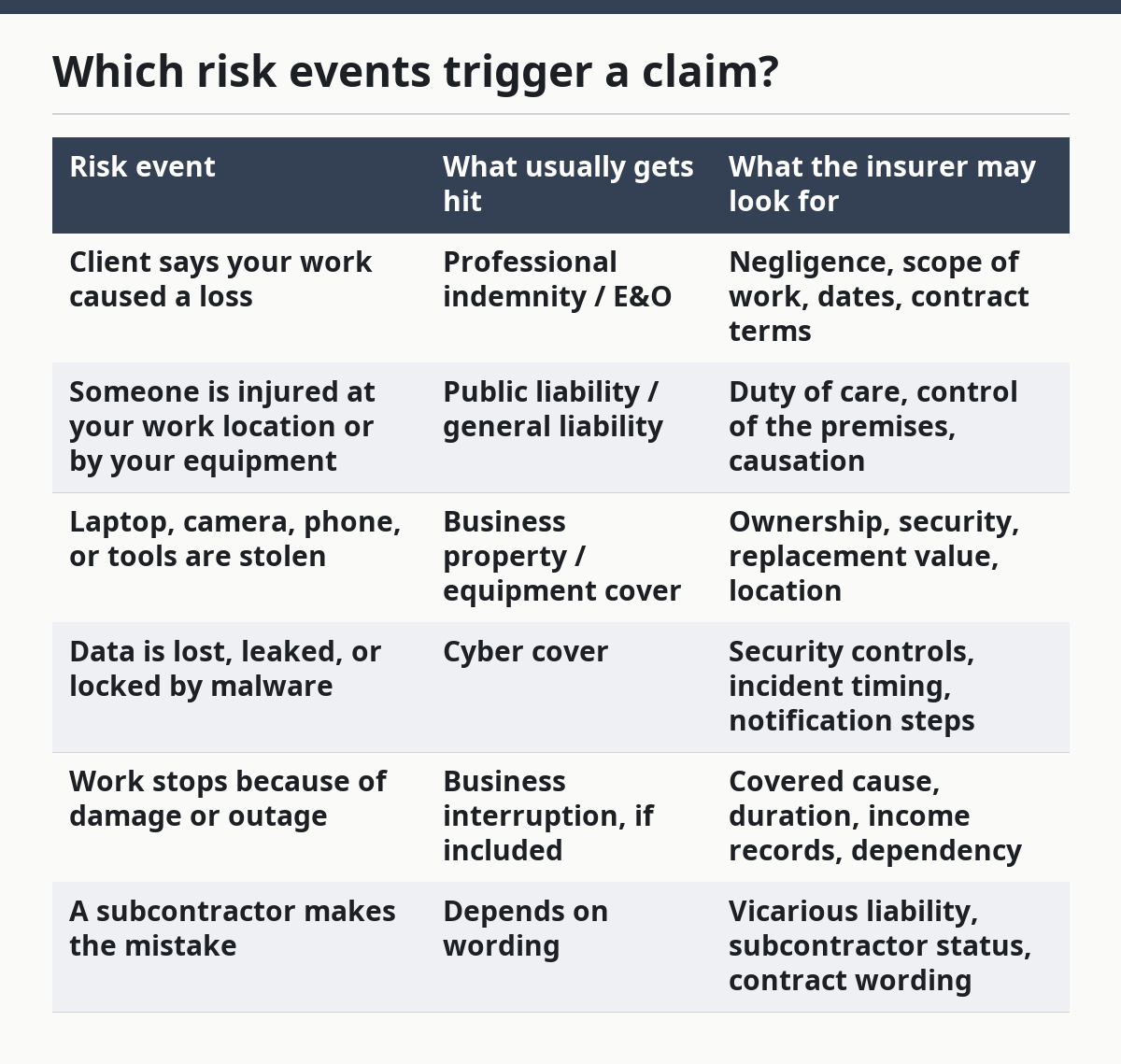
Here is the risk-event map in plain language:
| Risk event | What usually gets hit | What the insurer may look for |
|---|---|---|
| Client says your work caused a loss | Professional indemnity / E&O | Negligence, scope of work, dates, contract terms |
| Someone is injured at your work location or by your equipment | Public liability / general liability | Duty of care, control of the premises, causation |
| Laptop, camera, phone, or tools are stolen | Business property / equipment cover | Ownership, security, replacement value, location |
| Data is lost, leaked, or locked by malware | Cyber cover | Security controls, incident timing, notification steps |
| Work stops because of damage or outage | Business interruption, if included | Covered cause, duration, income records, dependency |
| A subcontractor makes the mistake | Depends on wording | Vicarious liability, subcontractor status, contract wording |
A claim response starts with classification. If you misclassify a client complaint as “just feedback,” you may miss a reporting deadline. If you treat every complaint as a claim, consult a professional so you do not confuse the insurer or weaken your own record. The right move is to match the event to the policy wording, then act as if the insurer may review every email, invoice, and draft.
How do claims-made policies work?
Claims-made policies respond when the claim is first made and often when it is reported during the policy period. That is different from occurrence cover, which looks mainly at when the incident happened.
This difference is one of the biggest traps for freelancers. A job done in March may produce a complaint in October, and the policy in force in October may be the one that matters. If the policy also requires the event to be reported during the same policy period or within a defined extended reporting window, a late notice can create trouble even when the work itself happened while you were insured.
The rule to check is the retroactive date. That is the earliest date from which past work is covered under a claims-made policy. Work done before that date may be outside cover even if the claim arrives later. The policy may also contain a continuity condition, meaning there must be uninterrupted cover from the retroactive date to the date of claim.
This is where many freelancers make a costly assumption: “I had insurance at the time, so I am covered.” With claims-made wording, the date of the claim and the date of notification can matter as much as the date of the job. A policy change, lapse, or cancellation can leave a gap.
The consequence is simple. If your policy is claims-made, save every complaint, correction request, and threat email from the day it arrives. Notify early, even if you think the issue will settle informally. Ask the insurer how they want the notice sent, what documents they need, and whether they want a statement of facts now or later.
Occurrence policies are simpler in this one respect: if the covered event happened during the policy period, later reporting is usually less sensitive to timing, subject to the policy terms. That said, consult a professional because prompt notice can still matter under the wording. It does not remove the need for prompt notice. It only reduces the chance that a later renewal will erase the incident from view. (Source: Insurance Information Institute)
What should you do after a covered event?
You should treat the first 24 hours after a freelance loss as an evidence-and-notice window. The goal is to stop more damage, preserve proof, and report the event in the form the insurer expects. A qualified adviser can help if the policy uses a special notice clause or a cyber vendor.
-
Stop the loss immediately. If a laptop is stolen, secure accounts and change passwords at once, but consult a professional if the device may hold regulated data or client credentials. If a client file has gone out by mistake, stop further sharing and freeze access. Verify that no one else can keep using the same access path. A problem sign is when the issue keeps spreading after the first 10 minutes.
-
Read the policy notice clause before you send anything. Look for “prompt notice,” “as soon as practicable,” “written notice,” or a fixed reporting period. Verify whether the insurer wants email, portal upload, or broker notice. A problem sign is waiting until the next renewal because you are unsure the loss is “serious enough.”
-
Document the event in one clean timeline. Record the date, time, people involved, what happened, and what was said. Save screenshots, invoices, contracts, delivery logs, file versions, and device serial numbers. Verify that the timeline matches your emails and calendar. A problem sign is a story that changes between messages.
-
Do not admit liability in writing. You can be courteous without saying the event was your fault or promising payment. Verify that your apology does not read like an admission of negligence. A problem sign is language such as “I accept full responsibility” before the insurer has seen the facts.
-
Notify everyone the policy requires. That may include the insurer, broker, cyber response vendor, landlord, platform, or client. Verify that you have the correct insured name and policy number. A problem sign is sending notice to the wrong entity and assuming somebody will forward it.
-
Separate covered costs from uninsured fixes. Put invoices, remediation costs, and repair estimates in separate folders. Verify whether the policy pays defence costs outside the limit or inside the limit. A problem sign is paying for major repairs before asking whether pre-approval is required.
-
Preserve damaged items and digital logs. Keep the laptop, camera, packaging, or corrupted files if the insurer may inspect them. For cyber events, save logs for as long as the policy or incident team asks. Verify chain of custody if anyone else touches the evidence. A problem sign is wiping the device before the insurer records the loss.
-
Track every insurer request. Make a list of requests, deadlines, and answers. Verify that your replies are complete and consistent. A problem sign is missing one request because the insurer asked the same question in two different emails.
A good claim response is orderly, boring, and fast. A bad one is emotional, delayed, and full of edits. The insurer does not need a dramatic account; it needs a clean one.
When should you stop and get help?
You should stop handling a freelance insurance claim alone when the event could trigger a large dispute, a coverage gap, or a legal-duty question. That is not a sign of weakness; it is a sign that the facts matter more than the headline.
A client is threatening a lawsuit or formal demand: This may become a professional indemnity claim, and defence strategy starts early — notify the insurer before the demand changes shape.
You missed a policy deadline by days or weeks: Late notice can affect cover under claims-made wording — ask the insurer or broker to review the wording immediately and explain the delay in writing.
The event involves personal data or a possible privacy breach: Notification duties can run on tight clocks and may involve regulators or affected people — use the insurer’s breach process if the policy includes one.
Several policies might apply at once: For example, a stolen device can involve property, cyber, and liability issues — send one accurate notice and ask which section responds rather than guessing.
You are not sure whether the person is a contractor, employee, or client: That status can change who is liable and which policy section applies — gather the contract and payment records before you make assumptions.
The loss is tied to regulated advice or a licensed activity: Standard freelancer cover may not fit that work cleanly — check the wording with a qualified adviser before relying on a normal policy label.
This guide is not for deciding whether to accept or reject a settlement, sue anyone, or price a policy. It is for understanding how claims work so you do not damage your own position with a late notice, a loose admission, or a missing file.
What mistakes cost freelancers money?
The most expensive mistake is treating every incident like a normal business complaint. A small issue can become a coverage dispute if you miss the policy’s reporting rules or fail to keep evidence.
-
Waiting to see if the client calms down. The consequence is late notice on a claims-made policy. The correct alternative is to report the circumstance early, even if no payment is being asked for yet.
-
Throwing away drafts, logs, or damaged gear. The consequence is weak proof of what happened and what was lost. The correct alternative is to preserve originals and keep a copy of digital records in more than one place.
-
Admitting fault in an apology email. The consequence is language the insurer may later quote back at you. The correct alternative is to be polite, factual, and careful about responsibility until the claim is assessed.
-
Mixing personal and work records. The consequence is a messy claim file that slows review. The correct alternative is to keep invoices, contracts, bank records, and incident notes in one folder from day one.
-
Assuming all freelancing cover works the same way. The consequence is false confidence from one policy type applied to another. The correct alternative is to check whether the policy is claims-made, occurrence-based, or limited to a narrow event such as equipment damage.
-
Ignoring subcontractor work. The consequence is surprise if a subcontractor error is excluded or treated differently. The correct alternative is to read the policy on outsourced work and keep written scope and handoff records.
A common generic article says “read the fine print.” That is true but too vague to help. The real issue is to read four clauses: notice, claims trigger, exclusions, and defence costs. Those four decide whether an event is merely inconvenient or a genuine insurance dispute.
How do exclusions and limits change the answer?
Exclusions and limits decide whether the insurer pays for the event you thought was covered. That is why the same freelance job can produce very different outcomes depending on the policy wording.
An exclusion is a category of loss the policy will not cover. A limit is the most the insurer will pay, and a sub-limit is a smaller cap inside the main limit for one type of loss, such as data restoration or replacement equipment. Some policies also carry an excess or deductible, which is the amount you pay before the insurer pays the rest.
The tricky part is that exclusions often sit close to the exact event a freelancer fears most. A policy may cover negligence but exclude deliberate acts. It may cover accidental data loss but not poor security hygiene. It may cover stolen gear but not unattended gear left in a vehicle. It may cover client claims but not claims between business partners or family members who share the work.
Limits matter just as much. A policy can respond and still leave most of the bill with you if the defence costs, remediation, or replacement value runs above the cap. In some policies, defence costs reduce the main limit; in others, they sit outside it. That difference can change the real value of the cover by a large amount, even when the headline limit looks similar.
The right response is to map the event to the wording before you assume a payout. If the claim sits near an exclusion, collect stronger evidence. If the loss may push against a sub-limit, ask what category the insurer will use. If the policy uses aggregate limits over a 12-month period, track prior claims so you do not discover the cap only after the second event.
This is also where country rules matter. Insurers in different markets may use different wording styles, disclosure rules, and complaint routes. A policy that looks familiar in one country can behave differently in another.
What changes in edge cases?
Edge cases need modified handling because the normal “file a claim and wait” approach can fail when the facts do not fit one box. The right move is to classify the event before you assume the policy wording is obvious.
A cyber event can look like a property loss, a liability event, and a service outage at the same time. If a client file is encrypted by ransomware, the first step is containment, not payment discussions. Save logs, isolate devices, and ask whether the policy includes incident response services, because some policies expect the insurer to coordinate experts from the start.
A subcontractor error can also be messy. If you hired another freelancer and they made the mistake, the insurer may still look at your contract, your supervision, and your own professional duty. Keep the subcontractor agreement, scope notes, and delivery emails. If the contract says you are fully responsible for outsourced work, that text may matter more than your informal arrangement.
A platform-based gig may add another layer. If you work through a marketplace, that platform may have its own terms, dispute route, or insurance condition. The issue is not just who caused the loss; it is who has contractual responsibility and who must be notified first. Save the platform terms as they existed on the service date, not only the current version.
A cross-border client creates timing and law questions. A dispute raised in one country may be governed by another country’s contract or claims rules. That is one of the clearest places to involve a qualified adviser, because a local policy phrase can have a very different effect once the claim crosses a border.
A long-tail issue can surface months after the job, such as a defect in a campaign, code, or report that only becomes visible later. In that case, the date of discovery, the date of first complaint, and the retroactive date all matter. Save work versions for at least the life of the project and any later notice period that your policy or contract requires.
What does a good claims response look like?
A good claims response is fast, written, and documented from the first hour. It does not try to prove innocence before the facts are assembled.
The cleanest response has four traits. First, it uses the policy notice route, not a casual side channel. Second, it keeps one timeline with dates, files, and names. Third, it avoids admissions and guesses. Fourth, it answers insurer questions with the same facts every time.
A poor response usually shows the opposite pattern. The freelancer waits too long, sends scattered screenshots, rewrites the story, or deletes a file that later becomes important. The insurer then spends more time checking whether the event fits the policy than dealing with the event itself.
The most useful habit is to keep an incident pack ready before anything happens. That pack should contain the policy number, broker contact, contract copies, project milestones, device serial numbers, cloud account details, and a note on where backups live. A 10-minute setup before the loss can save hours after it.
The right result is not always a cheque. Sometimes the best outcome is a defended claim, a settled complaint, or a denied claim that is denied for the right reason because notice was proper and the wording was clear. That is why the claims response matters as much as the cover itself.
What should you check before a claim starts?
You should check four things before an incident becomes a claim: the policy form, the notice rule, the exclusions, and the evidence you can still save. Those four checks decide most of the practical outcome.
First, confirm whether the policy is claims-made or occurrence-based, and whether there is a retroactive date. Second, find out how the insurer wants notice and whether a circumstance must be reported before a claim exists. Third, read the exclusions for cyber, subcontractors, deliberate acts, and contract liability. Fourth, gather proof of work, delivery, and communications before anything is overwritten or deleted.
This is also the moment to check the excess, the limit, and any sub-limits. A claim with a small excess can still be expensive if the loss sits in a narrow category, such as equipment cover with a low cap or cyber cover with a separate incident cap. If you have several policies, write down which one is primary and which one sits behind it.
A generic article might say “keep good records.” That is true, but the useful version is more specific: save project versions, signed scopes, invoices, device logs, receipts, and complaint emails in one place for every job. If the policy wants proof of value, proof of ownership, or proof of a service date, those records are what turn a vague story into a claim file.
FAQ
Do I need freelance insurance before I ever get a client complaint?
Yes, because the first complaint can be the start of the claim clock. A claims-made policy may care when the issue is first raised, not only when the loss becomes serious. If you wait until the dispute is obvious, you may already be inside a late-notice problem.
Is a stolen laptop always covered?
No, because coverage depends on the property wording, the location of the theft, and any security conditions. A laptop taken from a locked office may be treated differently from one left unattended in a car. Save the purchase record, serial number, and police report if the policy asks for them.
What is the difference between a claim and a circumstance?
A claim is a formal demand for money, correction, or defence. A circumstance is a known event that could later turn into one, such as a client warning that your work caused a loss. Many policies want circumstances reported early so the insurer can treat the later claim as linked to the earlier notice.
Should I tell the insurer even if I might fix the problem myself?
Usually yes, if the policy requires prompt notice or if the event could become a claim later. Fixing the problem does not always remove the reporting duty. If the issue involves data, injury, or a client demand, getting the notice on record early is often safer than waiting.
What if my policy lapsed before the complaint arrived?
That can be serious under claims-made wording, because the policy in force when the claim arrives may not respond if there is a gap in continuity. The date of work, the date of the complaint, and the retroactive date all matter. A qualified adviser should review the wording and the timeline right away.
Drafted with AI; not yet reviewed by a person.
