
Last updated: November 29, 2026
Quick answer: 5 policy details usually decide whether what is errors and omissions coverage in freelancer liability insurance? will respond to a claim. What is errors and omissions coverage in freelancer liability insurance? It is the part of freelancer liability insurance that responds when a client says your work mistake caused a financial loss. It is also called errors and omissions insurance, or professional liability insurance in many policies. This is general information, not financial advice; a qualified adviser should review your own situation, country, and contract terms.
Key takeaways
- Errors and omissions coverage is about claims tied to your professional work, not physical damage.
- The trigger is usually a client allegation of professional negligence or a service mistake that led to money lost.
- Many policies use a claims-made structure, so the timing of the claim matters.
- Not every freelancer needs it, but the need rises when one mistake can cost a client a contract, sale, deadline, or fee.
- Policy wording matters as much as the label on the front page.
What does errors and omissions coverage mean?
Errors and omissions coverage means protection for claims that your services were wrong, late, incomplete, or missed a promised result and caused financial loss. A “service mistake” can be a wrong calculation, a missed deadline, bad advice, a coding bug, a design file that fails a spec, or an omitted step that a client paid you to handle.
The point of this coverage is not to pay for every unhappy client. It usually matters when the client says your professional work caused a measurable loss, such as lost revenue, extra replacement costs, or fees paid for work that did not meet the agreed standard. That is why it sits inside freelancer liability insurance rather than a general business policy. For a broader view, see Freelancer Liability Insurance and professional liability insurance.
This coverage is built around the idea of professional negligence, which means a failure to use the care expected in your line of work. A breach of contract alone does not always turn into an E&O claim, but a contract claim can become one if the client says the breach led to money lost.
For a broader view of the insurance family it belongs to, the hub on Freelancer Liability Insurance is the right starting point. For policy terminology, the Insurance Information Institute explains professional liability coverage in general terms, and IRMI discusses claims-made coverage structures.
What does E&O usually cover?
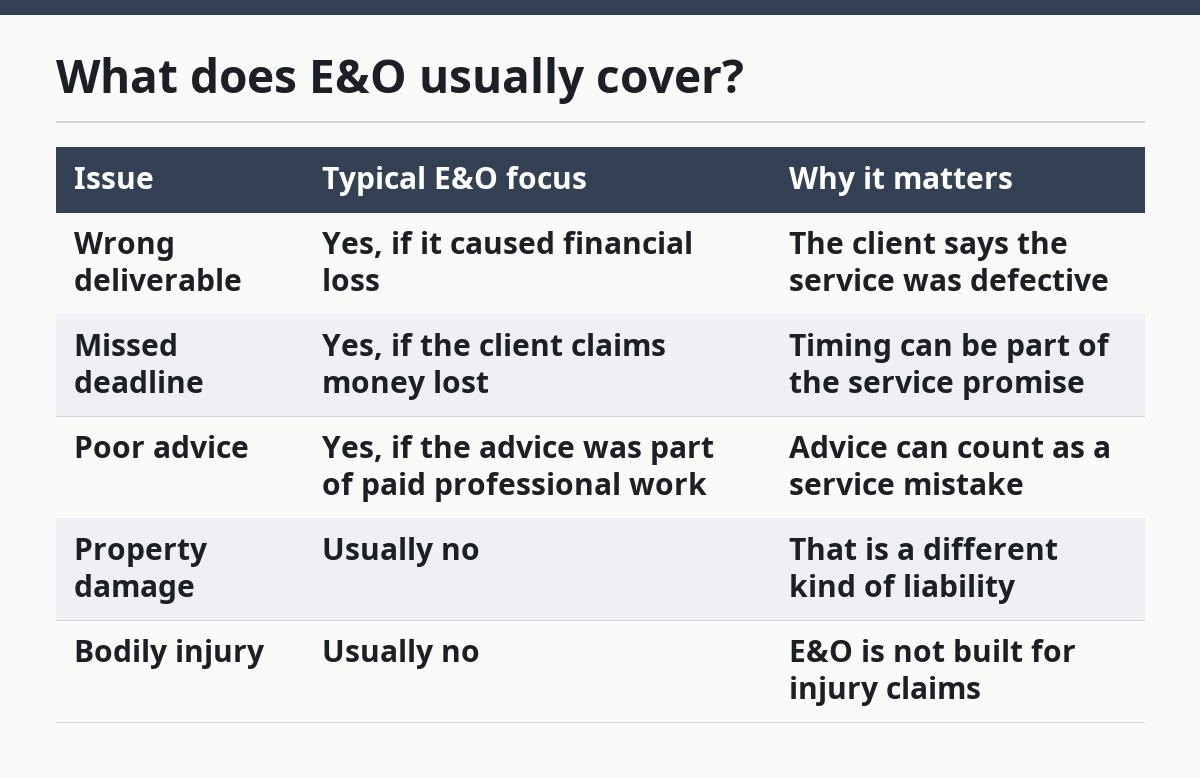
E&O usually covers defense costs, settlements, and judgments tied to covered professional claims, subject to the policy terms. That can include a client complaint about a mistake in your work, a missed specification, a bad recommendation, or a failure to deliver the service you promised.
The clearest way to think about it is this: E&O is about the money side of a professional dispute. It is not there because a client is annoyed. It is there when the complaint turns into a claim for financial loss. If a project caused a rerun, a rebuild, or a missed sale, that is the kind of harm the coverage is built to address.
A simple comparison helps:
| Issue | Typical E&O focus | Why it matters |
|---|---|---|
| Wrong deliverable | Yes, if it caused financial loss | The client says the service was defective |
| Missed deadline | Yes, if the client claims money lost | Timing can be part of the service promise |
| Poor advice | Yes, if the advice was part of paid professional work | Advice can count as a service mistake |
| Property damage | Usually no | That is a different kind of liability |
| Bodily injury | Usually no | E&O is not built for injury claims |
Policy language still controls the result. Some forms define “professional services” tightly, so the same mistake can be covered in one policy and excluded in another. A freelancer should read the wording before assuming a claim fits. See the NAIC consumer guidance on policy review and the insurer terms themselves before relying on a label.
Why do freelancers need it?
Freelancers need E&O when a single service mistake can create a client loss that is large enough to matter. That risk is common in work where the deliverable affects revenue, deadlines, compliance, or a launch date. A developer, copywriter, consultant, designer, marketer, editor, or analyst may all face this type of claim if a client says the work failed in a paid professional role.
The reason freelancers face this risk is simple: clients often depend on one person, one file, or one deadline. If the work is late or wrong, the client may point to a financial loss and look for someone to pay it. E&O is the insurance that is designed for that kind of complaint.
It is less useful when the work is low-stakes, short-term, or unlikely to create a financial claim. A hobby project, a one-off task with no meaningful client reliance, or work where the contract limits your responsibility may reduce the need. That does not mean the risk disappears; it means the value of the coverage is less clear.
A key point for freelancers is that the claim often comes after the job ends. A client may not spot the error for months. That delay is one reason E&O is often written as a claims-made policy.
How does a claims-made policy work?
A claims-made policy means the claim must be made during the policy period, and sometimes the service incident must also fall within a defined window. That timing rule is one of the most important parts of errors and omissions coverage for freelancers.
Here is the basic sequence in plain terms:
- Check the policy wording and identify the “professional services” section. Verify that your actual freelance work fits the description. If it does not, the problem is that a future claim may not match the policy at all.
- Confirm the policy period and the retroactive date, if the policy has one. The retroactive date tells you how far back covered work may reach. If your past work falls before that date, a later claim can be a problem.
- List the services you actually sell, not the services you hope to sell one day. Verify that the policy names or clearly includes those services. If the wording is vague, coverage can break when a claim is tested.
- Look for the claims process and notice rules. Many policies require prompt notice after a demand letter, complaint, or circumstance that could become a claim. If notice is late, coverage can be affected.
- Check whether legal defense is inside or outside the limit. Verify the limit language before you assume there is room for both defense and settlement. If defense costs erode the limit, a long dispute can use up the policy faster than expected.
- Review exclusions for intentional acts, fraud, known claims, and work outside your stated profession. If your risk sits in an exclusion, the policy may not respond even when the claim sounds serious.
- Because subcontractor work, past projects, and completed work can be treated differently, confirm with a qualified insurance professional or broker whether your policy includes them and read the insurer wording closely. If the policy excludes work done by others under your direction, the gap can appear in a real claim, not on paper only.
- Keep records of contracts, scope changes, emails, and final deliverables for each project. If those records are missing, it becomes harder to show what was promised and what was actually delivered.
The problem with claims-made structure is timing, not drama. A freelancer can do good work in March and still face a problem if the claim lands after the policy lapses and no extended reporting option applies. That is why policy dates matter as much as the premium line on the invoice. IRMI’s explanation of claims-made policies and the NAIC’s coverage guidance both stress checking dates and reporting rules.
What does E&O not cover?
E&O does not cover every business problem, and that limit is where many readers get the wrong idea. It is aimed at professional-service claims, not every loss linked to freelance life.
The most common gaps are intentional wrongdoing, criminal acts, unpaid invoices, and claims that fall outside the policy’s definition of professional services. If a client says you made a bad design choice, that may fit. If the client says you stole a logo file or promised a refund and never paid it, the policy may not help.
Another common gap is a claim that is really about disappointment, not money. A client can dislike a result without having a covered financial loss. A policy does not turn a weak outcome into a covered one just because the client writes an angry email.
A rough rule: E&O is a tool for allegations tied to paid expertise and financial harm. It is not a catchall for every dispute, every contract problem, or every business mistake.
When does the standard approach not fit?
The standard E&O setup does not fit every freelancer, and the mismatch usually shows up in five situations.
You do not give advice or services that can cause a client loss: the risk may be low enough that the policy adds less value than expected — review whether your work really creates financial exposure.
Your contract already shifts most risk away from you: the policy may still matter, but the promise you made on paper can be narrower than the policy language — check both together before relying on either one.
Your work is highly custom or experimental: claims may involve unclear scope, and the insurer may read that as outside the usual professional-service model — get the wording checked before you assume coverage.
You have changed services since you bought the policy: old coverage may not match your current work — update the policy description before a claim arises.
A client is already threatening a claim: the issue may now involve notice rules, exclusions, and timing — handle the paperwork carefully and get qualified help fast. The Insurance Information Institute recommends reviewing policy terms and reporting requirements promptly.
These are not signs to panic. They are signs that a plain “yes, I have E&O” answer is too simple for the real risk.
What mistakes do freelancers make?
Freelancers make the same few mistakes with E&O, and each one can turn a policy into a weak shield.
The first mistake is assuming all professional liability policies are identical. They are not. One policy may cover a narrow set of services, while another uses broader wording. The correct move is to compare the actual service description, exclusions, and claim notice rules.
The second mistake is waiting until a complaint becomes a formal claim. Many policies care about when the claim is reported. If a freelancer sits on a demand letter for weeks, the timing can become the problem.
The third mistake is forgetting that old work can still trigger a claim. A project from last year can produce a dispute today. If the coverage lapsed, the answer may depend on dates and reporting rules, not on how recent the mistake feels.
The fourth mistake is treating a contract clause as the same thing as insurance. A contract can limit liability, but that does not replace E&O. One is a legal promise between parties; the other is an insurance response if a covered claim arrives. If the wording is unclear, consult a qualified insurance professional or broker and compare it with the policy form itself.
The fifth mistake is failing to document scope changes. A project that starts as one page and ends as five rounds of revisions can become hard to defend if the records are thin. Good notes do not guarantee coverage, but bad records can make every dispute harder.
How do I tell if I need it?
You likely need E&O when a client can say your work caused a financial loss and that statement would not sound absurd. That is the core test. If your work affects revenue, deadlines, compliance, product launches, or professional advice, the exposure is usually more than trivial.
It also matters how clients hire you. If they depend on your judgment, your files, or your final approval, a mistake can have a direct money cost. A freelancer who only performs low-risk tasks may still want coverage, but the case for it is weaker than for someone whose work steers a client’s business decisions.
A good sign that E&O belongs on the radar is when your contract, email trail, or deliverable could be used to argue that you made a professional error. That is the point where the insurance is doing real work.
Is errors and omissions the same as professional liability?
Yes, in many policies errors and omissions coverage and professional liability insurance describe the same basic kind of protection. The label can vary by insurer, country, and policy form, but the function is similar: it is insurance for claims tied to professional mistakes, omissions, or negligence.
The phrase on the certificate matters less than the wording inside the policy. Two policies can share a name and still cover different services, claim triggers, and exclusions. A freelancer should read the actual definition of professional services and the claims notice rules before assuming the labels mean the same thing. For a general consumer explanation, see the NAIC and the Insurance Information Institute.
What does E&O cover for freelancers?
E&O covers claims that a freelancer’s professional mistake or omission caused a client financial loss, subject to the policy terms. That usually means defense costs and covered settlements or judgments linked to work you were hired to do.
It does not cover every problem that happens during a project. A complaint has to fit the policy’s language, and the loss usually has to be tied to the service itself, not just to general unhappiness. If the claim is about professional advice, a missed deadline, or a wrong deliverable, E&O is the part of freelancer liability insurance meant for that dispute.
When do freelancers need E&O insurance?
Freelancers need E&O insurance when their work can create a client claim for financial loss, especially if one mistake could be expensive. That is common in paid services that influence money, time, compliance, or business decisions.
The need rises when clients rely on your judgment or when a project failure could force them to pay twice, relaunch a campaign, fix a file, or miss a contract. It may be less pressing for very small, low-risk tasks, but the final call depends on the work, the contract, and the size of the possible loss.
Drafted with AI; not yet reviewed by a person.
