
Last updated: November 19, 2026
Quick Answer: The retroactive date for freelance E&O insurance should usually be the earliest date of work you want a claims-made policy to cover, and many freelancers try to keep the same date when they switch insurers.
Usually, the right retroactive date for How to Choose a Retroactive Date for Freelance E&O Insurance is the first date you want your claims-made policy to protect work you already did. Pick it badly, and an old project can sit outside coverage. This guide shows how to check the date, protect it when you switch carriers, and catch gaps before they turn into a claim.
Key takeaways
- A retroactive date is the earliest work date your claims-made policy may cover.
- The date should usually match the oldest covered work you want protected, not the day you bought the policy.
- When you change insurers, the main risk is losing date continuity between policies.
- A new insurer may agree to prior acts coverage, but only if the policy language and paperwork support it.
- If you see a gap between the old policy’s end date and the new one’s start, pause and fix that before you sign.
Important note: This is information, not financial advice. Your own policy terms, country, and contract duties can change the answer, so a qualified adviser should review your situation, and sources like IRMI and the Insurance Information Institute explain how claims-made timing works.
What the retroactive date actually does
The retroactive date marks the oldest work date your claims-made policy can reach back to cover. If the alleged mistake happened before that date, the claim may fall outside the policy even when the claim itself is filed today.
Take a project finished in March 2021. You bought freelance E&O insurance in 2024. If your retroactive date starts in 2024, that 2021 project may not be covered. If the date reaches back to 2021, it might be, subject to the rest of the policy terms and the policy wording, which claims-made policy guides from the Insurance Information Institute and IRMI both emphasize.
Here’s the wrinkle: the retroactive date is not the same thing as the policy inception date. The inception date is when the policy starts. The retroactive date is the line in the past. Those two dates can match, or they can be miles apart.
- Claims-made policy: covers claims first made during the policy period, if the claimed work falls after the retroactive date.
- Prior acts coverage: a promise that the policy can reach back to earlier work, usually through an agreed retroactive date.
- Coverage gap: any period where your old policy stops and the new one does not fully pick up the same past work.
Why does that matter? Freelance E&O claims often show up late. A client may spot a problem months or years after you delivered the work. If the date is too recent, the policy can leave older jobs exposed. That math stops working fast.
How do I choose a retroactive date for freelance E&O insurance?
Choose the earliest date you need the policy to protect, then make sure the policy language actually preserves that date. For many freelancers, that means the first day they started taking paid work in the covered service, but only if they want protection for all work since then.
For How to Choose a Retroactive Date for Freelance E&O Insurance, the practical answer is to anchor the date to real work, not memory. A clean paper trail beats a rough estimate.
Follow these steps in order:
- List every service you want covered. Write down the exact freelance service, such as copywriting, web design, or editing, and the first month and year you offered it for pay. Verify that the work type matches the policy class; if the policy excludes a service, the date won’t help. A bad sign is a date that covers old work but the wrong profession.
- Find the oldest project that still matters. Use your invoices, contracts, portfolio records, or tax files to find the earliest job you want protection for. Verify the start date of that project, not the finish date. If you can’t document the work period, that’s a sign to slow down and gather records before you set the date.
- Check your current or old claims-made policy. Read the declarations page and endorsements for the retroactive date, prior acts wording, and any change clause. Verify that the date on paper is the one you think you have. A mismatch here means the policy record, not your memory, controls the coverage line.
- Decide whether you need continuity from an older policy. If you already had claims-made coverage, the most reliable choice is often to keep the same retroactive date, if the insurer will carry it forward and the policy allows it. Verify that the new insurer will honor the earlier date. If the insurer will not, that is a warning sign, because a date reset can leave past work outside the new policy.
- Ask the new insurer to confirm the date in writing. Request the proposed policy or quote showing the retroactive date, not a verbal promise. Verify that the inception date and retroactive date are both visible. If the documents are vague, treat the date as unconfirmed and consult a qualified adviser before you bind coverage; insurance guidance from IRMI and the Insurance Information Institute both stress reading the policy language, not relying on summaries.
- Compare the date against any gap in coverage. Look for any month or day when no claims-made policy protected your work. Verify there is no break between the old policy ending and the new one starting. A gap can mean the old retroactive date does not carry cleanly into the next policy period.
- Match the date to your contract risk, not your wish list. Some client contracts ask for longer retention of liability than you expected. Verify the date works with the contracts you already signed, not just the jobs you remember. If a client requirement conflicts with the policy date, the problem is bigger than a simple form.
- Save the evidence with your policy file. Keep the declarations page, renewal papers, and any email that confirms prior acts coverage in one folder. Verify you can show the date if a claim comes later. If you can’t prove the date quickly, you may struggle to prove continuity later.
Once the date is documented, renewals get simpler. You still have to check it each year, but you are not rebuilding the history from scratch.
What should I check before I lock in the date?
Check the oldest exposed work, the policy language, and any break in coverage before you let the date stand. Those three items do most of the damage when people get this wrong.
For How to Choose a Retroactive Date for Freelance E&O Insurance, the number to watch is the earliest job date you can document, because that is the point where a claims-made policy can start to matter.
Use this quick check:
- Oldest at-risk project: the first job that could still lead to a claim today.
- Policy inception date: when the new policy starts, often the day the policy period begins.
- Prior acts wording: the clause that says the insurer will cover earlier professional work if the date allows it.
- Certificate or declarations page: the document that usually shows the retroactive date plainly.
- Any lapse: a day without continuous claims-made coverage can complicate the handoff.
If the date on the declarations page is newer than the work you need covered, that is a problem. If the policy says “prior acts excluded” or limits prior acts another way, the date alone may not solve it.
For a broader starting point on policy choices, the hub page on freelancer insurance basics and coverage choices should sit beside this one.
What happens if the date changes when I switch insurers?
A changed retroactive date can remove older work from the new policy, even if your current coverage is active. That is why switching carriers is the moment to slow down and read the forms line by line.
For How to Choose a Retroactive Date for Freelance E&O Insurance, switching insurers is where many freelancers lose continuity, because the old date does not automatically transfer to the new policy.
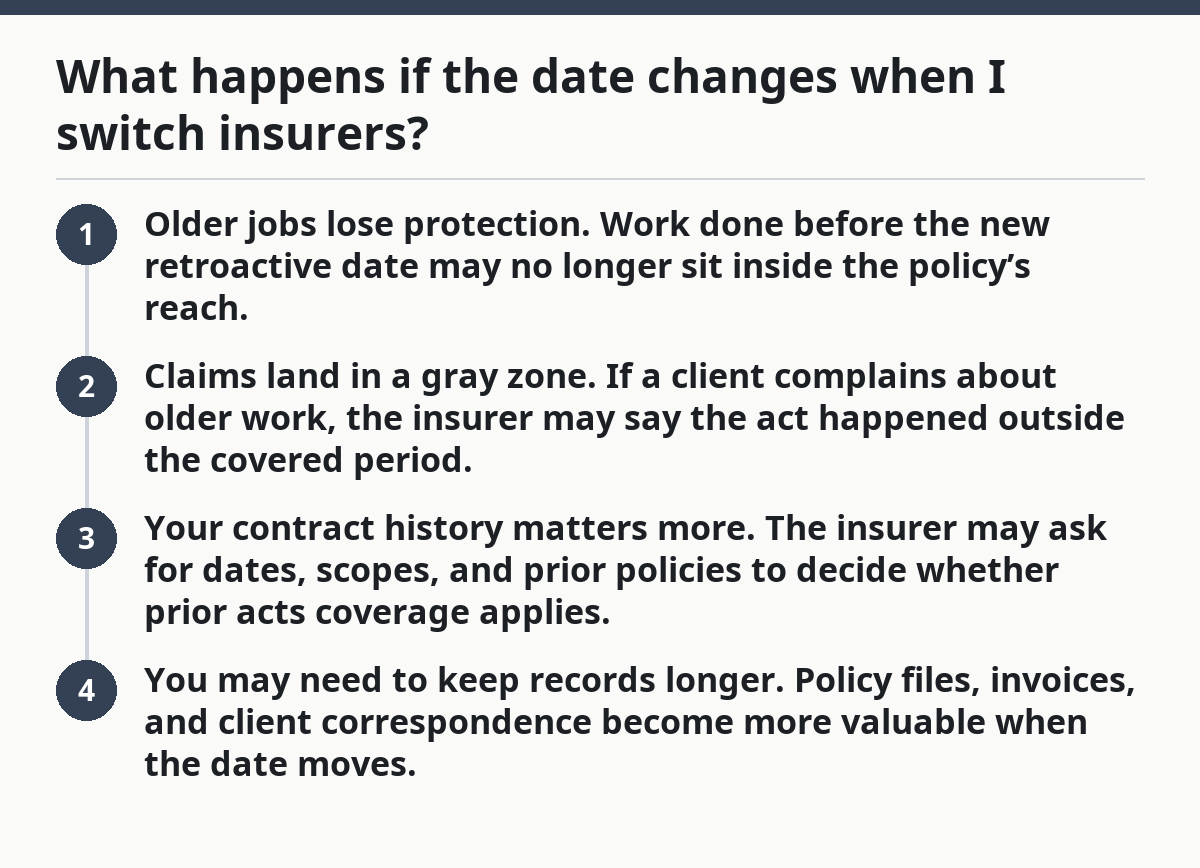
A changed date can mean:
- Older jobs lose protection. Work done before the new retroactive date may no longer sit inside the policy’s reach.
- Claims land in a gray zone. If a client complains about older work, the insurer may say the act happened outside the covered period.
- Your contract history matters more. The insurer may ask for dates, scopes, and prior policies to decide whether prior acts coverage applies.
- You may need to keep records longer. Policy files, invoices, and client correspondence become more valuable when the date moves.
Treating a switch like a simple price comparison is the trap. It is not. On claims-made coverage, continuity of the date can matter as much as premium, and guides from the Insurance Information Institute and IRMI both warn readers to check the trigger and timing carefully. One small date change can bite hard.
When should I stop and get qualified help?
Stop when the date problem touches a coverage gap, a disputed prior policy, or a contract promise you cannot verify on paper. Those are not guesswork situations.
For How to Choose a Retroactive Date for Freelance E&O Insurance, qualified help matters most when the paperwork, contract, and work history do not point to the same answer.
You had a lapse in claims-made coverage: a gap can break continuity and make the old date harder to carry forward — get the policy history reviewed before you bind anything.
The new insurer will not honor the old date: the prior acts grant may be limited or denied — ask for a written explanation and compare the wording side by side.
Your work history is mixed: if you changed services, entities, or jurisdictions, one date may not fit all work — separate the timeline before you decide.
A client contract names insurance dates: the contract can create a mismatch between what the insurer will cover and what you promised — check the contract against the declarations page.
You cannot document the oldest project: missing records can make the earliest covered date uncertain — gather invoices, proposals, emails, and tax records first.
The policy is being issued for a retroactive period you do not understand: unclear wording can hide exclusions — do not rely on a broker’s summary alone.
The mistakes freelancers make with retroactive dates
The biggest mistakes are guessing, resetting the date, and assuming the quote is enough. Each one can leave old work outside the policy when the claim arrives later.
For How to Choose a Retroactive Date for Freelance E&O Insurance, the safest process is to verify the date in the policy and tie it to records you can produce later.
Use this list:
- Guessing the oldest date. Consequence: you may pick a date that is too recent and lose coverage for older jobs. Better move: use invoices, contracts, and tax records to pin down the real start.
- Treating a new policy like a clean slate. Consequence: a new insurer may set a later date and erase prior acts protection for earlier work. Better move: ask whether the old date can be carried forward, and consult a qualified adviser if the answer is unclear.
- Reading only the premium, not the endorsements. Consequence: the paperwork can quietly change the retroactive date or limit prior acts. Better move: read the declarations page and endorsements together.
- Ignoring a one-day gap. Consequence: a lapse can break continuity even if the date looks right on both policies. Better move: line up the end and start dates before binding.
- Assuming the date covers all business lines. Consequence: one service may be protected while another is not. Better move: match the covered class of work to the date.
A simple rule helps: if you can’t show the date on the policy and connect it to real work, the date is not ready.
When the standard approach does not fit
The standard approach breaks down when your freelance business has more than one service line, more than one policy, or a messy coverage history. In those cases, one retroactive date may not tell the full story.
For How to Choose a Retroactive Date for Freelance E&O Insurance, a single date can be too simple when the business history is split across services or years.
For example, you started as a web developer in 2020, added UX consulting in 2022, and switched carriers in 2024. One date may not reflect the risk on all three streams. A single line on paper can hide a split history.
Use a different approach if:
- You changed professions under the same business name: verify which service the policy class actually insures.
- You have separate policies for separate clients or entities: each policy may carry its own date.
- You had a long break in freelance work: the gap may affect what the new insurer will accept as prior acts.
- You work across countries: rules and policy forms differ, so one carrier’s date language may not match another’s.
- You inherited old project liability through a firm or merger: the old work may need separate proof, not a fresh start date.
This is where a qualified adviser earns the fee. The question is not just “what date should I pick?” It is “what date can this policy actually support?”
What a good result looks like
A good result is a retroactive date that matches the oldest covered work you need, appears clearly on the policy, and survives the switch from one claims-made policy to the next. It also comes with records you can find in under 5 minutes.
For How to Choose a Retroactive Date for Freelance E&O Insurance, a good result is documented, continuous, and easy to prove if a claim arrives later.
Open one folder, and there it is: the declarations page, the previous policy, and the email that confirmed prior acts coverage. That is the finish line. It means the date is not just chosen — it is protected.
A strong setup usually has these traits:
- The date is tied to documented work, not memory.
- The new insurer has confirmed it in writing.
- There is no unexplained gap between policies.
- The policy wording on prior acts matches the date you expect.
- You can show a future claims handler the paper trail quickly.
If any of those pieces is missing, the date choice is shaky. Fix the paper trail before a claim tests it.
What happens if my retroactive date changes?
A changed retroactive date can narrow the span of work your claims-made policy may cover. If the new date is later than the old one, older projects may fall outside the policy even though the policy is still active. Check the declarations page and endorsements, and ask for written confirmation of what changed.
Can I keep my old retroactive date when switching insurers?
Often, yes, but only if the new insurer agrees to carry it forward and the policy documents show that agreement. The old date does not transfer by habit.
Drafted with AI; not yet reviewed by a person.
