

Last updated: November 23, 2026
Quick answer: in 3 checks, you can usually tell whether a freelance incident is an insurance claimable event: policy trigger, covered harm, and timing. A freelance incident is claimable when it matches a policy trigger and involves a loss the policy can cover, such as a written demand, bodily injury, property damage, or a professional mistake that led to a client loss. If there is only a vague complaint and no covered harm, it may not be claimable yet.
Key takeaways
- A claimable event is not the same as a bad project outcome; it has to connect to a policy trigger and a covered type of harm.
- Written demands, injury, and property damage are stronger claim signals than a casual complaint or an unhappy message.
- The policy wording matters more than the label on the email.
- When the facts are unclear, document the incident in writing and review the policy terms with a qualified adviser.
- This is information, not financial advice, and a qualified adviser should be consulted for your own situation.
This guide to How to Decide Whether a Freelance Incident Is an Insurance Claimable Event is for freelancers who already have, or are considering, freelancer liability insurance and need to sort out whether an incident looks claimable. It assumes you have the incident details, the client messages, and the policy wording in front of you, or can get them within 10 to 15 minutes. It does not replace advice from a qualified adviser, because policy language and reporting duties can change by country and by contract.
What makes a freelance incident claimable?
A freelance incident is claimable when the facts fit the policy wording, not when the situation simply feels serious. The usual filter is: did something happen that the policy names, and did it create a loss, demand, or injury the policy can respond to?
The easiest way to think about How to Decide Whether a Freelance Incident Is an Insurance Claimable Event is in three parts. First, identify the incident itself. Second, match it to a covered event, such as a claim, written demand, bodily injury, property damage, or a professional mistake. Third, check whether the policy has a trigger that is already active, such as a demand made during the policy period or an incident that happened while the policy was in force. Claims-made policies and occurrence policies handle timing differently, which is why the wording matters. The Insurance Information Institute explains that difference in its claims-made vs. occurrence overview, and the NAIC has a similar consumer explanation on claims-made policies.
A complaint alone is often not enough. A message like “this work is terrible” may be frustrating, but it does not always become a claimable event. A letter from a lawyer, a formal demand for payment, or a statement that the client wants compensation usually changes the analysis because it shows a claim or a likely claim.
How do you test the incident step by step?
You test it by checking the policy trigger first, then the harm, then the paperwork. This is a 7-step screen that works best when you do it in one sitting, with the policy declarations page, the full wording, the email thread, and any invoice or contract nearby.
- Read the policy trigger for 5 minutes. Look for the words “claim,” “incident,” “occurrence,” “written demand,” or “notification.” Verify whether the policy is claims-made or occurrence-based. If the wording does not define the trigger clearly, that is a problem because timing may decide coverage. See also claims-made vs. occurrence policies.
- List the event in 1 sentence. Write one plain sentence that says what happened, such as “the logo file was sent with the wrong brand name” or “a client says the website launch missed a deadline.” Verify that the sentence names a real act, not a feeling. If you cannot state the event without opinions, the facts are still too fuzzy.
- Match the harm to a covered category. Check whether the event involves bodily injury, property damage, or a professional mistake. Verify whether the policy covers that category at all. If the only harm is lost pride, stress, or a bad review, the event may be real but not claimable under some policies. Read the coverage section and compare it with freelancer liability insurance.
- Find any written demand within 24 hours of review. Search for emails, letters, texts, or messages that ask for money, corrective work, or legal action. Verify whether the demand is specific, such as a dollar amount or a deadline. A vague complaint is weaker than a demand that names a loss.
- Check whether the client blames the work or the accident. Decide whether the issue is a professional mistake, a bodily injury, or property damage. Verify the source of the problem: a bad design decision, a spilled drink on a laptop, or a fall at a work site are different facts. If the cause is unclear, coverage can turn on that detail.
- Compare the date of the event with the policy dates. Mark the incident date and the demand date on a calendar. Verify whether both fall inside the policy period or within any reporting window stated in the policy. If the dates do not line up, the event may fall outside the policy trigger. For timing basics, see policy period rules.
- Document the whole file in one place. Save the contract, invoices, screenshots, photos, and message thread in a dated folder within the same day if possible. Verify that the record shows who said what and when. A missing timeline is a problem because insurers decide from records, not memory. A clean file also helps if you later need to speak with a qualified adviser.
Does a written demand change the answer?

Yes, a written demand often turns a vague incident into a claimable event because it gives the insurer something concrete to assess. A demand can be a lawyer’s letter, a formal request for compensation, or even a direct message that clearly asks for payment or correction.
The key detail is not the tone; it is the substance. A client can sound calm and still make a demand, or sound angry and still make none. If the message says “pay for the damage,” “refund the fee,” or “fix the loss by Friday,” that is much closer to a claim than a casual complaint. A demand also helps show the link between the incident and the loss, which matters in liability coverage and in professional liability cover. The National Association of Insurance Commissioners has consumer guidance on why policy wording matters, and that is a useful reference when a demand arrives.
A written demand is not the only trigger. Some policies respond to an incident before any demand is made, while others need a claim or notice in a specific form. That is why the policy wording is the first thing to check, not the last.
What kinds of incidents are most likely to be claimable?
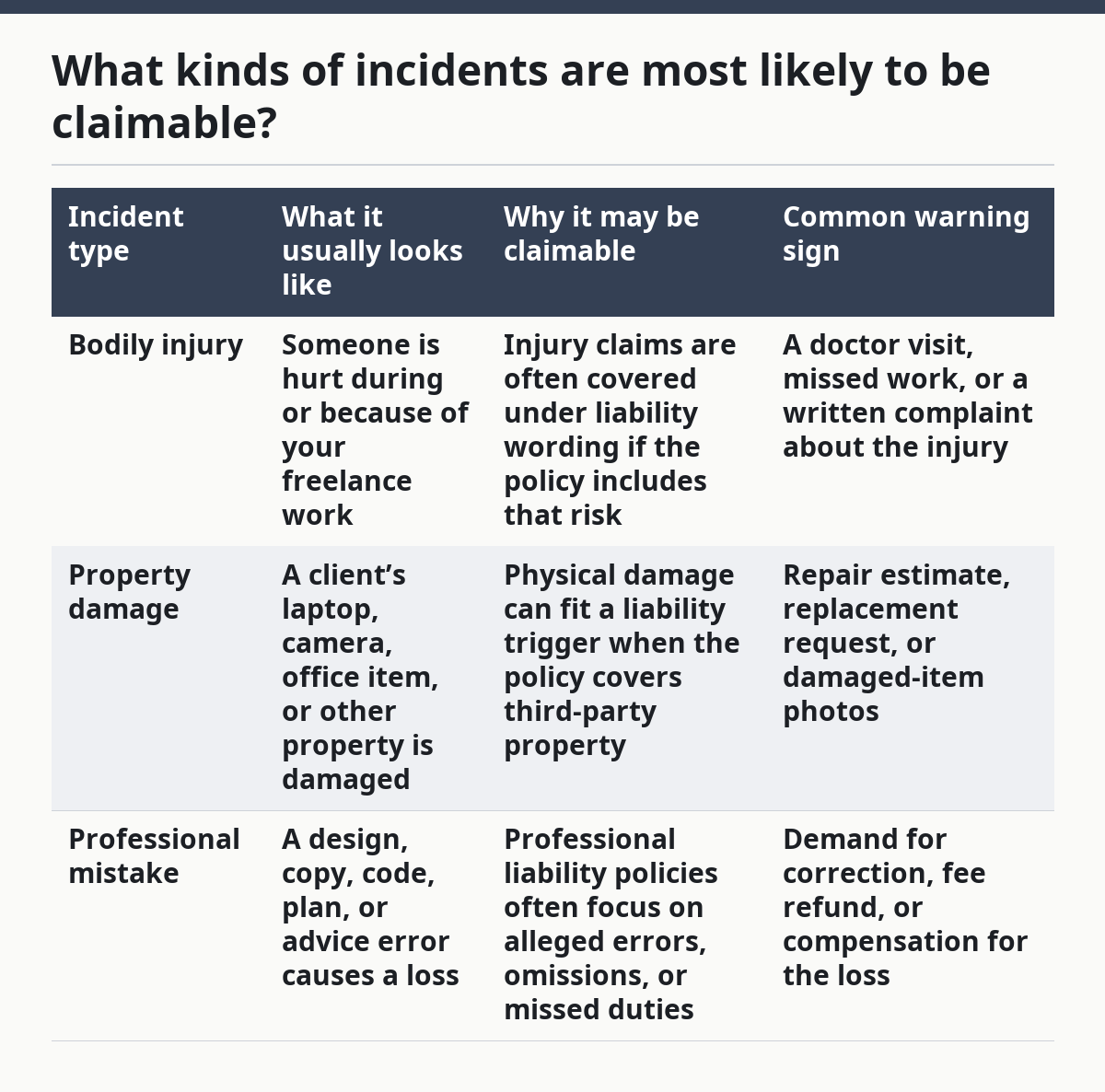
Bodily injury, property damage, and a professional mistake are the incidents most likely to raise a claim question. These are the categories most readers can spot quickly, even before a formal demand arrives.
| Incident type | What it usually looks like | Why it may be claimable | Common warning sign |
|---|---|---|---|
| Bodily injury | Someone is hurt during or because of your freelance work | Injury claims are often covered under liability wording if the policy includes that risk | A doctor visit, missed work, or a written complaint about the injury |
| Property damage | A client’s laptop, camera, office item, or other property is damaged | Physical damage can fit a liability trigger when the policy covers third-party property | Repair estimate, replacement request, or damaged-item photos |
| Professional mistake | A design, copy, code, plan, or advice error causes a loss | Professional liability policies often focus on alleged errors, omissions, or missed duties | Demand for correction, fee refund, or compensation for the loss |
A small mistake can still matter if the client says it caused a larger loss. A typo in a brochure may be trivial by itself, but if it leads to a missed sale or a breach allegation, the event can become claimable under some policies. The same is true for delayed delivery, wrong instructions, or a design error that the client says caused downstream damage.
The reverse is also true. Not every unpleasant event is claimable. A client who simply dislikes the style of the work may have a quality complaint, not a covered loss. That difference matters because liability insurance is built around losses and allegations, not taste. For a broader overview, see freelance insurance and professional liability insurance.
When should you stop guessing and get qualified help?
You should stop guessing when the incident could affect a large client loss, a legal deadline, or a timing rule in the policy. This is where the wrong read can cost coverage, and the right next step is a qualified adviser who can read the policy language with your facts.
The message comes from a lawyer: It may already be a formal claim — get qualified help before replying in detail. The legal language can trigger duties that a casual response could worsen.
The client asks for money or compensation in writing: That is a strong claim indicator — review the policy wording and get advice on the reporting path. A short email can matter as much as a letter.
Someone reports an injury or damaged property: This may involve third-party harm — document the event immediately and seek qualified help on coverage timing. Physical harm can move fast.
The incident happened near a policy start or end date: Timing may decide coverage — check whether the policy is claims-made or occurrence-based. A one-day mismatch can matter in some contracts.
The facts are still changing after 24 hours: The record is not stable yet — keep notes and get guidance before making a coverage call. A moving timeline can change the trigger.
The contract has indemnity or insurance clauses: The client agreement may shift duties — compare the clause with the policy before acting. Contract wording can create obligations that the policy does not mirror.
This page is not for deciding a legal case or a disputed claim. It is for sorting the incident into the right bucket before the file gets messy. If the event is already tangled with a lawyer, a deadline, or a formal demand, the safer move is outside the self-check.
What do people get wrong here?
People most often mistake “serious” for “claimable,” and that leads to bad calls. A frustrating project, a late payment, or a sharp client email can feel like a claim, but the policy may not treat it that way. If you are unsure, consult a professional who can compare the facts with the policy wording and the reporting rule.
One common error is waiting for the client to use the word “claim.” That can be too late, because a written demand or injury report may already be enough. Another is ignoring the date of the incident and focusing only on the date the complaint arrived. Claims-made policies can care deeply about when the demand was made, not just when the work happened. See also claims notice guidance.
A third mistake is treating internal notes as enough proof. Notes help, but they do not replace emails, photos, contracts, or a clean timeline, so it is wise to consult a professional if the file may become disputed. A fourth mistake is assuming all liability policies work the same way. They do not. A professional liability policy, a general liability policy, and an errors-and-omissions policy can respond differently to the same 1-page email.
The correct alternative is slower but cleaner: match the facts to the policy wording, save the paper trail, and verify the trigger before you decide anything is ordinary or claimable.
What if the incident is messy or partly your fault?
A messy incident can still be claimable if it fits the policy wording and the harm is the kind the policy addresses. Partial fault does not automatically end the analysis, because liability insurance is often built for allegations of mistake, not only for perfect blunders.
The edge cases are usually timing, mixed causes, and mixed harms. A freelancer might have a small professional error plus a client’s own delay, or a property damage issue plus a separate service complaint. In those cases, split the facts on paper. Write down which part is bodily injury, which part is property damage, and which part is a professional mistake. That 1-page split is often clearer than trying to describe everything in one paragraph.
Special care is needed when the client has not yet made a demand. The absence of a demand does not always mean the matter is safe to ignore, especially if the facts already point toward a likely claim or if the policy has a reporting rule tied to incidents. The policy wording decides whether the event is already claimable, only potentially claimable, or outside coverage altogether. If the wording is unclear, a qualified adviser can help interpret it.
FAQ
when does an incident become a claim?
An incident becomes a claim when the policy wording says it has become one, often after a written demand, legal notice, or similar request for compensation. A complaint alone may not be enough. The exact trigger depends on the policy type and the language in the contract.
do i need to notify my insurer right away?
You should not assume the right timing without reading the policy, because reporting duties differ by policy and country. Some policies expect prompt notice after a trigger, while others allow a different window. If the incident involves injury, property damage, or a written demand, the safest next move is to check the policy and get qualified advice.
what if the client has not demanded anything yet?
The event can still matter even if the client has not asked for money yet. A written demand is a strong claim indicator, but it is not the only one that can matter under a policy. Keep records now, because the first demand may arrive later and the date can affect coverage.
Where this fits in the bigger claims file
This decision is only one piece of the wider freelance claims, incidents, and documentation process. Once the incident is sorted as likely claimable, likely not claimable, or still unclear, the next file move is usually to keep the record clean and aligned with the policy language.
A good result is simple: the incident has a dated note, the harm type is named, the policy trigger is checked, and the written demand, if there is one, is saved with the rest of the file. A bad result is guessing, deleting messages, or assuming that a small complaint can never grow. In this subject, the paper trail often decides more than the emotion does.
Drafted with AI; not yet reviewed by a person.
