
Last updated: November 19, 2026
Key Takeaways
- Tail coverage extends reporting time for old claims after a claims-made policy ends.
- It can help a late claim reach the insurer that covered the work.
- You usually buy it before the policy ends by electing the reporting option the policy allows.
- Nonrenewal can change the reporting deadline, but old work may still be covered if the tail is properly elected.
Tail coverage keeps a claims-made freelance policy alive for old work after the policy ends. In How Tail Coverage Works After a Freelance Policy Ends, the key point is that it does not extend the work date; it extends the reporting window for claims that show up later. This guide explains when that matters, what an extended reporting period does, and how prior acts coverage fits in.
How does tail coverage work with a claims-made policy?
Tail coverage works by giving you a longer reporting window after a claims-made policy ends, so a late claim can still be sent to the insurer that covered the work. That window is often called an extended reporting period. It is the opposite of occurrence coverage, where the loss date matters more than the claim date.
According to the Insurance Information Institute, claims-made policies depend on when the claim is reported, and the policy’s reporting terms control coverage. The ISO Commercial General Liability Form also distinguishes claims-made and occurrence structures in policy language.
Picture this: your policy stops on July 1, but a client sends a demand letter in October about work you completed in April. If the policy includes tail coverage, you may still be able to report that demand after July 1. If it does not, the claim can land outside the reporting window even though the work happened while the policy was active.
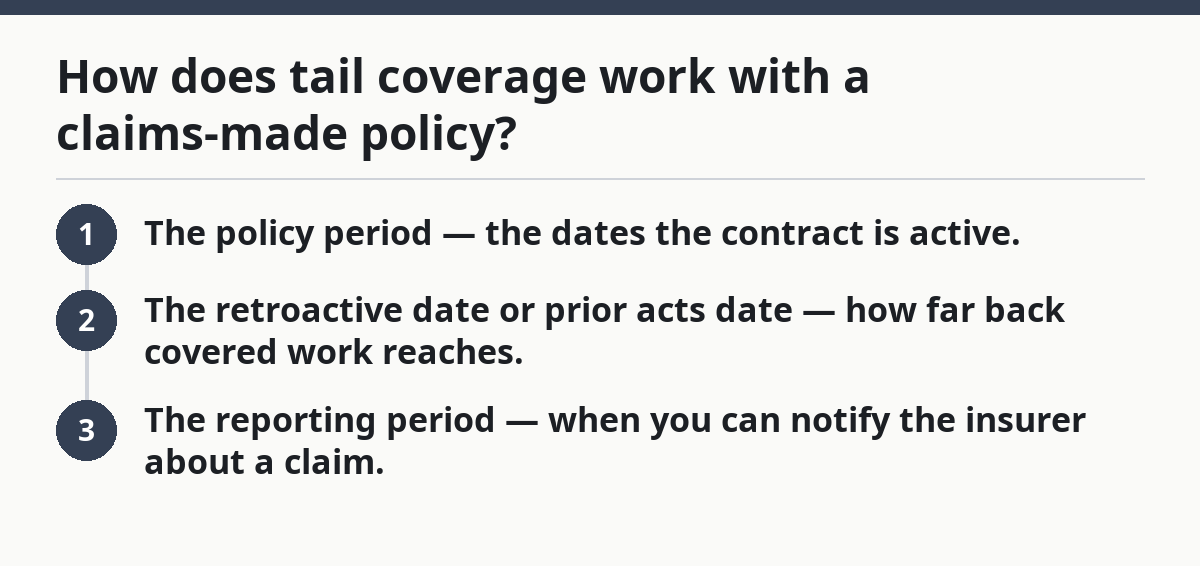
A claims-made policy usually has three moving parts:
- The policy period — the dates the contract is active.
- The retroactive date or prior acts date — how far back covered work reaches.
- The reporting period — when you can notify the insurer about a claim.
If any one of those pieces is missing or too narrow, tail coverage may not help. A freelance illustrator with a 2024 policy and a 2022 project cannot assume the insurer will accept the claim if the retroactive date starts in 2023. The coverage can end before the work does. That is the trap.
Common policy forms also differ on whether the tail is automatic after cancellation, available only by endorsement, or offered only after certain endings like nonrenewal. The exact label matters less than the wording. Read the reporting clause, not the marketing sheet. The National Association of Insurance Commissioners explains that policy terms and endorsements control how coverage works.
When do freelancers need tail coverage?
Freelancers need tail coverage when they can be sued or accused after the policy ends for work they already finished, and they do not have another policy that picks up those old acts. That risk is common in consulting, design, copywriting, web work, marketing, and other jobs where the harm may surface months later.
Picture this: you close a project in May, your client launches in August, and a third party complains in December that your work caused damage. Claims often arrive long after the file has been sent, the site has launched, or the campaign has gone live.
Tail coverage tends to matter most in these situations:
- You are stopping freelance work for a while.
- You are switching to a new carrier, and the new policy will not fully pick up old work.
- Your insurer nonrenewed the policy, and you need protection for work already done.
- A contract, client, or platform requires proof that old projects can still be reported.
It may matter less if your work is very low-risk and your policy language already gives you a broad reporting period. It also may not make sense if the new policy gives prior acts coverage that clearly reaches back far enough and there is no gap in the work history. Still, that is a policy-by-policy call, not a guess.
The biggest mistake is assuming “my policy ended” means “I am uninsured forever.” The real question is narrower: can this old claim still be reported? If the answer is yes, tail coverage is doing its job. If the answer is no, you may be exposed even if the project ended years ago.
How do you add tail coverage before the policy ends?
You add tail coverage by asking the insurer or broker about the extended reporting period before the policy ends, then buying the endorsement or option the policy allows. Waiting until after cancellation is often too late, or it costs more than the standard option if one exists.
Picture this: you know your freelance policy will end on June 30. You request the tail in June, not after the policy ends. That timing matters because some carriers only allow the tail to be elected during the policy term or within a short window after nonrenewal. The paperwork usually follows the policy form, not your calendar.
Use this basic procedure:
-
Check the ending date and the trigger.
Find the policy end date, the nonrenewal date if there is one, and whether the policy allows an extended reporting period after cancellation or only after nonrenewal. -
Read the retroactive or prior acts date.
Make sure the covered work date reaches back far enough for the projects you want protected. If the date starts too late, the tail cannot fix that gap. -
Ask what kind of tail is available.
Some policies offer a short free reporting period, some sell a longer one, and some bundle it into a replacement policy. The label matters because the reporting window may be different from the policy term. -
Confirm the claim notice rules.
Ask how claims must be reported: email, portal, written notice, or specific forms. A valid tail still fails if notice goes to the wrong place. -
Save proof of the election.
Keep the endorsement, the invoice, and the policy declarations page together. If a claim arrives 8 months later, you do not want to dig through old inboxes.
The strongest move is to keep the election proof with the policy file. A missing endorsement can turn a covered claim into a denied one.
What does nonrenewal change for old freelance work?
Nonrenewal changes your reporting deadline, but it does not erase the insurer’s responsibility for covered old work if tail coverage is available and properly elected. That is why nonrenewal and cancellation are not the same problem. The policy can end for one reason and still leave a reporting path open for prior acts.
Picture this: your insurer sends a nonrenewal notice because it no longer wants your line of work. You are not starting from zero. You are deciding whether the old policy should keep protecting claims tied to work that already happened. That decision lives in the tail.
A few things to watch:
- Nonrenewal date: the policy may end on a fixed date, and the election window may close fast.
- Switch to another carrier: the new insurer may cover prior acts only from a specific date, not your whole freelance history.
- Claims after the ending date: a demand letter can arrive months later, but only the reporting clause decides whether it belongs on the old policy.
One real limitation is that tail coverage often protects only claims tied to the old policy’s acts. It does not cure a coverage gap if you let the policy lapse and then did more work without another policy in force; consult a professional about how the policy and dates apply. See the NAIC’s consumer guidance and your policy language for confirmation. That is a different problem. Don’t mix them up.
The practical move is simple: if a policy is ending, get the carrier’s written explanation of the reporting period and keep it with the declarations page. If the insurer uses a 30-day or 60-day election period, that number is the one that matters, not the date you remember from an email thread.
Tail coverage vs. prior acts coverage: they are not the same
Tail coverage protects the reporting of old claims after a policy ends, while prior acts coverage moves the start date of covered work backward on the new policy. That is the cleanest way to separate them. One extends the old policy’s reporting window; the other expands the new policy’s reach.
Picture this: you leave Carrier A and join Carrier B. If Carrier B gives you prior acts coverage, it may cover work done before the switch date, subject to its own retroactive date. If it does not, you may need tail coverage from Carrier A to keep the old projects reportable.
The difference matters because freelancers often think one replaces the other automatically. It does not. A new policy with prior acts coverage can still leave a hole if:
- the retroactive date is too recent,
- the new policy has exclusions the old policy did not,
- or the claim notice lands after the old policy’s reporting period expires.
A tail also does not make a new policy better. It just keeps the old one alive for reporting. That means you can have both in play for different pieces of risk. A freelancer with long-running client work may need the old policy’s tail and the new policy’s prior acts coverage to avoid a gap.
If you compare policy forms, look for these exact phrases:
- Extended reporting period
- Prior acts coverage
- Retroactive date
- Nonrenewal
- Claims-made policy
Those words do more work than the sales pitch. On paper, they decide whether a claim from 6 months ago still has a home. The IIABA also discusses how claims-made wording and prior acts dates affect coverage.
The mistakes that cost freelancers the most
The biggest mistakes are missing the election deadline, assuming the new carrier picks up old acts automatically, and forgetting that a tail only helps with claims tied to the old policy period. Each one can leave a claim outside coverage even when the project itself looked safe.
Picture this: you shut down your freelance business, forward your mail, and assume the policy will “take care of itself.” That assumption gets expensive fast. Claims-made coverage is unforgiving about dates, and a 2-week delay can matter if the reporting window is short.
Common mistakes and the cost:
- Waiting until after the policy ends — you may miss the chance to buy the tail at all.
- Assuming prior acts coverage is automatic — the new policy may start at a later date.
- Ignoring nonrenewal language — some policies treat nonrenewal and cancellation differently.
- Throwing away the old policy file — you lose the endorsement, declarations page, and notice rules.
- Forgetting old subcontractor work — claims may arise from work you oversaw, not just work you personally delivered.
Do this instead: keep every claims-made declarations page for at least the period the policy could still answer a claim. The exact length depends on the policy, but the habit is the point. A claim that appears 18 months later should not be met with “I think I had insurance once.”
A plain reading of the policy is not glamorous. It is better than a denial letter.
Can old client claims be reported after cancellation?
Yes, old client claims can often be reported after cancellation if the policy includes an extended reporting period and the claim fits the policy’s old-work rules. That is the whole function of tail coverage. The claim must still match the covered acts, the reporting deadline, and the policy’s notice rules.
Picture this: a client disputes a logo job after your policy ended, but the design work happened while the policy was active. A tail may let you report that dispute after cancellation. If the work happened before the retroactive date, or the notice comes after the tail ends, the claim can still miss the mark.
That is why freelancers should read three dates together:
- when the work was done,
- when the policy ended,
- when the claim was first made or first noticed.
A claim made after cancellation is not automatically uncovered. It is just no longer eligible by default. The reporting period has to be there, and the claim has to fit inside it. That is the line that decides most disputes.
If the policy is already gone and you have not checked the tail terms, ask the insurer for the exact reporting language and the endorsement number. Then compare it with the old policy dates. If the dates do not line up, the answer is likely no. If they do, the claim may still belong on the old policy.
FAQ
Do freelancers always need tail coverage?
Freelancers do not always need tail coverage, but many do when they still need reporting protection for old work. A claims-made policy with a broad prior acts date or a replacement policy that truly picks up old work can reduce the need for a tail.
When should tail coverage be added?
Tail coverage should be added before the policy ends, or within the small window the policy allows after nonrenewal if that option exists. The deadline is set by the policy form, not by when the next project starts. If you wait too long, the carrier may refuse the endorsement.
Can old client claims be reported after cancellation?
Old client claims can be reported after cancellation if the extended reporting period is still open and the claim involves covered work from the old policy period. The report still has to follow the policy’s notice rules. If the tail has expired, the claim may fall outside coverage.
Drafted with AI; not yet reviewed by a person.
