

Last updated: November 19, 2026
Quick Answer: In about 5 checks, you can spot the most common insurance gaps in a statement of work. The article below explains how to check a statement of work for insurance gaps by comparing the scope, deliverables, access terms, and acceptance rules against the policy wording.
A statement of work can create insurance gaps when its scope, deliverables, access terms, or acceptance rules reach beyond what a policy usually covers. In How to Check a Statement of Work for Insurance Gaps, the main job is to compare the contract line by line with the policy before you sign or start work.
This is information, not financial advice. A qualified adviser should be consulted for your own situation, because insurance wording, contract law, and policy terms differ by country and change often.
Key takeaways
- A statement of work can be tight on project details and still leave a coverage gap.
- The biggest risk is not “bad insurance”; it is a contract term that asks for work outside the policy’s insured activity.
- Scope words, deliverables, access rules, and client dependencies are where many gaps hide.
- A clean review looks for mismatches between what the contract says you must do and what the policy says is covered.
- If the SOW expects unusual access, excluded work, or a guarantee-like result, stop and get qualified help before you rely on coverage.
What counts as an insurance gap?

An insurance gap is any place where the statement of work demands something the policy may not cover, or where the contract is broader than the insurance terms. In practice, the gap appears when a deliverable, method, or promise in the SOW sits outside the policy’s insured activity, exclusion list, or conditions.
This matters because a policy does not follow the contract automatically. A freelancer can agree to a scope of work that includes access to client systems, handling third-party data, or a specific acceptance standard, while the policy may exclude certain acts, certain losses, or work done under those conditions. The result is a clean contract on paper and a weak position when a claim or dispute comes up.
The statement of work, or SOW, is the project-specific document. It usually sits beside the contract and describes deliverables, timeline, dependencies, acceptance criteria, and sometimes exclusions. Those clauses are not just project management notes; they can reshape the insurance exposure tied to the job.
A useful way to think about it is this: the SOW tells you what you are being asked to do, and the policy tells you what risks are covered while doing it. If those two documents describe different jobs, there is a gap.
How do you check a statement of work for insurance gaps?
Therefore, you check it by comparing the SOW’s exact words against the policy’s covered activity, exclusions, and conditions, one clause at a time. The goal is to catch places where the contract widens your risk in ways the policy may not follow.
Start with the SOW in front of you and the policy declarations page, schedule, and exclusions together. Then read the document for scope of work, deliverables, acceptance criteria, access permissions, client dependencies, and any insurance exclusion wording. For a reader who wants a practical process, this is the part to use.
- Circle every deliverable and service description. Mark each noun and verb that describes what you must produce or do, such as design, code, advice, revisions, testing, or support. Verify that each item fits the type of work described in the policy; a problem shows up when the SOW adds a service that is not named or is plainly outside the insured activity.
- Check for scope creep words. Look for phrases like “as needed,” “all necessary changes,” or “any related tasks” and underline them. Verify that the scope has a clear boundary; a problem appears when open-ended wording can expand the work past the policy’s intended category.
- Read the deliverable exclusions carefully. If the SOW says certain items are excluded, identify what remains and what the client may still expect indirectly. Verify that excluded items do not return through another clause; a problem exists when the contract removes one task but still expects the same result through a different route.
- Map acceptance criteria to the policy terms. Write down the exact acceptance standard, such as approval after review, sign-off after testing, or delivery by a date. Verify that the standard is objective and tied to your work; a problem appears when the contract makes payment or completion depend on a result that can fail for reasons outside your control.
- Check access permissions and handling rules. Note any requirement to enter client systems, remote desktops, physical sites, or data stores. Verify that the policy does not exclude the kind of access involved; a problem shows up when the SOW assumes you can handle data, systems, or equipment that the policy does not contemplate.
- List client dependencies. Pull out every item the client must supply, such as files, credentials, approvals, samples, or access dates. Verify that the SOW says delays or failures by the client affect timing; a problem appears when the contract leaves you exposed if the client misses a 2-day, 5-day, or other deadline the SOW sets.
- Scan for warranty-like language. Find wording that promises things such as “guaranteed,” “free from defects,” or “compliant with all laws,” because those phrases can point to warranty-like risk. Verify whether the policy is meant to cover that kind of promise; a problem exists when the SOW turns a service into a broad guarantee, which can sit outside ordinary coverage.
- Check remedies and responsibility clauses. Look for repair obligations, re-performance, refunds, or liability for downstream losses. Verify whether the policy responds to that type of loss; a problem appears when the SOW tries to shift business loss, delay loss, or third-party loss onto you without a matching policy basis.
If you want a neutral outside reference point, the Insurance Information Institute and the National Association of Insurance Commissioners both publish consumer material on insurance terms and coverage concepts: Insurance Information Institute and NAIC. Those sources help with the policy side; the contract still has to be read on its own terms.
What should you compare in the SOW and the policy?
Conversely, you should compare the scope, the exclusions, the trigger for payment or acceptance, and the kind of loss the policy actually covers. The contract and the policy can sound similar and still point in different directions.
| SOW clause to inspect | What to compare in the policy | Gap signal |
|---|---|---|
| Deliverables | Insured activity and described services | The deliverable is broader than the service named in the policy |
| Exclusions | Policy exclusions and limitations | The SOW excludes one task but expects the same outcome anyway |
| Acceptance criteria | Conditions for claim response or completion | Completion depends on a standard unrelated to your own work |
| Access permissions | Coverage for client systems, sites, or data handling | The job needs access the policy does not clearly contemplate |
| Client dependencies | Conditions, cooperation, and timing | The client’s delay could make you appear responsible for failure |
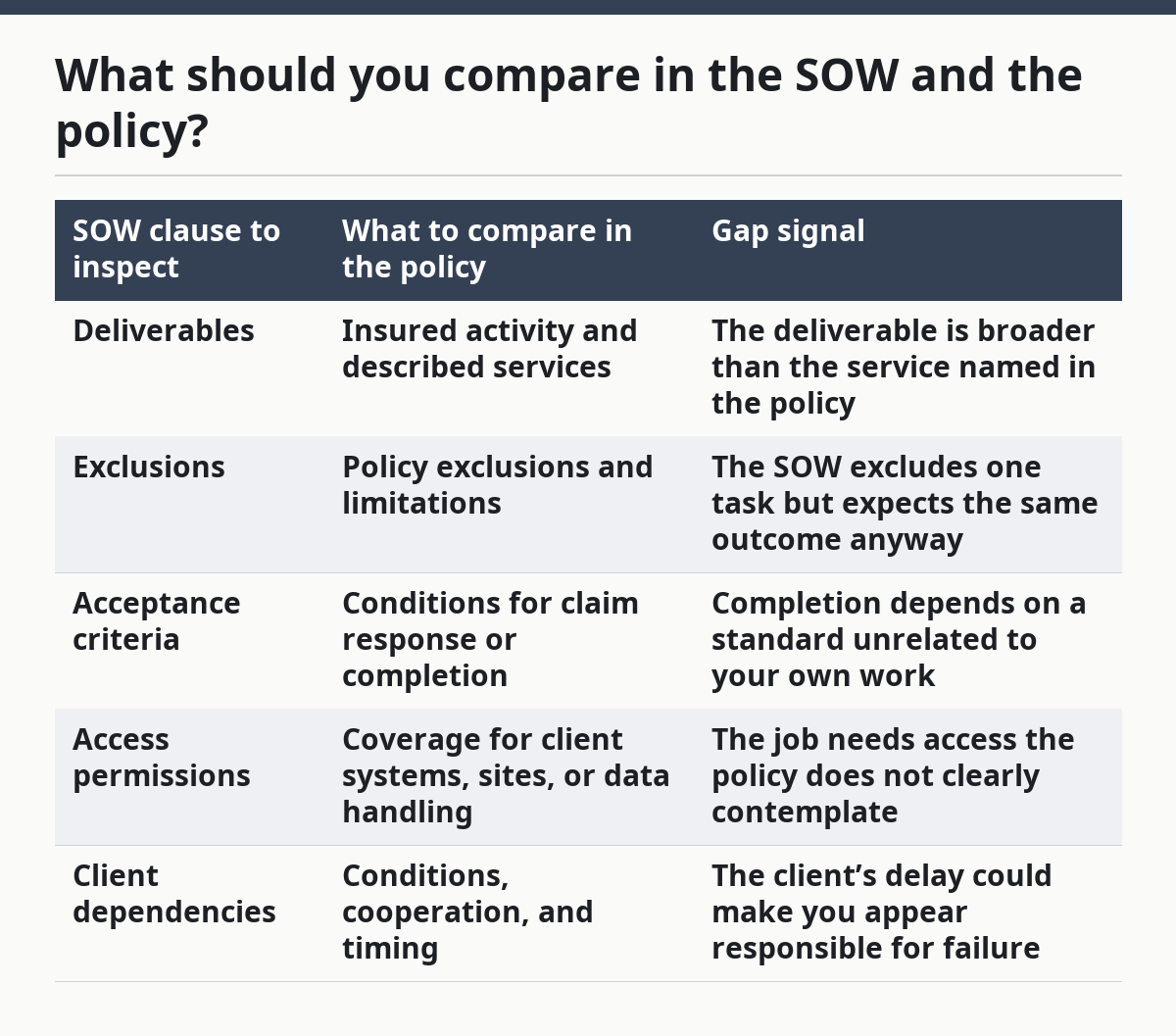
This comparison is the heart of the review. A SOW that looks tidy can still create a coverage gap if it shifts risk through wording instead of through an explicit change in services. The contract does not need to say “insurance” for the problem to exist.
A good sign is narrow, concrete language. Bad signs are broad verbs, total responsibility language, and hidden assumptions about who provides materials, access, or sign-off. A 1-page SOW can still be riskier than a longer one if it packs broad obligations into short lines.
When should you stop and get qualified help?
Therefore, you should stop when the SOW and policy no longer describe the same work, because that is where a coverage question becomes a professional judgment call. At that point, the issue is not a simple checklist problem anymore.
The SOW asks for work outside your usual field: A policy often tracks the type of work described in the application or schedule — If the SOW adds a new service line, pause before relying on coverage.
The contract requires access to client systems or data you do not normally handle: Access terms can change the risk profile — Get help if the SOW involves credentials, privileged access, or data handling that the policy does not clearly address.
The deliverable sounds like a guarantee: Warranty-like language can shift a service into a promise of outcome — Stop if the SOW ties payment or liability to a result you cannot control.
The exclusion list in the policy is broad or unclear: A vague exclusion can swallow the project — Get a careful review if the wording could apply to the core task itself.
The SOW and contract disagree with each other: Conflicting documents can create a dispute before the job even starts — Do not assume one clause wins without checking the full agreement set.
The client expects you to manage third-party risk: Third-party loss, delay, or dependency issues can fall outside ordinary coverage — Pause if the project assigns you responsibility for losses caused by vendors, platforms, or other outside parties.
This is also the point where the page should point upward to the broader Freelancer insurance and client contracts hub, because the SOW is only one part of the contract stack.
What mistakes create the biggest gaps?
The biggest mistakes are the ones that treat project wording as paperwork instead of risk wording; if the contract is unclear, consult a qualified insurance broker or lawyer, because coverage questions can turn on policy wording and applicable law. Each one can turn a normal project clause into a coverage problem.
First, people read only the summary of work and skip the exclusions. That mistake leaves out the one place where the real boundary often sits. The better move is to read the exclusion line before the deliverables line, then see whether the scope sneaks around it.
Second, people assume “related tasks” means minor extras only. It can mean a much wider set of duties, especially if the SOW uses open-ended wording. The safer alternative is to identify each added task in writing, rather than relying on a broad phrase.
Third, people ignore acceptance criteria because they look administrative. A 3-step approval process or a sign-off requirement can become the point where completion, payment, and dispute all begin. The better alternative is to ask whether the standard depends on your work alone or on someone else’s timing.
Fourth, people overlook client dependencies such as access credentials, source files, or approval dates. When those items are missing, a project can stall and the fault can get pushed back on the freelancer. The better alternative is to make the client’s duties explicit and time-bound.
Fifth, people assume a general liability policy or professional liability policy will fit any project wording. That assumption is risky because the policy may define covered services narrowly. The better alternative is to compare the exact SOW language with the policy wording, not with the job title.
What if the SOW is short or vague?
However, a short or vague SOW needs more care, not less, because missing words can hide the gap. If the document is only 1 or 2 pages, the absence of detail can make the scope look smaller than the risk.
In that case, focus on what is not said. Is there no exclusion list, no acceptance process, no named client dependency, and no statement about access? That silence can matter as much as a clause. A vague SOW may leave you guessing which tasks belong to you and which losses the client may try to push onto you later.
The fix is not to read between the lines. The fix is to mark every missing boundary and ask whether the contract and policy still line up without it. If they do not, the gap is real even if the project sounds simple.
What should a good result look like?
Ultimately, a good result is a SOW where the core task, the deliverables, the exclusions, and the access terms all match the kind of work your policy is written around. You should be able to point to each major clause and explain why it fits, or where it still needs review.
That does not mean the job is risk-free or fully covered. It means the contract does not quietly stretch the job beyond the policy’s shape. If the SOW is clear, the client dependencies are named, and the acceptance standard is concrete, you have a cleaner starting point for the insurance review that follows.
What should I check in an SOW for insurance issues?
Specifically, check the deliverables, exclusions, acceptance criteria, access permissions, and client dependencies first. Those are the clauses that most often change the risk picture without saying the word “insurance.” If any one of them is broad, vague, or tied to a guarantee, the SOW may create a gap that needs closer review.
How does a statement of work affect coverage?
Therefore, a statement of work affects coverage by defining the work that the policy may have to respond to. If the SOW expands the service, the access method, or the responsibility for a result, the policy may no longer match the job. That mismatch is where the gap starts.
What clauses create gaps between contract and policy?
Finally, the clauses that create gaps most often are broad scope wording, warranty-like promises, hidden exclusions, and acceptance terms that depend on factors outside your control. Client dependency clauses can also create a gap if they do not say what happens when the client is late or incomplete. These are the places where contract risk and policy wording stop lining up.
Drafted with AI; not yet reviewed by a person.
