

Last updated: November 19, 2026
Key Takeaways
- Freelance risk and contract compliance means managing legal, payment, delivery, and privacy terms before they become disputes.
- You reduce contract risk before signing by checking the clauses that affect money, timing, ownership, and responsibility.
- Every freelance contract should spell out scope, payment, rights, change control, termination, and dispute handling.
- You stay compliant during the project by following the contract in daily work, not just in the proposal.
Freelance risk and contract compliance means keeping the work, the money, and the paperwork aligned so you don’t miss payment, breach terms, or take on hidden liability. For the reader looking for Freelance Risk and Contract Compliance — The Complete Guide, the core answer is simple: a solid contract, followed consistently, prevents most avoidable freelance problems. The sections below settle what to put in the agreement, what to check before you sign, and what to do when the client pushes back.
What freelance risk and contract compliance actually cover

Freelance risk and contract compliance cover the legal, money, delivery, and privacy terms that can hurt you if they are vague or missing. If you do not control those terms, you can end up doing unpaid revisions, assigning away your rights, or accepting a dispute you never agreed to.
Picture this: you’ve got a signed SOW, a client wants “just one more round,” and the invoice is already 14 days old. The problem isn’t the extra work by itself — it’s that the contract never fixed revision limits, payment timing, or approval rules. That’s where compliance starts.
A clean freelance contract should settle who pays, when they pay, what gets delivered, and what happens if either side slips.
The main risk buckets are simple:
- Scope risk: the job grows without new pay.
- Payment risk: the client delays, withholds, or disputes invoices.
- IP risk: ownership of drafts, source files, or final work is unclear.
- Compliance risk: tax forms, confidentiality, data handling, or contractor classification are handled badly.
- Liability risk: the contract makes you responsible for losses you did not cause.
A generic “good vibes” agreement misses the details that matter. “Deliver marketing copy” is not the same as “deliver 12 landing pages, 3 rounds of edits, final files in Google Docs.” One is a trap. The other is a workflow.
The safest way to think about freelance risk and contract compliance is as a chain: if one clause is vague, the next one usually becomes harder to enforce. That is why the contract needs to be readable, specific, and usable in real life, not just in theory.
The key question is whether the agreement describes the work closely enough that both sides can follow it without guessing.
How do you spot contract risk before you sign?
You spot contract risk before you sign by checking the clauses that move money, time, ownership, and blame. That takes about 15 minutes if you know what to scan for, and it saves hours of cleanup later.
Picture this: the client sends a 9-page agreement and wants it back by 5 p.m. You do not need to read it like a novel. You need to find the parts that change your exposure if the project goes sideways.
Start with the sections that affect cash, scope, and rights.
Use this pre-sign checklist:
- Scope of work — Is the deliverable named, counted, or attached in an SOW? If not, expect scope creep.
- Payment terms — Look for net 7, net 14, net 30, deposits, late fees, and whether payment is tied to client approval.
- Revision limit — Check whether edits are capped in rounds, hours, or types of changes.
- IP ownership — Find out when rights transfer: on payment, on delivery, or immediately.
- Termination clause — See if either side can exit with 7, 14, or 30 days notice, and what gets paid on exit.
- Indemnity and liability cap — Look for language that makes you cover broad losses or uncapped damages.
- Confidentiality and data use — Check whether client data, customer lists, or drafts must be protected under a defined process.
- Independent contractor language — Make sure the contract matches contractor status, not employee control.
Red flags show up fast:
- “Unlimited revisions”
- “Payment after final client approval” with no deadline
- “Work made for hire” before payment, if the law in your location treats that language differently
- “Client owns all materials, including unused concepts”
- “Freelancer indemnifies client for all claims arising from the services”
Before you treat any of those lines as routine, check local law or ask a qualified legal or tax professional, because contract enforceability can depend on jurisdiction and the facts of the deal. According to the U.S. Small Business Administration, written contracts help set expectations and reduce disputes, and Nolo also recommends getting legal help when a clause could shift major risk to you. The truth is, if a clause sounds broad enough to cover anything, it usually does. That is the problem.
The next step is to compare the wording against what the project actually needs. If the agreement says one thing but the workflow demands another, the mismatch is your warning sign. In practice, that means you should read for deadlines, approvals, and ownership transfer as a connected set, not as isolated lines.
What clauses should every freelance contract include?

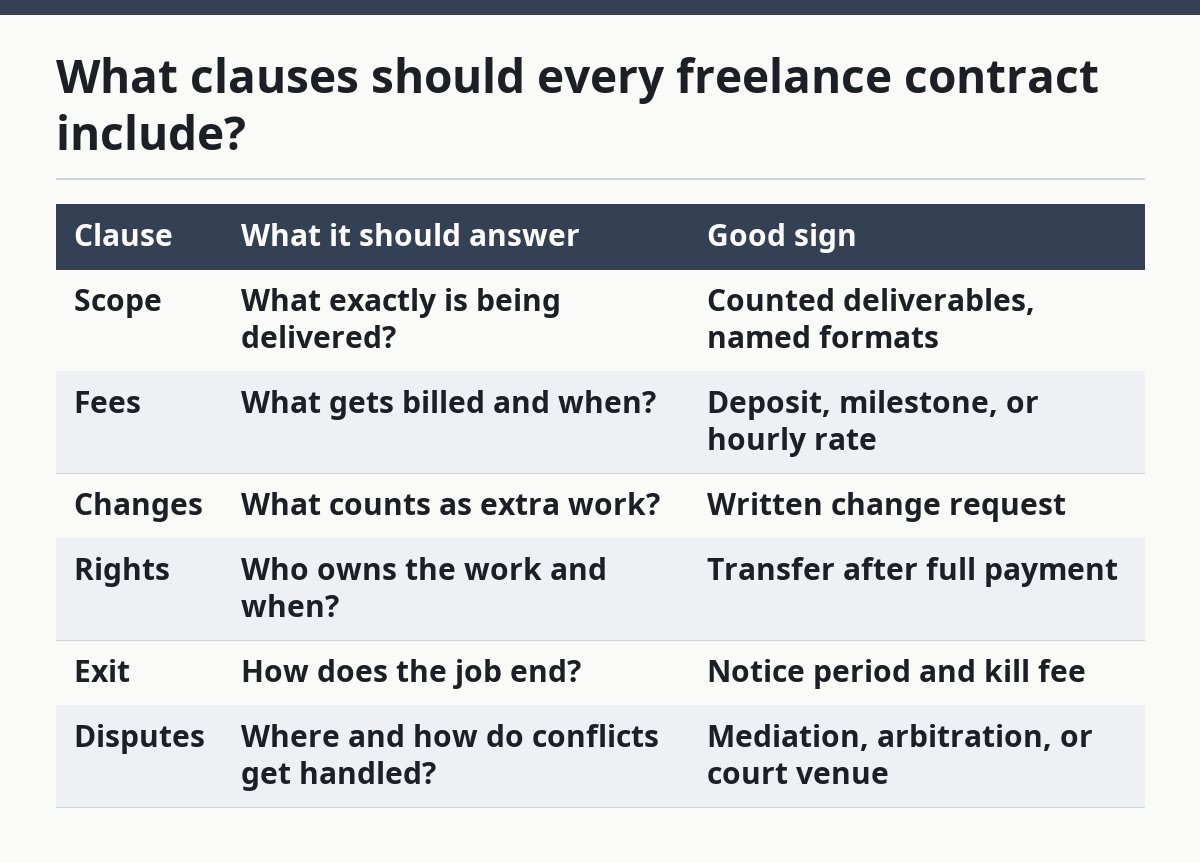
Every freelance contract should include scope, pay, rights, change control, termination, and dispute rules. Those six pieces are the core; without them, even a small project can turn into a billing fight or an ownership mess.
Picture this: you’re sending a clean proposal for a 6-week design project, and the client says the template is “close enough.” Close enough is not enough. You need language that stops the job from becoming a moving target once the first draft lands.
Here’s the catch: each clause should answer one narrow question.
Use a simple structure like this:
| Clause | What it should answer | Good sign |
|---|---|---|
| Scope | What exactly is being delivered? | Counted deliverables, named formats |
| Fees | What gets billed and when? | Deposit, milestone, or hourly rate |
| Changes | What counts as extra work? | Written change request |
| Rights | Who owns the work and when? | Transfer after full payment |
| Exit | How does the job end? | Notice period and kill fee |
| Disputes | Where and how do conflicts get handled? | Mediation, arbitration, or court venue |
A solid fee clause should also say whether expenses are reimbursed. If you expect software, travel, stock assets, or shipping to be paid back, spell that out. A missing expense line can cost more than a missed hour.
For IP, separate drafts from final deliverables if you can. Many freelancers hand over editable source files too early and lose leverage on payment. If the client needs source files, say when they transfer and under what condition.
For change control, use language that ties new work to a written estimate, even if the estimate is just an email reply. No paper trail, no extra work. That rule saves projects.
Those clauses also work together, so it helps to read them in sequence rather than one by one. Scope sets the boundary, fees turn the boundary into money, and rights determine what transfers after payment. Once those three are aligned, the rest of the contract is much easier to manage.
If the agreement has a signature page but none of those details, it is not really complete.
How do you stay compliant during the project?
You stay compliant during the project by matching your day-to-day workflow to the contract, not just the proposal. If the contract says written approval is required, a casual Slack “looks good” should not be treated like a formal signoff.
Picture this: the work is underway, the client keeps dropping requests into a chat thread, and the deadline is still 10 days away. This is where many freelancers lose control. The fix is not more effort. It’s tighter process.
The contract only protects you if you use it.
Follow this operating routine:
- Log every request in writing — Put scope changes, deadlines, and approvals in email or your project tool. A chat message can be easy to miss.
- Tie work to milestones — Break a 4-week or 8-week project into dated checkpoints so nobody can pretend the whole job was one vague promise.
- Invoice on the contract’s schedule — If the agreement says net 14, invoice right away at the milestone, not at the end of the month.
- Pause on missing approvals — If the client has not signed off, do not start the next phase as if the delay is your fault.
- Track deliverables and revisions — Note version numbers, file names, and the number of revision rounds used.
- Store records for at least 6 years — Keep signed contracts, invoices, approvals, and final files in one folder in case of a dispute or tax question.
- Keep client data separate — Use a dedicated folder or workspace for confidential files and limit access.
This is where compliance and cash flow meet. If you invoice late, track loosely, or accept verbal scope changes, your records stop telling the same story as your contract. That weakens your position fast.
On the flip side, a simple habit like “every change gets a dated email” can prevent a dispute over whether the extra page, extra wireframe, or extra edit was included. The habit is small, but the benefit can be large.
A good workflow also makes handoff easier at the end of the project. When approvals, versions, and invoices all line up, you can show what was delivered and why the final billing is correct. That is the practical side of freelance risk and contract compliance: the contract only matters when the records match it.
What happens when a client ignores the contract?
When a client ignores the contract, you should stop the extra work, point back to the written terms, and reset the deal in writing. If you keep going without a reset, you are accepting new terms without new pay.
Picture this: the client asks for a rush weekend edit, then says the original price should still stand because “it’s all part of the project.” That is not a misunderstanding. It’s a scope and payment problem.
The right response is calm and specific, not emotional.
Use this script structure:
- Restate the clause: “The agreement covers 2 revision rounds and payment within 14 days of invoice.”
- Name the change: “This request adds new sections and a rush deadline.”
- State the fix: “I can quote it as a change order and start once approved.”
- Set the boundary: “If you want me to continue under the current fee, I can finish the agreed deliverable only.”
If the client refuses to honor payment terms, do three things in order:
- Send a written reminder with the invoice number and due date.
- Quote the exact contract language that applies.
- Pause additional work until the overdue amount or written dispute plan is resolved.
This approach works because it keeps the issue factual. You are not arguing about effort; you are enforcing terms. A written reset is usually stronger than an informal promise, especially when the project has already moved beyond the original proposal.
The same rule applies to approvals. If the contract requires signoff before the next phase, treat silence as silence, not consent. That keeps the project aligned with the contract and reduces the chance that you end up working for free.
Which compliance mistakes cost freelancers the most?
The most expensive compliance mistakes are unclear scope, weak payment terms, bad IP language, and sloppy recordkeeping. Those errors usually show up as unpaid time, lost ownership, or a fight you cannot document cleanly.
Picture this: you finish a project, send the final file, and only then realize the contract never said when payment transfers ownership or whether source files were included. Now the client has the work, and you have leverage only if the paperwork helps you.
That’s why these mistakes hurt.
The biggest ones are:
- Starting without a signed agreement — You lose the paper trail that proves what was promised.
- Using one email for everything — Important approvals get buried.
- Agreeing to unlimited revisions — The project can drag for months.
- Accepting “net 60” without cash reserves — Your business absorbs the delay.
- Handing over final files too early — You give away leverage before the invoice clears.
- Ignoring local tax or contractor rules — Classification and reporting problems can follow you later.
One of the ugliest mistakes is a clause that says the client owns everything, including unused concepts and rough drafts, the minute you create them. That can wipe out your ability to reuse ideas in future projects. If you need to keep templates, frameworks, or methods, define them as pre-existing materials or excluded tools.
Another trap is the blank indemnity clause. If it says you cover “any claims arising out of the services” without a limit, you may be taking on more risk than the fee justifies. That is not normal small-business housekeeping. That is a liability shift.
A cleaner approach is to keep a short internal checklist for every job:
- Signed agreement
- Scope confirmed
- Payment dates entered
- Revision cap written down
- IP transfer point noted
- Client approvals stored
- Final invoice sent
Simple is good. Vague is not.
If you want a practical next step, review each of those items before work starts and again before the final file goes out. That two-point check catches most mistakes while there is still time to fix them. It also makes later disputes easier to resolve because the records already support the contract.
What records should you keep for tax, disputes, and audits?
You should keep signed contracts, invoices, approvals, file versions, and payment records for at least 6 years unless your local rules say longer. Those records are what prove the work, the terms, and the money trail if questions come up later.
Picture this: six months after a project ends, the client claims a feature was never approved and asks for a free fix. If you have dated signoff, the version history, and the invoice trail, the argument gets much shorter. If you do not, you are guessing against memory.
Memory loses.
Keep these files together:
- Signed master agreement and any SOWs
- Email approvals and change requests
- Invoices and receipts
- Proof of payment
- Final deliverables and draft versions
- Any cancellation or termination notice
- Tax forms or contractor onboarding documents
Name your files in a way that makes them easy to search. A format like Client_Project_Date_Version beats random download names every time. It takes seconds to set up and saves time when you need the exact PDF, not “final-final-2.”
If you work across borders or with sensitive data, keep an eye on transfer rules, invoice details, and contract language about data handling. That does not mean every freelancer needs a legal review for every gig. It does mean you should not treat a cross-border project like a local one with extra stamps. Before accepting one, consider getting advice from a qualified professional familiar with the countries involved, because tax, privacy, and payment rules can differ materially.
The clean rule is this: if it affects payment, ownership, scope, or privacy, save it. If you can’t prove it, you may not be able to enforce it. Records are part of freelance risk and contract compliance, not an afterthought.
FAQs about freelance risk and contract compliance
What is the biggest risk for freelancers?
The biggest risk for freelancers is usually unpaid or underpaid work caused by weak scope and payment terms. A project that starts with vague deliverables often ends with extra work that was never priced.
Do I need a contract for every freelance job?
Yes, you should use a written agreement for every paid job, even a small one. A short contract or SOW can cover scope, price, timing, and ownership in a way that a casual email thread cannot.
What should I do if the client refuses my contract changes?
You should treat that as a negotiation point, not a personal rejection. If the client won’t accept basic payment, scope, or rights terms, the safest move is usually to walk away or offer a narrower scope with tighter terms. If you are unsure, consult a qualified legal or business professional, because the right response can depend on the deal and your jurisdiction. As the Legal Information Institute explains, contract terms and assent matter, and practical guides from Nolo also recommend getting legal help when a term could shift major risk to you.
How long should I keep freelance records?
Keep them for at least 6 years unless your local tax, business, or contract rules require longer. That window covers most payment disputes, tax questions, and ownership questions that come up after a project ends.
Can I use one contract for every client?
You can use one base contract for most clients, but the scope sheet or SOW should change for each job. The base terms stay stable; the deliverables, dates, fees, and special terms should be project-specific.
Drafted with AI; not yet reviewed by a person.
