

Last updated: November 19, 2026
A freelance policy review for a freelance business gets messy fast when your services, income, or contracts change.
Schedule the policy review for a freelance business 30 days before renewal, then check coverage, declarations, and client terms against your current work.
The steps below show how to set the review, what to pull first, and what should change.
Key Takeaways
- Book the review before the renewal notice turns into a last-minute scramble.
- Gather the policy declarations, the current year’s revenue, and any new client contract terms.
- A solid review checks more than premium and limits; it checks services, exclusions, and proof-of-insurance wording.
- An insurance broker can help translate the policy language, but the freelancer still has to flag business changes.
- If your work shifted in the last 12 months, the review should happen even if the premium looks fine.
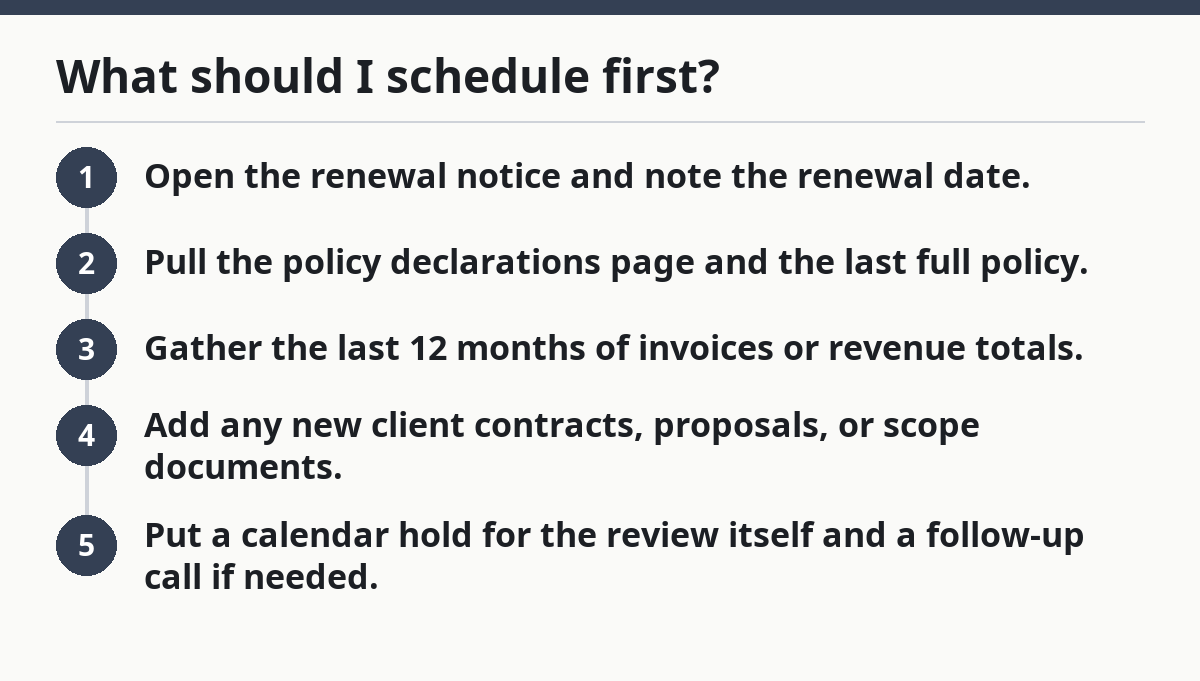
What should I schedule first?
You should schedule the review from the renewal notice and your policy declarations, because those two documents tell you what the insurer already thinks your business looks like. Picture this: you’re juggling client work, invoices, and an email that says your policy renews in 30 days. That is the moment to put a review on the calendar, not after the payment posts.
Set a 45-minute block if the business is simple, or 60 to 90 minutes if you added services, hired contractors, or changed revenue sharply. The point is to give yourself enough time to compare paper to reality without rushing through exclusions. A rushed review misses the one line that matters.
Do this in the same place you keep contracts and tax records. That can be a notes app, a spreadsheet, or a folder with PDFs. The format matters less than being able to pull up the same year-over-year facts in one sitting.
- Open the renewal notice and note the renewal date.
- Pull the policy declarations page and the last full policy.
- Gather the last 12 months of invoices or revenue totals.
- Add any new client contracts, proposals, or scope documents.
- Put a calendar hold for the review itself and a follow-up call if needed.
When that setup is right, you should be able to answer, in plain English, what your business sold this year and what risks came with it. If you can’t, the review is too early or your records are too thin.
How do I run a freelance policy review step by step?
You run it by comparing your current business to the policy line by line, then correcting anything that no longer fits. Picture this: you’re not “checking insurance” in the abstract. You’re asking whether the work you do today still matches the way the policy is written.
Start with the declarations page, then move to the insuring agreement, exclusions, endorsements, and any schedule of covered services. A good review takes one pass for facts and one pass for gaps.
- Confirm the business name and structure. Check that the legal name, DBA, address, and entity type match your current setup. If you changed from sole proprietor to LLC, the policy should reflect it.
- Check the covered services list. Compare the listed services with the work you actually sold in the last 12 months. If the policy names “graphic design” but your contracts now include email marketing or web layout, write that down.
- Match revenue to the insured amount. Review the revenue figure or payroll estimate used for the policy. If your gross revenue moved up, the insurer may have priced the risk on stale numbers.
- Read exclusions and endorsements. Look for any new carve-outs, like subcontractor work, cyber-related claims, or advice-based services. Endorsements can help or hurt depending on what they add.
- Review your deductible and limits. Make sure the deductible still fits your cash flow and the limits still fit the size of your client work. A low premium with a weak limit is not a win.
- Check client contract language. Some clients want specific proof of insurance, additional insured wording, or a set notice period for cancellation. Your policy has to support those promises.
- Flag anything that changed. New services, new software, new countries, new contractors, and new revenue targets all belong on the same list.
- Send the list to your broker or insurer. Ask for written confirmation of any change before the renewal is finalized.
If the review is working, you end with a short list: unchanged, update, or ask for clarification. Not a pile of vague notes.
What should I check beyond premiums and limits?
You should check the parts that decide whether a claim is covered at all, because the premium tells you almost nothing about that. The truth is, freelancers get tripped up by wording, not by the price tag.
A policy review should usually include the declarations page, coverage triggers, exclusions, endorsements, and any claim-made timing rules. Those details matter more than a small premium swing when your work changes midyear.
- Declarations page: Confirm the named insured, business address, policy period, and coverage type.
- Covered operations: Make sure the policy still describes your real services, not the version you sold two years ago.
- Exclusions: Read the carve-outs for advice, data loss, subcontractors, professional services, or international work.
- Endorsements: Check whether anything was added that narrows coverage or creates a new reporting rule.
- Client contract terms: Compare the policy to what clients now ask for in master service agreements or statements of work.
A broker can help translate those pages, but don’t hand off the whole job. An insurance broker sees the policy; you see the actual project scope. Those are not the same thing, and if the wording is unclear, consult a qualified insurance professional or attorney. The Insurance Information Institute’s coverage guidance is a useful starting point: https://www.iii.org/article/business-insurance-coverage-basics
For a deeper walkthrough of coverage types and what they do, the hub on freelancer insurance basics and coverage choices should sit alongside this page. This article is about the schedule and the review checklist, not every policy type under the sun.
How do new services and revenue changes affect the review?
They affect it by changing what the insurer thinks you do and how much exposure you bring. Picture this: last year you wrote blog posts, and this year you also manage paid ads, client analytics, or video editing. That is not a small tweak. It changes the risk profile.
A new service line, even a small one, can trigger a gap if the policy language is narrow. Revenue changes can also matter because many freelance policies use your income, billings, or project size to price the risk. If those numbers are outdated, the review starts from the wrong base.
Use a simple rule during the review: if a service appears in a proposal, a contract, or an invoice, it belongs on the review list. If a service is only “something I might do later,” it does not belong there yet.
- New services: Add them to the list of operations you send to the insurer or broker.
- Revenue up or down: Note the new annual total and what caused the shift.
- New contractors: Flag anyone doing client-facing or deliverable work under your name.
- New tools or platforms: Mention software that changes how work is delivered or stored.
- New geography: Note if clients, data, or projects moved into other states or countries.
The review should end with a plain answer: does the policy still describe the business you run now? If the answer is fuzzy, the insurer needs the update before renewal closes.
How should client contract updates change the review?
Client contract updates should change the review whenever they add insurance promises your policy may not support. Picture this: the contract asks for additional insured status, a certificate of insurance, or a notice of cancellation, and you agree before checking the policy. That is how a small admin choice turns into a coverage problem.
Look for any new wording on indemnity, limitation of liability, confidentiality, data handling, and proof-of-insurance requirements. A client contract update matters if it changes your legal exposure or the paperwork a client expects from you. A policy review should catch both.
A clean way to do this is to keep a one-page contract checklist beside the policy review notes. On that page, list:
- proof of insurance requested,
- policy minimums,
- notice periods,
- additional insured requirements,
- subcontractor rules,
- data or privacy obligations.
Then compare the contract list against the policy declarations and endorsements. If the contract asks for something the policy doesn’t show, write down the exact line and send it to the broker or insurer.
The mistake here is treating contracts as a legal-only problem and insurance as an admin-only problem. They overlap. A new contract clause can make a previously fine policy feel thin overnight, so it is wise to consult a professional if the wording is unclear. The U.S. Small Business Administration has general guidance on contracts and risk management: https://www.sba.gov/business-guide/manage-your-business/insurance-required-and-recommended
What does a good annual review look like?
A good annual review ends with a decision and a paper trail, not a gut feeling. Picture this: you’ve checked the policy, compared the contracts, and looked at the year’s revenue. Now you need a clean record of what changed and who said what.
Set up the review so it produces three outputs in under 90 minutes: a note of unchanged items, a list of requested changes, and a record of the broker or insurer response. That keeps the next renewal from starting from zero.
Use this final checklist:
- Save the renewal notice and declarations page together.
- Write down any business changes since the last policy period.
- Note whether the broker or insurer confirmed those changes in writing.
- Save updated certificates or endorsements in the same folder.
- Mark the next review date for the same month next year.
A good annual review is boring in the right way. It is short, repeatable, and easy to compare year over year. If a review turns into a scavenger hunt every time, the process is broken, not the policy.
How do I work with an insurance broker on the review?
You work with an insurance broker by bringing a clean summary, not a vague “can you check it?” email. Picture this: you send the policy declarations, the renewal notice, and a short list of business changes, and the broker can answer faster because the facts are already sorted.
Start the conversation with the three items a broker can act on immediately: your current services, your current revenue, and your current client terms. That is enough to begin a meaningful review. If you only send the premium and ask whether it looks high, the conversation stalls.
Ask the broker for written confirmation on anything that changes. If the broker says a new service is covered, ask where it appears in the policy or endorsement. If the broker says a contract term is fine, ask which policy language supports that answer.
A broker is useful for reading policy language, spotting mismatches, and flagging when an underwriter needs more information. The broker is not a substitute for knowing what your business actually does. That part is yours.
FAQ
How often should freelancers review insurance?
Freelancers should review insurance at least once a year, and again whenever the business changes in a way that affects coverage. A renewal notice is often the easiest trigger, but it is not the only one. New services, a jump in revenue, or a new client contract can justify an extra review in the same 12-month period.
What should i check during a policy review?
You should check the policy declarations, covered services, exclusions, endorsements, limits, deductible, and any contract terms tied to proof of insurance. The review should also cover revenue changes and any new tools, contractors, or work locations. If the policy language does not match the work you sell now, the review is incomplete.
When should i update my insurer about business changes?
You should update your insurer as soon as a change becomes part of real work, not after the claim. If the change shows up in an invoice, contract, proposal, or project brief, it belongs on the insurer’s desk. That includes new services, new revenue, and new contract obligations.
Drafted with AI; not yet reviewed by a person.
