
Last updated: November 19, 2026
Key Takeaways
- A freelancer risk control system is a repeatable way to screen clients, write safer contracts, protect data, and document work.
- Freelancer risk controls turn vague danger into a process you can repeat for each job.
- The main freelancer insurance types are professional indemnity, public liability, cyber cover, business contents cover, and, in some cases, business interruption or income protection.
- Your contract and insurance match when the risk you accept is no wider than the cover you carry.
Freelancer risk controls and insurance readiness are about stopping one client mistake, one laptop failure, or one claim from turning into a cash-flow crisis. Freelancer risk controls and insurance readiness — The Complete Guide is a written process for checking client risk, contract risk, data risk, and insurance gaps before the work starts. The steps below settle what to do, what to ignore, and when to get qualified help.
What this guide covers, and who it is for
This guide applies to solo freelancers, one-person contractors, and small independent service businesses that invoice clients directly and carry their own risk in Freelancer risk controls and insurance readiness — The Complete Guide. It assumes you already know your service model, your clients, and whether you keep client files, store personal data, or travel for work.
It also assumes you need a practical system, not a theory lesson. The goal is to help you spot where a client, contract, or claim can hit your income, then map those risks to insurance you can actually understand, such as professional indemnity, public liability, cyber cover, or business contents cover.
If your work includes regulated advice, custody of client money, medical or legal decision-making, or a signed contract with unusual liability clauses, you should get qualified help before relying on a template policy or a standard insurance form. This article is information, not financial advice, and a qualified adviser should review your own situation because country rules, policy wordings, and limits differ.
The truth is, many freelancers only think about insurance after a problem appears.
That timing is bad.
- Risk controls reduce the chance of a loss.
- Insurance readiness means your paperwork and limits match the work you actually do.
- A policy you can’t explain in plain English is usually a bad fit.
- A contract clause you haven’t read can matter more than the premium.
What is a freelancer risk control system?
A freelancer risk control system is a repeatable way to screen clients, write safer contracts, protect data, and document your work so a dispute does not become a money hole. It is not one policy or one checklist. It is the set of habits that decide whether a loss is small or expensive.
The mechanism is simple. If you lower the chance of a claim and shrink the size of the claim when it happens, you may need less insurance pressure later and you may be easier to insure. Insurers often care about controls because controls change how likely a claim is to land.
Picture this: you are about to start a project with a new client, the scope is still fuzzy, and the client wants a quick quote by Friday. That is exactly when risk control matters, because vague scope and fast starts are where unpaid work, rework, and blame usually begin.
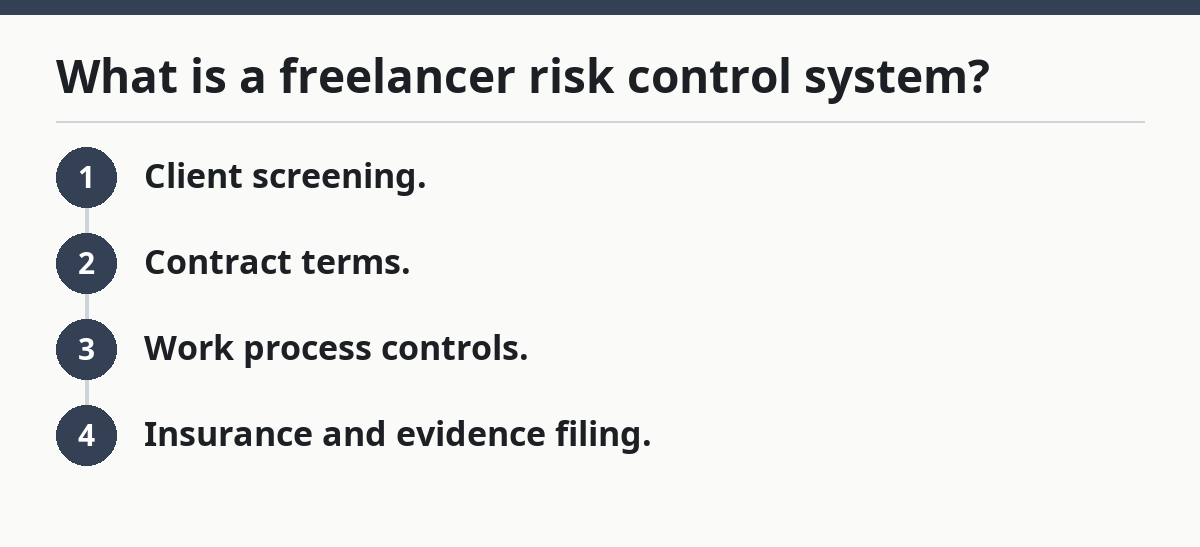
A good system usually has 4 layers:
- Client screening.
- Contract terms.
- Work process controls.
- Insurance and evidence filing.
And yes, they work together. A contract without a file trail is weak. Insurance without a contract review is guesswork. A data backup plan without a cyber policy may still leave you paying the first hit.
The kinds of loss freelancers actually face
Freelancers usually face four loss types, not one. There is income loss from late payment or cancellation, liability loss from mistakes or injury, data loss from a breach or device failure, and asset loss from theft or damage.
The right control depends on which loss hurts you most. A designer who stores client files in cloud storage faces different exposure than a copywriter who only sends Word docs by email, and both face different risks from an on-site client visit.
- Income risk: unpaid invoices, scope creep, project cancellation.
- Liability risk: errors, omissions, defamation, injury to a visitor.
- Data risk: stolen devices, phishing, bad access control.
- Asset risk: laptop theft, camera damage, office contents loss.
How do freelancer risk controls work step by step?
Freelancer risk controls work by turning vague danger into a documented process you can repeat for every job. The best version starts before a quote goes out and ends only after invoices, files, and backups are closed out.
Picture this: you have a promising lead, but the client wants you to begin before the contract is signed. That is where a step-by-step control process keeps emotion out of the decision, because speed is often where freelancers give away leverage.
- Screen the client before you quote. Ask for the legal entity name, billing address, scope summary, and decision-maker contact. Verify the company name on an official registry if one exists in that country, and check whether the work is for a person, a sole trader, or a company. A problem shows up when the client refuses to name who signs, who pays, or who approves changes.
- Classify the work by risk type. Mark the job as low, medium, or high exposure based on whether you give advice, handle personal data, enter a client site, or make public-facing claims. Write the classification on your intake form. If you can’t tell whether the work creates legal or financial exposure, that is a warning sign to slow down and get the scope reviewed.
- Set scope in writing before work starts. Define deliverables, excluded tasks, revision limits, deadlines, and who supplies the inputs. Use plain terms like “two revision rounds” or “one site visit of up to 2 hours” rather than loose promises. A problem appears when the client keeps adding tasks without a change order or new fee.
- Build a payment gate. Ask for deposit terms, milestone dates, and a late-payment trigger in the contract. Confirm what happens if the client pauses the project for more than a stated number of days. If payment depends on a verbal promise, the control has failed before the work begins.
- Protect your files and devices. Use multi-factor authentication, a password manager, automatic updates, and cloud backups with version history. For device protection, keep work devices separate from personal devices if possible. A problem shows up when one password opens email, storage, and payment accounts, because one breach then becomes many.
- Track approvals and changes. Keep dated written approval for brief, scope, draft, and final sign-off. Save email threads, messages, and change requests in one folder. If a client says, “I never approved that,” and you can’t find the approval, your evidence trail is weak.
- Close the job cleanly. At handoff, confirm what was delivered, what remains out of scope, what files you retain, and how long you keep records. Archive the project for a defined retention period, such as 6 years where local record rules or contracts require it, but check your local law because retention periods differ by country and sector. A problem shows up when old files are scattered across inboxes and personal drives.
What to verify at each step
Each step should end with a simple check. You want evidence, not vibes. A client screen should show a real legal identity. A scope sheet should show deliverables and exclusions. A file system should show backups that can actually be restored.
Use a short checklist:
- Is the paying entity named?
- Is the work described in one paragraph?
- Are revision limits written down?
- Is the payment trigger clear?
- Can you restore one test file from backup?
- Can you prove approval for the last deliverable?
If any answer is no, the system is not ready yet.
That is the point.
Which insurance types matter for freelancers?
The main freelancer insurance types are professional indemnity, public liability, cyber cover, business contents cover, and, in some cases, business interruption or income protection. Which ones matter depends on what you do, where you work, and what your contract says.
Professional indemnity, also called errors and omissions cover in some markets, is for claims that your advice, service, or output caused a financial loss. Public liability is for injury or property damage to other people. Cyber cover can help with incident response, data restoration, and certain third-party claims after a breach, though policy terms vary a lot.
Picture this: your laptop is stolen from a train, or a client says your work caused a missed deadline and a lost sale. Those are different events with different policies, and the wrong one will not step in just because the claim feels unfair.
Here’s the catch: a policy name is not enough. The wording matters more than the label. A “professional indemnity” policy can exclude certain advice areas, and a “cyber” policy can exclude losses tied to weak passwords or unpatched devices.
What each policy is meant to cover
A plain-language map helps:
- Professional indemnity: client loss from mistakes in your professional service.
- Public liability: injury or damage to third parties.
- Cyber cover: data incidents, ransomware response, privacy claims, and digital recovery costs.
- Business contents: physical tools, furniture, and some office equipment.
- Business interruption: lost income after a covered event, if the policy includes it.
Some freelancers also need motor cover for business travel, employers’ liability if they hire staff, or specialist cover for media, design, consulting, health, or IT work. Country rules differ, so the same label may mean something different in another market.
What the policy wording usually decides
A claim can turn on exclusions, excess, retroactive dates, and notification deadlines. The excess is the amount you pay before the policy contributes. The retroactive date is the earliest work date the policy will cover. Notification deadlines tell you how quickly you must report a possible claim.
These details matter more than a glossy summary page. If you delay reporting until the client threatens legal action, the insurer may ask why the issue was not reported earlier. If the policy starts after the work began, old work may be excluded.
How do I know if my contract and insurance actually match?
Your contract and insurance match when the contract risk you accept is no wider than the cover you carry. If the contract makes you liable for broad losses, uncapped damages, or third-party promises your policy excludes, there is a mismatch.
Picture this: a client sends a 12-page contract that includes broad indemnity language, a short response window, and a promise that you will cover all downstream losses. That contract may look routine, but it can shift far more risk onto you than a standard policy is written to handle.
The best check is to compare five things line by line:
- Scope of work.
- Liability cap.
- Indemnity clause.
- Data handling terms.
- Insurance requirements.
If the contract asks for a policy limit, a certificate, or named cover types, check the exact wording against the policy schedule and wording, not a sales summary. A mismatch can be as simple as a client demanding cyber cover while your work never touches personal data, or as serious as a cap that is too low for the exposure.
Red flags in contract language
Some terms deserve extra attention:
- Indemnity for “all losses” without a cap.
- Liability for subcontractors you do not control.
- Warranty that your work is error-free.
- Very short claim-notification windows.
- Broad promises to comply with laws you have not been told about.
None of those terms is automatically impossible, but each one widens your exposure. The fix is to narrow the wording, add a cap, or get the contract reviewed before you sign.
What evidence should you keep?
Keep the signed contract, the quote, change requests, approvals, invoices, and any proof of delivery in one file set. Keep copies of insurance schedules, endorsements, and renewal notices with the same project records. If a dispute comes up 18 months later, missing documents can be as damaging as a bad clause.
A clean file set should answer three questions in under 2 minutes:
- What was agreed?
- What changed?
- What proof do I have?
If you can’t answer those quickly, your readiness is weaker than you think.
When should a freelancer stop and get qualified help?
A freelancer should stop and get qualified help when the work touches regulated advice, high-value liability, cross-border data rules, or contract terms that shift risk in a way you do not fully understand. On a money topic like this, qualified help is the right move when the stakes or wording are beyond a template.
Picture this: you are about to sign a client agreement that names specific insurance forms, unusual indemnities, or a dispute venue in another country. That is not the moment for guesswork, because one bad assumption can make your cover useless or your exposure much larger than you planned.
The contract requires uncapped indemnity: That can make one claim exceed your policy structure — ask a qualified adviser or lawyer to review the risk transfer before signing.
The work includes regulated advice: Financial, legal, tax, medical, or insurance advice can trigger extra duties — use a specialist who understands the local rules.
The client handles personal data across borders: Data law may change by country and region — get guidance on privacy, breach response, and notification duties.
You cannot explain an exclusion: If you do not know what a policy excludes, you do not know what it covers — ask the insurer or broker for a written explanation.
The project depends on one large payment: A single late invoice can hurt your cash flow — get help with contract terms and credit control before work starts.
The right outside help is not a sign of weakness. It is a sign that the job is no longer a simple freelance task.
What mistakes do freelancers make most often?
The most common mistakes are easy to see after the damage is done: they quote before they understand the scope, accept contract language they never read, and assume a policy will fix a bad process. That usually costs time, money, or both.
Picture this: you finish the work, the client disputes the result, and the insurer asks for the signed scope, the approval trail, and the date the issue was first noticed. If any one of those pieces is missing, the claim gets harder fast.
- Skipping the scope check. The consequence is unpaid extras and scope creep. The better alternative is a written scope with exclusions and revision limits before work begins.
- Buying insurance without reading exclusions. The consequence is a painful surprise at claim time. The better alternative is to check what the policy refuses to cover, not just what it advertises.
- Mixing work and personal data. The consequence is weak security and harder recovery after a breach. The better alternative is separate accounts, separate storage, and multi-factor authentication.
- Ignoring contract caps. The consequence is unlimited exposure in a dispute. The better alternative is to match liability to what you can realistically carry.
- Waiting too long to report a problem. The consequence is a possible breach of policy notice terms. The better alternative is to report early, even if the claim is only a possibility.
- No backup restore test. The consequence is discovering too late that backups are useless. The better alternative is to test a restore at least once after setup and after major changes.
The mistake that costs the most
The costliest mistake is treating insurance as a substitute for control. That thinking is backward. Insurance responds after something goes wrong; controls are what keep the loss smaller and the claim cleaner. For policy wording and risk-transfer details, see the Financial Conduct Authority and the National Association of Insurance Commissioners for general guidance, and consult a qualified adviser or lawyer for your own situation.
If you do one thing this month, do this: review one live client contract and one policy wording side by side. Not the marketing summary. The actual documents.
What changes for freelancers with higher-risk work?
Higher-risk freelance work needs tighter controls, more specific insurance, and a lower tolerance for vague wording. This includes consultants who give strategic advice, creatives who publish public content, IT freelancers who handle systems access, and anyone who works on-site or stores sensitive data.
Picture this: your work can affect revenue, compliance, or public reputation, and the client expects you to carry the risk in your own name. That is the kind of job where a generic contract template and a basic policy summary are rarely enough.
For higher-risk work, the standard approach needs four changes:
- Tighter scope control: smaller deliverables, more approvals, clearer revision limits.
- Stronger evidence trail: dated sign-offs and version history.
- Broader insurance review: check exclusions, retroactive dates, and limits carefully.
- More frequent review: quarterly, not yearly, if the work changes fast.
A freelancer who handles confidential files, source code, or client money may need added controls such as access logs, separate admin accounts, encrypted storage, and a more detailed incident plan. If the work is highly regulated, the insurance question is only one part of the risk picture.
Edge cases that need special handling
Some jobs break the normal pattern:
- International clients: laws, tax rules, and dispute venues can differ by country.
- Subcontracting: you may inherit liability for another person’s work.
- On-site work: injury and property damage exposure rises.
- Long projects: the chance of scope drift and record loss increases.
- Content and media work: defamation, copyright, and takedown claims can appear late.
Each edge case means the contract, insurance, and file system need a specific review. A one-size template is not enough.
What does a good freelancer readiness setup look like?
A good freelancer readiness setup is simple enough to use on a busy week and strong enough to survive a dispute. It has one intake form, one contract process, one backup routine, and one insurance file that is easy to find in under a minute.
Picture this: a new lead arrives on Monday, a revision request lands on Wednesday, and a billing question arrives on Friday. If your system works, you can answer each one with the same documents and the same rules every time.
A solid setup usually includes:
- Client intake form.
- Signed scope or contract.
- Payment terms and late-fee terms where allowed.
- Multi-factor authentication on key accounts.
- Cloud backup plus one separate backup copy.
- A folder for policy documents and claim contacts.
- A calendar reminder for annual review, and a mid-year review if the work changes.
The best part? You do not need a giant operations manual. You need a system that removes guesswork when you are busy. That is what keeps small problems small.
How to review the setup once a year
Use one annual review to check:
- Whether your work changed.
- Whether your client mix changed.
- Whether your data handling changed.
- Whether your policy wording still fits.
- Whether your contract template still matches your real risk.
If one answer changed, update the related control immediately. If several changed, you may need a full reset of your contract template and insurance review.
How do I start if I have almost nothing in place?
Start with the documents that stop the biggest losses first: scope, payment terms, backup, and insurance proof. You do not need a perfect system on day one, but you do need a written one.
Picture this: you have one browser tab, three client jobs, and no formal process. The first move is not buying a policy you cannot explain. The first move is writing down how you accept work, how you get paid, and how you keep evidence.
Begin with these four actions:
- Create a one-page intake form.
- Add a written scope and revision limit to every quote.
- Turn on multi-factor authentication.
- Save your policy wording and certificate in one folder.
Then add the rest in order: payment controls, backup testing, contract review, and annual renewal reminders. If you already have a policy, read the exclusions before the renewal date, not after.
A quick readiness check
You are in better shape if you can answer yes to these:
- Do I know what work I do not cover?
- Do I know which contract terms I accept?
- Do I know where my policy wording is?
- Can I restore my files?
- Do I know when to escalate a claim question?
If one of those is no, there is still work to do.
What questions do freelancers ask most often?
Do I need insurance if I only work from home?
You may still need cover if your work can cause financial loss, data loss, or injury to someone who visits your home. Home contents or home business cover may not include professional liability or cyber claims, so the policy labels matter. The UK Information Commissioner’s Office also explains why data handling still matters even when you work remotely.
Is professional indemnity the same as public liability?
No, they cover different problems. Professional indemnity is aimed at alleged mistakes in your service or advice, while public liability is aimed at injury or property damage to other people.
What is the biggest mistake in freelancer insurance readiness?
The biggest mistake is assuming the policy matters more than the paperwork around it. A weak contract, poor records, or slow claim reporting can make a valid policy much less useful.
How often should I review my setup?
Review it at least once a year and again whenever your work changes in a meaningful way. A new client type, a new country, new data handling, or a new subcontractor arrangement can change your exposure fast.
What should I do before I sign a new client contract?
Check the scope, payment terms, liability cap, indemnity language, and insurance requirement against your policy wording. If the contract asks you to take on risk you do not understand, get qualified help before you sign.
Drafted with AI; not yet reviewed by a person.
