

Last updated: November 22, 2026
Compare the renewal offer against your declarations page, your current policy term, and every endorsement before you accept it. If the carrier has changed the premium, deductible, limits, or exclusions, the right move is to compare the renewal quote line by line, not by the total price alone. This is information, not financial advice; for your own situation, a qualified adviser should review the policy details with you.
Key takeaways
- Start with the declarations page, because it shows what your current coverage actually was.
- A lower premium can hide a higher deductible, a shorter policy term, or a new exclusion.
- The cleanest comparison is not “old bill vs new bill”; it is “old coverage vs new coverage.”
- The renewal offer that keeps your needed coverage and changes the fewest terms is usually easier to judge.
- If the carrier changed an endorsement or removed a coverage feature you rely on, price matters less than the gap it creates.
What are you really comparing?

You are comparing the renewal offer to the policy you already have. A renewal quote can look similar to last year’s bill while quietly changing the deductible, endorsement language, or a coverage limit, so the declarations page is the anchor document.
That is the main mistake a generic article misses: the premium is only one line item, and it is not the whole offer. The renewal paperwork may include the same carrier name and the same policy term, but that does not mean the same risk is being covered.
Use a 3-document check: the renewal offer, the current declarations page, and any endorsement notices attached to the renewal. If those three do not match, you are not comparing like with like.
For a quick reference on policy language and consumer rights, the NAIC and your state insurance department are the first places to look. Those sources explain insurance terms in plain language, but they do not replace a review of your own contract.
Which renewal offer is better if I want fewer surprises?
The renewal offer with the fewest changes is better if you want stability. A quote that keeps the same carrier, the same policy term, and the same core coverage terms is easier to judge because the comparison is mostly about price and any small wording changes.
This option wins when the declarations page is still a good fit and the renewal paperwork only tweaks language you do not rely on. It is also the better fit if you need continuity for client contracts, invoices, or proof of coverage, because the paperwork stays simple.
The weakness is obvious: “same carrier” does not mean “same protection.” A renewal can still raise the deductible, narrow an endorsement, or adjust a limit. If you skim only the total premium, you can miss a change that matters more than the dollar amount.
Pros
- Easier to compare against the current declarations page
- Less chance of a gap caused by a missed endorsement change
- Less paperwork if the policy term and carrier stay the same
Cons
- Small wording changes can hide real coverage cuts
- A low premium change may come with a higher deductible
- Easy to accept by habit instead of by review
This option is for the freelance business owner who wants to keep the current setup and only accept changes that are clearly explained in the renewal quote.
When does a higher premium still make sense?

A higher premium can make sense if the renewal offer keeps the coverage you actually need. The right comparison is not “more expensive” versus “cheaper”; it is “what changed for the extra cost, and is that change worth it for this policy term?”
This is the better choice when the renewal adds back a removed endorsement, keeps a lower deductible, or preserves a limit you know you use in real work. A $0 difference in premium can still be the wrong offer if the carrier quietly reduced a protection that matters to your freelance activity.
The drawback is that higher premium increases the ongoing cash burden, and that can matter in a freelance budget. It is also easy to overpay for features you do not use just because the renewal language sounds reassuring.
Pros
- Can preserve or restore coverage features that matter
- May avoid a deductible increase
- Can be worth it if the old declarations page already matched the business risk
Cons
- Costs more during the next policy term
- Can tempt you into paying for coverage you do not need
- Harder to justify if the only change is a brand-name endorsement with no practical benefit
This option is for the freelancer whose work exposure changed during the year and who needs the renewal offer to reflect that change, not just to look tidy on paper.
The honest side-by-side
The best comparison is the one that shows what changed, not just what it costs. If two renewal offers come from the same carrier, the key question is which one keeps the important contract terms closest to your current declarations page.
| Criteria | Keep the current terms | Accept the revised renewal | Winner for [condition] |
|---|---|---|---|
| Premium | Usually easier to spot change because the rest stays the same | Can be higher or lower depending on the changes | Current terms if you want predictability |
| Deductible | No change if the renewal truly matches the old policy | May shift even when the carrier stays the same | Current terms if the deductible is already acceptable |
| Coverage limits | Preserves what the declarations page already shows | May adjust limits up or down | Revised renewal if the old limit is too thin |
| Endorsements | Fewer moving parts to miss | Can add or remove important language | Current terms for simple policies |
| Policy term | Stays easier to compare across years | May come with new dates or timing rules | Current terms when timing matters |
| Coverage gaps | Lower risk of an accidental gap | Higher risk if a new exclusion appears | Current terms for continuity |
| Paper trail | Simpler to document for clients or records | Needs closer reading of the renewal quote | Current terms for clean records |
| Fit for changed work | May no longer match your freelance work | Can better reflect a changed risk profile | Revised renewal if your work changed |
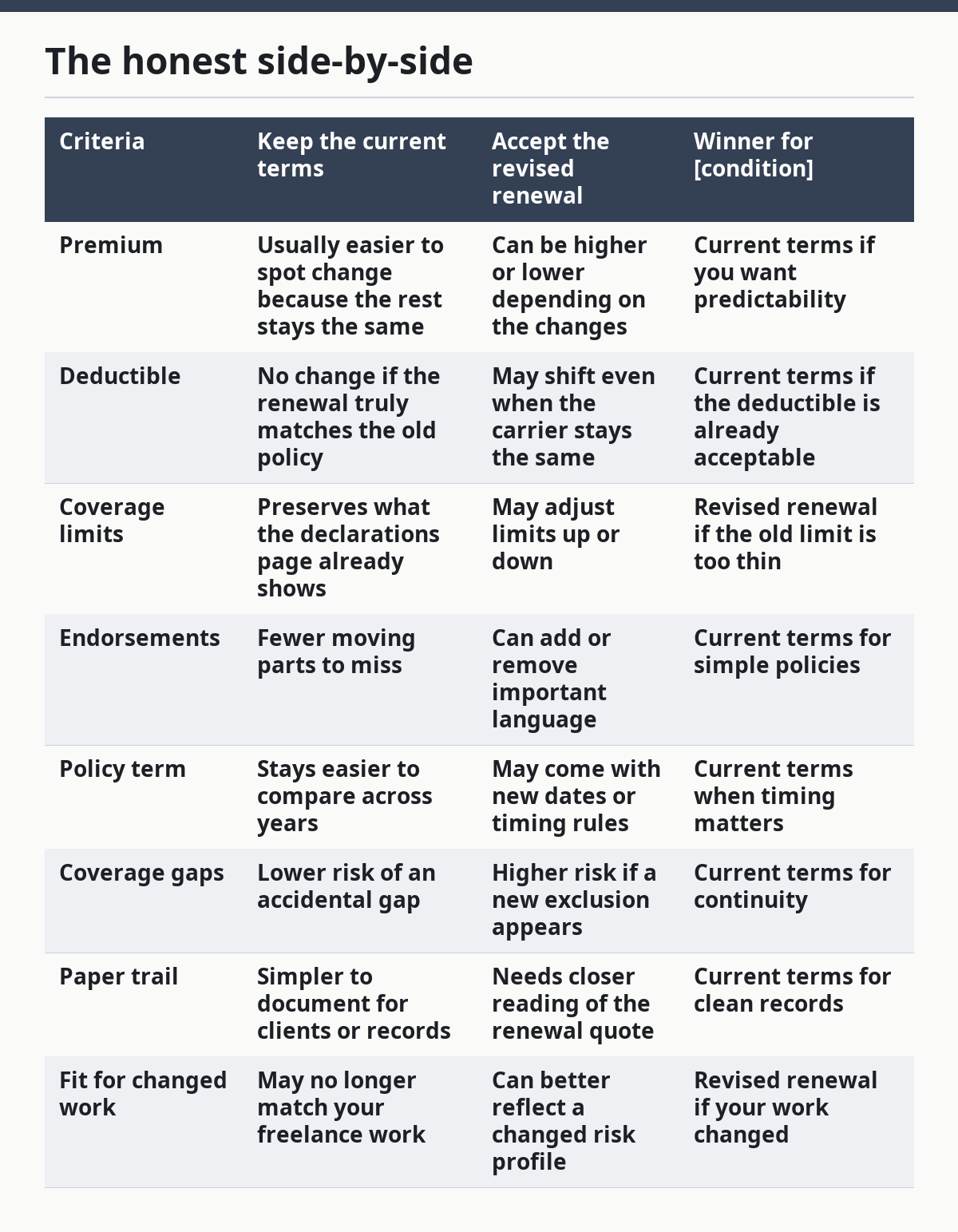
This table points to the real job of a renewal comparison: find out whether the new paperwork keeps the same risk transfer or quietly changes it. The premium is visible in 10 seconds; the deductible, endorsement, and exclusion changes are where the decision usually lives.
How do I compare renewal paperwork?
You compare renewal paperwork by reading the declarations page first, then checking every line that differs in the renewal quote. Start with the named insured, policy term, coverage limits, deductible, and endorsements, because those are the fields that change the actual contract.
Then look for what is missing. A renewal that does not restate a coverage feature may still keep it, but if an endorsement number disappeared or a condition changed, treat that as a real change until the carrier confirms otherwise. That is the step most people skip, and it is where confusion starts.
A clean method is to mark 5 items: premium, deductible, limits, endorsements, and exclusions. If all 5 match, the renewal is probably a simple extension. If even 1 changes, read the whole section again before you accept it.
The comparison works best when you ask one question: “If I had to make a claim on this policy term, what would be different?” That question forces attention away from the bill and toward the contract.
What are the exception cases?
The verdict flips when the renewal offer changes the thing you actually depend on. If the premium rises but the deductible stays low and the endorsement language stays intact, the higher-cost option can still be the better fit.
It also flips if your freelance work changed in the last year. A policy that was fine for occasional client work may be wrong if you added larger contracts, new tools, or a different service line, even if the carrier stayed the same.
A third exception is a new exclusion or a reduced limit hidden inside an endorsement. In that case, the cheaper renewal can be the worse deal because the missing protection is the part that matters.
A fourth exception is administrative mismatch. If the declarations page lists the wrong business name, address, or covered activity, the issue is not price at all; it is whether the renewal matches the way you actually operate.
What should I choose?
Choose the renewal offer that matches your current declarations page most closely if your freelance work has not changed and the deductible, limits, and endorsements still fit. Choose the revised renewal if it keeps a key coverage feature that the first offer drops or weakens. Neither if the renewal paperwork contains an exclusion, deductible jump, or endorsement change you do not understand.
That is the cleanest rule for a same-carrier comparison. The goal is not to find the cheapest bill; it is to keep the policy term and coverage terms aligned with the work you actually do.
What should I check on a renewal offer?
Check the declarations page, the premium, the deductible, the coverage limits, and every endorsement attached to the renewal. Those five items tell you whether the carrier kept the same deal or changed the contract in a way that matters to your freelance business.
If one of those items changed, read the related section again before you accept the renewal. A small line can change the meaning of the whole offer.
Can a renewal have different coverage terms?
Yes, a renewal can have different coverage terms even when the carrier stays the same. The renewal quote may change the deductible, limits, exclusions, or endorsements for the next policy term, so a familiar carrier name does not guarantee a familiar contract.
That is why the declarations page matters. It is the quickest way to spot whether the renewal still matches the coverage you expected.
How do I compare renewal paperwork?
Compare the renewal paperwork against your current declarations page line by line. Start with the policy term, then check the named insured, premium, deductible, limits, endorsements, and exclusions.
If a line changed and the renewal offer does not explain why, ask for the specific page or endorsement that caused the change. That keeps the comparison tied to the contract, not to guesswork.
Drafted with AI; not yet reviewed by a person.
